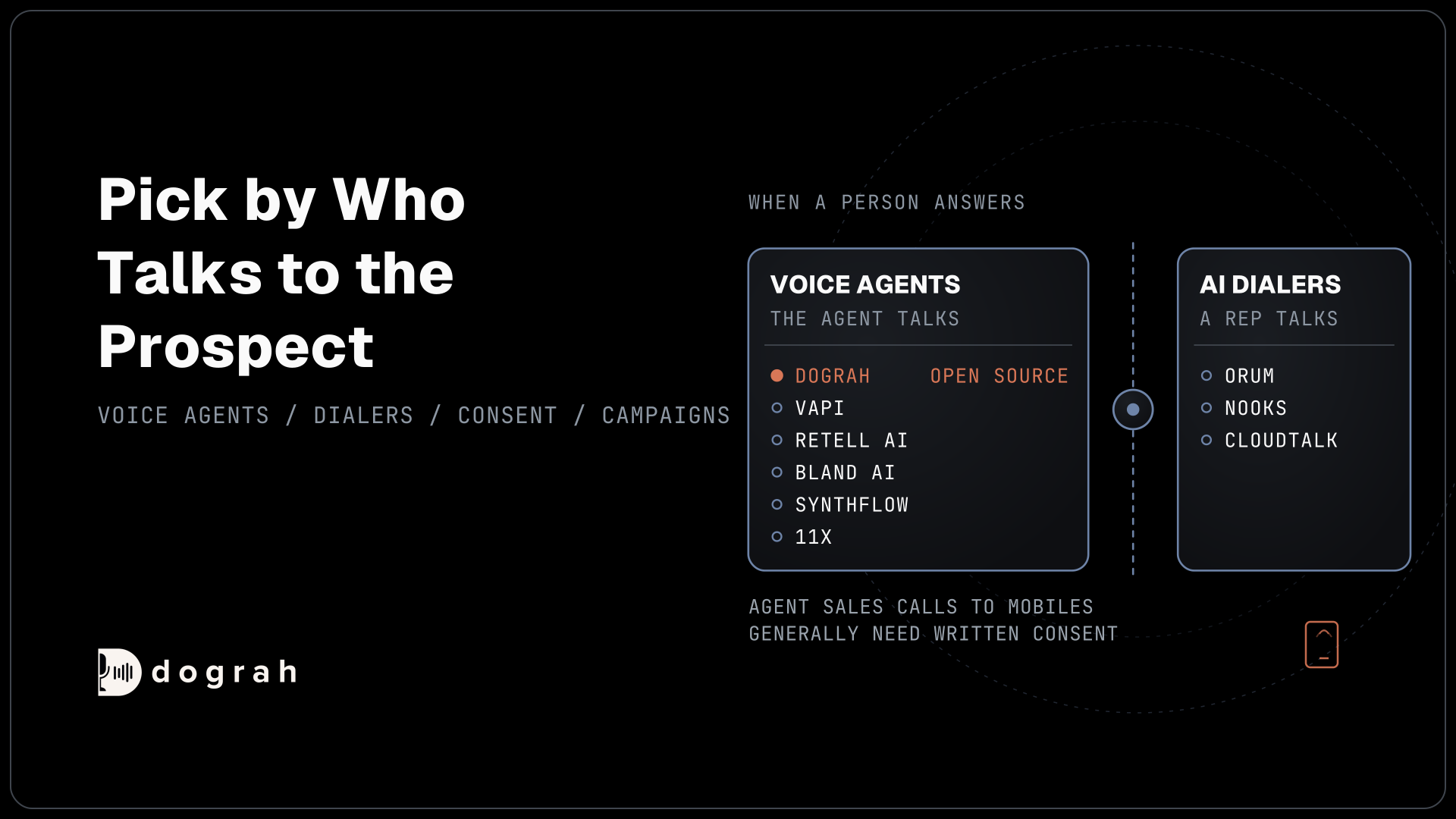

"AI dialer" can mean a power or predictive dialer with AI features that connects human reps faster, or an AI agent that dials a list and holds each conversation itself. Dograh, the open-source AI voice agent platform, is the second kind. Its campaigns call your list, self-hosted or on Dograh Cloud, and transfer interested people to your team.
Key Takeaways
- Power and predictive dialers connect reps faster, and an AI agent holds the call.
- Predictive dialing risks abandoned calls when more people answer than reps.
- Consent and calling-hour rules apply whichever dialer places the call.
Two different products are sold as an AI dialer, and the wrong one changes who talks to your customers. We explain power and predictive dialers, compare the types, show a Dograh agent calling a list and cover the US rules every dialer meets. For the wider field, see our guide to voice AI.
Two products called an AI dialer
Search for "AI dialer" and you will find two different products under one name.
The first is a classic dialer with AI features added. It still exists to get a human rep on the line. The AI scores which leads to call first and detects whether a person or a machine answered. Some tools also coach the rep after the call. The rep does the talking.
The second is an AI agent that places the calls and talks. It dials a list at a pace you set, holds each conversation on its own and hands interested people to a person. Nobody waits for a free rep, because the agent is the one on the line.
The two solve different problems. The first makes a sales team faster. The second takes routine calls off the team, such as reminders or renewals. Most of the confusion comes from comparing them as if they were the same thing.
Power and predictive dialers, simply
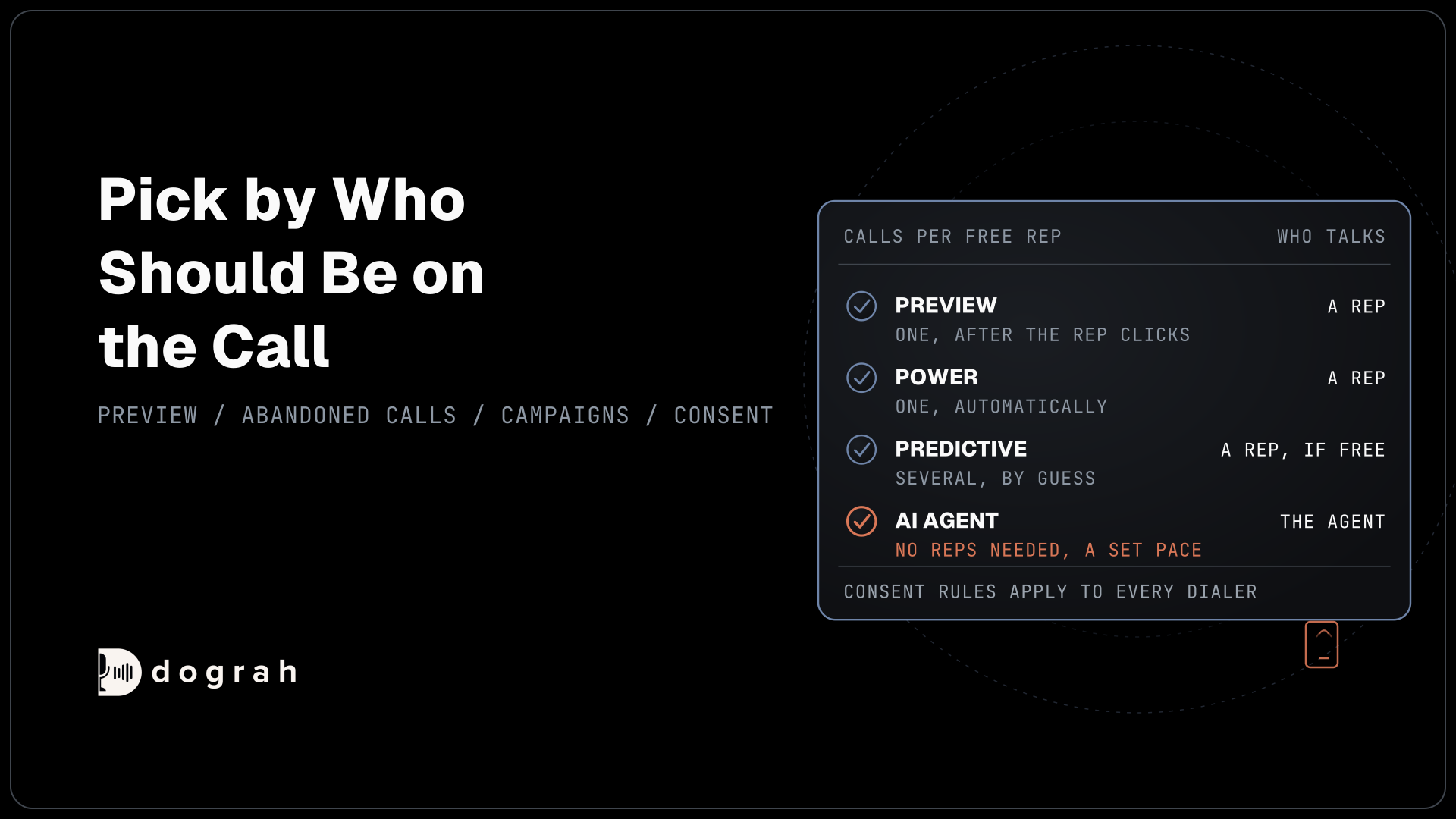
Traditional dialers differ in how many numbers they call for each free rep.
A preview dialer shows the rep the next contact and waits for a click. A power dialer skips the click: as soon as a rep finishes a call, it dials the next number on the list, one line per rep. Reps still sit through rings and voicemail.
A predictive dialer goes further. It dials several numbers for each rep, betting that most won't answer. When the bet is wrong and more people pick up than there are free reps, someone answers and hears silence or a recorded message. That is an abandoned call, and it is the reason predictive dialing has its own rules.
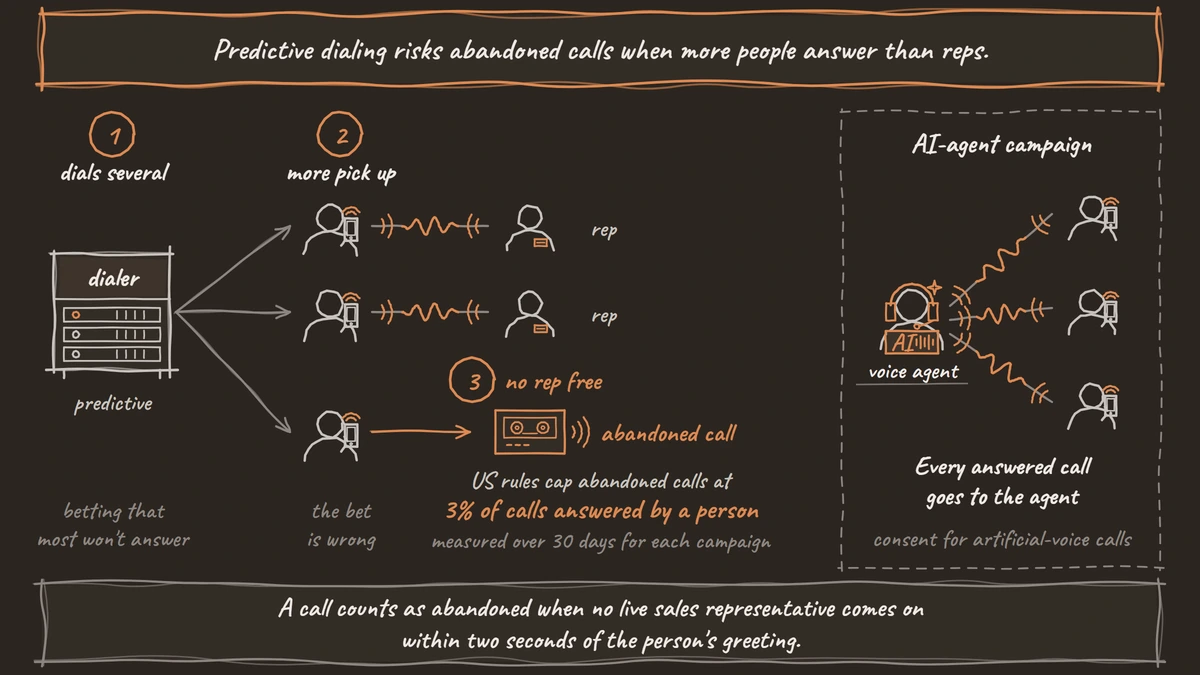
US rules cap abandoned calls at 3% of calls answered by a person, measured over 30 days for each campaign. A call counts as abandoned when no live sales representative comes on within two seconds of the person's greeting. Predictive dialers spend a lot of their tuning on staying under that line.
Dialer types side by side
The table compares the main kinds of dialer by who is on the line and what can go wrong.
| Dialer type | Calls per free rep | Who talks when someone answers | Main risk |
|---|---|---|---|
| Preview | One, after the rep clicks | A rep | Slow, rep time spent dialing |
| Power | One, automatically | A rep | Reps wait through rings and voicemail |
| Predictive | Several, by guess | A rep, if one is free | Abandoned calls |
| Dialer with AI features | Any of the above | A rep, helped by AI | Same as its dialing mode |
| AI agent (Dograh campaign) | No reps needed, calls go out at a set pace | An AI agent, with transfer to a person | Consent for artificial-voice calls |

Open Source Alternative to Vapi / Retell
Self-hosted voice agent platform — no per-minute fees
dograh-hq/dograh
Star on GitHub
An AI agent on every call
In an AI-agent campaign, there is no ratio of calls to reps to tune. Every answered call goes to the agent, and you control volume with pace.
A Dograh campaign starts from a CSV with a phone_number column. Any extra columns, such as a first name or an appointment time, become variables the agent can use on that call. Max Concurrent Calls caps how many calls run at once, and Calls Started per Second, one by default, sets how fast new calls begin.
Retries are a setting. Turn on Enable Retries, choose up to 10 Max Retries and a Retry Delay, and pick which results get another try: a busy signal, no answer or a voicemail. A Call Schedule limits dialing to Time Slots in one Timezone per campaign. With no time slots set, the campaign dials continuously, so set them before launch. A Circuit Breaker pauses the campaign when too many calls fail, so a broken model key doesn't burn through your list.
Voicemail is the first thing to plan. Detection is off by default, and our post on voicemail detection covers when to turn it on. The opening line is the second, covered in our post on the first 15 seconds of an AI outbound call.
When a caller wants a person, the Transfer Call tool works on Twilio, Telnyx, Plivo, Cloudonix and Asterisk ARI. The rep's line rings first, and the person on the call is joined only once the rep picks up. On Twilio, a short spoken introduction can play to both of them first.
The US rules every dialer meets
An AI agent ends over-dialing, and the calling rules still apply. Several cover every outbound program in the US, whatever dialer sits behind it.
Under the Telephone Consumer Protection Act (TCPA), the FCC's telemarketing rules require prior express written consent before a sales call with an artificial or prerecorded voice to a mobile or home number. A reminder or other service call to a mobile needs prior express consent, but slip any offer into it and it counts as telemarketing. The same rules bar sales calls before 8 a.m. or after 9 p.m. at the called person's location.
The FCC's 2024 ruling on AI-generated voices settles how an AI agent fits. It found that AI-generated voices count as "artificial" voices under the TCPA, and that the law makes no exception for technology sold as the equivalent of a live agent. So an AI agent is never your live representative for these rules. Collect the consent that artificial-voice calls require, and have counsel review the setup before you dial.
The FTC's Telemarketing Sales Rule adds a safe harbor for abandoned calls. Ring for at least 15 seconds or four rings, and play a recorded message with the seller's name and number within two seconds when no rep is free.
Opt-outs need a process. When someone says to stop calling, the agent takes that by voice and sends it to your system, which then keeps the number off the next list. Each such call also carries a do_not_call outcome in Dograh, so you can export them and clean the list before the next campaign.
Join the Dograh Community
Dograh is an OSS alternative to Vapi. Join our Slack community for queries, releases, best practices & community interactions.
Choosing a dialer, or keeping yours
Pick by who should be on the call. If every conversation needs a person, a power or predictive dialer for your reps is still the right tool. If many calls follow the same script, an AI agent can take them and pass the interested people on. On cost, a self-hosted Dograh install carries no per-minute platform fee, though servers, model keys and phone minutes still cost money, and Dograh Cloud charges a 1¢-a-minute platform fee.
Many teams already run a dialer and don't want to replace it. VICIdial, the open-source dialer, can send calls to a Dograh agent through Asterisk ARI. The agent can transfer to a VICIdial in-group and update lead fields. This is an advanced organization feature, set up under Platform Settings.
For the sales side, our guide to AI voice agents for outbound sales covers scripts and lists. Our post on outbound campaigns for BPOs covers running them at contact-centre scale.
Glossary
- Predictive dialing
- Dialing several numbers for each free rep, on the bet that most won't answer. It keeps reps busy but abandons calls when more people answer than there are reps.
- Abandoned call
- Under US rules, a call where no live sales representative comes on within two seconds of the person's greeting. Abandoned calls are capped at 3% of answered calls per campaign over 30 days.
- Safe harbor
- A set of steps in the FTC's Telemarketing Sales Rule that protects a seller whose dialer abandons calls, such as ringing for at least 15 seconds and playing a recorded message with the seller's name and number.
- Prior express written consent
- A signed agreement, which can be electronic, to receive sales calls with an artificial or prerecorded voice. AI-generated voices count as artificial voices under the TCPA.