
Voicemail detection, also called answering machine detection (AMD), is how an outbound calling system decides in the first seconds of a call whether a person or a machine answered. Machines include voicemail greetings, full mailboxes, call screeners and phone menus. Detection can be wrong in both directions, so you also choose what happens when the system is unsure.
Key Takeaways
- Detection fails two ways: it hangs up on people or talks to machines.
- Dograh reads the first words of an answer and treats unsure answers as people.
- A left message names the business and gives a callback number.
This post is part of our guide to Voice AI Explained, whose orchestration section covers the jobs no model does alone. Here we explain how detection decides and why it misfires, then set up the voicemail and screening options in Dograh, the open-source AI voice agent platform we build.
How a system tells a person from a machine
Every detector listens to the first few seconds after the call connects and guesses who answered from what it hears. The older methods rely on timing. A person usually says something short, such as "Hello?", and then waits. A voicemail greeting talks for longer without a break.
Twilio's answering machine detection works this way at the carrier. It measures the stretches of speech and silence in the greeting, and an optional mode waits for the end of the greeting, usually the beep, before it reports back. If it cannot decide within its default 30 seconds, it returns "unknown".
Genesys uses a similar rule in its contact centre software: under 2.2 seconds of speech, then 0.7 seconds of silence, reads as a person. So "Hello, this is John Smith" sounds like a person, while the same words plus a company name sound like a machine.
Newer detectors also use the words. A transcript of the greeting carries phrases such as "leave a message" or "after the tone", and a language model can judge the ones no fixed list covers. A 2026 preprint on real-time voicemail detection reported 96.1% accuracy on 764 labelled phone recordings for a timing-based classifier, with a 0.3% false positive rate and a 1.3% false negative rate across more than 77,000 production calls. It is one author's paper about one system, so measure your own calls too.
Two ways to get it wrong
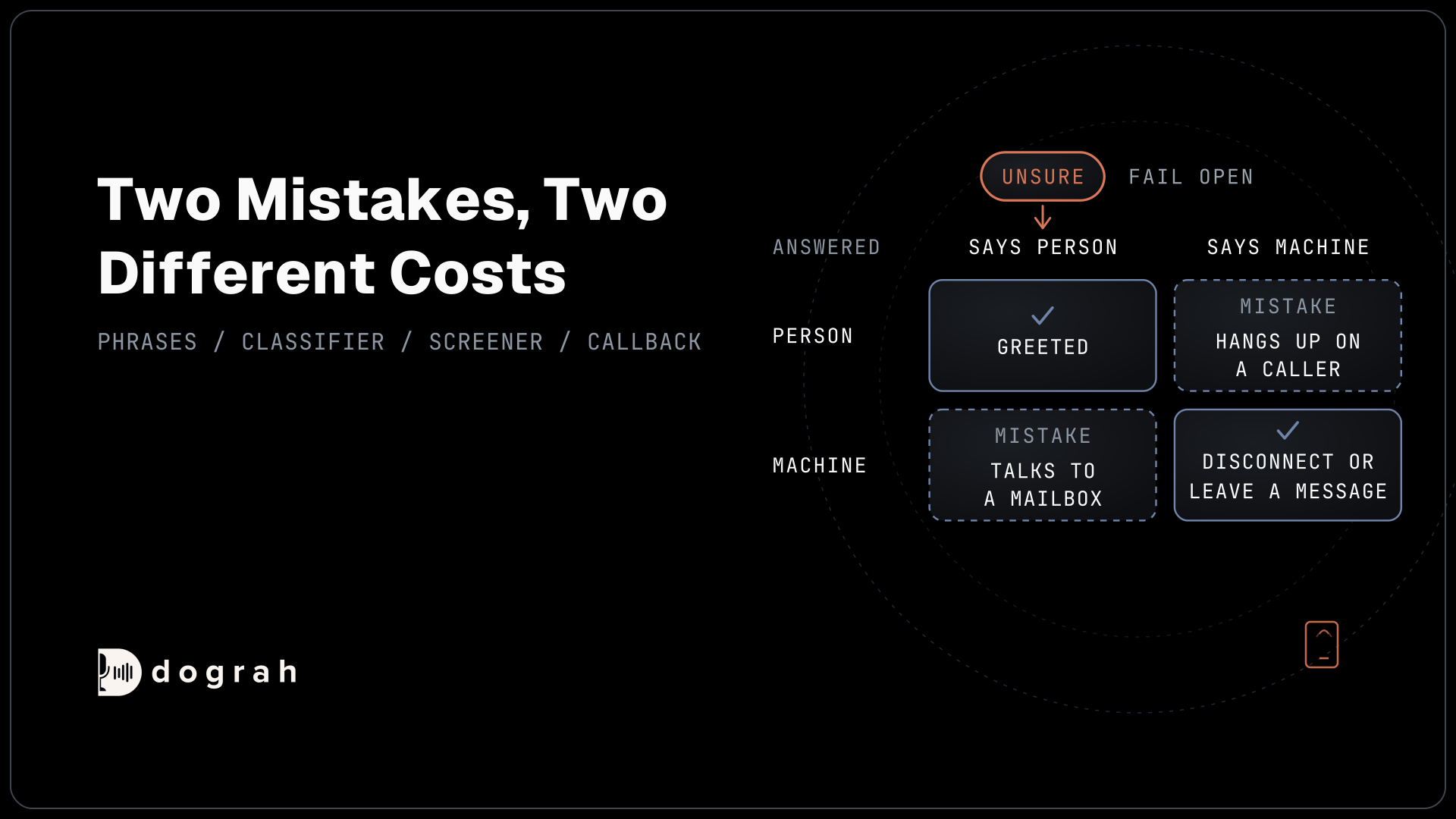
A detector makes two different mistakes, and each one costs something different. If it labels a person as a machine, the agent hangs up on someone who picked up, and that call is lost. If it labels a machine as a person, the agent starts talking to a voicemail box. You pay for minutes nobody hears, and the recording left behind is half a conversation.
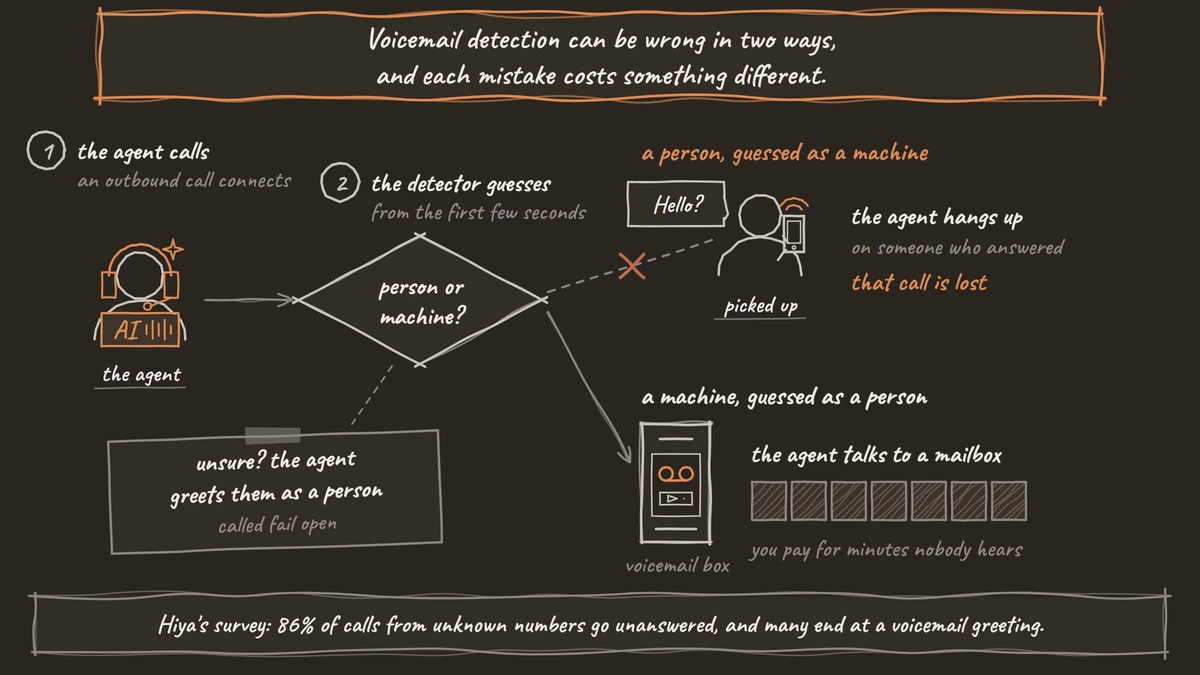
Twilio's page warns that its detection "will not always return the right answer". So the real question is which mistake you would rather make when the detector is unsure. Our view is that an unsure answer should go to the agent as a person, a choice called fail open, and Dograh is built that way. A few seconds spent on a voicemail cost less than hanging up on a customer who answered.
Machines answer a large share of outbound calls anyway. Hiya's State of the Call 2026, a survey of more than 12,000 consumers in six countries, found that 86% of calls from unknown numbers go unanswered. Many end at a voicemail greeting, so your rule runs on a big part of every campaign.

Open Source Alternative to Vapi / Retell
Self-hosted voice agent platform — no per-minute fees
dograh-hq/dograh
Star on GitHub
How voicemail detection works in Dograh
Dograh reads the words of the first answer instead of relying on the carrier's detection result. The setting lives in the agent's Settings, under Voicemail & Screening, and it stays off until you switch on "Enable voicemail and screening handling". It applies to outbound calls on agents with separate speech and language models. Speech-to-speech models skip it.
Once it is on, Dograh transcribes what the other end says and checks it against fixed phrase patterns first, in English and Italian, such as "leave a message" or "after the tone". Anything the patterns miss goes to a language model, which has three seconds to label the answer as a person, a voicemail, a full mailbox, a call screener, a phone menu or unknown. A short answer of under 2.5 seconds counts as a person straight away.
Each label leads to one action. Voicemail follows your voicemail setting. A full mailbox or a phone menu ends the call, because the agent has no keypad tool to press through a menu. A call screener hears your screening message. A person, or an answer the classifier cannot place, gets the agent's normal greeting. Every call that reaches voicemail is tagged voicemail_detected, and a campaign can retry it later if you switch on retries for voicemail.
You can edit what the classifier is told under "Classifier instructions". For calls that are not in English, describe the greetings and carrier announcements your callers actually hear, because the built-in phrase list covers only English and Italian. The listening time before the agent greets a silent line comes from Delayed Start on the Start Call node, 1.2 seconds by default.
What Is an Orchestration Layer in Voice AI? puts this job next to the others a platform runs on every call.
What to do when a voicemail answers
You choose one of two actions under "When voicemail is detected": "Disconnect the call" or "Leave a message". Disconnect is preselected when you first turn the setting on, and it suits most lists. The agent hangs up and tags the call, so the campaign can try again later.
Every minute spent talking to a mailbox is billed by the carrier and the model providers. Self-hosted Dograh has no per-minute platform fee (servers, model keys and phone minutes still cost). Dograh Cloud has a 1¢-a-minute platform fee. Our breakdown of what an AI voice agent costs per minute shows how those minutes add up.
"Leave a message" plays a fixed message you type, or a recording you upload, and then ends the call. The message starts right after the greeting is classed as voicemail. A mailbox records only after its tone, so listen to the result on a few real mailboxes. If the first words are cut off, record a short pause at the start of the clip.
Keep the message short and free of personal details. A voicemail cannot verify who will hear it, so it never names an order or an appointment. Give the business name and a number to call back, and keep the reason general, such as "about your recent request".
The law sets a floor too. In the US, the FCC's rules under the Telephone Consumer Protection Act (TCPA) require a prerecorded or artificial-voice message to name the business at the start and give a phone number during or after the message. The FCC has ruled that an AI voice counts as artificial. A telemarketing message left on an answering machine must also give a toll-free number the person can call to opt out.
So a sales voicemail from an AI agent generally needs that toll-free number spoken in it. Rules differ by country and by type of call, so confirm your own message with counsel.
Join the Dograh Community
Dograh is an OSS alternative to Vapi. Join our Slack community for queries, releases, best practices & community interactions.
Call screeners and phone menus
Some phones answer with a screener that asks who is calling before it rings the person. Write a short "Screening message" with your name and reason for calling, and the agent says it, then waits silently for the person to pick up. "Screening wait (seconds)" sets how long it waits, 30 seconds by default and up to 60, and the agent tries at most twice. Leave the message blank and screened calls simply end.
Phone menus are different. A business line that answers with "press 1 for sales" ends the call, because Dograh has no keypad (DTMF) tool. If your list holds many business numbers with menus, take them out, or give those calls to staff.
How to test voicemail handling
Test on real phone calls, because browser test calls never meet a mailbox. Call phones you control and let each one ring through. Try a mobile, a landline, an office line with a menu and a phone with call screening switched on. Then read each call's tag and transcript. Check that every person was greeted and every mailbox got the action you chose.
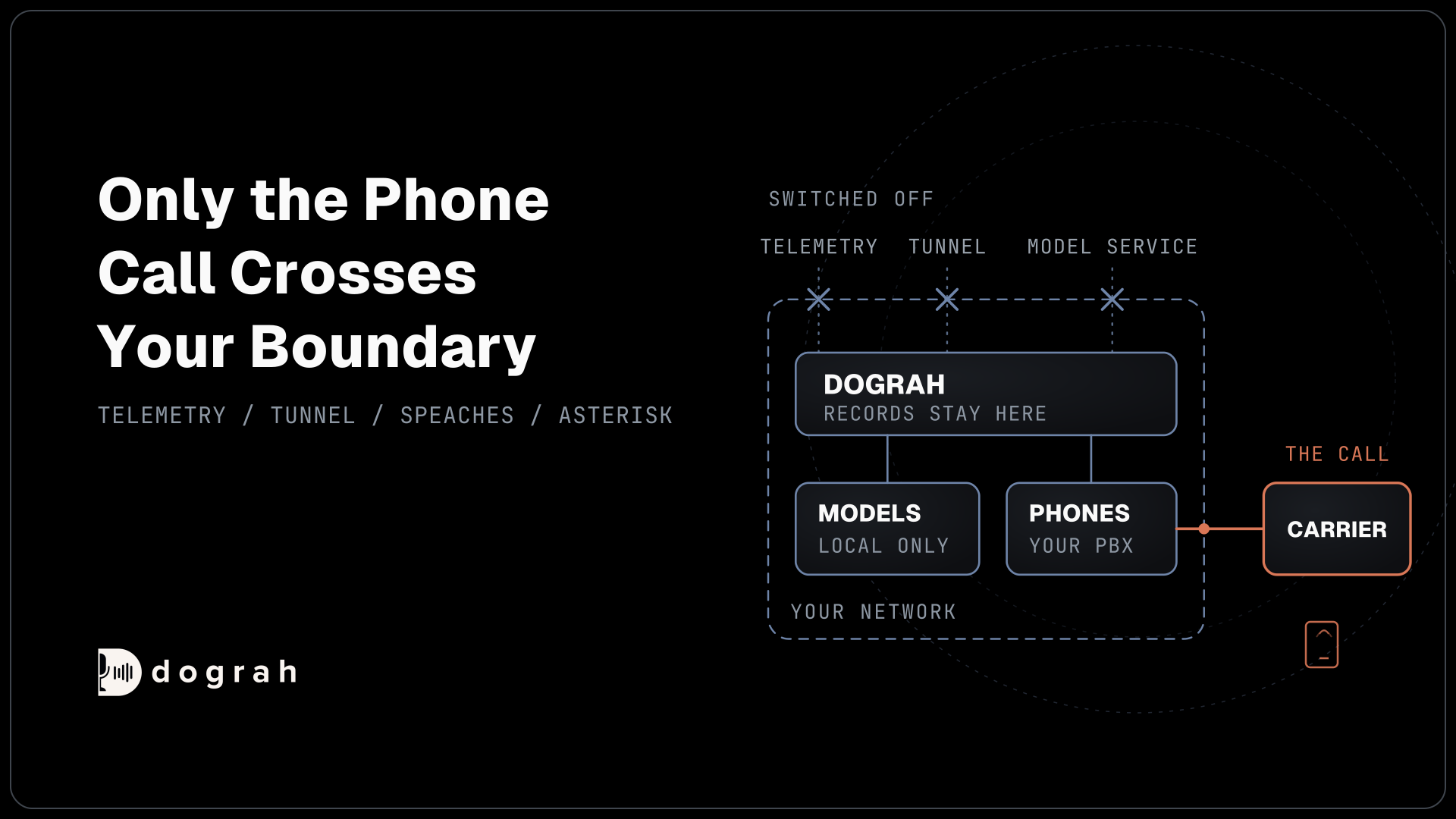
Telephony 101 for voice AI explains how a call gets from the carrier to the agent. Dograh is self-hostable, so when you host it, detection and the call audio run on your own servers.
Start with Disconnect the call and watch the tags for a week. Switch to Leave a message only for lists where a callback is worth the minutes.
Glossary
- Answering machine detection (AMD)
- The check an outbound calling system runs in the first seconds of a call to decide whether a person or a machine answered. Carriers usually time speech and silence in the greeting, while Dograh reads the transcript of the answer.
- Call screener
- A phone feature that answers for the person, asks the caller to say who they are, then decides whether to ring through. A voice agent needs a separate message for it, or the person never hears the call.
- Fail open
- A design choice where an uncertain result takes the normal path. In voicemail detection, an answer the classifier cannot place goes to the agent as a person, so nobody who picked up is cut off.