
AI voice agents for outbound sales and cold calling start where consent already exists, with inbound sales lines and callbacks to web leads who asked to hear from you. An AI-voice sales call to a mobile generally needs prior express written consent. The agent names the business at the start and hands ready buyers to a rep.
Key Takeaways
- Start with inbound sales lines and web-lead callbacks. Save cold lists for last.
- AI voices are artificial voices, so sales calls you place generally need written consent.
- The agent takes a spoken opt-out. Your own system keeps the do-not-call list.
Point an AI voice at a cold list too early, and the first problem is consent, not the script. This guide orders sales calls from inbound lines to cold lists, then covers the opening, qualifying, the handoff to a rep, running the list in Dograh and choosing cold calling software.
Which sales calls to hand an agent first
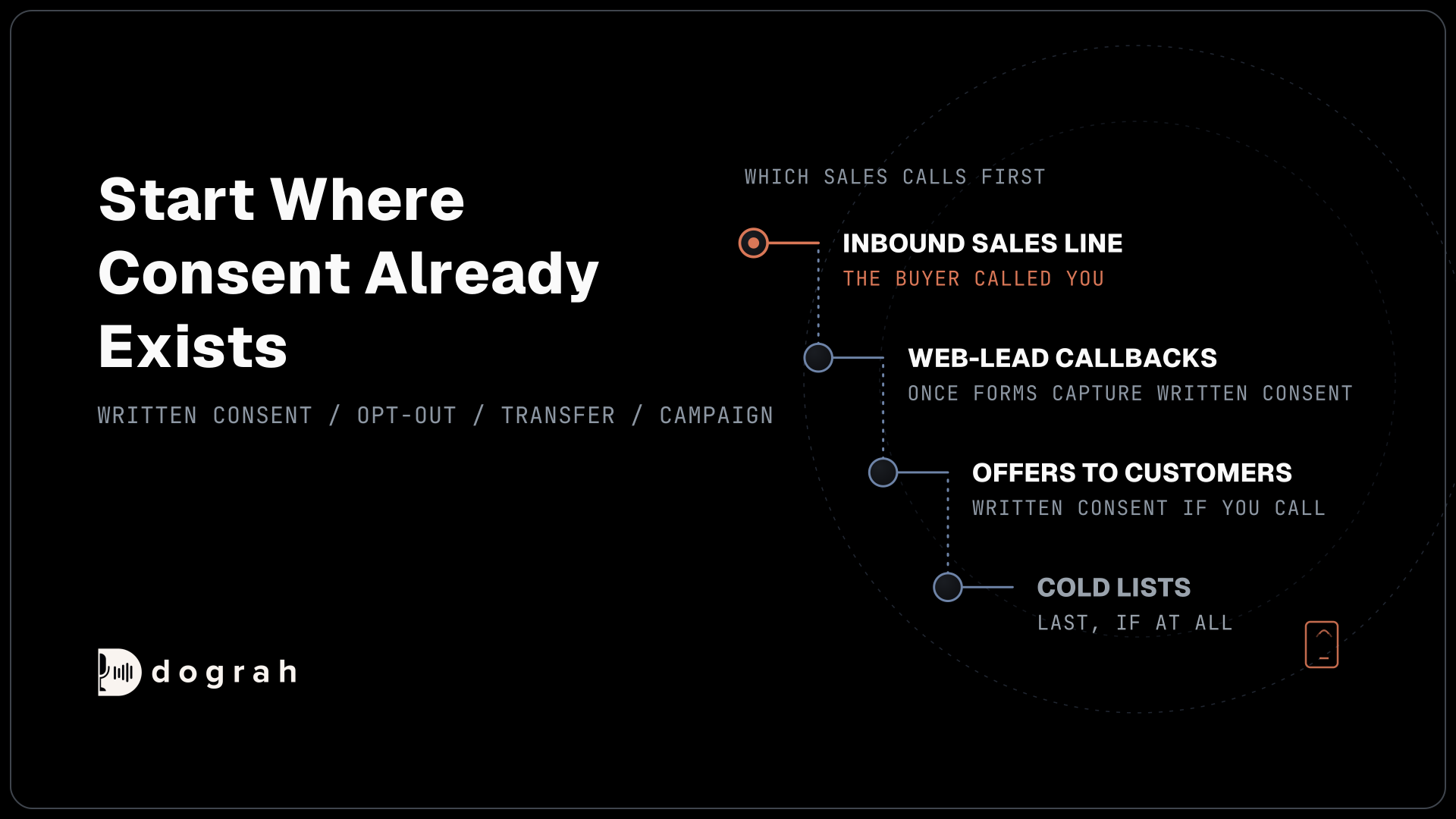
Outbound sales covers more than cold calls, and the calls differ most in one way: whether the person already asked to hear from you. An inbound sales line is the easiest. The buyer called you, so the agent answers and either books a meeting or connects a rep. A callback to a web lead comes next, because the form the lead filled in can carry the consent the call needs.
Follow-ups sit close behind. A lead who got a quote or sat through a demo and then went quiet can get a call that asks where things stand. Offers to existing customers follow their own rule, which depends on who started the call. A cold list, made of numbers that never asked to hear from you, is the hardest call for the agent and the riskiest under the law.
The numbers on cold dialing show why it goes last. Belkins' cold calling benchmarks, drawn from more than 175,000 dials its sales reps logged in 2025, put the connect rate at 9.9% per dial. Of the conversations that did happen, 4.6% booked a meeting, which works out to roughly 370 dials for one meeting. An agent can make those dials without tiring, but each one is still a call to someone who did not ask for it.
Our developer's guide to AI outbound calling that converts covers the voice pipeline behind these calls. This guide stays with the sales side, from consent to the handover.
Consent comes before the first dial
Consent is the first design decision, because it decides which numbers may go on the list at all. The FCC's 2024 ruling on AI-generated voices puts AI voices in the artificial voice category of the Telephone Consumer Protection Act (TCPA), so every sales call your agent places follows the rules for artificial voice calls.
Those rules sort calls by purpose. The FCC's calling rules treat a call made to encourage a purchase or an investment as telemarketing. A telemarketing call with an artificial voice, to a mobile or a home line, needs prior express written consent. That is an agreement the person signed, on paper or electronically, that names the number and says signing is not a condition of buying anything. A service call with no offer, such as an order update, needs only prior express consent. Add an offer to it and it becomes a sales call.
Two shortcuts don't work. A customer relationship does not stand in for written consent. It matters only for do-not-call rules, and never covers an AI-voice sales call by itself. Business buyers are not exempt either. The rule follows the line called, and a business owner's mobile is still a mobile.
Calls the customer starts are different. The FCC's ruling reaches calls the business places, so an offer inside an inbound sales call generally needs no TCPA consent. AI voice agents for upsell and cross-sell covers how the direction of the call sets the rule.
Cold lists also meet the National Do Not Call Registry. The FTC's Do Not Call data book for fiscal year 2025 counts over 258 million active registrations, and over 2.6 million Do Not Call complaints in that one year. Scrub every list against the registry before it goes anywhere near a campaign. Sales calls also stay between 8 a.m. and 9 p.m. in the called person's own time zone. Several states add rules of their own, so confirm your consent wording and calling setup with counsel before the first campaign.
The first fifteen seconds of the call
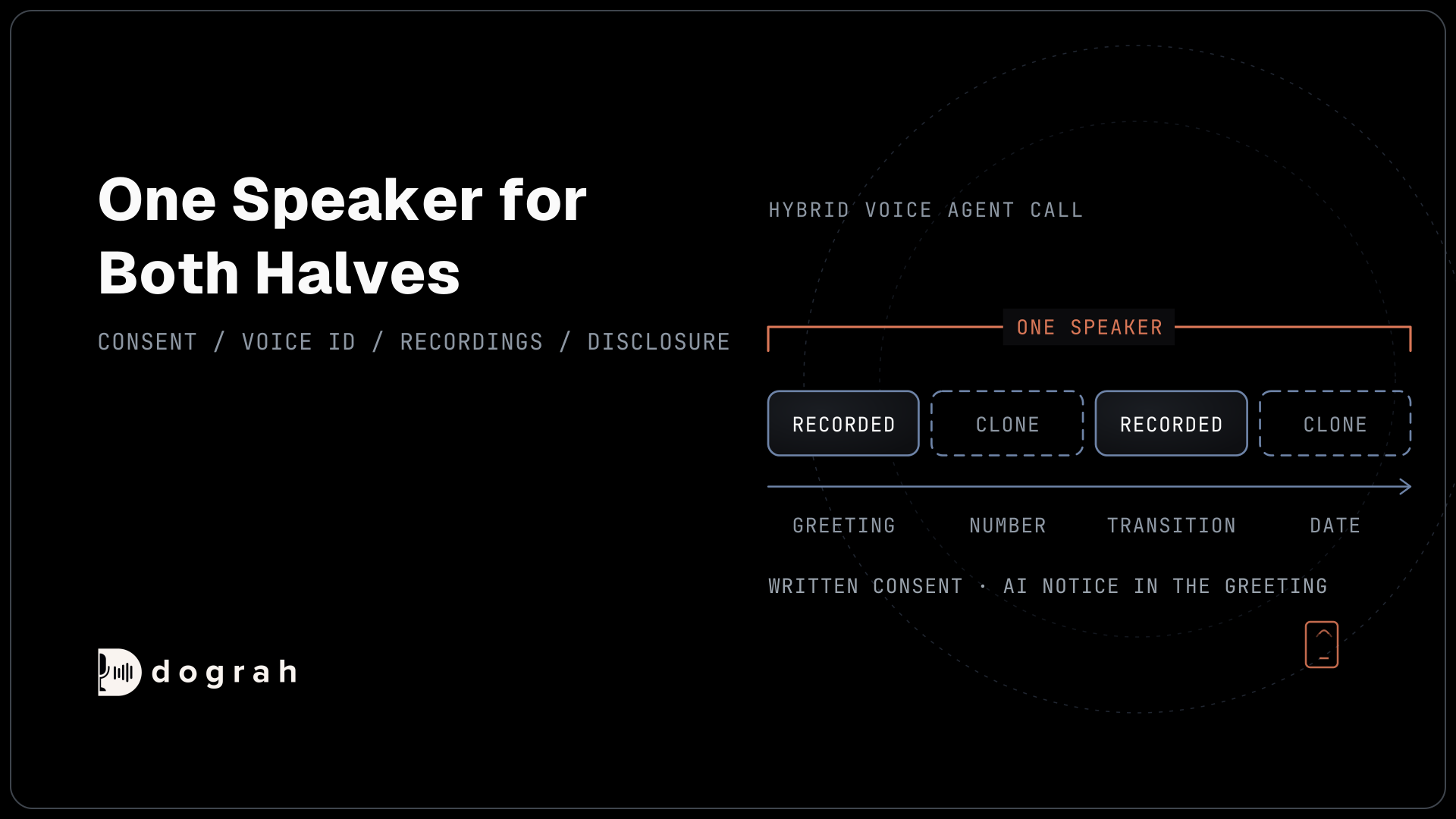
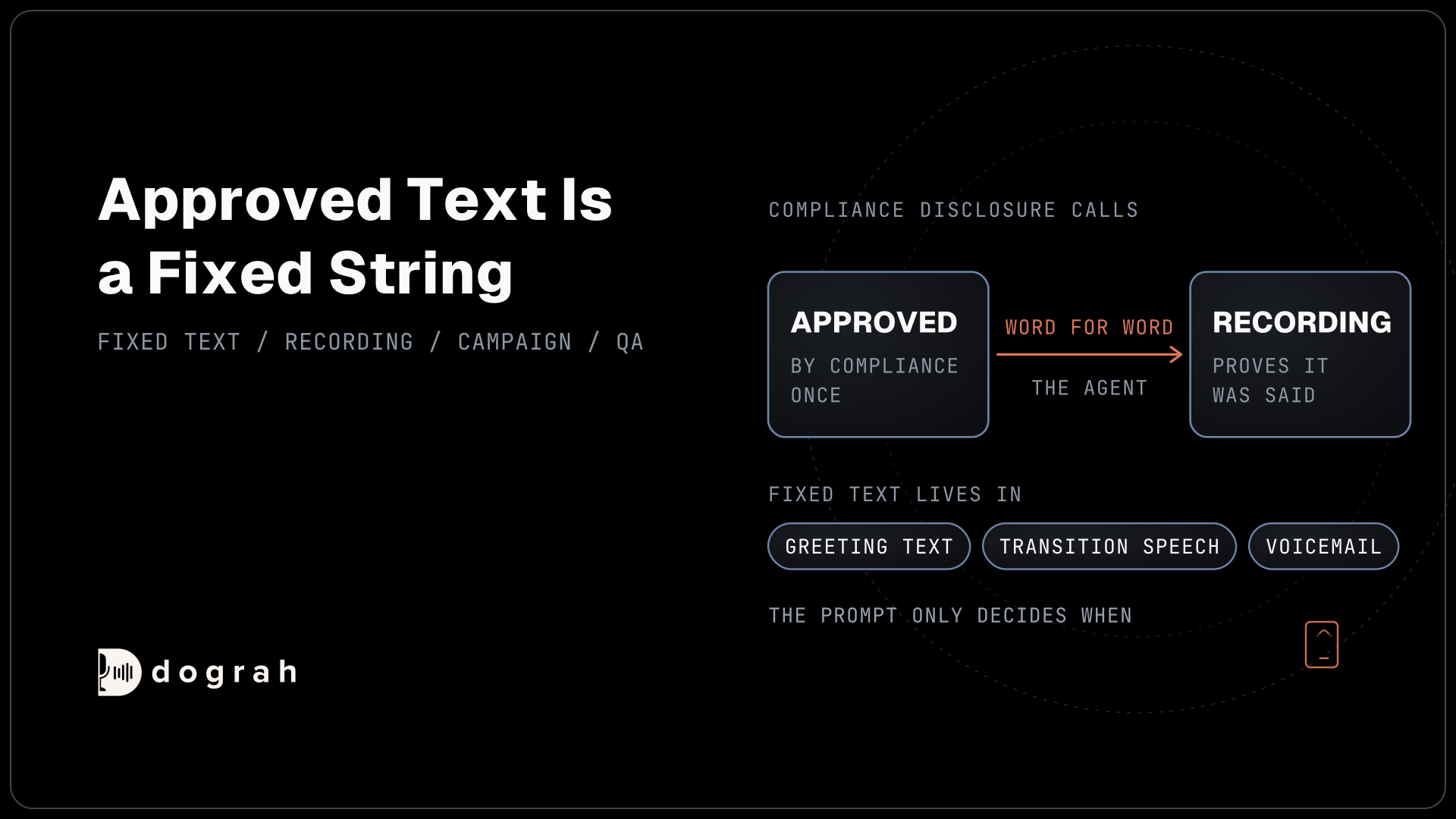
The opening tells the person who is calling and why, and a sales call cannot skip either part. The FCC's rules ask an artificial voice call to name the business at the start and to give a phone number during or after the message. In Dograh, both go in the Greeting Text, the fixed text the agent speaks word for word as the call connects. The Start Call node ships with Allow Greeting Interruption switched on, letting a buyer cut in after two words, so switch it off and the name and number are heard in full. Inside a step, the model writes its own sentences, so anything you must say exactly belongs in fixed text.
A greeting for a web-lead callback might read:
"Hi {{first_name | there}}, this is the virtual assistant for Northwind Solar, calling about the quote you asked for on our website. Our number is +1415555XXXX. If you'd rather not get these calls, just tell me and I'll make sure we stop."
The fallback after the bar matters. Without it, a missing name is spoken as empty text. Telling the buyer up front that an automated assistant is calling also goes in the Greeting Text next to the business's name, whether you choose to or a law you're under requires it. California is one example: its AB 2905 requires calls placed through an automatic dialing-announcing device to say when the recorded message uses an artificial voice.
Our post on the first 15 seconds of AI outbound calls covers how the opening should sound and why a slow reply loses the call. AI cold call script templates gives ready-to-copy openings and opt-out lines you can paste into the Greeting Text and prompt.

Open Source Alternative to Vapi / Retell
Self-hosted voice agent platform — no per-minute fees
dograh-hq/dograh
Star on GitHub
Qualify, then hand the buyer to a rep
A sales call ends well when a ready buyer reaches a person who can close. The agent asks a short, fixed set of questions, the same for every lead, and records each answer as the person stated it. Those recorded answers are the model's reading of the call, so when a rep needs the buyer's exact words, the transcript and recording have them. Tell the agent in the prompt never to promise a price or a discount your system did not return. AI voice agents for lead qualification covers the question set and how each call ends.
Transfer Call handles the handover on Twilio, Telnyx, Plivo, Cloudonix and Asterisk ARI. The rep's phone rings first, and the buyer is brought in only once the rep picks up. Teams on Twilio can add a short spoken introduction that both sides hear before the connection. No summary goes across by default, so an HTTP API tool writes the answers to your CRM before the transfer, and the rep picks up already knowing what the buyer wants.
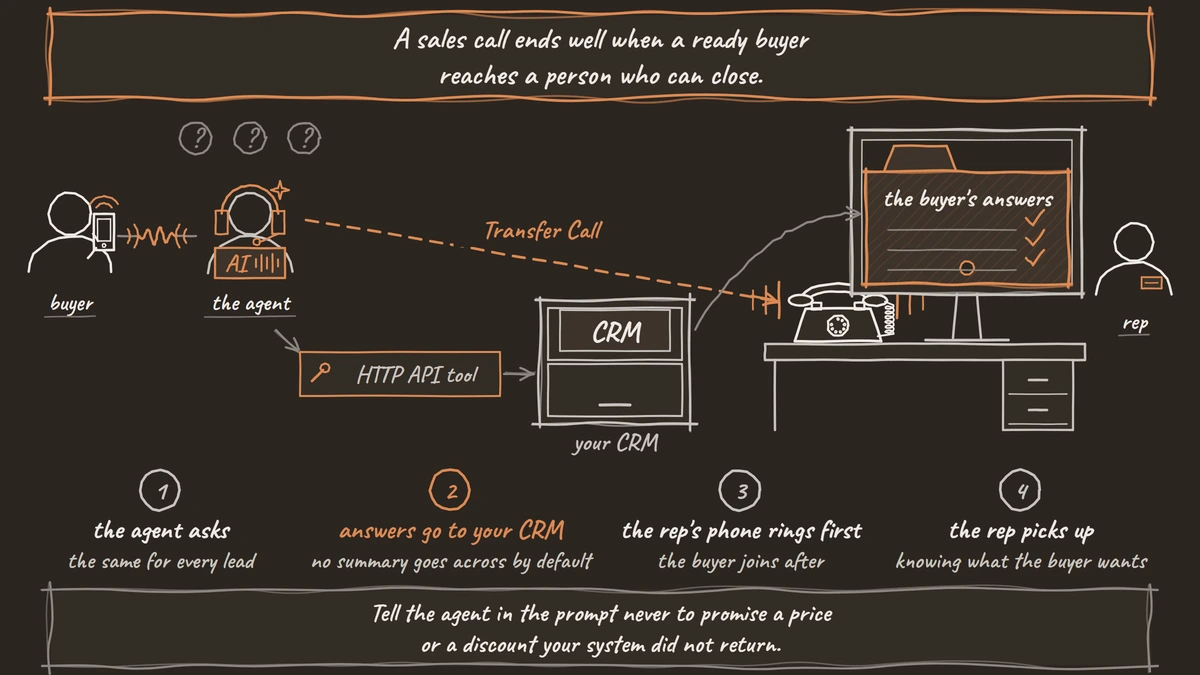
Should the rep miss the call within the 30-second default, the buyer stays on with the agent. Tell it in the prompt to offer a callback and write that request to your CRM. A lead who is not ready yet gets logged for a later follow-up, and the agent ends the call politely. Our post on AI sales agents follows a voice sales agent through this work day to day, from qualifying a lead to booking the meeting.
Car dealers live or die on this handover, because a web lead that never reaches the sales desk is a lost visit. AI voice agents for automotive lead qualification covers the dealer's questions and the desk transfer.
Offers to customers you already have
Selling to existing customers is its own call, because the offer has to come from their account. Inside a call the customer placed, the agent finishes the request first and makes one offer only after it is solved. On a call you place to make the offer, written consent has to be on file before the first dial, the same as any other AI-voice sales call.
Verify the person before any account detail. The number on file points to an account, but anyone could be answering it, so the agent asks for an approved check, such as date of birth or the last four digits of an account number, before it names a plan or a balance. The offer and its price come from your system through an HTTP API tool, never from the model, and a no ends the topic for that call. Money stays off the call too. The agent never takes a card number, and an HTTP API tool asks your own system to send its secure payment or application link by text or email.
AI voice agents for product cross-sell in banking covers offers drawn from a bank's own eligibility system, with every advice question going to a banker. For online stores, AI voice agents for upsell and cross-sell in e-commerce covers add-on offers from the store's catalog after a purchase.
Running the call list in Dograh
Outbound sales calls run as a campaign, and most of the sales rules turn into its settings. A campaign takes a CSV file with a phone_number column, and every other column, such as the lead's name or the product they asked about, becomes a variable the greeting and prompt can use. Build that file in your own system, only from contacts whose consent is on file and who are off the registry and your own list.
Retries are part of the plan, because most first dials go unanswered. Max Retries runs from 0 to 10, with 2 by default, and Retry Delay sets the gap, from 30 seconds to an hour. Retry On has separate switches for Busy Signal, No Answer and Voicemail. Call Schedule sets the calling hours by weekday in one Timezone, so split a national list by time zone and keep each campaign's hours inside 8 a.m. to 9 p.m. locally.
Calls Started per Second, 1 by default, sets the dialing pace. The Circuit Breaker pauses a campaign when too many connected calls fail in the AI pipeline, such as a speech-to-text or language model error, by default 50% of at least 5 calls within 120 seconds. A 401, 402 or 403 from a provider pauses it at once, so a bad key never burns through the list.
Voicemail handling is off by default. Turn on "Enable voicemail and screening handling" in the agent's Settings, and "When voicemail is detected" offers Disconnect the call, the default, or Leave a message, as text or a recording. It applies to outbound calls on agents with separate speech and language models. The choice is one setting per agent, so to skip messages for some contacts, run them on a second agent set to disconnect. You choose whether voicemail outcomes are retried, not which retry leaves the message. A message left this way still names the business and gives its number.
When a buyer says stop, the agent takes that spoken opt-out at once, records it in your system through an HTTP API tool and hangs up. Your system then drops the number before the next list goes out. Under the FCC's rules, a stop request is honored within ten business days, and the number stays on your own do-not-call list for five years.
With call disposition extraction switched on under Settings, General, each call also gets an outcome code such as do_not_call. Dograh records it on the call, so you can export those calls and check that every number came off before the next upload. A campaign can also split its calls across agent versions, so two openings can run on the same list.
How to Build an AI Cold Calling Agent walks through each of these settings in order.
Join the Dograh Community
Dograh is an OSS alternative to Vapi. Join our Slack community for queries, releases, best practices & community interactions.
Choosing AI cold calling software
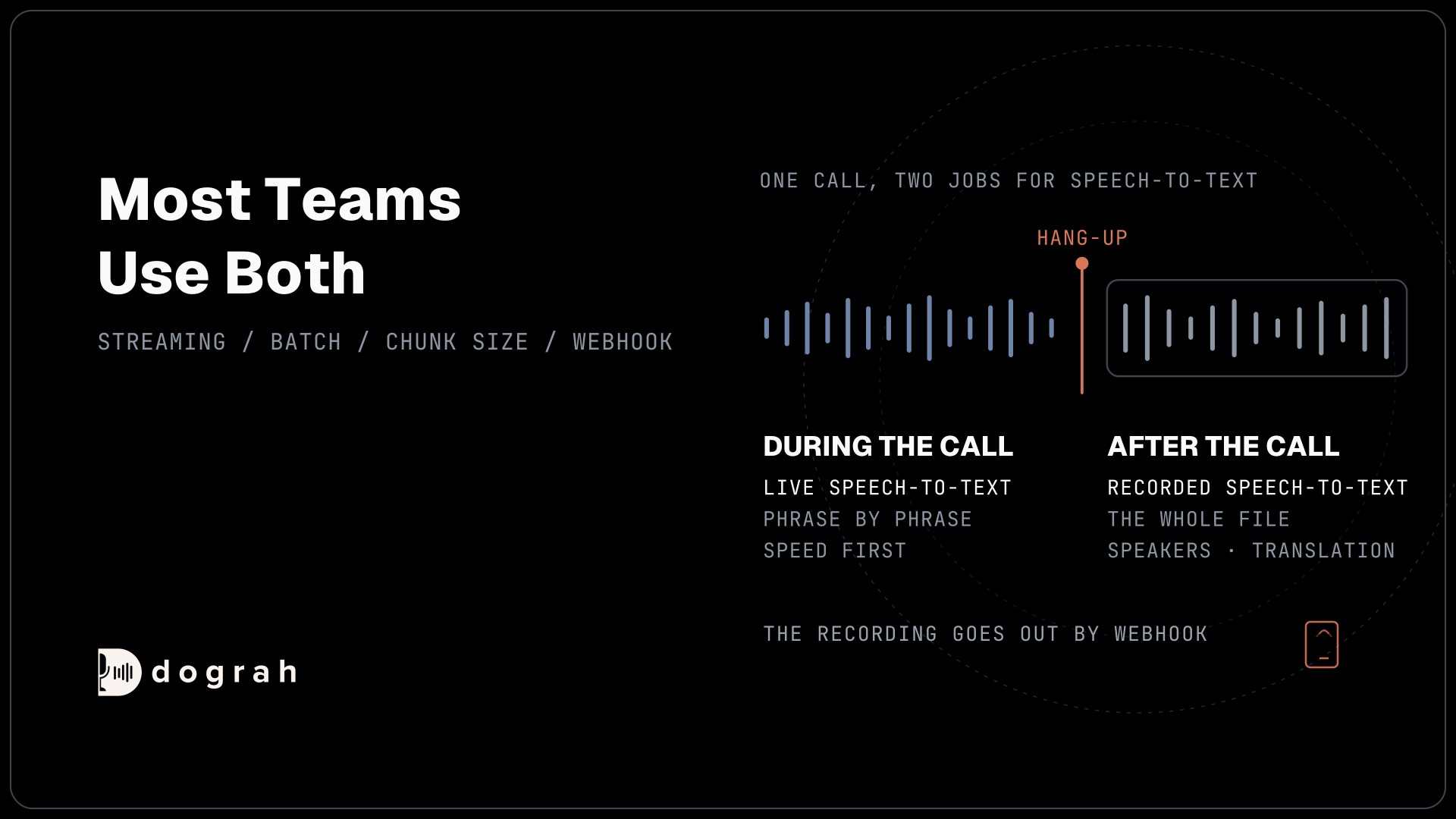
Two kinds of product sell under this name, and they do different jobs. An AI dialer places many calls at once and puts a human rep on the line when a person answers. A voice agent holds the conversation itself and brings in a rep only for buyers who are ready. If your reps want more live conversations, a dialer fits. If you want reps to talk only to qualified buyers, a voice agent does.
Judge a voice agent platform on where call records sit and how quickly you can change the script after the first week of real calls. Dograh is self-hostable, so recordings and transcripts can sit in your own storage. Dograh handles orchestration, meaning the call flow, the tools and the telephony, while the speech and language models sit in a separate layer that you pick. We built a dedicated page for a self-hosted AI sales calling agent that names your business first and hands ready buyers to a rep.
A sales team running it on its own servers pays no per-minute platform fee, though servers, model keys and phone minutes still have to be paid for. Teams on Dograh Cloud pay a 1¢-a-minute platform fee.
Best AI Cold Calling Software compares voice agent platforms and AI dialers on their own published pricing and features.
Where to start with AI sales calls
Start with your inbound sales line, because the buyer called you and the consent question is simplest. Add callbacks to web leads next, once your forms capture written consent that names your business. Offers to existing customers come after that, and cold lists last, if at all.
Test on a real phone number before launch. Most phone calls reach the agent as 8 kHz audio, while a browser test runs at 16 kHz, so product names can sound different to the speech model. Add your product and plan names to the Dictionary in the agent's Settings so the agent hears them correctly. Transfers work only on real phone calls, so test the handover to your reps on a real line as well.
Each sales call above has its own deep dive:
- AI Voice Agents for Automotive Lead Qualification
- AI Voice Agents for Product Cross-sell in Banking
- AI Voice Agents for Upsell and Cross-sell in E-commerce
- How to Build an AI Cold Calling Agent in Dograh, Step by Step
- Best AI Cold Calling Software: Voice Agents and AI Dialers
- AI Sales Agents: What a Voice Sales Agent Does All Day
- AI Cold Call Script Templates: Fixed Lines and Prompt Guidance
Glossary
- Prior express written consent
- A signed agreement, electronic signatures included, that allows sales calls with an artificial voice to a named number and says signing is not a condition of buying. An AI-voice sales call to a mobile generally needs it.
- Telemarketing
- In the FCC's rules, a call made to encourage a purchase or an investment. A service call that adds an offer generally becomes telemarketing and needs written consent.
- Artificial voice
- A voice not spoken live by a person. The FCC's 2024 ruling places AI-generated voices in this group, so every call an AI agent places follows the artificial voice rules.
- National Do Not Call Registry
- The FTC's list of numbers whose owners do not want sales calls. Sales lists are scrubbed against it, and a business also keeps its own do-not-call list of people who asked it to stop.