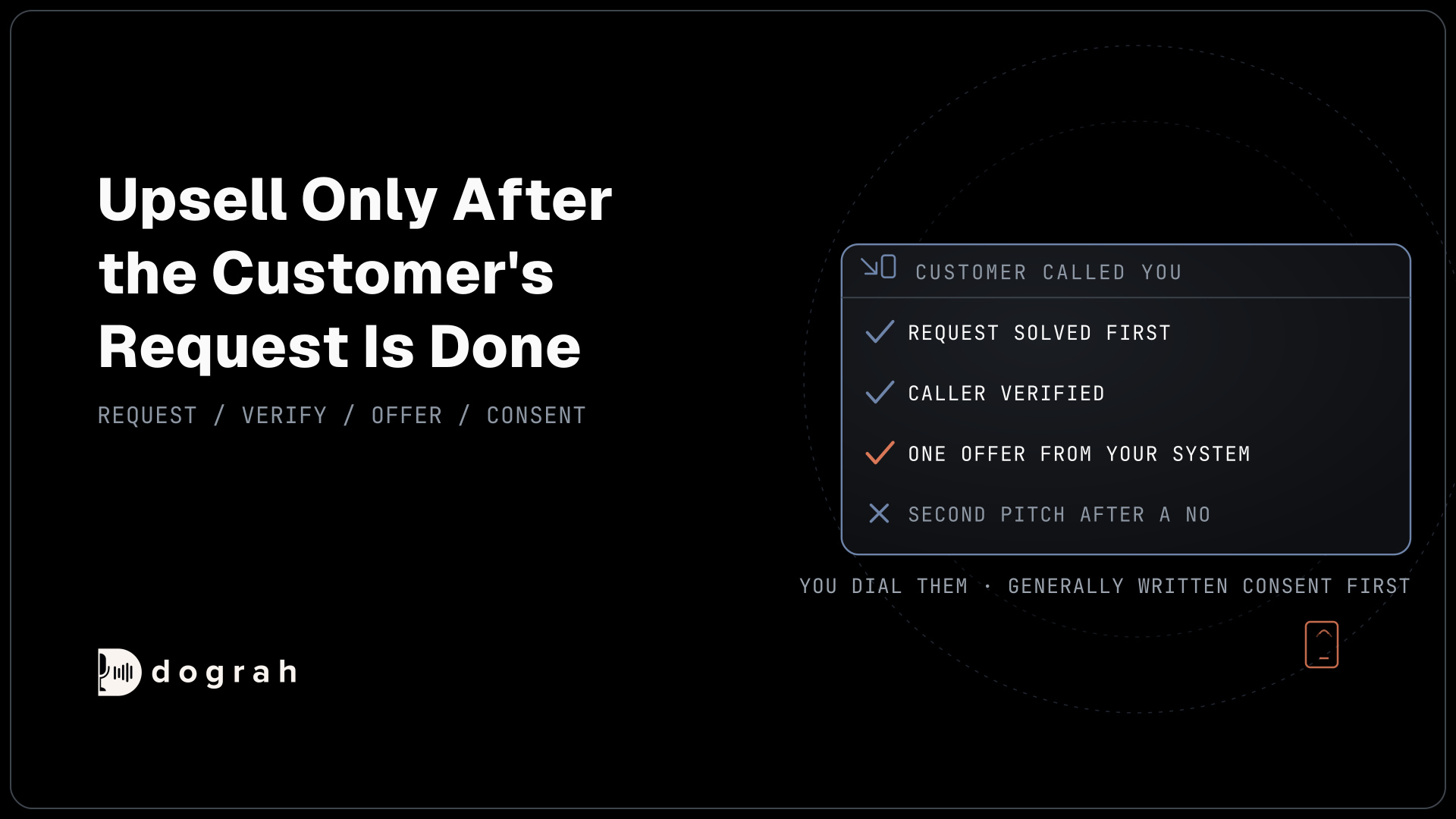

AI voice agents for upsell and cross-sell make one offer drawn from your own system, after verifying the customer. Inside a call the customer placed, the offer comes once their request is done and generally needs no consent. A follow-up call you place to make the offer generally needs prior express written consent first.
Key Takeaways
- Offer inside the customer's own call only after their request is done.
- A call you place to make an offer generally needs written consent.
- Make one offer, priced by your system. A no ends the topic.
This post is part of our guide to AI voice agents by use case. The guide's section "Outbound sales calls: leads, upsell and win-back" puts it in one line: upsell and cross-sell depend on who started the call. Here is how both versions of the offer run in any business, in Dograh, an open-source, self-hostable voice agent platform.
Who starts the call sets the rule
An upsell offers a bigger or better version of what the customer already has, such as a higher plan. A cross-sell offers something related, such as home internet to a mobile customer. On the phone, both follow the same rule, and that rule depends on who dialled.
An offer made inside a call the customer placed to you generally needs no consent. A follow-up call you place to make the offer generally needs prior express written consent. The words of the offer can be identical; the consent depends on the direction of the call.
That split also decides where to start. Inbound offers come first, because the customer is already on the line and the consent question is simpler. Outbound offer calls come second, once you have a list where every contact signed the right consent. Renewal calls sit close to this line too, and AI voice agents for renewals and retention covers where a renewal notice turns into an offer.
The offer inside a customer's own call
The customer's own request comes first, and the offer only after it is done. A caller who rang about a bill and hears a pitch before the bill is fixed has a reason to hang up. Tell the agent in the prompt to finish the request, confirm it is solved, and only then make the offer.
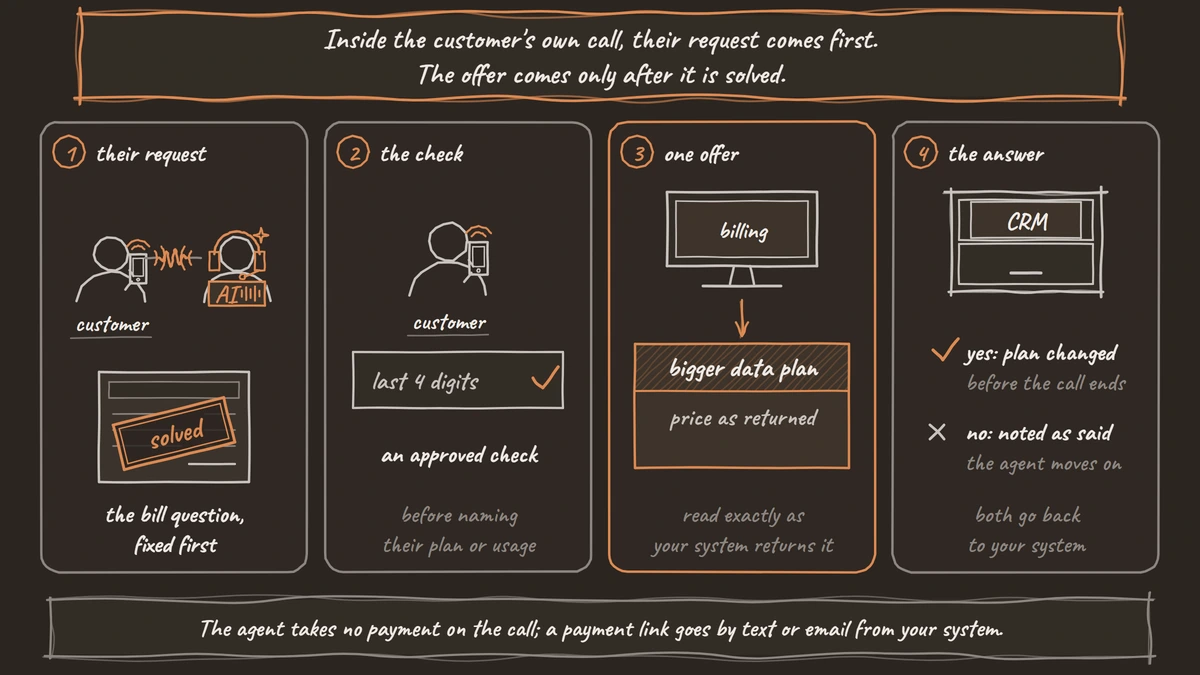
The customer is verified before any offer that uses their account. A phone number finds the record but does not prove who is calling. So tell the agent in the prompt to ask for an approved check, such as date of birth or the last four digits of an account number, before it names their plan or usage.
The offer itself comes from your system, never from the model. An HTTP API tool asks your billing or order system which offer this customer is eligible for, and at what price. Tell the agent in the prompt to read the offer and the full price exactly as returned, and to make one offer only. The best offer answers what the customer just asked about. A caller who keeps running out of data hears about a bigger plan, not a new phone.
A yes is written back to your system through another HTTP API tool, so the change is real before the call ends. If money is due, Dograh takes no payment on the call. Recordings and transcripts keep whatever is said, so the call never asks for a full account, card or Social Security number; use a short check such as the last four digits, and send payment links by text or email from your own system. A no is recorded as the customer said it, and the agent moves on. Call-recording consent laws still apply to inbound calls.

Open Source Alternative to Vapi / Retell
Self-hosted voice agent platform — no per-minute fees
dograh-hq/dograh
Star on GitHub
The consent line for offers
The consent rule comes from the FCC's rule, 47 CFR 64.1200. This section is general information, not legal advice.
The rule covers any call that "includes or introduces an advertisement or constitutes telemarketing, using an automatic telephone dialing system or an artificial or prerecorded voice" to a mobile number, and allows it only with "the prior express written consent of the called party". Telemarketing is a call made "for the purpose of encouraging the purchase or rental of, or investment in, property, goods, or services". Written consent is "an agreement, in writing, bearing the signature of the person called", naming the number to call.
In its February 2024 declaratory ruling, the FCC confirmed that AI voices count as artificial voices, and said its requirements apply to "any AI technology that initiates any outbound telephone call". That is why a call the customer places to you generally sits outside these rules. The same ruling says a live agent choosing prerecorded messages "does not negate the clear statutory prohibition against initiating a call using a prerecorded or artificial voice", so a call built on recorded human clips counts too.
Read together, a service call you place that adds an offer generally becomes a sales call that needs written consent. Our post on service reminders in automotive shows the other choice: keep the offer off the reminder entirely. The guide to compliant AI voice agents covers the wider rules. Confirm your position with counsel.
Running an outbound offer call
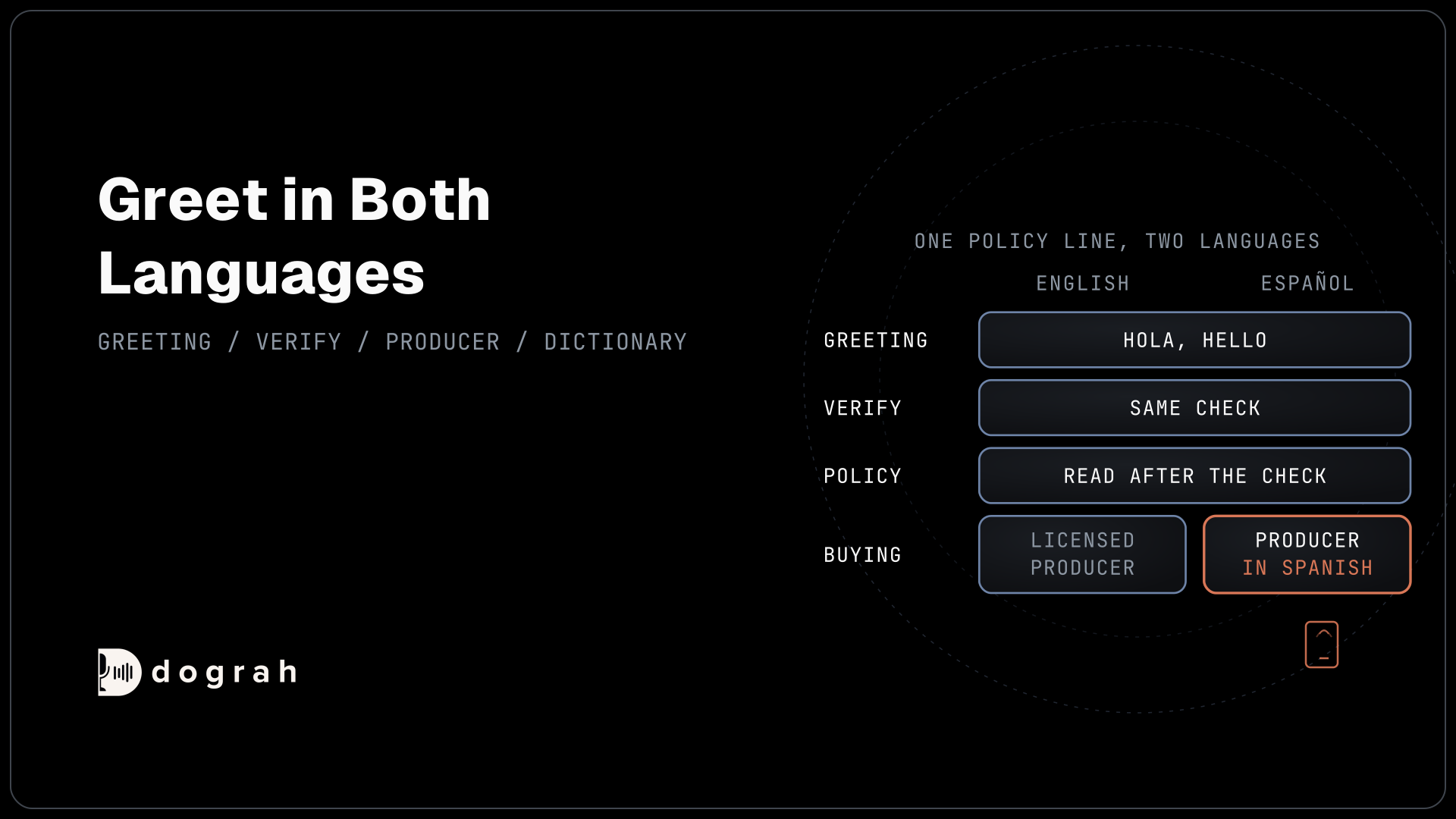
An outbound offer call runs only on contacts whose written consent is on file in your own system. Build the list there, then upload it to a campaign. Each column, such as the plan name, becomes a variable. A fixed greeting per contact, as text or a recorded clip, can come from the campaign file. Contacts without one hear the agent's normal greeting.
The rule asks a call like this to name the business at the start and offer an automated opt-out "within two (2) seconds of providing the identification information". Put both in the Greeting Text, the fixed line Dograh speaks word for word as the call connects. After the verify step, the agent makes the one offer the system returns, and a no ends the topic for that call.
When the customer says stop, tell the agent in the prompt to write the opt-out first, then end the call with the End Call tool. Its goodbye line is fixed text or a recorded clip, played exactly as saved. Dograh keeps no do-not-call list. When a caller opts out, an HTTP API tool writes it to your own list, and you remove those numbers before the next campaign upload. The do_not_call call tag records the request but never blocks a later call.
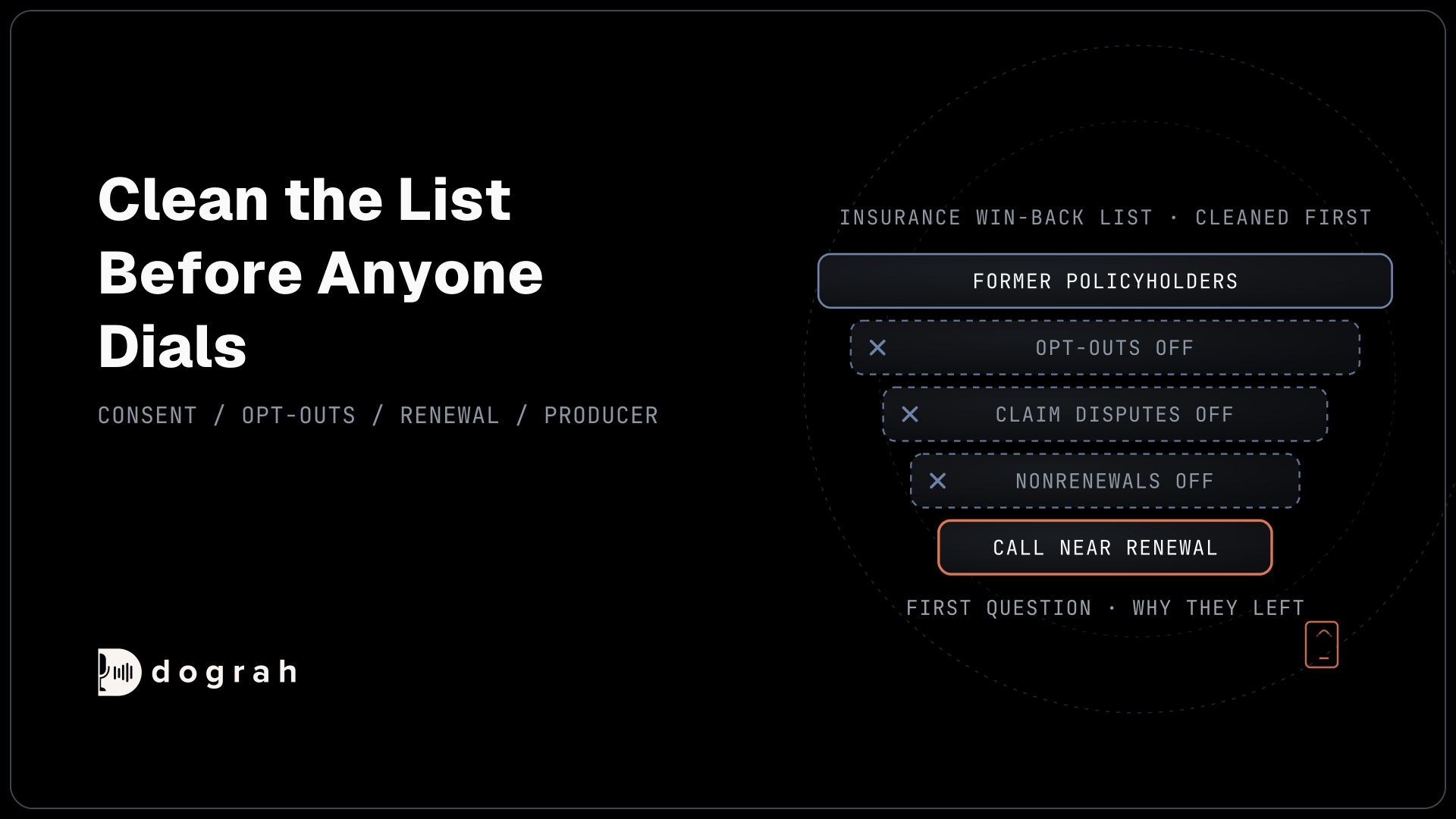
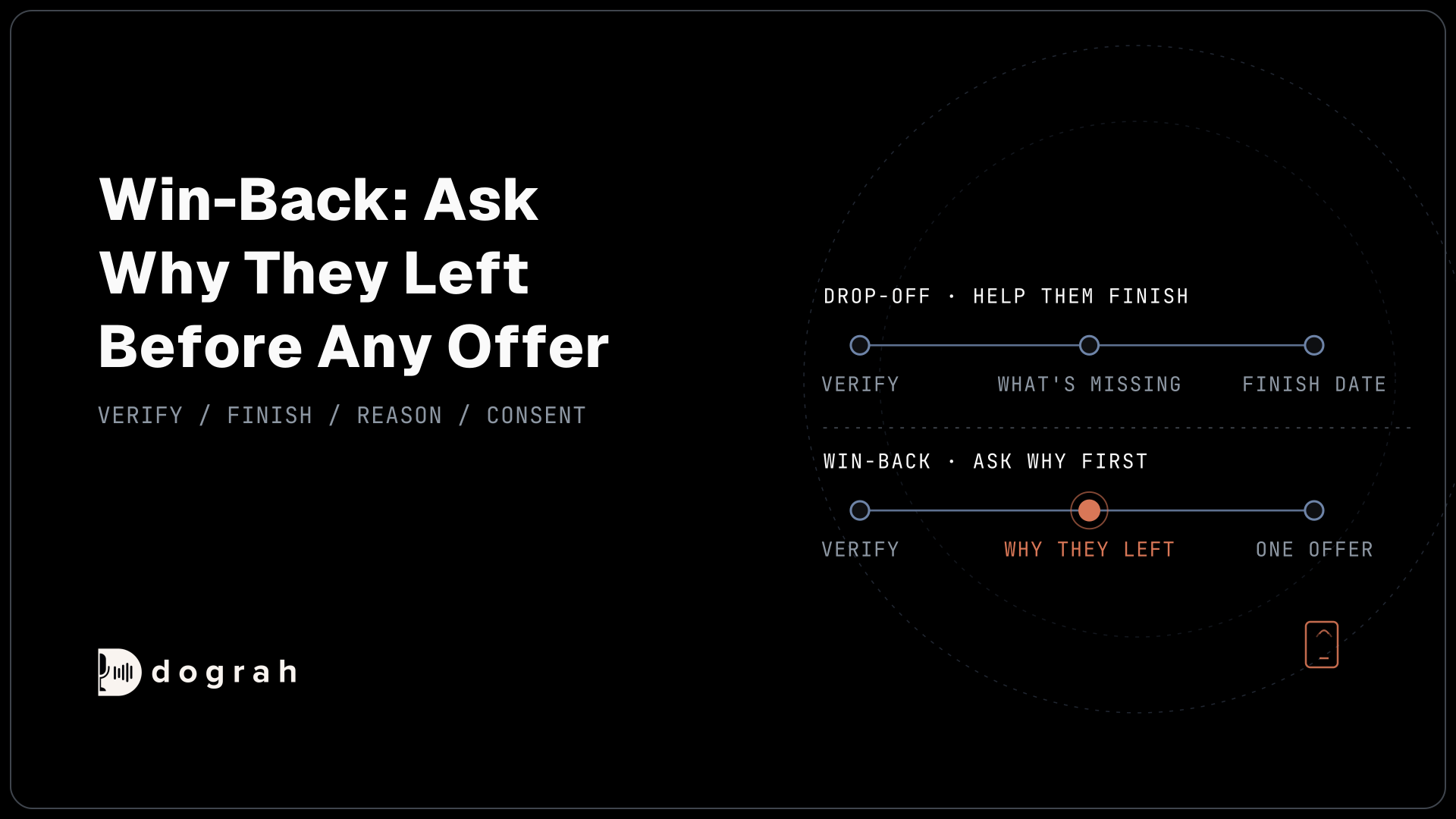
The FCC has adopted FCC 26-67, which is not yet in effect. It says: "Revocation requests made in response to robocalls that contain an advertisement or constitute telemarketing revoke consent to all future robocalls containing an advertisement or that constitute telemarketing from that caller." Read plainly, one "stop" on an offer call generally ends all of your AI-voice sales calls to that person, including win-back calls; our post on win-back and drop-off recovery covers those.
Calling hours run by weekday in one time zone per campaign, so split the list by time zone. A customer with questions the offer cannot answer goes to a person. Transfer Call works on Twilio, Telnyx and Asterisk ARI. It passes no summary by default; on Twilio it can play a short spoken introduction to both people. Write the details to your system with an HTTP API tool before the transfer.
Self-hosted Dograh has no per-minute platform fee (servers, model keys and phone minutes still cost); Dograh Cloud has a 1¢-a-minute platform fee.
Join the Dograh Community
Dograh is an OSS alternative to Vapi. Join our Slack community for queries, releases, best practices & community interactions.
Upsell and cross-sell by industry
Each industry decides what can be offered and adds its own rules, such as telecom's customer-data approvals. These posts cover them:
- AI Voice Agents for Room Upgrade Upsell: hotel upgrades before arrival.
- AI Voice Agents for Plan Upgrades and Cross-sell in Telecom: bigger plans and home internet.
- AI Voice Agents for Post-Purchase Follow-up in E-commerce: check-in calls, with reorder offers kept separate.
- AI Voice Agents for Mortgage Rate & Refinance Callbacks: borrowers asking about rates.
- AI Voice Agents for Trial-to-Paid Conversion Calls: SaaS trial users.
- AI Voice Agents for Outbound Campaigns in BPO: contact centers running offer campaigns for clients.
Glossary
- Cross-sell
- An offer of a related product or service, such as home internet to a mobile customer, as opposed to an upsell, which offers a bigger or better version of what the customer already has.
- Prior express written consent
- Under 47 CFR 64.1200, a signed written agreement that authorises a business to make AI-voice or prerecorded sales calls to a named phone number. An outbound offer call generally needs it before the first dial.
- Telemarketing
- In the FCC's rule, a call made to encourage the purchase or rental of, or investment in, property, goods or services. A service call you place that adds an offer generally becomes telemarketing.
- End Call tool
- A Dograh tool the agent uses to end a call, with a goodbye line that is fixed text or a recorded clip, played exactly as saved. Ending is the agent's decision, so the prompt says when to use it.