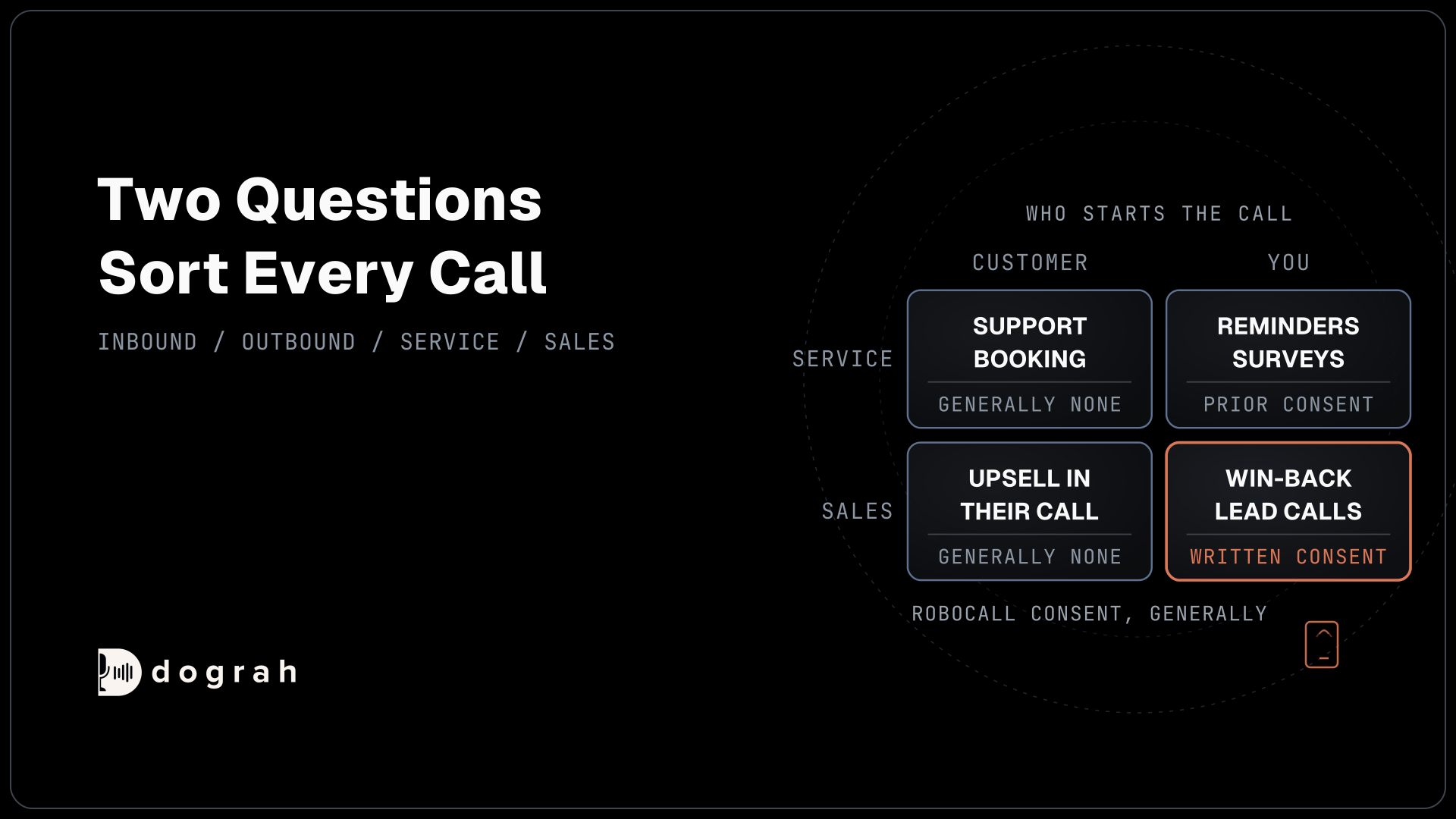

The main AI voice agent use cases are inbound support, appointment scheduling, lead qualification, payment reminders, NPS and CSAT surveys, renewals, upsell and win-back. Sort each one by who starts the call and whether it sells. The second question sets the consent rule. Every call verifies the person before sharing details and keeps a route to a person.
Key Takeaways
- Inbound calls verify first. Outbound calls read your record once the person answers.
- Calls you place need consent; sales calls generally need signed, written consent first.
- Payment links and opt-out lists live in your own systems, not in Dograh.
This guide sorts the eight calls businesses most often hand to a voice agent and shows how each runs in Dograh, an open-source voice agent platform that reads and writes your CRM, calendar or billing system during the call. You can self-host it or run it on Dograh Cloud.
Two questions that sort every call
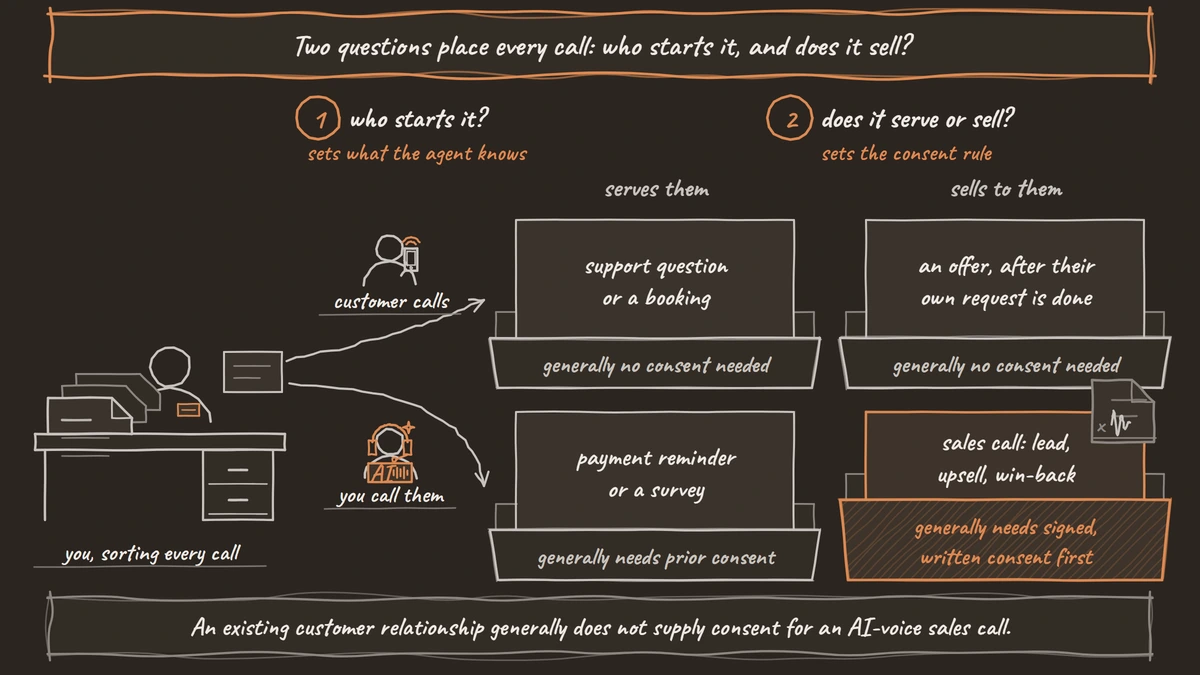
The first question decides what the agent knows when it speaks. On an inbound call, the agent starts with only the calling number. A phone number finds a record but does not prove who is calling, so the agent verifies the person first, then reads their account. On an outbound call, you dial from your own list, so the agent already has the record. Pre-Call Data Fetch can refresh it once the call connects (on outbound calls, after the person answers). It can change what the agent says, but it never decides whether the call is placed.
The second question decides the consent rule. In its February 2024 declaratory ruling, the Federal Communications Commission (FCC) said: "callers must obtain prior express consent from the called party before making a call that utilizes artificial or prerecorded voice simulated or generated through AI technology. If these robocalls introduce an advertisement or contain telemarketing, the Commission's rules require that the caller obtain the prior express written consent of the called party."
The same ruling says these requirements apply to "any AI technology that initiates any outbound telephone call". So a call the customer makes to you generally needs no consent under these rules, though call-recording consent laws still apply. A service call you place generally needs prior express consent, and a sales call needs prior express written consent.
Both terms are defined in the FCC's rule, 47 CFR 64.1200. Telemarketing is a call made "for the purpose of encouraging the purchase or rental of, or investment in, property, goods, or services". Prior express written consent is "an agreement, in writing, bearing the signature of the person called", which also names the number to call. A web form with an e-signature can meet it; a box ticked years ago for a different business generally does not.
Here is where the eight call types land:
| Call type | Who starts it | Service or sales | Consent, generally |
|---|---|---|---|
| Inbound customer support | Customer | Service | None under the robocall rules |
| Appointment scheduling | Either | Service | None inbound; prior express consent outbound |
| Lead qualification | Either | Service inbound, sales outbound | Written consent for an outbound call that pitches |
| Payment and bill reminders | You | Service | Prior express consent |
| NPS and CSAT surveys | You | Service, while it offers nothing | Prior express consent |
| Renewals and retention | You | Notice is service; an offer is sales | Written consent once it asks them to renew or makes an offer |
| Upsell and cross-sell | Either | Sales | None inside their call; written consent for a call you place |
| Win-back and drop-off recovery | You | Drop-off can be service; win-back is sales | Written consent once it pitches |
This is general information, not legal advice; confirm your position with counsel.
Inbound calls: support, booking and new leads
Inbound calls come first because missing them costs the most. In CallRail's survey of 1,000 US consumers, 78% said they have abandoned a business after an unanswered call.
Inbound customer support runs on two answer sources. Fixed answers, such as opening hours or how a return works, come from documents you upload to the agent's Knowledge Base. Live answers, such as an order status or a balance, come from your system through an HTTP API tool during the call, and only after the caller passes the verify step. Disputes, and anything else that needs judgement, go to a person. Our guide to AI voice agents for inbound customer support covers both sources and the handoff.
For appointment scheduling, the agent reads live slots from your calendar or booking system during the call, offers two or three, writes the chosen one back and reads it back to the caller. A reschedule or a cancel runs the same loop. Dograh has no built-in calendar connector, so each step is an HTTP API tool against your own system. To stop a retried request from booking twice, add a Preset Parameter named workflow_run_id with the value {{initial_context.workflow_run_id}}, and let your system ignore a second booking with the same ID. AI voice agents for appointment scheduling walks through the loop.
A new lead who calls in is the inbound half of lead qualification. The agent asks the same questions every time, records each answer as stated, and never scores the lead or promises a price or an approval. The call ends in a booked meeting, a handover to sales or a logged lead. AI voice agents for lead qualification covers the fields and the outbound half. If your main inbound job is answering the front desk, our guide to AI receptionists covers that role.
Outbound service calls: reminders, surveys, renewals
Outbound service calls tell the customer something or ask about their account. Hiya's State of the Call report, a survey of more than 12,000 consumers in six countries, found that 86% don't answer unknown phone numbers, so every outbound call type plans for voicemail and calls from a number customers know.
Payment and bill reminders are first-party service calls before or on the due date. The agent verifies the customer, then names the amount and the date, and records any promise-to-pay date as the customer stated it. The payment link comes from your billing system or payment provider. Once a debt is in default, or a third party collects it, it becomes debt collection, with its own rules. AI voice agents for payment and bill reminders draws that line.
NPS and CSAT surveys ask one score and one "why". NPS asks how likely the customer is to recommend you, on 0 to 10; CSAT asks how satisfied they were with one interaction. Pick one per call. Tell the agent in the prompt to read the score back and record it as said, never to guess it from the customer's tone. A low score, or a problem that is still live, goes to a person. AI voice agents for NPS and CSAT surveys covers the question design.
A renewal call has two halves. The notice states the renewal date and the terms, read from your system after verification, and records what the customer says they intend to do. That notice is generally informational if it states only the date and terms. Asking them to renew, or making an offer, is the sales half, and it generally needs prior express written consent. A cancel request is recorded and routed to your team, never argued on the call. AI voice agents for renewals and retention covers both halves.
All three run as Campaigns. Each column of the CSV you upload, such as the due date or plan name, becomes a variable the agent can use. A per-contact greeting, as text or a recorded clip, can come from the same file. Calling hours are set by weekday in one time zone per campaign (UTC by default), so split a list that spans time zones. Retries run from 0 to 10, 2 by default, and campaigns have no per-contact call cap, so your list decides how often anyone is called.
A running campaign can be paused and resumed, but its contact list cannot be edited. To stop calling someone mid-campaign, pause it and start a new one from a corrected list. For lists that change daily, start calls from your own system with the API Trigger.

Open Source Alternative to Vapi / Retell
Self-hosted voice agent platform — no per-minute fees
dograh-hq/dograh
Star on GitHub
Outbound sales calls: leads, upsell and win-back
Any outbound call that encourages a purchase is generally telemarketing, and with an AI voice it needs prior express written consent before the first dial.
The outbound half of lead qualification is the most common case. Calling back a fresh form fill generally rests on the consent that form captured, if it was written consent naming your business and the number. A bought, shared or old lead list is different: a pitching AI-voice call to it generally needs written consent naming your business.
Upsell and cross-sell depend on who started the call. An offer made inside a call the customer placed to you, after their own request is done, generally needs no consent. A follow-up call you place to make the offer needs prior express written consent. Either way, make one offer drawn from what your system knows about the customer, and record a decline as said. AI voice agents for upsell and cross-sell covers both versions.
Drop-off recovery that only helps someone finish what they started, such as an application or a booking, with nothing new offered, is generally an informational call needing prior express consent. It becomes a sales call needing prior express written consent once it pitches something or adds an incentive. An abandoned cart stays a sales call, because the call invites a purchase. Win-back calls someone who already left, so it is a sales call from the first line. Ask why they left before any offer, and record the reason as they said it. AI voice agents for win-back and drop-off recovery covers both.
An existing customer relationship does not replace consent. The FCC's rule defines an established business relationship, based on a purchase or transaction in the last 18 months, "for purposes of telephone solicitations". It matters for the do-not-call rules; it generally does not supply consent for an AI-voice sales call.
The FCC has also adopted FCC 26-67, which is not yet in effect. It says: "Revocation requests made in response to robocalls that contain an advertisement or constitute telemarketing revoke consent to all future robocalls containing an advertisement or that constitute telemarketing from that caller." So one "stop" on a sales call generally ends all of your AI-voice sales calls to that person. Our guide to compliant AI voice agents covers the full picture. This is general information, not legal advice; confirm your position with counsel.
Rules that run through every call type
Every call runs greet, verify, disclose. The Greeting Text is fixed text spoken word for word as the call connects, so it carries the business name exactly. If you want to tell callers they're speaking with an automated assistant, or your location requires it by law, write that in the Greeting Text too. Next comes the verify step, an approved check such as date of birth or the last four digits of an account number. Asking for the person by name only finds the right person. Nothing personal, such as a balance or an appointment, is said before the check passes.
Every call keeps a route to a person. Transfer Call works on Twilio, Telnyx and Asterisk ARI. It passes no summary by default; on Twilio it can play a short spoken introduction to both people. Write the details to your system with an HTTP API tool before the transfer. If nobody answers, the caller stays with the agent; tell it in the prompt to offer a callback. Web calls cannot transfer.
Emergencies get fixed text, never words the AI writes. Draw a pathway to an emergency step whose Transition Speech says, for a medical emergency, "hang up and call 911" (999 in the UK), and for a hazard such as a gas leak or a fire, "get to safety and call 911".
Dograh takes no payments and has no keypad (DTMF) tool. Recordings and transcripts keep whatever is said, so the call never asks for a full account, card or Social Security number; use a short check such as the last four digits, and send payment links by text or email from your own system. Dograh sends no texts or emails itself. During a call, an HTTP API tool asks your messaging provider to send one; after the call, a webhook can.
Voicemail handling is off by default. Turn it on in the agent's Settings, then under "When voicemail is detected" choose "Disconnect the call" or "Leave a message". A message should hold only the business name and a number to call back, because anyone in the household can play it.
Dograh keeps no do-not-call list. When a caller opts out, an HTTP API tool writes it to your own list, and you remove those numbers before the next campaign upload. The do_not_call call tag records the request but never blocks a later call. Tell the agent in the prompt to end the call with the End Call tool the moment someone asks not to be called again; its goodbye is fixed text or a recorded clip, played exactly.
Join the Dograh Community
Dograh is an OSS alternative to Vapi. Join our Slack community for queries, releases, best practices & community interactions.
Which use case to automate first
Start with one use case whose calls happen often and end in a clear outcome, such as a booked slot or a promise-to-pay date. Service calls usually come before sales calls: their consent is simpler and a mistake costs less.
Once an agent is live, Dograh's QA node scores each step of its calls, including test calls from the editor. Our post on automated QA for voice agents covers how to set the Sample Rate.
Test on a real phone line before launch. Most phone calls reach the agent as 8 kHz audio, while a browser demo runs at 16 kHz, so an agent that sounds fine in the browser can mishear on the phone. To test two openings on outbound calls, split the campaign between two versions of the agent. If any term here is new, our voice AI glossary explains it.
Self-hosted Dograh has no per-minute platform fee (servers, model keys and phone minutes still cost); Dograh Cloud has a 1¢-a-minute platform fee.
By industry: where the rules get specific
Each industry adds its own rules to these call types: clinical safety, shutoff notices, legal privilege, fair housing. The industry guides cover them:
- AI Voice Agents for Hospitals and Health Systems
- AI Voice Agents for E-commerce and Retail
- AI Voice Agents for Telecom, Cable and Broadband
- AI Voice Agents for Utilities and Energy
- AI Voice Agents for Law Firms
- AI Voice Agents for Real Estate
Each call type above has its own deep dive:
- AI Voice Agents for Inbound Customer Support
- AI Voice Agents for Appointment Scheduling
- AI Voice Agents for Lead Qualification
- AI Voice Agents for Payment and Bill Reminders
- AI Voice Agents for NPS and CSAT Surveys
- AI Voice Agents for Renewals and Retention
- AI Voice Agents for Upsell and Cross-sell
- AI Voice Agents for Win-Back and Drop-off Recovery
Glossary
- Prior express written consent
- Under 47 CFR 64.1200, a signed written agreement that authorises a business to send AI-voice or prerecorded sales calls to a named phone number. An outbound sales call with an AI voice generally needs it before the first dial.
- Telemarketing
- In the FCC's rule, a call made to encourage the purchase or rental of, or investment in, property, goods or services. A service call that adds an offer generally becomes telemarketing.
- Pre-Call Data Fetch
- A Dograh setting at the bottom of the Start Call node that asks your system for the caller's data once a call connects. On outbound calls it runs after the person answers, and it never decides whether a call is placed.
- Verify step
- The check that proves who is on the line, such as date of birth or the last four digits of an account number. A phone number or a name only finds the record; nothing personal is said until the check passes.