
AI voice agents for drop-off recovery call people who started something, such as an application or a booking, and help them finish it. With nothing new offered, that is generally an informational call needing prior express consent. A win-back call goes to a former customer, asks why they left before any offer, and generally needs prior express written consent.
Key Takeaways
- Drop-off help with nothing new offered is generally an informational call.
- A pitch or an incentive generally makes it a sales call needing written consent.
- On win-back, ask why they left first and record the reason as said.
This post is part of our guide to AI voice agents by use case. The guide's section "Outbound sales calls: leads, upsell and win-back" says win-back and drop-off recovery look alike, yet they follow different rules. Here is how each one runs in any business, in Dograh, an open-source, self-hostable voice agent platform.
Two calls that look alike
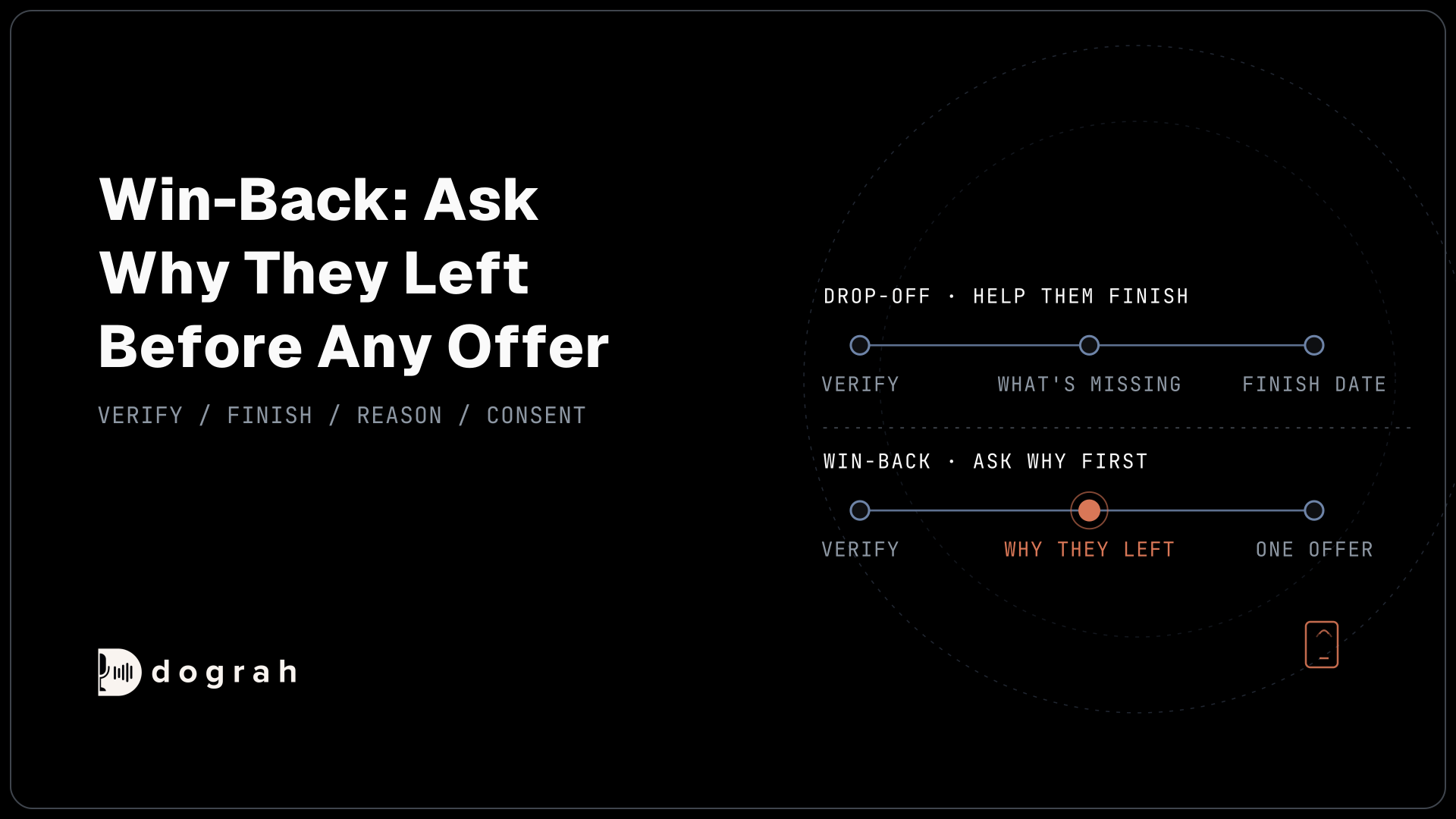
Both calls go to someone who stopped, and what they stopped decides the call. Drop-off recovery calls a person who started something and did not finish, such as an application missing a document or a booking left half done. The call helps them finish what they asked for. Win-back calls a former customer, someone who cancelled or stopped buying. That call asks them to come back, so it is a sales call from the first line.
The consent rule follows that split. Drop-off recovery that only helps the person finish what they started, with nothing new offered, is generally an informational call needing prior express consent. It becomes a sales call needing prior express written consent once it pitches something or adds an incentive, such as a discount to finish today. An abandoned cart stays a sales call, because the call invites a purchase. A current customer who might leave is neither of these. That is a renewal or retention call, covered in AI voice agents for renewals and retention.
Drop-off recovery: help them finish
The list comes from your own system: people whose application, booking or sign-up has sat unfinished for a set time, whose form gave consent to be called, and who have not opted out. Start each call from your system with the API Trigger, which dials at once and passes what is missing to the agent, or upload a weekly list to a campaign.
The call opens with the business's name and asks for the person by name. That only finds the right person. Before naming anything about their application, tell the agent in the prompt to ask for an approved check, such as date of birth or the last four digits of a reference number, because a family member may have answered.
Once verified, the agent names exactly what is missing, read from your system: "the signed lease form" or "a copy of your ID", never a guess. It explains why the item is needed and records the date the person says they will finish. If they need a link, an HTTP API tool asks your own system or messaging provider to send it by text or email.
Tell the agent in the prompt to offer nothing new, such as a discount or an upgrade. The call stays a service call only while it helps finish what the person asked for. A person who says they no longer want it is recorded as such, and your system takes them off the list.

Open Source Alternative to Vapi / Retell
Self-hosted voice agent platform — no per-minute fees
dograh-hq/dograh
Star on GitHub
Win-back: ask why they left first
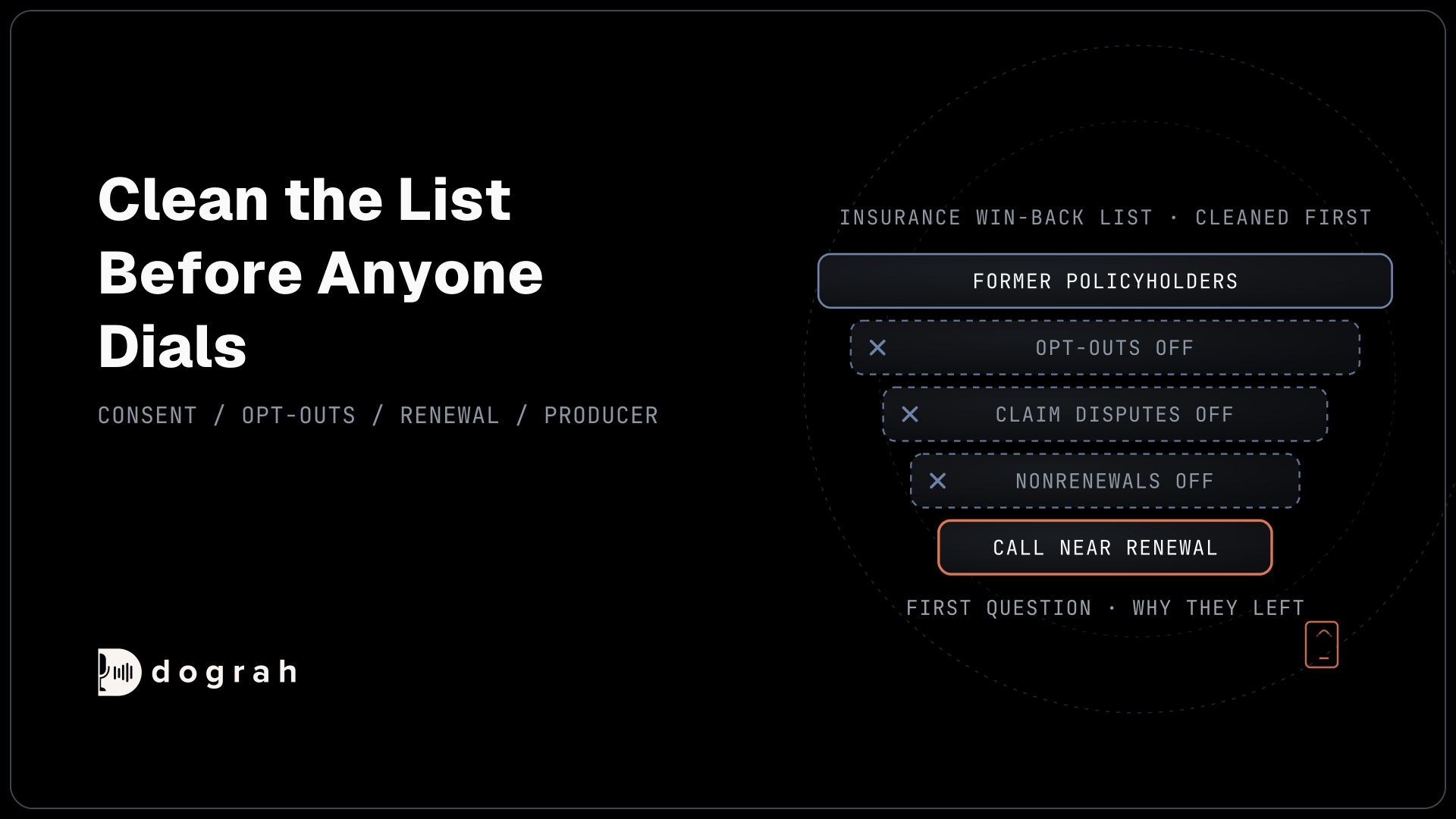
Win-back runs only on former customers whose written consent is on file in your own system. Build that list there, leave out opt-outs, and upload it to Campaigns. Former customers screen calls. Hiya's State of the Call report, a survey of more than 12,000 consumers in six countries, found 86% don't answer unknown phone numbers and 41% of unrecognised calls are left to go to voicemail. Call from your known business number, and keep any voicemail to the business's name and a number to call back.
After the verify step, the first question is why they left, asked openly and before any offer. The answer is worth having even if they never come back. Record it with variable extraction on the Agent node, as a field such as reason_for_leaving, captured as the customer stated it. Extraction is an AI step, so the transcript and recording stay the exact record.
Then the agent makes at most one offer, and only the one your system returns for that reason. A customer who left over price may hear about a lower-priced plan. Tell the agent in the prompt that a no ends the offer for good on that call. A second, bigger offer after a no turns the call into a complaint.
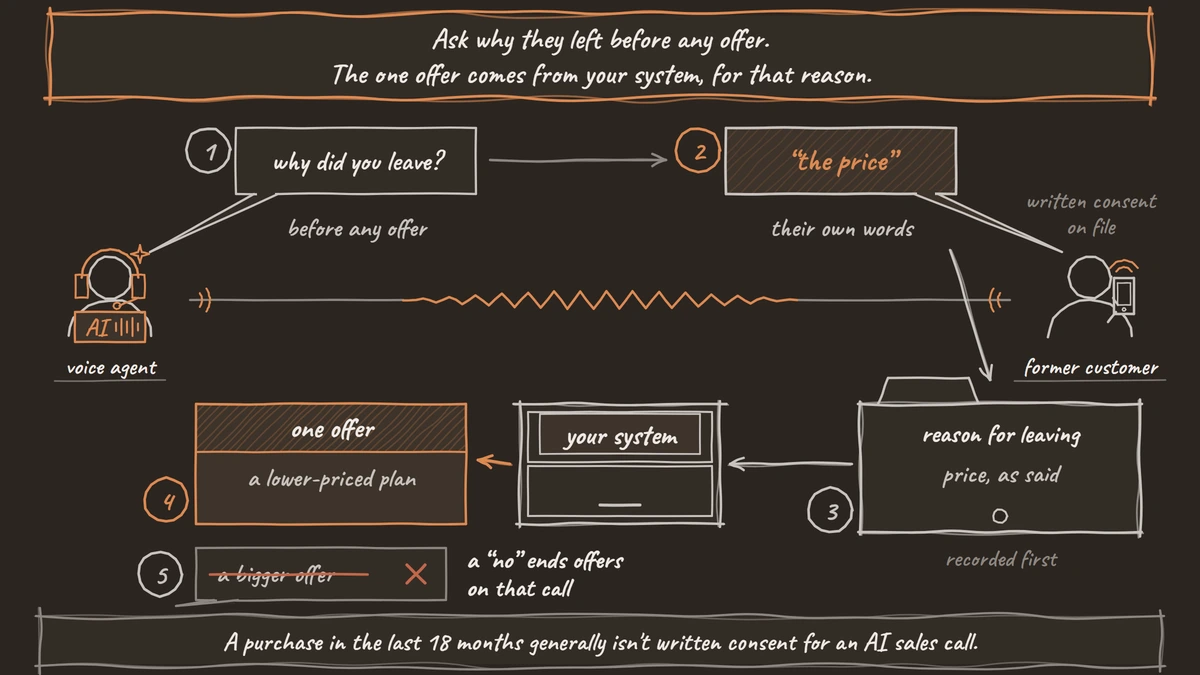
Either way, the reason goes back to your system. A Webhook node sends the call's results, {{gathered_context.reason_for_leaving}} included, once the call ends.
The consent rules for both calls
The consent line comes from the FCC's rule, 47 CFR 64.1200. This section is general information, not legal advice.
The rule bars an AI-voice call that "includes or introduces an advertisement or constitutes telemarketing" to a mobile number "other than a call made with the prior express written consent of the called party". Telemarketing is a call "for the purpose of encouraging the purchase or rental of, or investment in, property, goods, or services". A win-back call encourages a purchase, so it generally needs written consent.
Past purchases do not fill that gap. The rule defines an established business relationship "for purposes of telephone solicitations", based on a purchase or transaction within "the eighteen (18) months immediately preceding the date of the telephone call", which "has not been previously terminated by either party". That matters for the do-not-call rules; it generally does not supply written consent for an AI-voice sales call, and a cancellation may have ended it. Recorded human clips do not change this. The FCC's February 2024 declaratory ruling says a live agent choosing prerecorded messages "does not negate the clear statutory prohibition against initiating a call using a prerecorded or artificial voice".
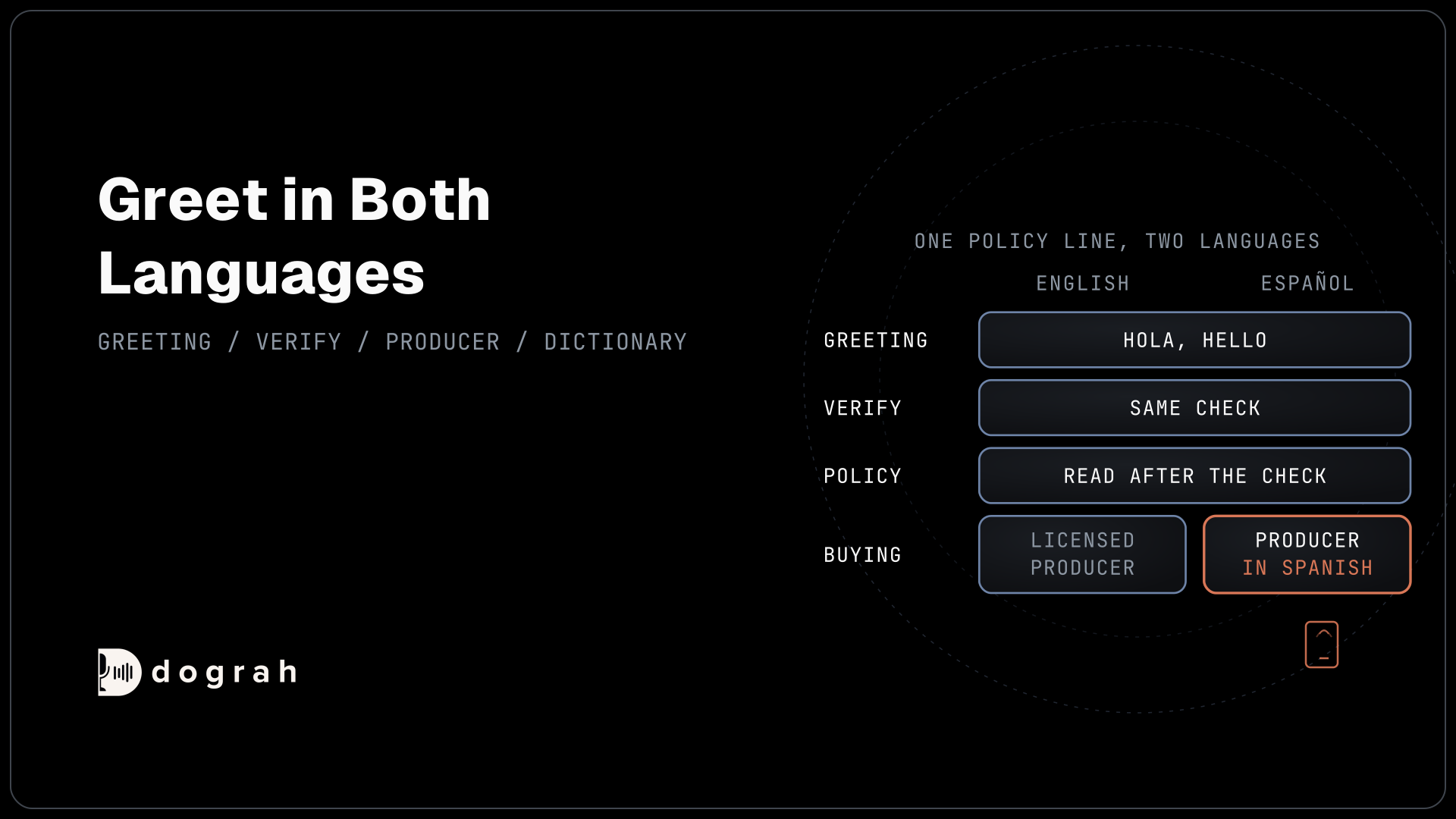
A sales call like this also has to name the business first and offer an automated opt-out "within two (2) seconds of providing the identification information". Put both in the Greeting Text, the fixed line Dograh speaks word for word as the call connects. When someone says stop, tell the agent in the prompt to write the opt-out first, then end the call with the End Call tool, whose goodbye line is fixed text or a recorded clip. Dograh keeps no do-not-call list. When a caller opts out, an HTTP API tool writes it to your own list, and you remove those numbers before the next campaign upload. The do_not_call call tag records the request but never blocks a later call.
The FCC has adopted FCC 26-67, which is not yet in effect. It says: "Revocation requests made in response to robocalls that contain an advertisement or constitute telemarketing revoke consent to all future robocalls containing an advertisement or that constitute telemarketing from that caller." Read plainly, one "stop" on a win-back call generally ends all of your AI-voice sales calls to that person, upsell calls included; our post on upsell and cross-sell covers those.
A campaign's calling hours use one time zone, so split the list by time zone. To test two openings, split the campaign between two versions of the agent. Our guide to compliant AI voice agents covers the wider rules. Confirm your position with counsel.
Self-hosted Dograh has no per-minute platform fee (servers, model keys and phone minutes still cost); Dograh Cloud has a 1¢-a-minute platform fee.
Join the Dograh Community
Dograh is an OSS alternative to Vapi. Join our Slack community for queries, releases, best practices & community interactions.
Win-back and drop-off recovery by industry
Each industry adds its own rules, such as telecom's customer-data approvals. These posts cover them:
- AI Voice Agents for Application Follow-up: applicants missing one item.
- AI Voice Agents for Abandoned-Cart Recovery: shoppers who left a cart, a sales call.
- AI Voice Agents for Missed-Call Recovery in Law Firms: callbacks to callers nobody answered.
- AI Voice Agents for Quote Follow-up in Home Services: customers with an open quote.
- AI Voice Agents for Quote Follow-up in Insurance: shoppers with an open insurance quote.
- AI Voice Agents for Win-Back in Telecom: former mobile and broadband customers.
- AI Voice Agents for Win-Back in Insurance: lapsed policyholders.
- AI Voice Agents for Gym Membership Sales & Win-Back: former gym members.
- AI Voice Agents for Churn-Risk Check-in Calls in SaaS: accounts going quiet before they leave.
- AI Voice Agents for Candidate Re-engagement: past job candidates and a new role.
Glossary
- Drop-off recovery
- A call to someone who started an application, booking or sign-up and stopped, to help them finish it. With nothing new offered it is generally informational; a pitch or an incentive generally makes it a sales call.
- Established business relationship
- Under 47 CFR 64.1200(f)(5), a relationship based on a purchase or transaction in the last 18 months, defined for the do-not-call rules. It generally does not supply written consent for an AI-voice sales call.
- Prior express written consent
- Under 47 CFR 64.1200, a signed written agreement that authorises a business to make AI-voice or prerecorded sales calls to a named phone number. A win-back call generally needs it before the first dial.
- Variable extraction
- An Agent node setting in Dograh that turns what the caller said, such as the reason they left, into named fields once the node finishes. It is an AI step, so the transcript and recording remain the exact record.