
AI voice agents for candidate re-engagement call past candidates from your applicant tracking system about a new role. The agent verifies the person, asks only whether they are interested and when they could start, and records the answers as stated. Interested candidates go to scheduling, and opt-outs are written back. Calls are limited, for example to one every 90 days.
Key Takeaways
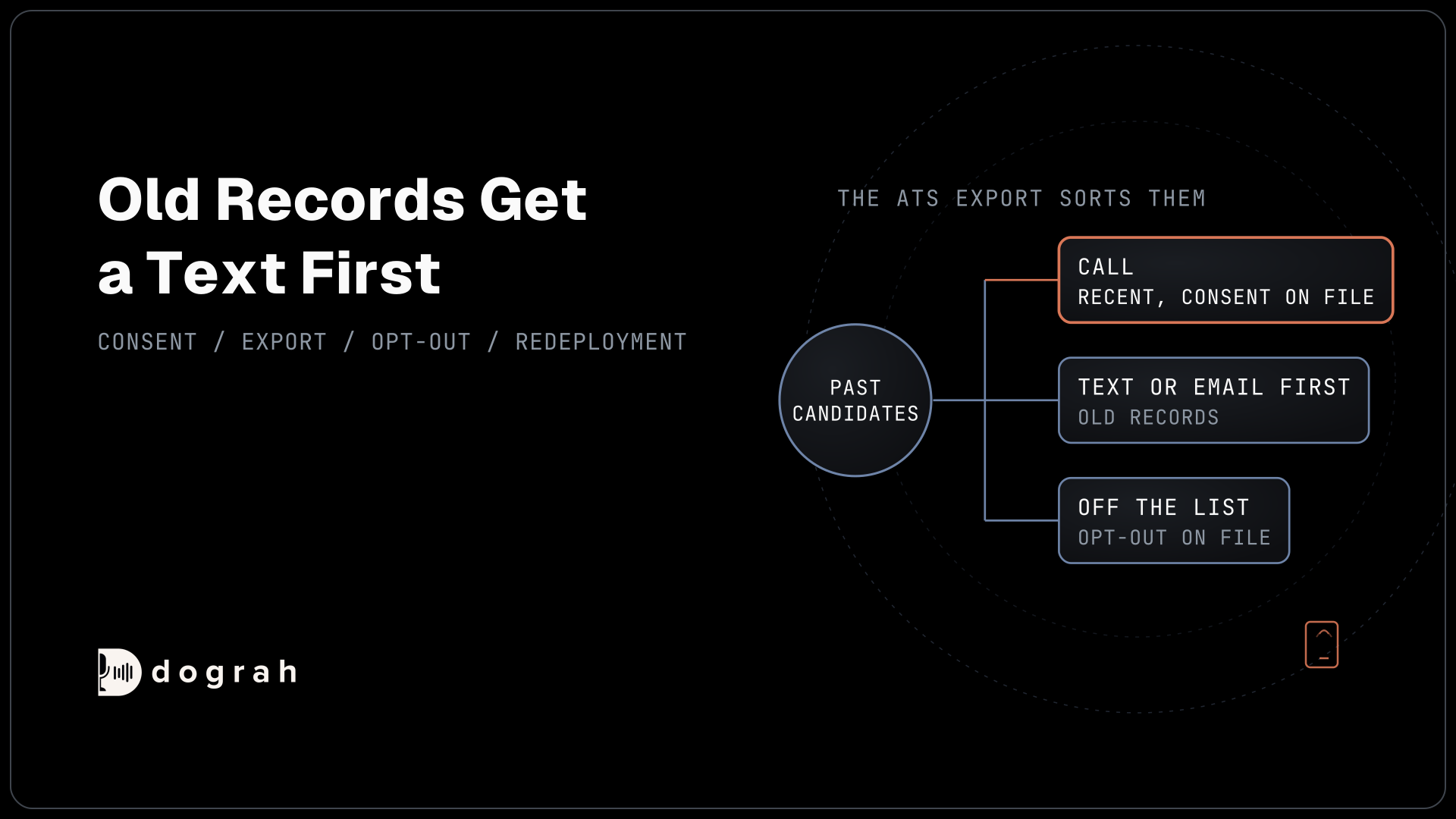
- Call recent and opted-in candidates. Old records get a text first.
- The call asks interest and availability only. It never re-screens.
- Set a call limit in the ATS export, for example one call every 90 days.
This post is part of our guide to AI voice agents for staffing and recruitment. The guide's section on calls to past candidates makes the case that an ATS full of past candidates is often the quickest source of the next placement. This post builds that call in Dograh, an open-source, self-hostable voice agent platform, from the list you export to the answer written back.
Which past candidates to call, and which to text first
The call list is the most important decision in a re-engagement campaign, and it is made in your applicant tracking system (ATS), before Dograh dials anyone.
Start from the consent flag. Export only candidates whose record shows they agreed to be contacted by phone about roles, and drop anyone called within your limit (for example, the last 90 days) or with an opt-out on file. Campaigns have no per-person call cap, so that limit has to live in the export itself.
Then split what is left. A candidate who applied in the last few months, or finished an assignment with you recently, will usually welcome a call. A record that has sat untouched for two years belongs to someone who may not remember you, and an automated call out of nowhere can feel intrusive. Send those people a text or email from your own ATS or messaging system first, and call only the ones who reply asking for a call. Dograh has no SMS tool, so that first message never comes from the agent.
The call list then goes to Campaigns as a CSV, with the role, the candidate's name, the record ID and the date of the last call as columns the agent can use. Set calling hours by weekday so calls land when people can talk, such as early evening. For one-off calls, the ATS can start each call itself through the API Trigger.
Consent comes from the original application
A call about a job opening generally rests on the consent the candidate gave when they applied, as long as the call stays about the job. This section is general information, not legal advice.
Under 47 CFR 64.1200, a call to a mobile number using "an artificial or prerecorded voice" generally needs "the prior express consent of the called party", and the Federal Communications Commission treats an AI voice as artificial. An application form that collects a phone number and says the agency will call about roles is the usual basis.
The stricter tier applies to telemarketing, which the same rule defines as a call "for the purpose of encouraging the purchase or rental of, or investment in, property, goods, or services". Offering someone work generally is not that, because the candidate is not being sold anything. A call that also pitches the agency's paid services, such as a CV-writing package, generally is, and needs prior express written consent. For candidates who never asked to hear about new roles, the guide's safe default is written consent before the first call.
Keep the call about the role, and keep the consent wording on your application forms up to date. Confirm your own position with counsel before the first campaign.

Open Source Alternative to Vapi / Retell
Self-hosted voice agent platform — no per-minute fees
dograh-hq/dograh
Star on GitHub
What the call asks, and what it never asks
The call has one job, to find out whether this person wants this role and when they could start, and it gets there only after it knows who it is talking to.
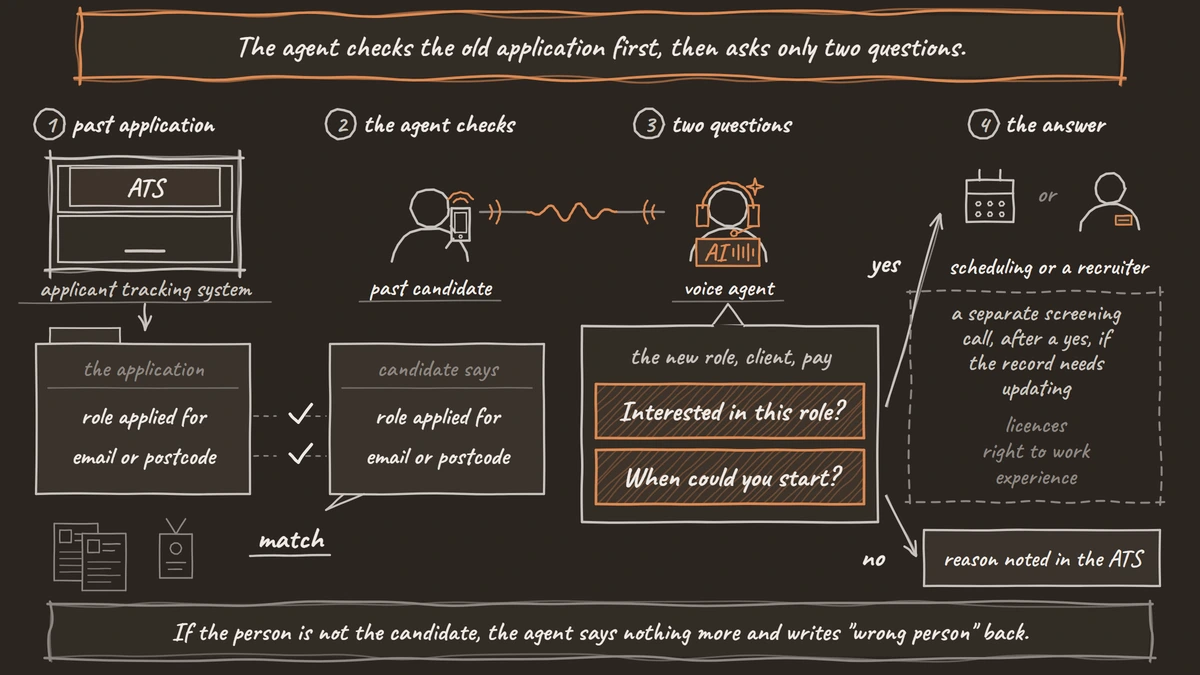
If you want to tell candidates they're speaking with an automated assistant, or your location requires it by law, write it in the Greeting Text along with the agency's name; it is fixed text, for example: "Hello, this is an automated assistant calling from Northside Staffing. This call is recorded." The agent then asks for the candidate by name. A name finds the right person but does not verify them, and numbers get reassigned. So before the agent mentions any role or client, it runs the staffing check: the candidate's name, the role they applied for last time, and the email or postcode on their application. An HTTP API tool sends those answers to your ATS to check, so the expected answers never sit in the agent. If the person is not the candidate, the agent says nothing more and writes "wrong person" back so the number leaves the list.
After the check, the agent describes the new role, including the client employer and the pay, then asks whether the candidate is interested and when they could start. Each answer lands in an extraction variable, recorded as the candidate stated it, along with any preferred location or shift they mention.
The call never re-screens. It does not ask about licences, right to work or experience again, even when the new role needs them. Those questions belong to the candidate screening call, which runs after a yes if the record needs updating. A candidate who says yes is handed to the scheduling flow, covered in AI voice agents for interview scheduling, or booked for a recruiter call. A "no" is recorded with the reason the candidate gave. How to open an outbound call so people stay on the line is the subject of The First 15 Seconds Decide Everything in AI Outbound Calls.
Redeployment: call contractors before the assignment ends
Redeployment is the warmest re-engagement call, because the contractor is already working with you and the end date is in your system.
Set the ATS to start a call through the API Trigger a couple of weeks before each assignment ends. After the same staffing check, the agent asks whether the contractor wants another assignment and from which date, and records any change they mention, such as the hours or distance they can manage. Those answers go to the recruiter, who matches the next placement.
The agent can name the current client in this call, because the contractor works there and has just been verified. It still names a new client only after a yes on interest. A contractor who wants a break is recorded as such, with the date they gave, so the next call waits for it.
Join the Dograh Community
Dograh is an OSS alternative to Vapi. Join our Slack community for queries, releases, best practices & community interactions.
Caps, opt-outs and the record
Past candidates stay open to your calls only if you call rarely and stop the moment they ask.
Set a cap, for example one re-engagement call every 90 days, counted from the last campaign that included the candidate. Retries for a busy line or no answer stay inside that campaign; Campaigns let you set up to 10 retries, and one is enough here. Retries do not reset that period.
A spoken "stop calling me" is a revocation, and there is no keypad option, so the agent writes it to the ATS during the call. Under 47 CFR 64.1200(a)(10), a person may revoke consent "by using any reasonable method to clearly express a desire not to receive further calls". FCC 26-67, an order the FCC adopted on 30 September 2026, lets callers apply some revocations only to the category of calls they were made on, once it takes effect. A simpler rule for an agency is to treat any "stop" as covering all its automated calls to that person.
When a call reaches voicemail, the message gives the agency's name and a callback number, never the role or the client, since anyone could hear it. A voicemail in an AI voice is still an artificial-voice message, so the consent rules above apply to it too.
After every call, a webhook writes the outcome to the candidate's record: interested, not now, wrong person, opted out or no answer. Webhook-Driven Voice Agents: Real-Time Data In and Out covers the payload. Self-hosting Dograh keeps the recordings and transcripts on the agency's own servers; the audio stays inside your infrastructure only when the speech and language models run there too. Self-hosted Dograh has no per-minute platform fee (servers, model keys and phone minutes still cost); Dograh Cloud has a 1¢-a-minute platform fee.
Glossary
- Re-engagement call
- An outbound call to a past candidate about a new role. It verifies the person, asks only about interest and availability, and records the answers as stated, leaving any screening to a separate call.
- Redeployment
- Placing a contractor in a new assignment as the current one ends. The call goes out from the ATS before the end date and asks about availability for the next assignment.
- Prior express consent
- The permission 47 CFR 64.1200(a)(1) requires before a call to a mobile number using an artificial or prerecorded voice, such as an AI voice. Calls that are telemarketing need prior express written consent.
- Revocation
- A person withdrawing consent to further calls. Under 47 CFR 64.1200(a)(10), any reasonable method counts, including saying so on the call, so the agent writes it to the ATS at once.