
AI voice agents for candidate screening run the first call after an application. They can say they are an automated assistant, then verify the candidate and ask the recruiter's knock-out questions about availability, location, licences and experience. Each answer is recorded as stated and sent to the applicant tracking system, which applies the recruiter's rule. The agent never scores anyone.
Key Takeaways
- The recruiter writes the knock-out questions. The ATS applies the rule.
- Every candidate hears the same closing line, whatever they answered.
- No score leaves the call, so nothing on it rates the candidate.
This post is part of our guide to AI voice agents for staffing and recruitment. The guide's section on calls before the interview names the screening call as the first conversation after an application, where the agent asks the recruiter's knock-out questions and the applicant tracking system (ATS) applies the rule. This post shows how to write those questions and run the call in Dograh, an open-source, self-hostable voice agent platform, so it records answers and never produces a score.
What a knock-out question is, and who writes it
A knock-out question asks for a fact the role cannot do without, and the recruiter writes it before the first call is made. Typical ones are "Can you work night shifts from Monday?", "Can you get to the site for a 6 a.m. start?", "Do you hold a current forklift certificate?" and "How many years have you worked in a warehouse?".
Each question has a rule beside it in the ATS, such as "night shifts: must be yes". The agent never sees the rule, only the question and the field to fill.
Ask only what the role needs, and nothing that touches age, health, family plans or religion. Location is asked as travel ("how far can you travel to the site?"), because Illinois names zip codes as a proxy that may not be used in AI hiring decisions. The postcode on the application is used only to confirm who is speaking.
Fixed questions are also what the best evidence supports. In the field experiment by Brian Jabarian and Luca Henkel, with about 70,000 applications and recruiters making every hiring decision, the authors traced the better outcomes of AI-led interviews to questions asked in a more structured and consistent way. For a worked example with one role, see AI Voice Agents for Delivery Driver Recruitment Screening.
How the screening call runs
The call has four parts in a fixed order: the greeting, the identity check, the questions and a closing that is the same for everyone.
If you want to tell candidates they're speaking with an automated assistant, or your location requires it by law, write it in the Greeting Text along with the agency's name in the Start Call node, which Dograh speaks word for word: "Hello, this is Northside Staffing's automated assistant. This call is recorded." It plays before verification, so it names the agency and nothing about the application. The agent then asks for the candidate by name. That finds the right person. It does not prove who they are.
The check comes next. The candidate confirms the role they applied for and the email or postcode on the application, and the agent compares both with the record. Only after a match does the agent mention the client employer or the pay rate. On an inbound line, Pre-Call Data Fetch set to "Inbound calls only" loads the application behind the caller's number when the call connects, and the check still runs. An outbound callback needs the consent covered in the guide, collected on the application form.
Candidates notice when the AI is hidden. In the Greenhouse 2026 Candidate AI Interview Report, a survey by a company that sells hiring software, 21% of US job seekers surveyed (1,200 of 2,950 across five countries) found out an AI was involved only after the interview had started, and 46% wanted the option to request a human interview. So the agent offers a recruiter right after the check: "If you would rather speak to a recruiter, say so at any point."
Then the questions, one at a time. Each answer lands in an extraction variable, recorded as the candidate stated it. A candidate who says "I had one, it ran out in March" is recorded with those words, never squeezed into a yes or a no. Extraction is an AI step, so the transcript and recording stay the exact record.
The agent asks every question, even after an answer that fails the rule. Ending the call early would tell the candidate the result.

Open Source Alternative to Vapi / Retell
Self-hosted voice agent platform — no per-minute fees
dograh-hq/dograh
Star on GitHub
Where the knock-out rule lives
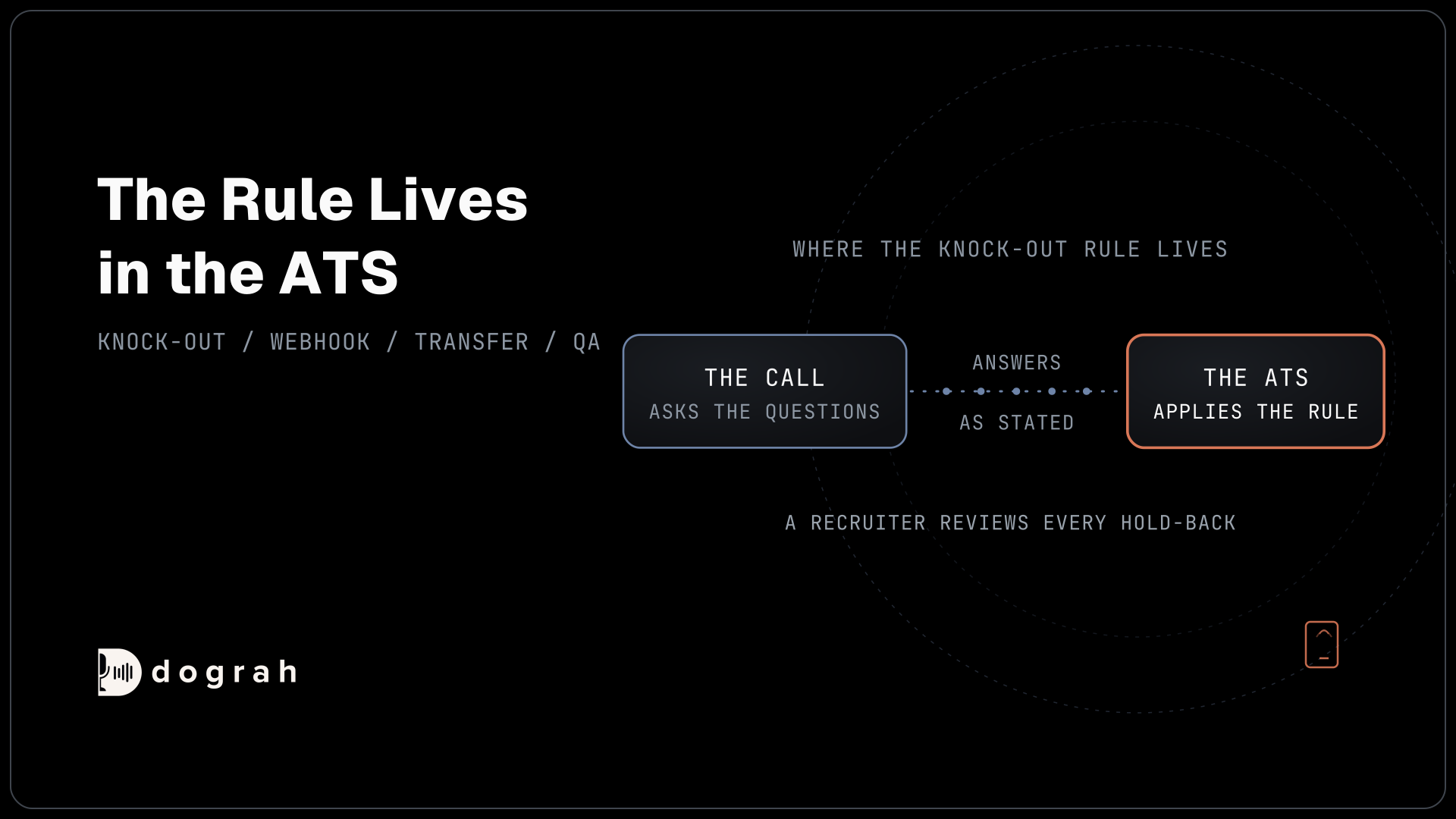
The rule lives in the ATS, because a written rule applied to recorded answers behaves the same way on every call.
In Dograh, the AI chooses the next pathway by reading the condition written on it. That suits a conversation and does not suit a hiring rule. A pathway such as "no certificate, end the call" would let the model decide who moves on, and the call would show the outcome.
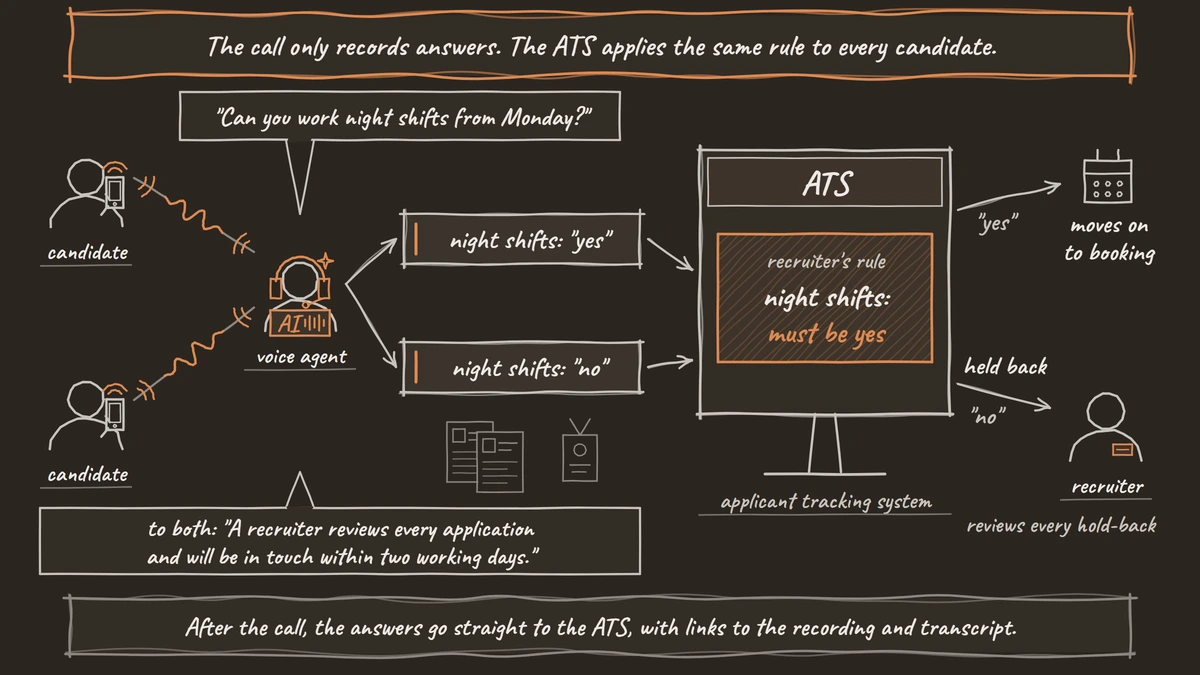
When the call ends, a webhook sends the answers to the ATS, with links to the recording and the transcript. A temporary failure, such as a timeout, is retried automatically up to five times. A wrong URL or credential is not retried, so test the endpoint before the line goes live.
The ATS applies the recruiter's rules and moves an application on or holds it back. A recruiter reviews every hold-back before anyone is turned down. Booking happens after that, in the scheduling flow described in AI voice agents for interview scheduling. Some teams book on the same call when the ATS can reply at once. That works, but the candidate who is not offered a slot hears the verdict in its absence.
A call to a past candidate about a new role never repeats the screen, as AI voice agents for candidate re-engagement explains.
Why the call produces no score
A score is where a call that collects answers turns into a tool the law treats as part of the decision. This section is general information, not legal advice.
NYC Local Law 144 covers automated employment decision tools (AEDTs), tools whose score, classification or recommendation substantially assists a hiring decision. An employer or agency may use one only if it has been "subject to a bias audit within one year of the use of the tool", and candidates must get notice 10 business days before use. Scoring is a real feature some buyers want, and it comes with these duties. Generally, a call that returns only the candidate's answers, with a written rule and a person deciding, is a different design.
A score can slip in through the back door. Dograh's QA node scores each step of the agent's own conduct, so write its prompt about the agent, such as whether it read the questions as written, and never ask it to judge the candidate's fit. Keep extraction variables to answers too. A field called "suitability" is a score with another name.
State rules point the same way. Illinois has required notice when AI is used in recruitment and hiring since 1 January 2026, and Colorado's SB26-189, whose duties start on 1 January 2027, adds notice and explanation duties for automated tools that shape employment decisions. They keep changing, so confirm your own position with counsel.
Join the Dograh Community
Dograh is an OSS alternative to Vapi. Join our Slack community for queries, releases, best practices & community interactions.
What the candidate hears when an answer does not fit
The candidate hears the same ending as everyone else, because a verdict from a machine is the one thing this call must never give.
The closing is fixed: "Thank you. A recruiter reviews every application and will be in touch within two working days." A candidate who asks "Did I pass?" hears that a recruiter makes that call. A candidate who corrects an earlier answer has the correction recorded, and the transcript keeps both.
A candidate who asks for a person is put through to a recruiter with Transfer Call, which works on Twilio only and passes no summary, so the agent writes the answers to the ATS first. If nobody picks up within 30 seconds (the default), the candidate stays with the agent, which writes a callback request to the ATS through an HTTP API tool. A candidate who asks not to be called again has that written to the ATS during the call.
Reading the first weeks of calls
Read the transcripts with the recruiter who wrote the questions before you trust the line.
A QA node samples calls at a rate you set and tags each step, and Automated QA for Voice Agents covers how to read the results. Look for questions reworded into leading forms, answers forced into a yes or a no, a closing that hints at a result, and any candidate who asked for a person and did not get one.
Self-hosting Dograh keeps recordings and transcripts on the agency's own servers. The audio stays inside your infrastructure only when the speech and language models run there too. Dograh has no retention setting, so your own policy decides how long records are kept. Self-hosted Dograh has no per-minute platform fee (servers, model keys and phone minutes still cost); Dograh Cloud has a 1¢-a-minute platform fee.
Start with an inbound screening number on the job ad, where the candidate dials you. Add outbound callbacks once the consent wording on the application form is settled.
Glossary
- Knock-out question
- A screening question about a fact the role cannot do without, such as a current certificate. The agent asks it and records the answer; the recruiter's rule for it lives in the ATS.
- Extraction variable
- A field Dograh fills from the conversation, such as the candidate's answer about night shifts. Extraction is an AI step, so the transcript and recording stay the exact record.
- Automated employment decision tool (AEDT)
- NYC Local Law 144's term for a tool whose score, classification or recommendation substantially assists a hiring decision. Using one in New York City needs a bias audit within a year of use and notice to candidates.
- Applicant tracking system (ATS)
- The hiring system that holds each application and the recruiter's rules. It receives the call's answers by webhook and decides, with a recruiter, whether an application moves on.