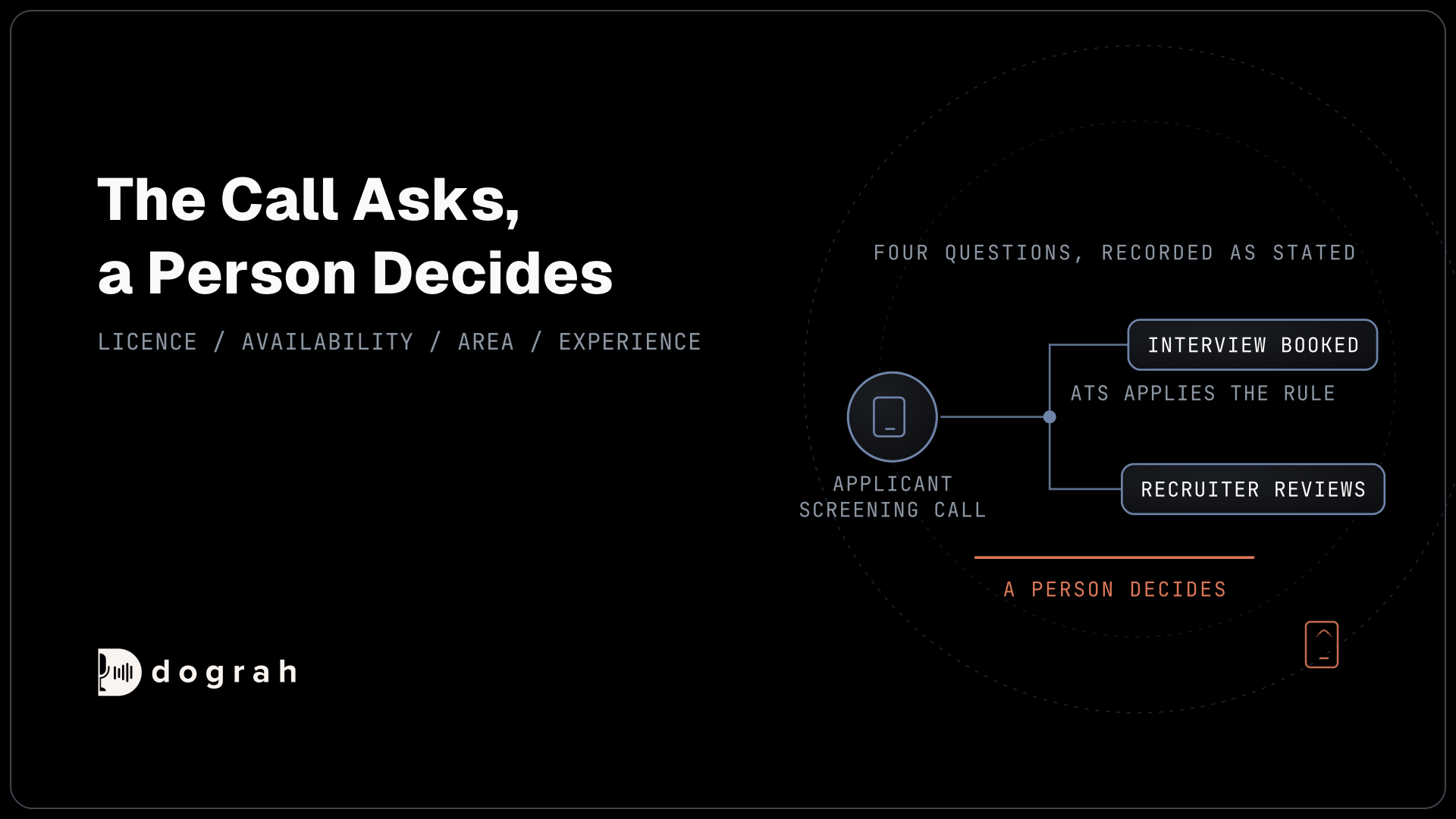

An AI voice agent for delivery driver recruitment screening takes or returns an applicant's call at any hour, asks about licence type, availability, working area and experience, and records each answer as the applicant stated it. Applicants who meet the employer's rules get an interview booked on the call. The agent never makes the hiring decision.
Key Takeaways
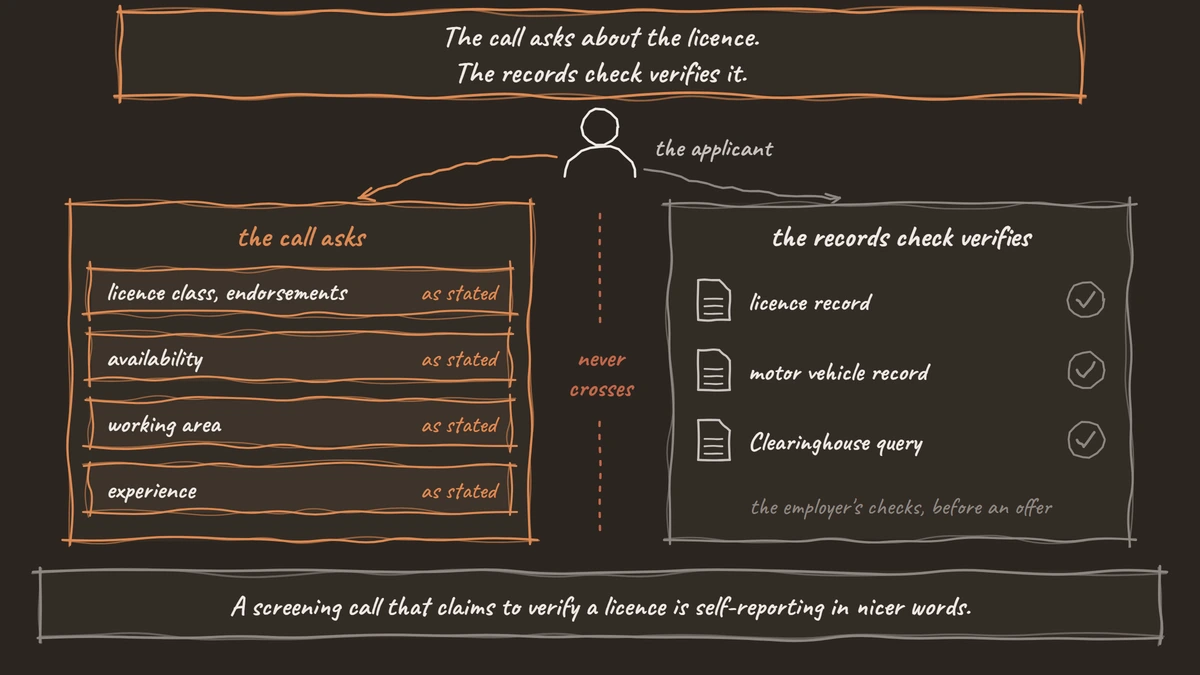
- The call asks about the licence. The records check verifies it.
- Tell applicants an AI is screening, and keep the transcript and recording.
- The applicant tracking system applies the rules. A person decides.
This post is part of our guide to AI voice agents for logistics and delivery. The guide's section on calls to drivers covers the screen that asks licence type, availability, area and experience, books the interview, tells applicants an AI is on the line and never makes the hiring decision. This post is that screen in detail. In Dograh, an open-source, self-hostable voice agent platform, the screen is one flow, and every answer is recorded as the applicant stated it.
Why driver applicants never get the callback
A delivery driver applies at the end of a shift, and the recruiter calls back during the next one. The applicant is driving, the voicemail goes unanswered, the recruiter tries once more the following afternoon, and by then another fleet has made an offer. Hiring drivers is a race to the first real conversation, and recruiters who work office hours start that race late.
A voice agent removes the schedule from the problem. The simplest design is inbound: the phone number on the job ad is the screening line, so an applicant who finishes a route at 11 p.m. calls it, answers the questions and leaves with an interview time. A callback to the applicant's mobile also works, with one condition. An outbound call made with an artificial voice generally needs the applicant's prior express consent, which the application form captures when it asks for a phone number and says a call will follow. The post on US consent rules for delivery calls sets out where that line sits.
Who is hiring shapes the questions. A parcel fleet screens for a standard licence and a local radius. A carrier screens for a commercial driver's licence (CDL) with endorsements and a lane preference. The post on AI voice agents for freight and trucking covers the carrier side of the business.
Four questions the call can ask, and what it cannot verify
The screen asks four things, and it records what the applicant says rather than deciding what it means. Before any of them, the call runs greet, verify, disclose: the agent names the company and the purpose, confirms the applicant's name and the reference or phone number from the application, and only then reads back any detail of the application.
The four questions are the licence (class and endorsements, such as hazardous materials, tanker or doubles), availability (days, nights, weekends and a start date), the working area (a home depot, a radius or preferred lanes) and experience (years, equipment driven, the kind of delivery work). In Dograh, each answer is an extraction field on the Agent node. Extraction is an AI step, so the field holds the answer as the applicant stated it, and the transcript and recording stay the exact record. Add the endorsement names, depot names and route names to the agent's dictionary so "HazMat" and "Northside depot" are heard as the words they are.
What the call cannot do is verify any of it. An applicant who says "Class A, tanker endorsement, clean record" has made a statement, and the licence record, the motor vehicle record and the Drug and Alcohol Clearinghouse query are the employer's checks to run before an offer. A screening call that claims to verify a licence is describing self-reporting in nicer words. Ours says what it is: the applicant's answers, recorded, with the checks to follow.

Open Source Alternative to Vapi / Retell
Self-hosted voice agent platform — no per-minute fees
dograh-hq/dograh
Star on GitHub
Tell applicants an AI is screening, then keep the records
Two duties follow the applicant through the whole call, and both are easier when they are built in rather than bolted on. The first is notice. The greeting is fixed text in the Start Call node, so it always says the same thing: this is an automated screening call for the company, it is recorded, and a recruiter will review the answers. Several US states now expect an applicant to be told when an automated system is used in a hiring decision, and the states' rules differ, so the FAQ below gives the detail and the dates. The prose version is simpler. Say it on every call, in the first ten seconds.
The second duty is the records. The transcript, the recording and the extracted answers are employment records produced by what California calls an automated-decision system (ADS), and some states say how long they must be kept. Self-hosted Dograh writes all three to your own storage, so your retention policy, not a vendor's, decides when they are deleted. When the speech and language models also run on your servers, the audio never leaves your infrastructure. With hosted model keys the contract moves, and the audio still reaches the model provider.
Generally, an employer that tells applicants about the screen, keeps the records and can show that the questions do not sort people by a protected characteristic is in a defensible position. The duties come from state statutes and regulations, so confirm your own position with counsel before the line goes live. The Illinois summary by Fisher Phillips, the text of Colorado SB26-189 and the California Civil Rights Council's regulations are the places to start.
The call never makes the hiring decision
The agent records answers, and the employer's own system applies the rules. A knockout question, such as "do you hold a Class A licence?", produces a recorded fact. Whether a "no" ends the application is a consequential decision, in Colorado's words, and the rule behind it belongs to the employer, in the applicant tracking system (ATS), not in the agent. Dograh's AI picks the next pathway from written conditions, which is right for a conversation and wrong for a hiring rule, so the agent sends the answers to the ATS through an HTTP API tool and lets the ATS reply with "book an interview" or "route to a recruiter". A person reviews every application the ATS does not advance, and the applicant is told a recruiter will be in touch, never given a verdict by a machine.
Two design rules fall out of the law. The working area is asked as the applicant's own radius or home depot, and the agent never infers anything from a postcode, since Illinois names zip codes as a proxy it will not accept. And when an applicant is not advanced, the system can produce a plain explanation of what the automated step did, because Colorado will expect one on request from 2027. Both are easier to build on day one than to retrofit.
Join the Dograh Community
Dograh is an OSS alternative to Vapi. Join our Slack community for queries, releases, best practices & community interactions.
Book the interview before the call ends
An applicant who meets the rules should leave the call with a time, not a promise. When the ATS replies "advance", the agent books the interview inside the call through an HTTP API tool, either against Calendly's API or directly against the ATS calendar, and the post on Booking Meetings Mid-Call With Calendly Integration shows the mechanics. The agent reads the slot back, the applicant confirms it, and the confirmation goes out as a text, sent by your messaging provider when the agent's HTTP API tool calls it.
After the call, a webhook node sends the ATS the four answers, the slot, the recording link and the extracted variables. A temporary failure is retried automatically, up to five attempts, while a wrong URL or credential is not, so test the endpoint before the line goes live, acknowledge fast and process the record on your side.
Applicants who are not advanced get the same courtesy in fewer words: thanks, a recruiter will review, and the callback number. Once an applicant becomes a driver, the rules change again, since the next calls reach a person who may be behind the wheel, and the post on driver and dispatch callbacks covers how those calls are kept short and hands-free.
The first number to watch is how many applicants who applied after 6 p.m. had an interview on the calendar before 9 a.m. the next day. If that climbs, the line is doing the one job a recruiter's diary could not.
Glossary
- knockout question
- A screening question whose answer, by the employer's own rule, ends the application. The agent records the answer; the applicant tracking system applies the rule.
- consequential decision
- Colorado's term for a decision that relates to a person's access to employment and other listed areas. It brings notice duties when an automated system is involved.
- automated-decision system (ADS)
- California's term for a computational process that makes or facilitates a decision about an employment benefit. Its records must be kept for a set period.
- prior express consent
- The TCPA consent tier that generally covers an outbound call made with an artificial voice to an applicant's mobile number.