
In the US, an AI voice agent calling a mobile number about a delivery needs prior express consent unless an exemption applies. The package-delivery exemption covers a package delivery company under tight conditions, so shippers, retailers and 3PLs should generally rely on consent captured at checkout. An upsell raises the consent tier. General information, not legal advice.
Key Takeaways
- The FCC treats an AI voice as an artificial voice under the TCPA.
- The package-delivery exemption is written for the carrier, under seven conditions.
- One offer inside a delivery call changes the consent you need.
This post is part of our guide to AI voice agents for logistics and delivery. It explains when a US delivery call needs consent, who the package-delivery exemption actually covers, and what to build into a Dograh agent so it stays on the right side of both. It is general information, not legal advice. The flows themselves are built in Dograh, an open-source, self-hostable voice agent platform; this post is about the rules they have to follow.
What the law says: an AI call to a mobile needs consent
The Telephone Consumer Protection Act (TCPA) is the US law on automated calls, and one rule in it decides everything else in this post. Under 47 U.S.C. 227(b)(1)(A), it is unlawful "to make any call (other than a call made for emergency purposes or made with the prior express consent of the called party) using any automatic telephone dialing system or an artificial or prerecorded voice" to a mobile number.
This matters to a delivery operation because a voice agent is an artificial voice. The Federal Communications Commission (FCC) said in a 2024 ruling that the TCPA's words "encompass current AI technologies". So, generally, every outbound delivery call to a US mobile number needs one of two things before it is placed: the called person's prior express consent, or an exemption that fits the call.
The rules also say how the call must open. Under 47 CFR 64.1200(b), the message must "state clearly the identity of the business" at the start and give a telephone number during or after it. In a Dograh agent, put the company name and a callback number in the Start Call node's Greeting Text, an optional fixed line spoken word for word the moment the call connects. If it's left empty, the language model writes the opening, so set it. Type the company name as plain text and give any variable a fallback such as {{customer_name | there}}, or a missing value is read aloud as the raw placeholder.
The delivery exemption is for carriers, not shippers
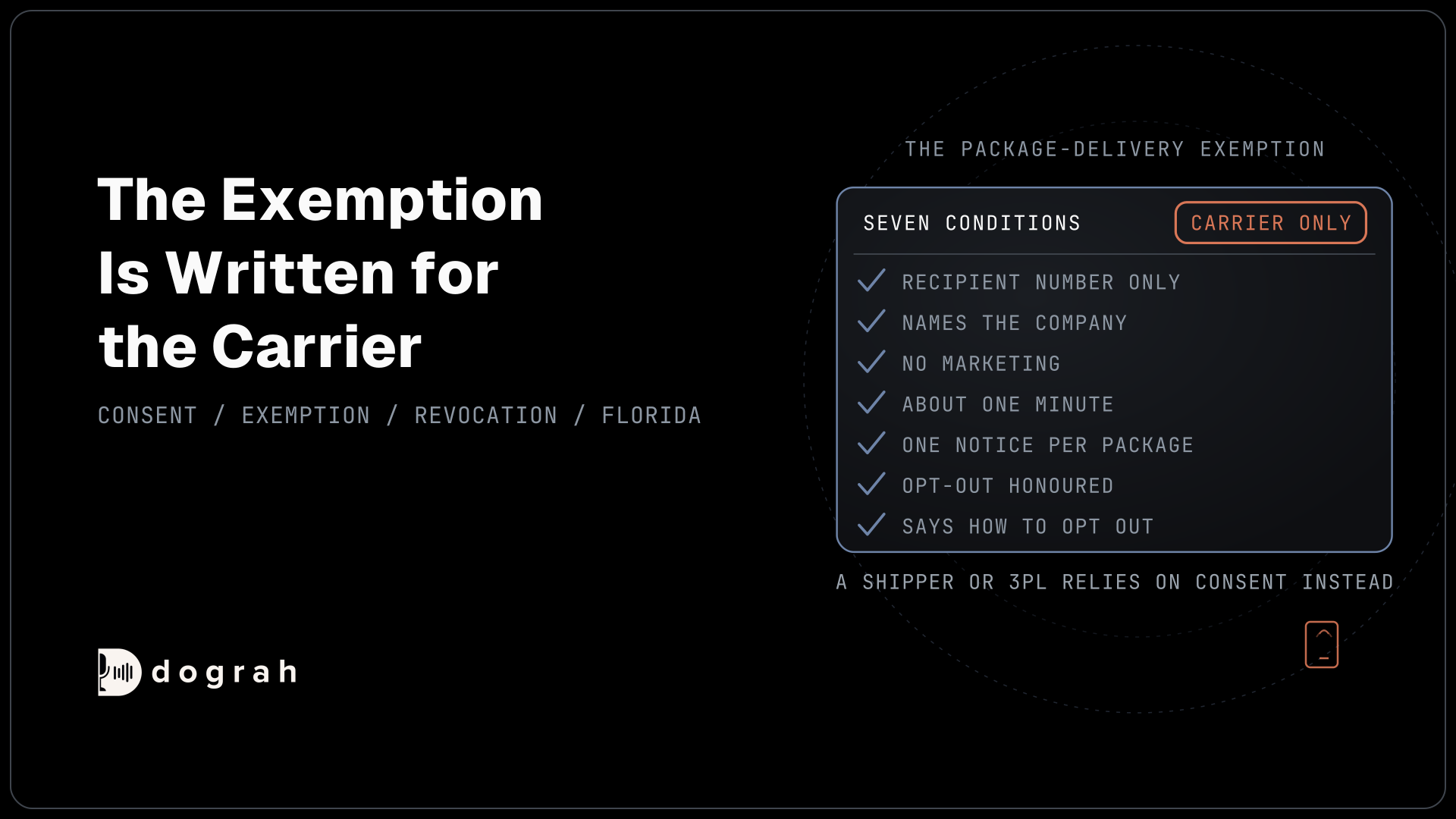
The FCC wrote one exemption for delivery calls, and most readers of this post are not the company it names. Under 47 CFR 64.1200(a)(9)(i), calls "made by a package delivery company to notify a consumer about a package delivery" need no prior consent, as long as the call is free to the recipient and seven conditions hold.
The seven conditions, in plain words. The notice goes only to the recipient's number. It names the delivery company and gives its contact details. It contains no marketing. It is short, "generally one minute or less in length for voice calls". It is sent once per package, with one extra attempt allowed when a signature is required and the recipient was out. It offers an opt-out and honours it within six business days. And every notice says how to opt out.
Two things follow. First, the exemption is written for the carrier. A retailer that sold the goods, a shipper that booked the freight or a third-party logistics provider (3PL) running the warehouse is generally not "a package delivery company", so the exemption does not cover their calls. Second, a call that offers a new window or a safe place and takes an answer is a conversation, which sits outside a one-minute, one-per-package notice.
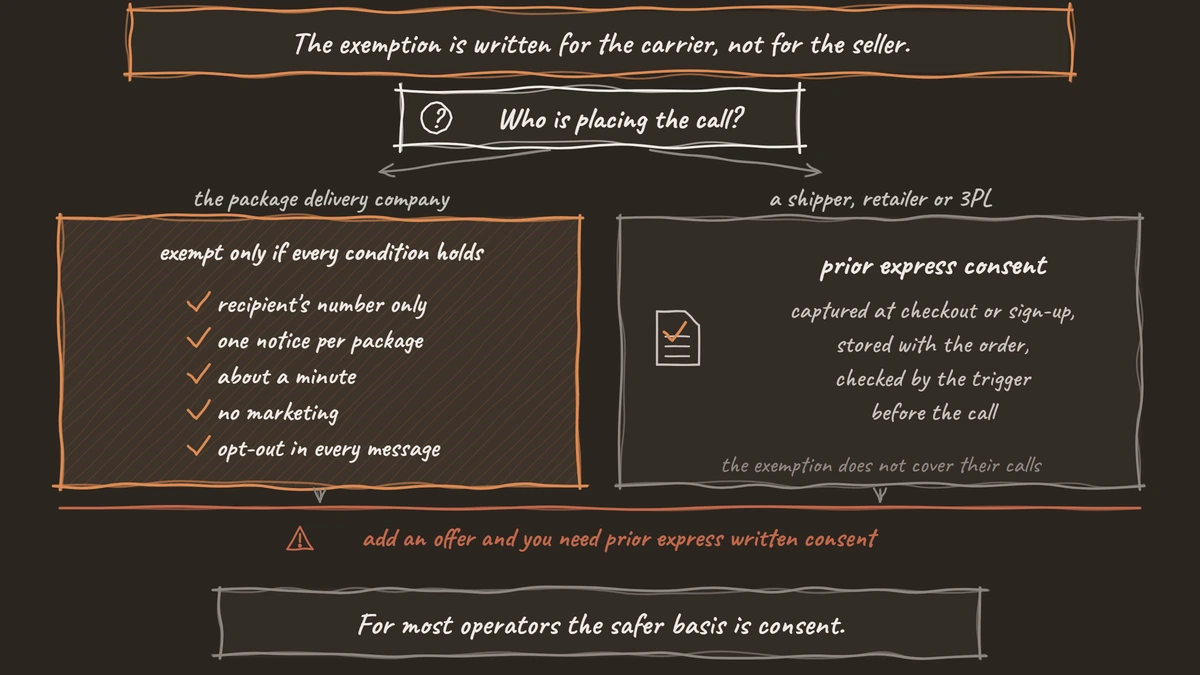
So for most operators the safer basis, generally, is consent. Capture prior express consent for delivery calls at checkout or at account sign-up, in words that cover calls as well as texts, and store it where the agent's trigger can read it. Either way, confirm your own position with counsel; this is informed commentary, not a verdict.
Informational or marketing: the sentence that changes the tier
Consent comes in two tiers, and one clause moves a call between them. Under 47 CFR 64.1200(a)(2), a call that includes or introduces an advertisement or constitutes telemarketing to a mobile number requires "the prior express written consent of the called party". A plain delivery update is informational and rests on prior express consent. The moment the agent adds "and while I have you, we can add insurance for four dollars", the call includes an advertisement and generally needs the written tier, and if you were relying on the package-delivery exemption, the no-marketing condition is gone with it.
The practical rule is to keep the two call types in separate agents. The delivery agent updates, reschedules and confirms, and never sells. In a Dograh agent, the language model you choose writes each reply from the node's prompt, so the surest way to keep an offer out of the delivery agent is to give that agent no product information to offer and no tool that could add one. Then tell it in the prompt never to suggest purchases, and check the transcripts with a QA node.

Open Source Alternative to Vapi / Retell
Self-hosted voice agent platform — no per-minute fees
dograh-hq/dograh
Star on GitHub
Revocation and what the agent must do with it
A called party can take consent back by saying so, and the agent has to hear it. Under 47 CFR 64.1200(a)(10), consent may be revoked "by using any reasonable method to clearly express a desire not to receive further calls or text messages", and a request made during a call counts.
Build for it. Give the delivery agent an extraction field for a revocation request, so the AI records that the caller asked for no more calls, as the caller stated it, with the transcript as the exact record. Send that field to your order system by webhook after the call and have the trigger check it before any further call. The broader "revoke-all" portion of the rule, under which one revocation covers unrelated messages from the same caller, was narrowed by the FCC in September 2026; the detail and the effective date are in the FAQs. Treating every revocation as covering every call type is still the simpler build and the safer one.
State rules: Florida as the example
Several states have their own calling laws, and Florida's shows how they bite. Under Fla. Stat. 501.059(8)(a), "A person may not make or knowingly allow to be made an unsolicited telephonic sales call if such call involves an automated system for the selection and dialing of telephone numbers or the playing of a recorded message when a connection is completed to a number called without the prior express written consent of the called party." The statute defines a "telephonic sales call" as a call, text or voicemail made "for the purpose of soliciting a sale of any consumer goods or services".
A delivery update that sells nothing is generally outside that definition. An offer inside it is generally inside. The same clause that changes the federal tier changes the state one. A growing number of states have laws of this shape, with their own hours and frequency limits, so the honest instruction is to check the statute for each state you deliver into, and to let the trigger logic hold the per-state rules rather than the agent.
Join the Dograh Community
Dograh is an OSS alternative to Vapi. Join our Slack community for queries, releases, best practices & community interactions.
What the scale looks like, and what to build
The rules exist because the volume is enormous. The Pitney Bowes Parcel Shipping Index puts 2025 US parcel volume at 67 parcels per person and 171 per household, which works out to 732 parcels generated every second. A notice with no decision attached is a text your delivery system sends. The call is for the moment a decision is needed: a new window, a safe place, an address that does not resolve.
The build follows the law. Store the consent flag with the order and check it in your trigger logic before the API Trigger starts a call, so an unconsented number is never dialled; the pattern is in API Triggers: Start a Voice Agent Call From Any System. Put the company name and a callback number in the Start Call node's Greeting Text. Verify the caller before any shipment detail is spoken; the phone number found the record and does not prove who answered. Add the revocation extraction field and the webhook write-back. Keep the delivery agent sales-free.
Two clusters in this guide carry the calls themselves: AI voice agents for delivery delay and exception alerts for the outbound delay call, and AI voice agents for delivery coordination for the pre-dispatch window call. The general TCPA treatment, and the debt-collection rules that sit beside it, are in AI Voice Agents for Fraud-Alert Callbacks and AI Voice Agents for Debt Collection.
Glossary
- prior express consent
- The consent tier the TCPA requires for an automated or artificial-voice informational call to a mobile number. For delivery calls it is usually captured at checkout or sign-up.
- prior express written consent
- The higher tier 47 CFR 64.1200(a)(2) requires when a call includes or introduces an advertisement or constitutes telemarketing.
- package-delivery exemption
- The rule in 47 CFR 64.1200(a)(9)(i) that lets a package delivery company notify a recipient without prior consent, under seven conditions including one notification per package and no marketing.
- revocation
- A called party's request to stop receiving calls or texts, valid by any reasonable method, including a spoken request during the call.