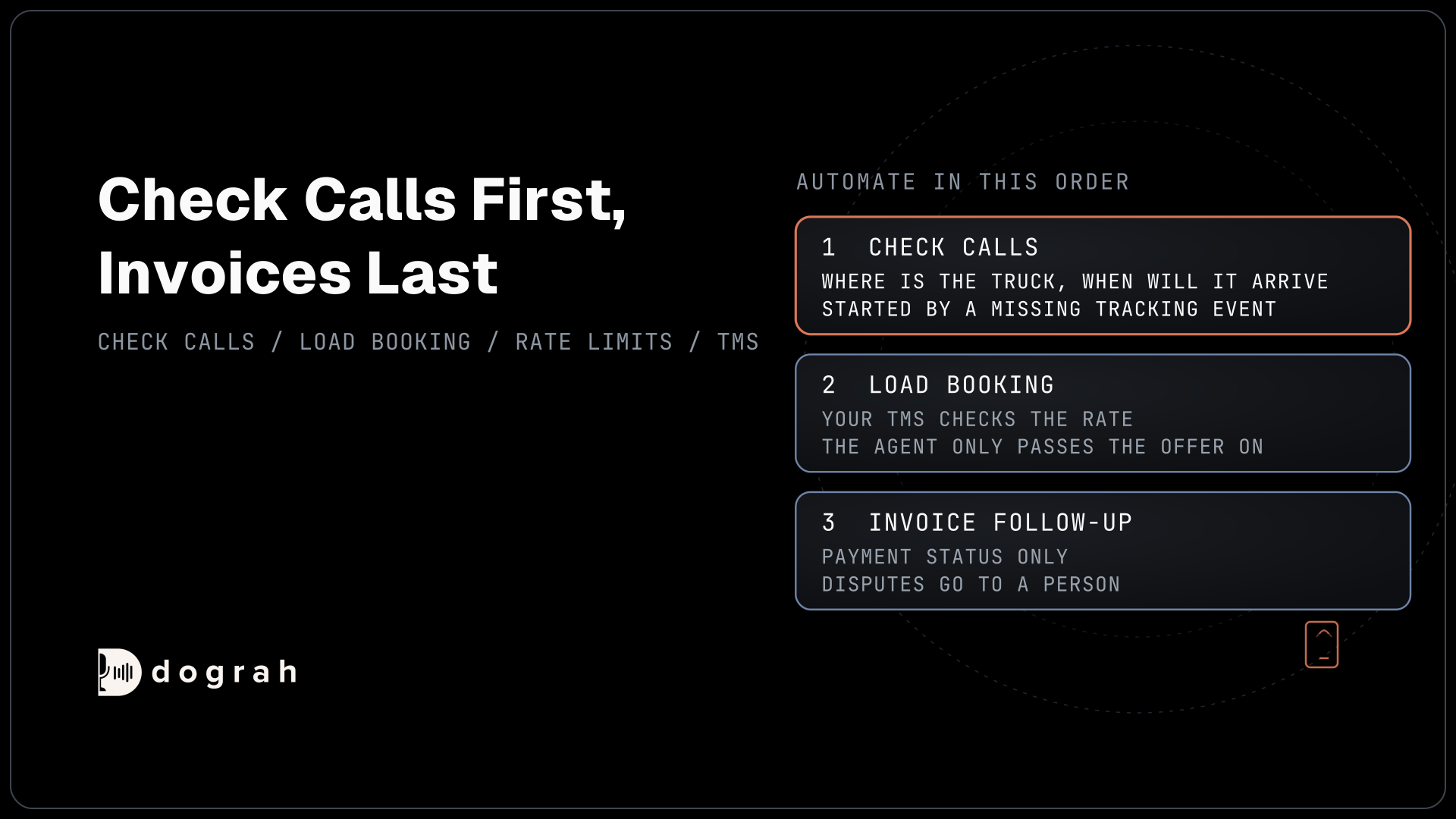

AI voice agents for freight and trucking take three kinds of call: carrier check calls, load booking requests and invoice follow-up. Automate them in that order: check calls are structured and start from a missing tracking event, while load booking needs the broker's rate limits checked by its own transportation management system (TMS). Every exception goes to a person.
Key Takeaways
- Check calls first: structured, high volume, started by your transportation management system (TMS).
- The rate rule lives in your system, never in the agent's prompt.
- Enterprise freight voice AI serves the ten largest brokers. Everyone else can self-host.
This post is part of our guide to AI voice agents for logistics and delivery. The guide notes that brokers and carriers live with check calls, load booking requests and invoice follow-up. This page takes those three calls in the order a freight desk should automate them. Each of the three is a short flow in Dograh, an open-source, self-hostable voice agent platform, reading your TMS during the call and writing the carrier's answer back to the load.
Three calls run a freight desk
A freight desk is a phone operation with a transportation management system (TMS) attached, and the phone side has three recurring shapes. The broker calls the carrier to ask where the truck is. The carrier calls the broker to ask for a load, or the broker calls to offer one. And after the load delivers, someone calls about the invoice.
Each call is paid for out of a margin that keeps shrinking. The American Transportation Research Institute (ATRI) puts the cost of running a truck in 2025 at a record $2.336 per mile, so a driver pulled over to take a status call, or a dispatcher who spends the morning on them, is costed against miles not driven. Our post on AI voice agents for carrier check-calls and load updates takes that cost apart. Here I only want to rank the three calls.
The ranking is by how safely each one automates. A check call moves information and commits nothing. A load booking call commits money. An invoice call touches money that has already moved. That order, check calls first and invoices last, is the rest of this post.
Start with carrier check calls
Check calls are the right first call because they are structured, there are a lot of them, and your TMS already knows when one is needed. A truck that has not produced a geofence event at the pickup by the time it should have is the trigger. The TMS sees the gap and starts the call through the API Trigger, with the load number and the appointment time in the initial context, so the agent opens the call already knowing what it is asking about.
The call itself is short. The agent greets the dispatcher or the driver, confirms the load number, or the carrier's PRO number, before it says anything else about the load, and asks two things: where is the truck, and when will it arrive. Both answers are recorded as extracted variables, as the carrier stated them, and written to the load by webhook. If what the carrier says does not match the GPS, the agent does not pick a winner. It flags the conflict for a person.
This is production practice at the top of the market. C.H. Robinson reports that two AI agents now automate 95% of its checks on missed less-than-truckload (LTL) pickups, saving more than 350 hours of manual work a day across more than 11,000 customers, with the agents making 100 calls and 100 decisions at once. Those are the company's own figures, and the scale is the point: a check call is a call a machine can make all day without the carrier noticing a difference in the question.
Load booking comes next, with the rate limits held in your TMS
Load booking is the next call to automate, once the money rule sits where the agent cannot change it. A carrier phones in from the load board, asks about a lane and names a rate. A human broker knows the ceiling for that lane. The agent should not know it at all.
Dograh keeps the ceiling in your TMS and reaches it through an HTTP API tool. When the carrier names a rate, the agent sends the load number and the rate to your TMS. The TMS answers inside or outside your limits. Inside, the agent confirms and the TMS issues the rate confirmation after the call. Outside, the agent says a broker will call back, then transfers (Transfer Call runs on Twilio numbers) or ends the call. The AI never holds the number, so nobody can talk it past the limit.
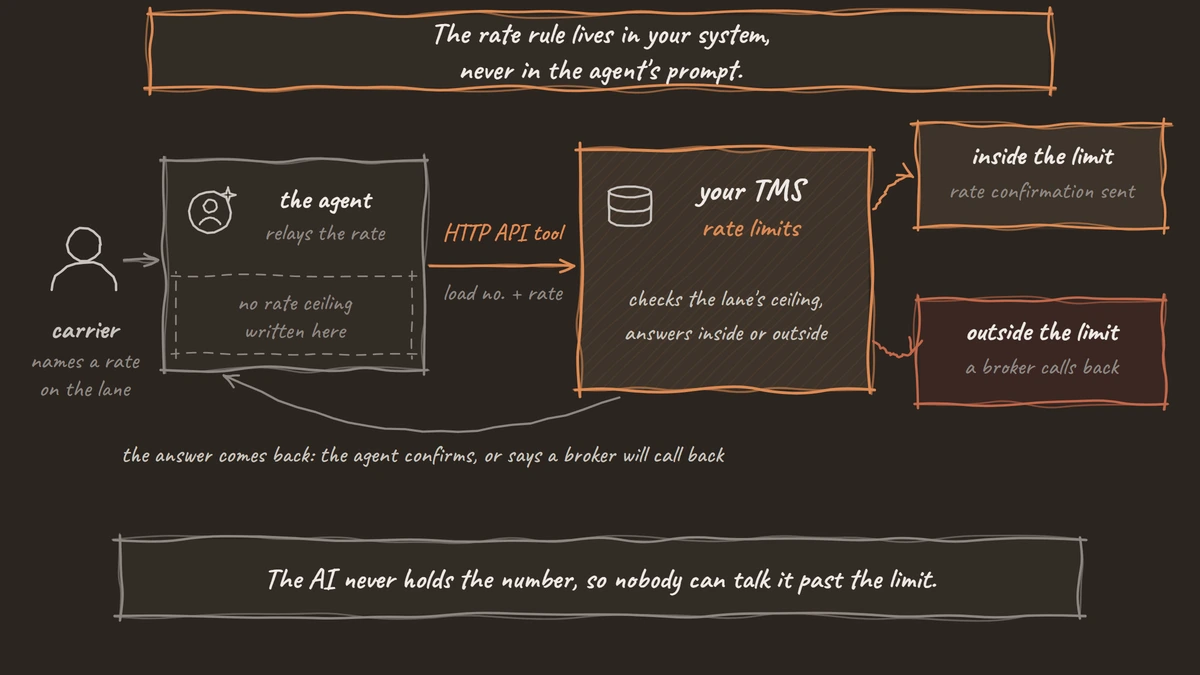
Two more rules make this call safe. The agent verifies the carrier before it discusses a rate, with the carrier's motor carrier (MC) number or the last digits of the account on file, because a phone number finds a record and does not prove who is calling. And every exception, which means every "can you do better" and every carrier not yet on file, goes to a person. The agent writes what it heard to the TMS through the tool before it transfers, so the broker who picks up sees the lane and the offer on screen. The transfer passes no summary of its own.

Open Source Alternative to Vapi / Retell
Self-hosted voice agent platform — no per-minute fees
dograh-hq/dograh
Star on GitHub
Invoice follow-up last
Invoice follow-up is the last call to automate because it is the least structured and the lowest volume. A carrier calls to ask whether an invoice was received, when it pays, or why a detention charge was cut. The agent can verify the carrier, read the payment status from your accounting system through an HTTP API tool and answer the first two questions. The third is a dispute, and a dispute gets a person. Treat this call as a small addition once the first two are running.
Who the enterprise vendors serve, and who they leave out
The largest brokers already have a voice AI vendor, and the rest of the market does not. HappyRobot, according to Forkast's report on its Series C, says it has more than 150 customers and agents in production at eight of the ten largest US brokers. Those are the company's own numbers. The product is closed and it publishes no price list, which tells you who it is built for.
Most of freight sits below that tier. The American Trucking Associations counts about 580,000 active US motor carriers, and more than nine in ten of them run ten or fewer trucks. The brokers who serve them are mid-sized desks with a TMS, a phone system and no budget for an enterprise contract. They still make the same three calls every day.
For that tier, owning the platform is the practical route. Self-hosted Dograh has no per-minute platform fee; the broker pays for servers and for the speech and language models it chooses, and the call flows and the recordings sit on its own infrastructure. Our roundup of the best AI voice agents for logistics compares seven platforms on open source, self-hosting, on-prem and cost, and shows where that tier lands.
Answer the carrier's objection
Carriers have a fair objection to broker voice agents: that a machine which can call all day will call all day, and the small carrier's phone will ring more, not less. The design answer is that the agent should remove calls from the carrier's day. It calls only when a geofence event is missing and asks two questions. Then it writes the answer where the broker's team can see it, so nobody calls again for the same update.
Two obligations come with calling carriers. Most of the people who answer are owner-operators on a mobile phone, and an artificial-voice call to a mobile generally needs prior express consent; carrier onboarding paperwork is where a broker captures it. And the agent should say it is an automated assistant at the start of the call rather than let the carrier work it out. The federal rule on hand-held phones while driving also shapes when a driver can take the call at all; our post on AI voice agents for driver and dispatch callbacks is built around it.
The same respect for the driver's time applies to hiring. A carrier screening applicants by phone can run the first call as an agent that asks about licence type, availability and area and books an interview, which our post on AI voice agents for delivery driver recruitment screening covers.
Join the Dograh Community
Dograh is an OSS alternative to Vapi. Join our Slack community for queries, releases, best practices & community interactions.
Rate conversations are why the call data stays yours
Every load booking call is a rate conversation, and rate conversations are the most commercially sensitive thing a brokerage says out loud. Recordings and transcripts of them belong on the broker's own servers, under the broker's retention rules, with the TMS as the only system of record. That is the own-your-data case for this segment, and it is stronger here than anywhere else in logistics. Our page on self-hosted voice agents for freight brokers sums up check calls and load updates on a platform the brokerage runs itself.
Before any of these calls goes live, two checks. Outbound calls need consent captured at onboarding or sign-up, and the rules differ by state; our US post on consent for delivery calls sets them out for American operators. And the first flow you switch on should be the check call, on one lane, with a dispatcher reading every call outcome for the first two weeks. When the answers written to the TMS stop needing correction, add load booking with the rate check in place.
Glossary
- PRO number
- The carrier's own tracking number for a shipment, printed on the bill of lading and used to find the load.
- extracted variables
- Answers the agent records from the conversation, as the carrier stated them, for the TMS to store; the recording stays the exact record.
- geofence event
- A telematics signal that a truck entered or left a drawn area, such as a pickup or delivery site.
- load board
- A marketplace where brokers post loads and carriers find them.