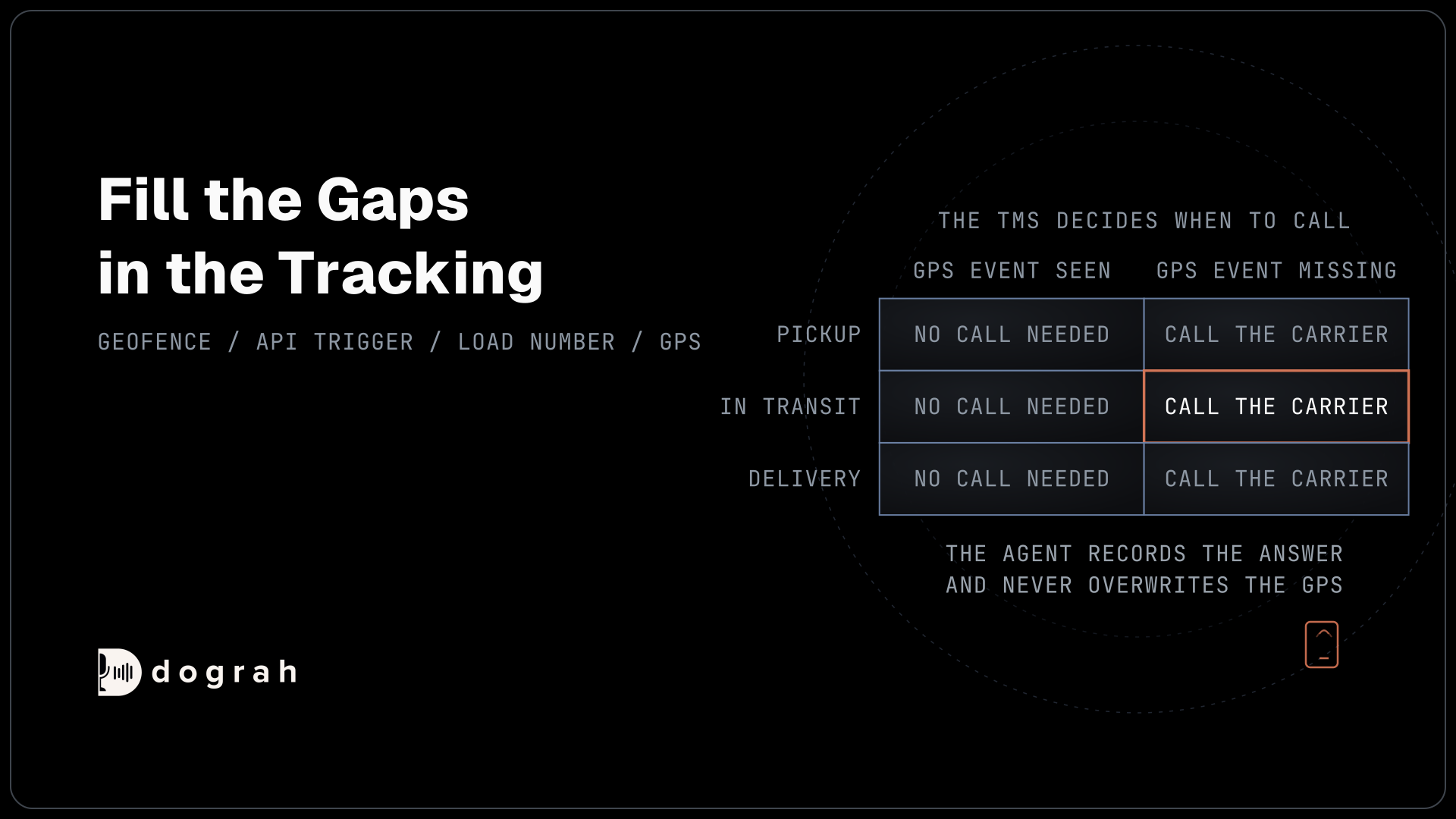

AI voice agents for carrier check-calls and load updates phone a carrier only when the broker's TMS sees a missing tracking event. The TMS starts the call through an API trigger, the agent confirms the load number, asks for location and arrival time, records both as stated, and flags any conflict with the GPS for a person.
Key Takeaways
- Fewer than four in ten carriers use AI for real-time tracking. Brokers still phone.
- Let the TMS decide when to call: a missing geofence event, never a timer.
- The agent records what the carrier said and never overwrites the GPS.
This post is part of our guide to AI voice agents for logistics and delivery. The guide's freight section says the broker's TMS should check for a missing geofence event and start the check call itself. This post is the full design of that call, from the trigger to the write-back. In Dograh, an open-source, self-hostable voice agent platform, the TMS starts the call and the carrier's answer is written back to the load.
The check call survives because tracking still has gaps
Brokers still phone carriers for a reason: a large share of loads produce no tracking data when the broker needs it. Trimble's Transportation Pulse Report 2026, a survey of more than 230 logistics executives in Europe and North America, found 42% of carriers deploying AI for pricing and lane optimisation and 39% using it for real-time tracking. Load matching is where 55% see the biggest benefit. Inconsistent data is the obstacle they name most.
Even the carriers with high tracking compliance leave gaps in their telematics data. Descartes MacroPoint's 2026 top-carrier award went to 1,450 carriers that tracked more than 1,000 loads in the first half of the year at a compliance of at least 90%. That is an award threshold rather than an industry average, and it still means the best-tracked fleets leave about one load in ten without data at some point. The check call is what fills that gap.
The person who answers is often the driver. The American Trucking Associations counts about 580,000 active US motor carriers, and 91.5% of them run ten or fewer trucks. A carrier that size has no dispatch desk. The broker's call reaches an owner-operator's mobile, often in the cab, and that fact shapes everything below.
Cost the call by what is measured
Check-call volume is unmeasured, and every figure in circulation about it traces back to a vendor's blog. So I will not tell you how many calls a load generates or what share of a dispatcher's day they eat. I will cost the call by what is measured: the truck's time.
The American Transportation Research Institute (ATRI) puts the cost of operating a truck in 2025 at a record $2.336 per mile, 3.4% higher than the year before. Take fuel out and it is $1.854 per mile, up 4.2%, with tolls the fastest-rising line at 13.2%. A driver who pulls over to answer a status question is being paid against miles that are not moving, and a carrier running ten trucks on those numbers has no slack for it.
That is the honest case for automating the call. The point is to make fewer, shorter calls and to land each one in the load record, so nobody asks the same question twice. Our segment page on AI voice agents for freight and trucking ranks this call first among the three a freight desk makes, for exactly that reason.
Let the TMS decide when to call
The decision to call belongs to the TMS, because the TMS is the system that knows a tracking event is missing. A load that should have produced a pickup geofence event by 09:00 and has not is the trigger. A truck that was due to arrive at the consignee and has gone quiet is another. A timer that calls every carrier every two hours is the overload carriers complain about, and it is the one design to avoid.
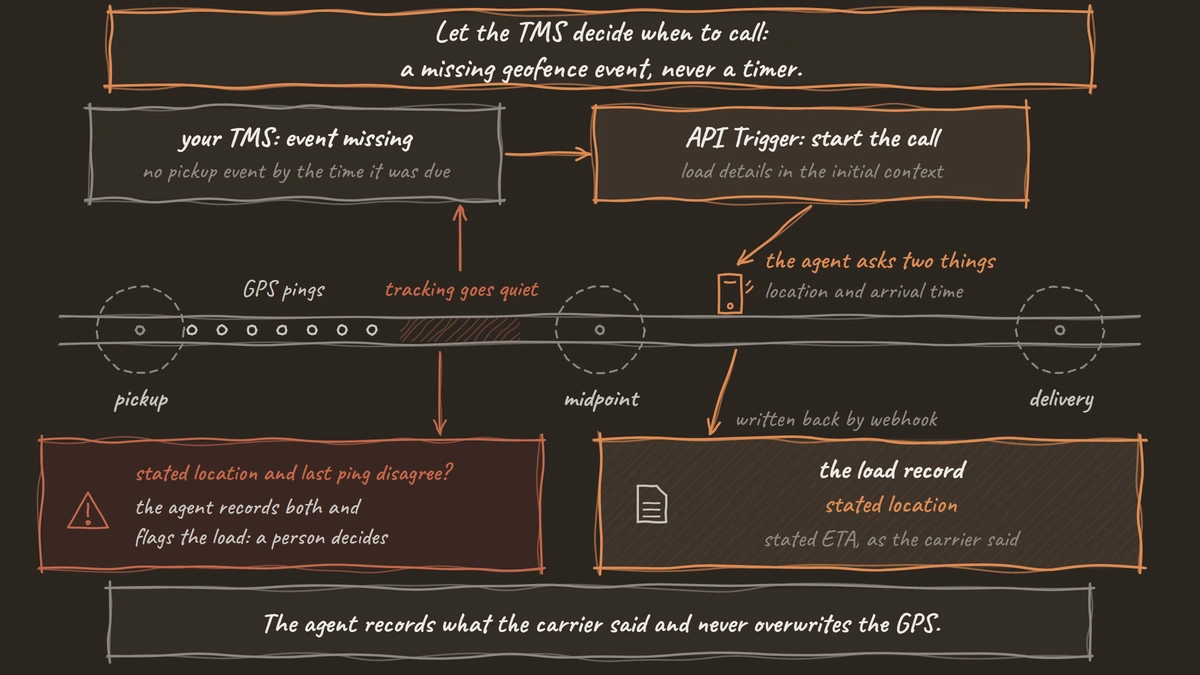
Dograh receives that decision through its API Trigger. The TMS posts the carrier's number and the load details, which arrive in the agent's initial context, so the agent opens the call knowing the load number and the appointment time without asking for them. The production URL runs the published flow only, which keeps a half-edited draft from calling a carrier. Our tutorial on starting a voice agent call from any system covers the request.
Once the call connects, Pre-Call Data Fetch can refresh the load from the TMS, so if a GPS ping arrived in the seconds between the trigger and the answer, the agent knows before it asks. The fetch has a 10 second timeout and the call carries on if it fails. It runs when the call starts, so it cannot decide whether to call; that stays with the TMS.

Open Source Alternative to Vapi / Retell
Self-hosted voice agent platform — no per-minute fees
dograh-hq/dograh
Star on GitHub
Verify the load, ask two things, record them as stated
The call itself should take under a minute and follow one shape. The agent greets, says it is an automated assistant calling for the brokerage, and asks the carrier to confirm the load number or the PRO number before it says anything else about the load. That order matters. A phone number finds a record in the TMS; it does not prove who picked up, and load details are commercially sensitive.
Then two questions: where is the truck now, and when will it arrive. The answers are recorded as extracted variables, as the carrier stated them. If the driver says "just past Amarillo, there by four", the load gets "just past Amarillo" and "about 16:00", and the recording and transcript hold the exact words. Dograh's extraction is an AI step that captures the answer as given; the transcript is the record of what was said.
Everything else goes to a person. Late, off-route or out of hours; a detention clock already running; an appointment missed or refused; a breakdown or any safety event; any mention of rates or money; and any answer that does not fit the route or the timestamps. The agent does not decide that a late truck is fine. It writes what it heard and hands over.
When the driver and the GPS disagree
The agent never picks a winner between the driver and the GPS. If the stated location does not match the last ping, or the stated arrival time cannot be reached from where the GPS says the truck is, the agent records both and flags the load for a dispatcher. Overwriting the GPS with what a driver said would hide the one signal a broker most needs to see.
The write-back runs by webhook after the call: stated location, stated ETA, the flag and the call outcome land on the load in the TMS. If the TMS endpoint has a temporary problem, the webhook is retried automatically, up to five attempts; a wrong URL or credential is not retried, so test the endpoint before the first live lane. Our post on webhook-driven voice agents covers the payload.
When the carrier needs a person during the call, the agent writes the load details and the carrier's update to the TMS through an HTTP API tool before it transfers, so the dispatcher sees them on screen as the call lands. Transfer Call runs on Twilio numbers and passes no summary of its own; on Twilio, an optional spoken introduction can summarise the call for both sides, and it is off by default.
Join the Dograh Community
Dograh is an OSS alternative to Vapi. Join our Slack community for queries, releases, best practices & community interactions.
Consent, the driver's seat, and where the recordings live
Most of these calls reach a mobile phone, and an artificial-voice call to a mobile generally needs prior express consent. Carrier onboarding is where a broker captures it, alongside the insurance certificate and the W-9. The agent should also say it is automated at the start of every call rather than let the carrier work it out. Our US post on consent for delivery calls sets out the federal rule and the state rules that sit on top of it.
The driver's seat adds a second constraint. A driver generally cannot use a hand-held phone while driving a commercial vehicle, and a carrier cannot require it, so a check call that reaches a moving truck has to work hands-free or wait for a stop. Our post on AI voice agents for driver and dispatch callbacks is built around that rule and the call design it forces.
The recordings of these calls hold locations and appointment times, and rates if a carrier strays into them. They belong on the broker's own servers, under the broker's retention rules, with the TMS as the only system of record. Self-hosted Dograh runs there with no per-minute platform fee; the broker pays for the servers and the speech and language models it chooses. Start with one lane, with a dispatcher reading every call outcome for two weeks, and widen it when the answers written to the load stop needing correction.
Glossary
- tracking compliance
- The share of a carrier's loads that produced location data through the broker's tracking tool.
- PRO number
- The carrier's own tracking number for a shipment, used to confirm the load at the start of a call.
- initial context
- The load details the TMS sends with the API Trigger so the agent starts the call already knowing the load.
- telematics
- The GPS and vehicle data a truck's onboard unit sends to a tracking platform.