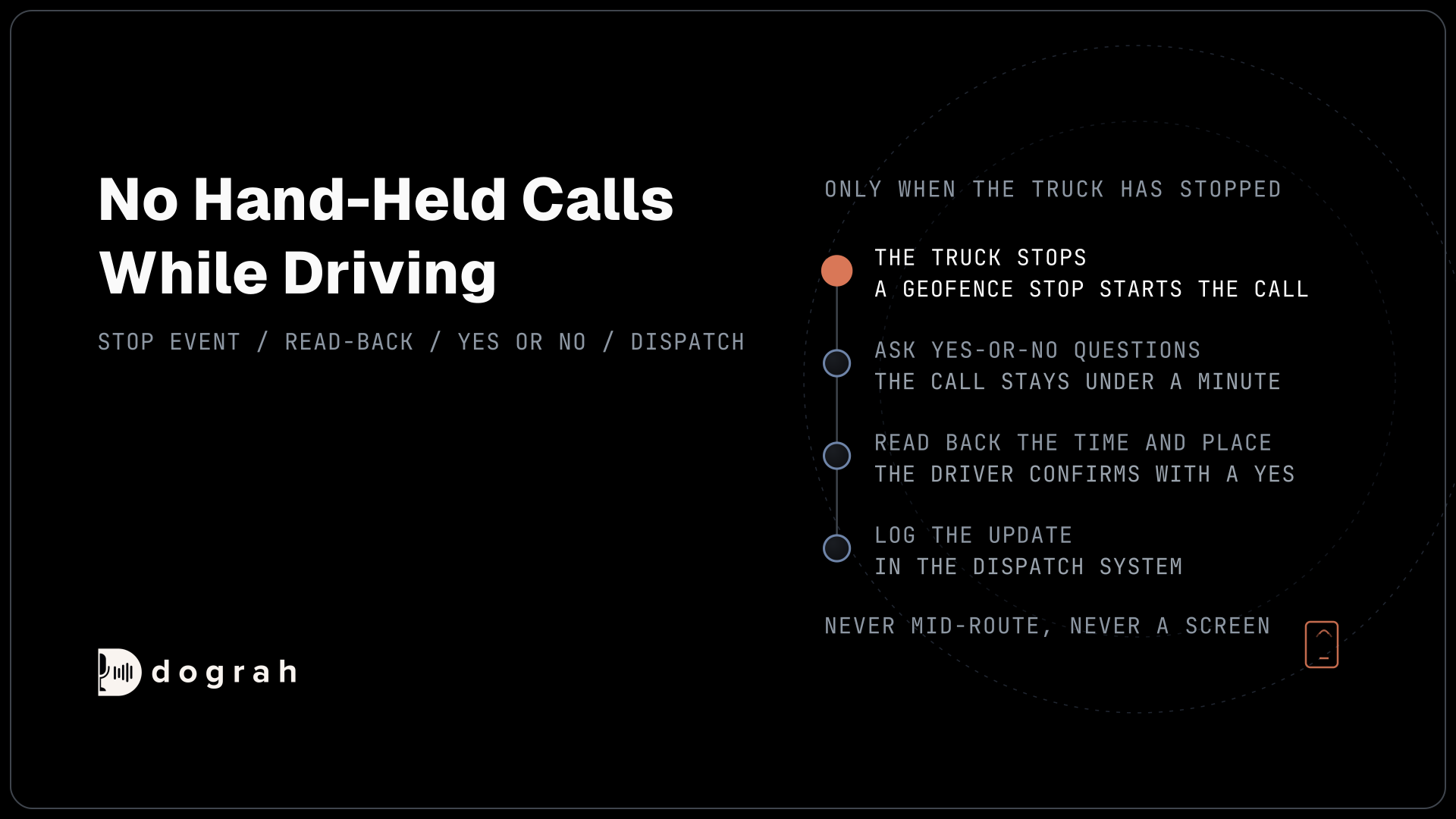

AI voice agents for driver and dispatch callbacks call a driver about a delay or a new arrival time, only when telematics shows the truck has stopped. The call stays under a minute, asks yes-or-no questions, reads every time and place back, never asks the driver to look at a screen, and logs the answer to the dispatch system.
Key Takeaways
- No hand-held calls while driving, so the callback waits for a stop.
- Yes-or-no questions and read-backs keep the call under a minute.
- Every answer lands in the dispatch system before a dispatcher ever picks up.
This post is part of our guide to AI voice agents for logistics and delivery. The guide's section on calls to drivers says a callback should be hands-free, under a minute, built on yes-or-no questions and read-backs, and started from a telematics stop event. This post gives the full design, and the settings in Dograh, an open-source, self-hostable voice agent platform, that keep each call short and hands-free.
The driver is driving: the rule that shapes every callback
Every call to a driver starts from one fact: the person you are calling may be driving a truck. 49 CFR 392.82 says: "No driver shall use a hand-held mobile telephone while driving a CMV." The next paragraph binds the carrier: "No motor carrier shall allow or require its drivers to use a hand-held mobile telephone while driving a CMV."
The rule also says when a driver is driving, and that is what makes callbacks workable. Stopped in traffic or at a red light still counts as driving, because the text includes being "temporarily stationary because of traffic, a traffic control device, or other momentary delays". Pulled over and "halted in a location where the vehicle can safely remain stationary" does not count. So a stopped GPS reading is not enough on its own. The agent calls when the truck is at a depot, a geofenced stop or parked, and offers a callback for any other moment.
Read generally, a call that reaches a moving truck has to work without the driver touching the phone, and a carrier that expects drivers to pick up by hand on the road is generally on the wrong side of the rule. Hands-free rules vary by state and by country, and this post is general information about designing the call, not legal advice; confirm your own position with counsel.
Which dispatch calls earn a callback
Three kinds of dispatch message are worth a call: a delay that changes the plan, a route change, and a new arrival time the driver has to confirm. Trimble's Transportation Pulse Report 2026 found 59% of carriers put ETA calculation and alerting at the top of their agentic AI priorities, while more than half still see AI's primary role as augmenting human decision-making. That second finding is the design brief: the agent relays and confirms, the dispatcher decides.
Not every change is a call. A stop that moved by ten minutes with nothing for the driver to decide is a message to the driver app or a text from your dispatch system. The call is for the moment dispatch needs an answer: can you make the new window, are you taking the detour.
What stays human is the list every dispatcher knows. Pay and hours go to a person, and so does anything that sounds like a dispute, a breakdown, an accident, a distressed driver or a service failure that will cost a customer. A stilted automated exchange on any of those does more damage than a slow human callback would.
Start the callback from a telematics stop event
The agent should call when the truck has stopped, and telematics is what tells it so. A geofence arrival at a shipper or at the yard is a stop event. So is a dwell signal, the truck stationary long enough to be parked rather than queued at a light. The one rule for the trigger is that no callback is placed mid-route.
Dograh receives the stop event through its API Trigger. The dispatch system posts the driver's number and the update that needs confirming, which arrives in the agent's initial context, so the agent opens with the reason for the call rather than a question about who it has reached. Our tutorial on starting a voice agent call from any system covers the request.
Two cases need a fallback. If the driver does not answer, answer supervision tells the agent nobody picked up, and the attempt is logged rather than spoken into a voicemail. If the driver answers and says it is not a good time, the agent offers a callback and ends the call. The update waits; the driver's attention does not.

Open Source Alternative to Vapi / Retell
Self-hosted voice agent platform — no per-minute fees
dograh-hq/dograh
Star on GitHub
Design the driver callback for ears only: short, spoken, yes or no
The whole call is designed for a person who cannot look at anything. That gives four rules. Under a minute. Questions a driver can answer with yes or no. A read-back of every time and every place, so a misheard "fifteen thirty" is caught by the driver and not by the customer. And the agent never asks the driver to look at a screen or press a key; Dograh's calls are spoken, with no keypad tool to tempt the flow designer.
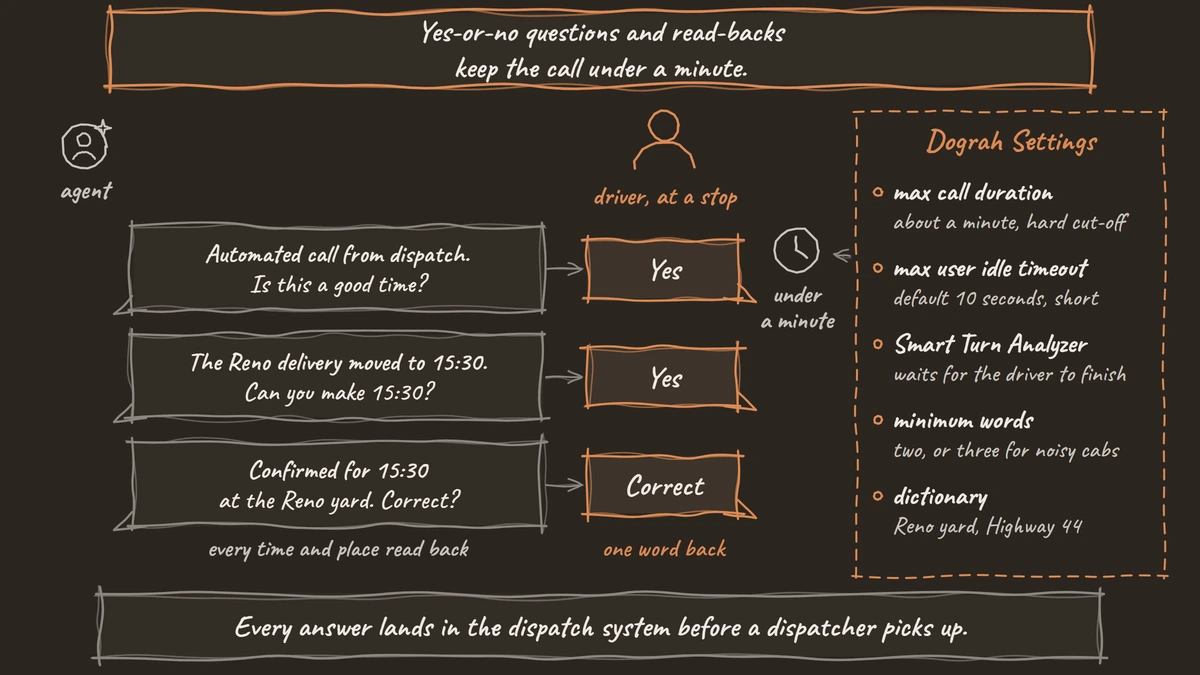
There is no special hands-free setting in Dograh. The design is in the flow, and a handful of the agent's Settings make it hold. Lower the max call duration from its default of 300 seconds to something close to a minute, so a call that drifts is cut rather than extended. It's a hard cut-off that ends the call mid-sentence, so test that a full read-back fits inside it. Keep the max user idle timeout (default 10 seconds) short. After one silent stretch the agent asks if the driver is still there; after a second, it says goodbye and hangs up. Turn on Smart Turn Analyzer for turn detection, so the agent waits for the driver to finish rather than cutting into a half-spoken place name. The minimum words for interruption setting, which defaults to two, is what stops a cough or a "yeah" from barging in on the read-back; keep it at two or raise it to three for noisy cabs.
The dictionary earns its place here. Add your depot names and route names, so "the Reno yard" and "Highway 44" come back from speech-to-text as the words your dispatchers use. There is no noise-suppression feature to lean on. How the agent copes with road noise depends on the speech-to-text provider you choose, so test on a real phone call from a moving cab.
Log every update and hand off with the context on screen
Every answer the driver gives is written to the dispatch system before anyone reads it. The agent records the confirmed time and the yes or the no as extracted variables, as the driver stated them, and a webhook carries them to the dispatch system after the call. The payload below is the shape of that write, with the fields your dispatch system keys on in load_id, the driver's number in driver_phone and the confirmed time in eta_confirmed:
{
  "load_id": "L-48213",
  "driver_phone": "+1415555XXXX",
  "update_type": "arrival_time",
  "eta_confirmed": "15:30",
  "driver_answer": "yes",
  "call_outcome": "confirmed"
}
What this does: It puts the driver's confirmation on load L-48213 as a structured record, so the dispatcher sees the 15:30 arrival on the board without listening to the call. The recording and transcript stay as the exact record of what was said.
If the dispatch system has a temporary problem, the webhook is retried automatically, up to five attempts; a wrong URL or credential is not, so test it before the first live lane. Our post on webhook-driven voice agents covers the webhook node.
Anything off-script goes to a dispatcher. Before transferring, the agent writes the load details and the driver's update to the dispatch system through an HTTP API tool, so the dispatcher sees them on screen. Transfer Call runs on Twilio numbers and passes no summary of its own; on Twilio, an optional spoken introduction can summarise the call for both sides, and it is off by default.
Join the Dograh Community
Dograh is an OSS alternative to Vapi. Join our Slack community for queries, releases, best practices & community interactions.
Consent, cost and who holds the recordings
A driver's minute is paid for. ATRI's 2026 operating-cost report, as FleetOwner's breakdown sets it out, puts driver wages at $0.818 per mile and benefits at $0.210, a combined $1.028, the first year driver compensation has averaged above a dollar a mile. Five minutes on the phone at a dock is a real cost, one more reason the call is designed to end in one.
Drivers answer on mobile phones, and an artificial-voice call to a mobile generally needs prior express consent. Driver onboarding is where a carrier captures it, and the agent should say it is an automated call from dispatch at the start of every call. Our US post on consent for delivery calls covers the federal rule and the state rules on top of it.
The recordings hold locations and the driver's phone number, and they belong on the carrier's own servers under the carrier's retention rules, with the dispatch system as the only system of record. Self-hosted Dograh runs there with no per-minute platform fee; the carrier pays for the servers and for the speech and language models it picks. The broker side of these calls is in AI voice agents for carrier check-calls and load updates, and the segment view in AI voice agents for freight and trucking. Start with one lane and one dispatcher reviewing every call, and widen it when the answers stop needing correction.
Glossary
- telematics
- The GPS and vehicle data a truck's onboard unit sends to the dispatch or tracking platform. Stop events, dwell signals and geofence arrivals all come from it.
- geofence
- A boundary drawn on a map around a depot, yard or customer site. The truck crossing it creates an arrival or departure event the dispatch system can act on.
- stop event
- A telematics signal that the truck has arrived at a site or has been stationary long enough to be parked.
- answer supervision
- A telephony setting that tells the agent whether a person actually picked up, so unanswered calls are logged rather than spoken into.