
AI voice agents for booking confirmations in hotels call only the bookings that need a decision, after the hotel's own system has sent the confirmation message. The agent verifies the confirmation number and surname, confirms dates and arrival time, records any change as the guest stated it and writes it back. The call carries no offer.
Key Takeaways
- The hotel's system sends the confirmation; the call is for undecided bookings.
- Verify the confirmation number and surname before naming any booking detail.
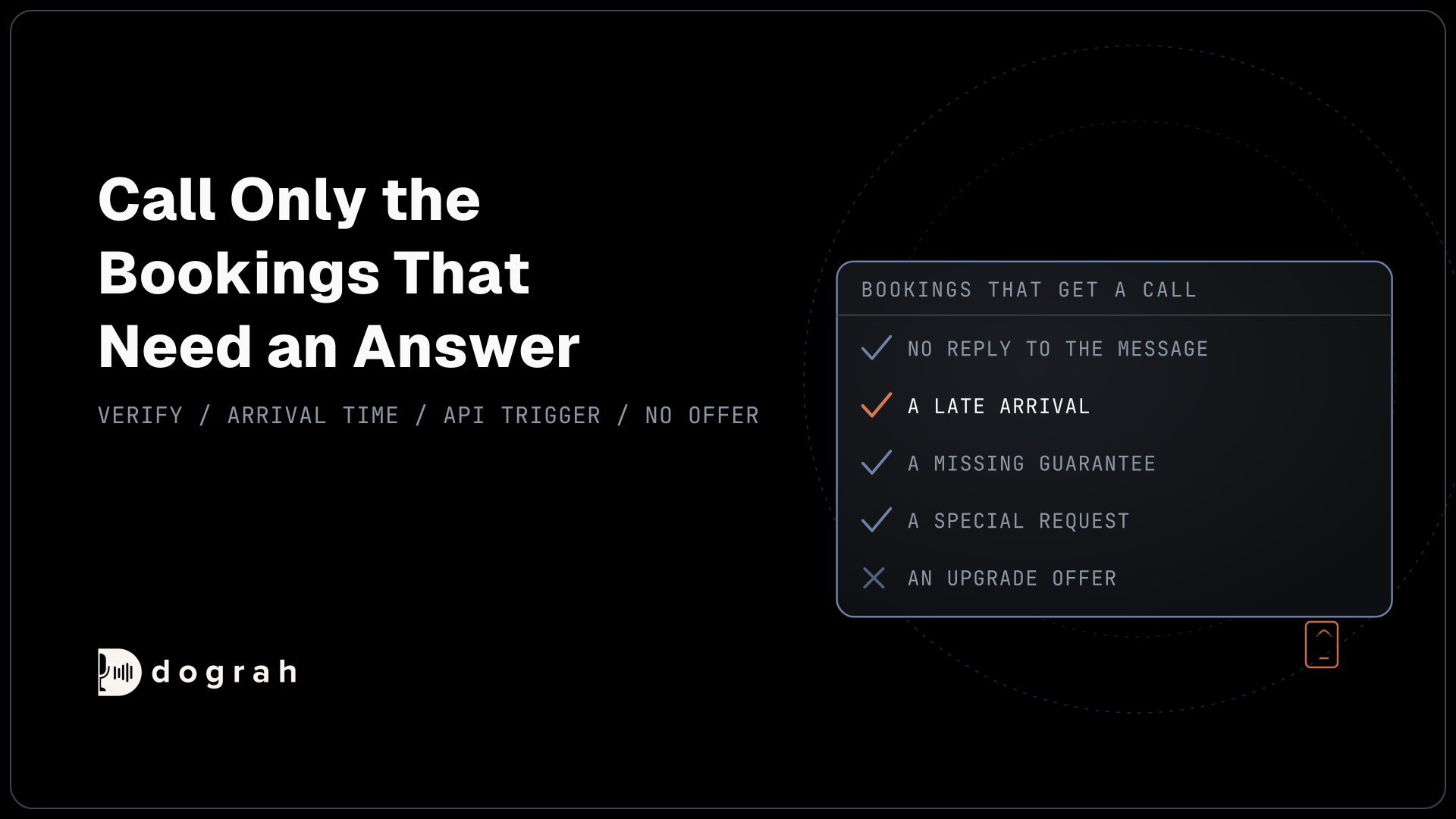
- No upgrade offer on this call, even for guests who consented.
This post is part of our guide to AI voice agents for hotels and hospitality. The guide's section on the stay before arrival keeps the confirmation call for the bookings that need a decision. This post sets out which bookings those are and how the call runs on Dograh, an open-source, self-hostable voice agent platform, started by the hotel's own system.
The message confirms, the call decides
Every booking already gets a confirmation message from the hotel's property management system (PMS), and most guests need nothing more. Dograh has no SMS tool and sends no texts, so that message stays with the PMS or the hotel's messaging platform, with no voice agent involved.
A call earns its place only when the booking needs an answer the message did not get. Four cases cover most of it: the guest never replied, the guest is likely to arrive late, the rate's guarantee is still missing, or a special request needs checking with the guest. Everything else stays a message.
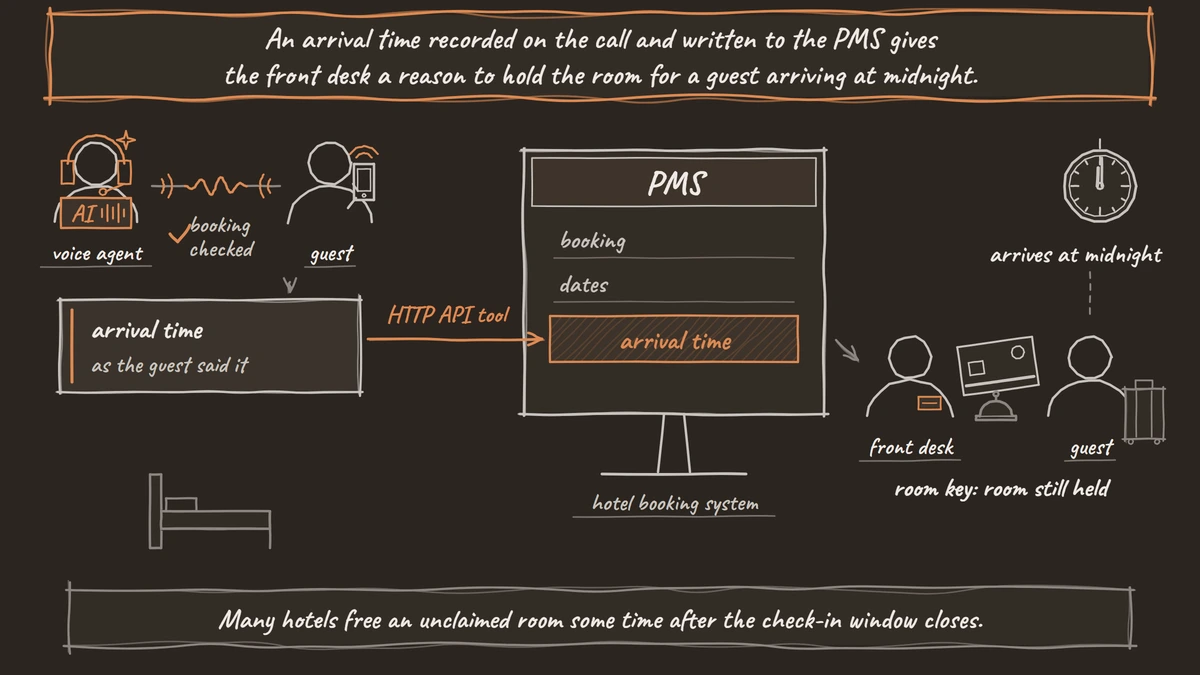
Late arrivals matter most. Many hotels run a room release rule, freeing an unclaimed room some time after the check-in window closes. An arrival time recorded on the call and written to the PMS gives the front desk a reason to hold that room, and a guest who arrives at midnight finds it still there.
How the hotel's system starts the call
The hotel decides who gets called, and its system starts each call. For one booking at a time, the PMS or a small job beside it calls Dograh's API Trigger with the guest's phone number and the booking ID in initial_context. For a nightly batch, a Campaigns list uploaded from the PMS does the same job. Our post on API triggers shows the request.
Bookings change between the export and the call. Pre-Call Data Fetch, at the bottom of the Start Call node and set to Outbound calls only, asks the PMS for the booking again once the call connects. That keeps the agent from confirming dates that changed an hour ago. It refreshes a call that is already happening and never decides whether to call.
Campaigns has its own retry settings: up to 10 retries (2 by default), a retry delay from 30 seconds to an hour, switches for retrying on busy, no answer or voicemail, and calling hours by weekday. It has no per-guest call cap. The hotel's own list has to enforce how often one guest is called, or retries are set to zero.
Greet, verify, then confirm
The call runs greet, verify, then confirm, and nothing about the booking is said before the verify step. Greeting Text plays word for word as the call connects. Write it to name the hotel and ask for the guest by first name with a fallback, such as {{first_name | the guest on the booking}}. If you want to tell guests they're speaking with an automated assistant, or your location requires it by law, add that line too. Asking for the guest by name finds the right person. It does not prove who answered.
So the agent asks for the confirmation number and the surname on the booking before it names a date or a room. A guest without the number to hand is told the hotel will follow up by message, and the call ends with nothing disclosed. How much the first seconds of an outbound call decide is covered in The First 15 Seconds Decide Everything in AI Outbound Calls.
Once verified, the agent confirms the dates and asks for an arrival time. It records each answer as the guest stated it, and an HTTP API tool writes the arrival time and any change to the PMS before the call ends. A special request, such as an early check-in or a cot, is recorded and passed to staff. The agent never promises it, because only the hotel knows whether the room will be ready.
If the guarantee is missing, an HTTP API tool asks the hotel's own system to send a secure payment link by text or email. No card number is taken on the call. A guest who wants to move or cancel the stay is handed to the change flow, which AI voice agents for cancellations and rescheduling in hotels covers.

Open Source Alternative to Vapi / Retell
Self-hosted voice agent platform — no per-minute fees
dograh-hq/dograh
Star on GitHub
No offer on this call
A confirmation call is an informational call, and it carries no offer of any kind. This is general information, not legal advice.
In its February 2024 declaratory ruling, FCC 24-17, the Federal Communications Commission (FCC) confirmed that the restrictions of the Telephone Consumer Protection Act (TCPA) on the use of "artificial or prerecorded voice" "encompass current AI technologies that generate human voices". The rule text at 47 CFR 64.1200 then sets the consent. A call to a mobile number with an artificial voice needs "the prior express consent of the called party". A call that "includes or introduces an advertisement or constitutes telemarketing" needs "the prior express written consent of the called party". A residential-line call that has no advertisement needs no consent when "the caller makes no more than three calls within any consecutive 30-day period to the residential line and honors the called party's request to opt out of future calls".
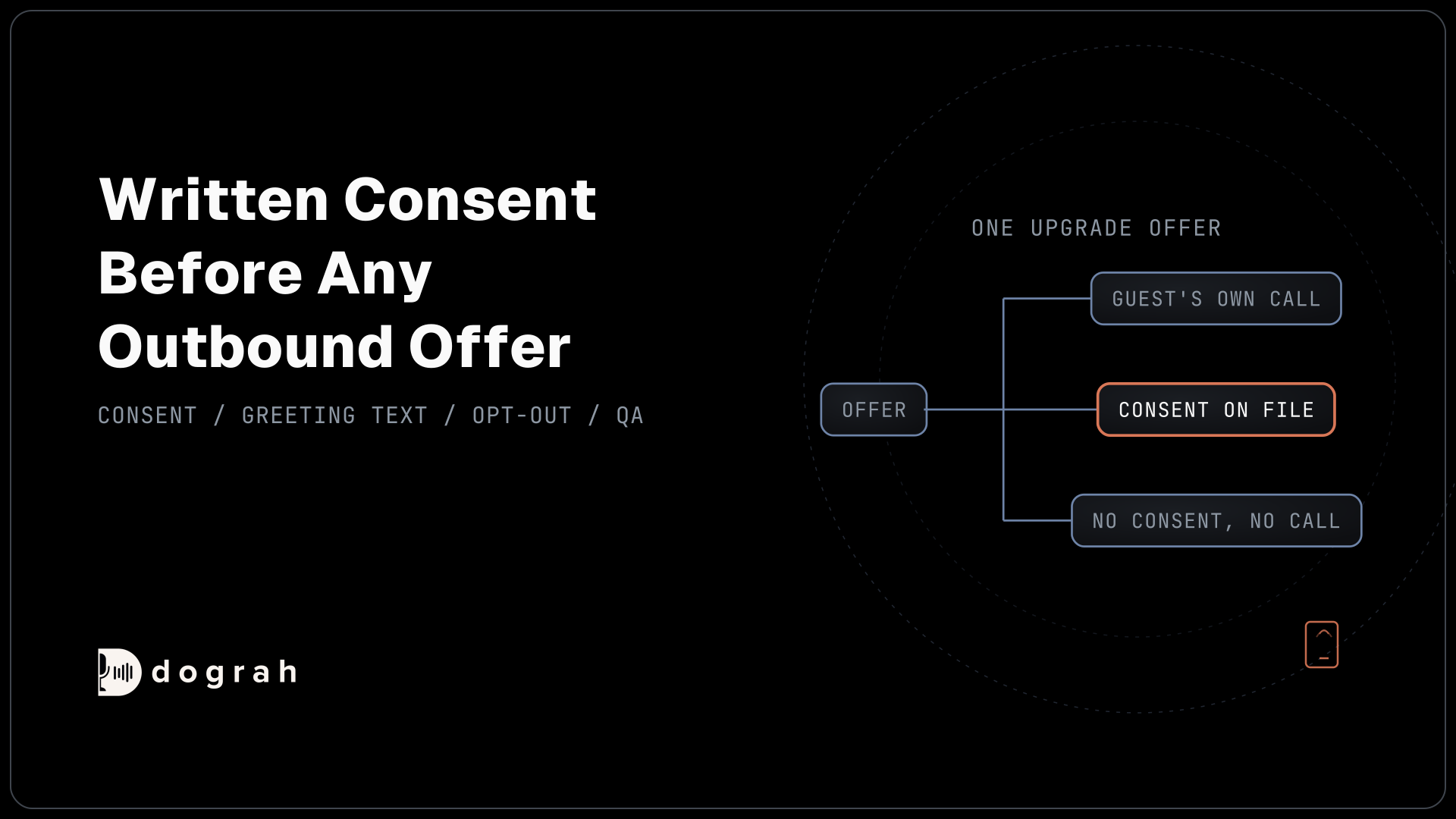
Read together, a confirmation call generally rests on the consent the guest gave when sharing a phone number for the booking, and an upgrade pitch generally turns it into telemarketing. Our rule is simpler than the law: the confirmation call never carries an offer, even for a guest with written consent on file. Upgrades get their own call, set out in AI voice agents for room upgrade upsell.
A guest who asks not to be called again says so by voice. The agent records it, and an HTTP API tool writes it to the hotel's system so the next list leaves that guest out. Confirm your own position with counsel before the first campaign.
Join the Dograh Community
Dograh is an OSS alternative to Vapi. Join our Slack community for queries, releases, best practices & community interactions.
What to check once it is live
Each call should end in an outcome the hotel can count, such as confirmed, changed, payment link sent or not verified. Extract that outcome as a variable and send it with the transcript link to the PMS by webhook. A temporary failure there is retried automatically.
Read the first week of transcripts for two failures: a booking detail spoken before the verify step, and anything that sounds like an offer. A quality assurance (QA) node can score a random sample of calls after that. If guests keep calling back to book a second stay, the inbound side is in AI voice agents for hotel reservations.
Self-hosted Dograh has no per-minute platform fee (servers, model keys and phone minutes still cost); Dograh Cloud has a 1¢-a-minute platform fee.
Glossary
- API Trigger
- Dograh's endpoint that starts an outbound call when another system, such as the hotel's PMS, sends a request with the phone number and booking details.
- Informational call
- A call that carries no advertisement or sales pitch, such as a booking confirmation. Under the TCPA it generally needs less consent than a telemarketing call.
- Prior express written consent
- Under the TCPA, a signed written agreement that lets a business make advertising or telemarketing calls with an artificial or prerecorded voice. An upgrade offer by an AI voice agent generally needs it.
- Room release rule
- A hotel's rule for freeing an unclaimed room some time after the check-in window closes. A recorded arrival time tells the desk to hold the room for a late guest.