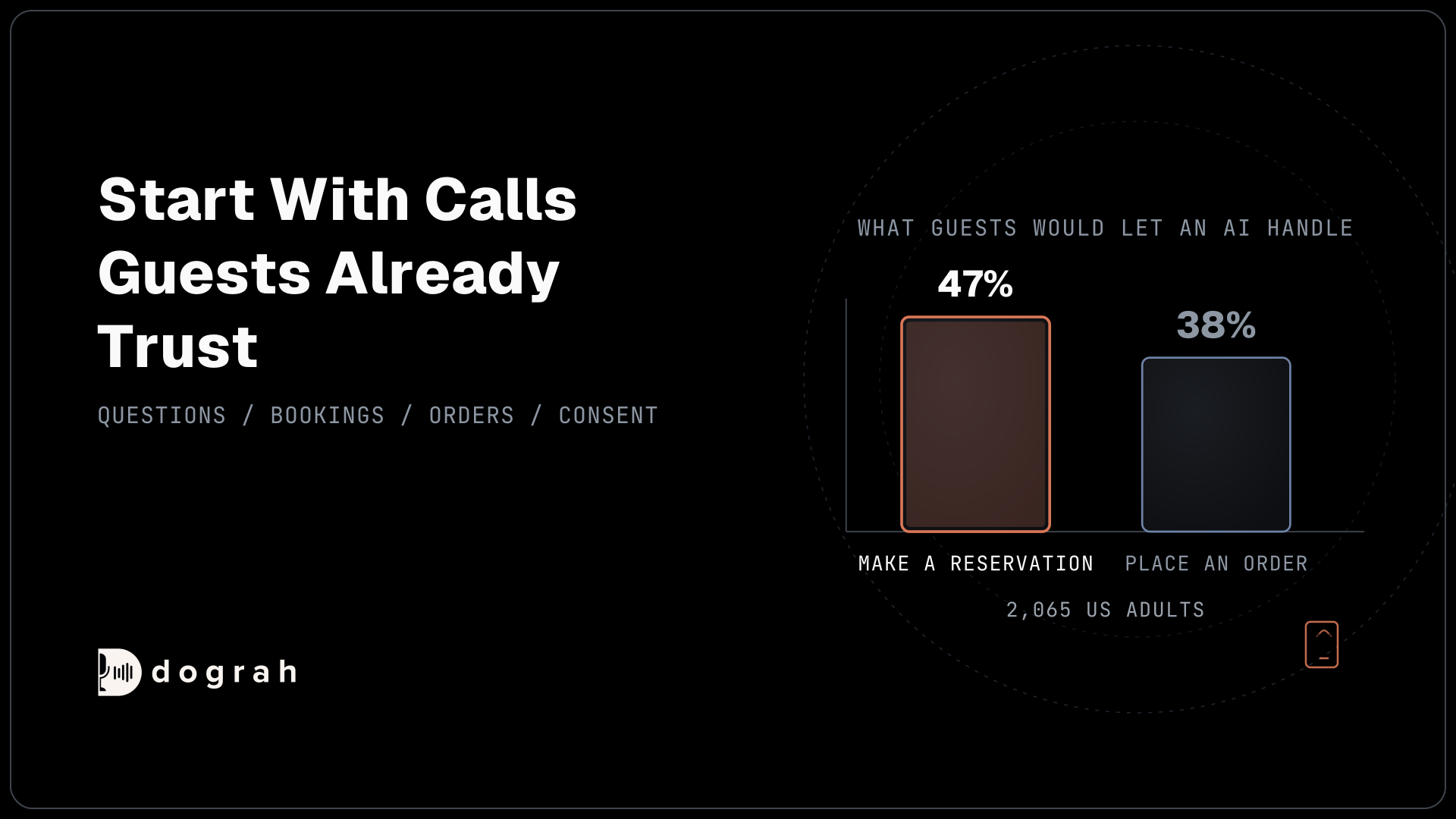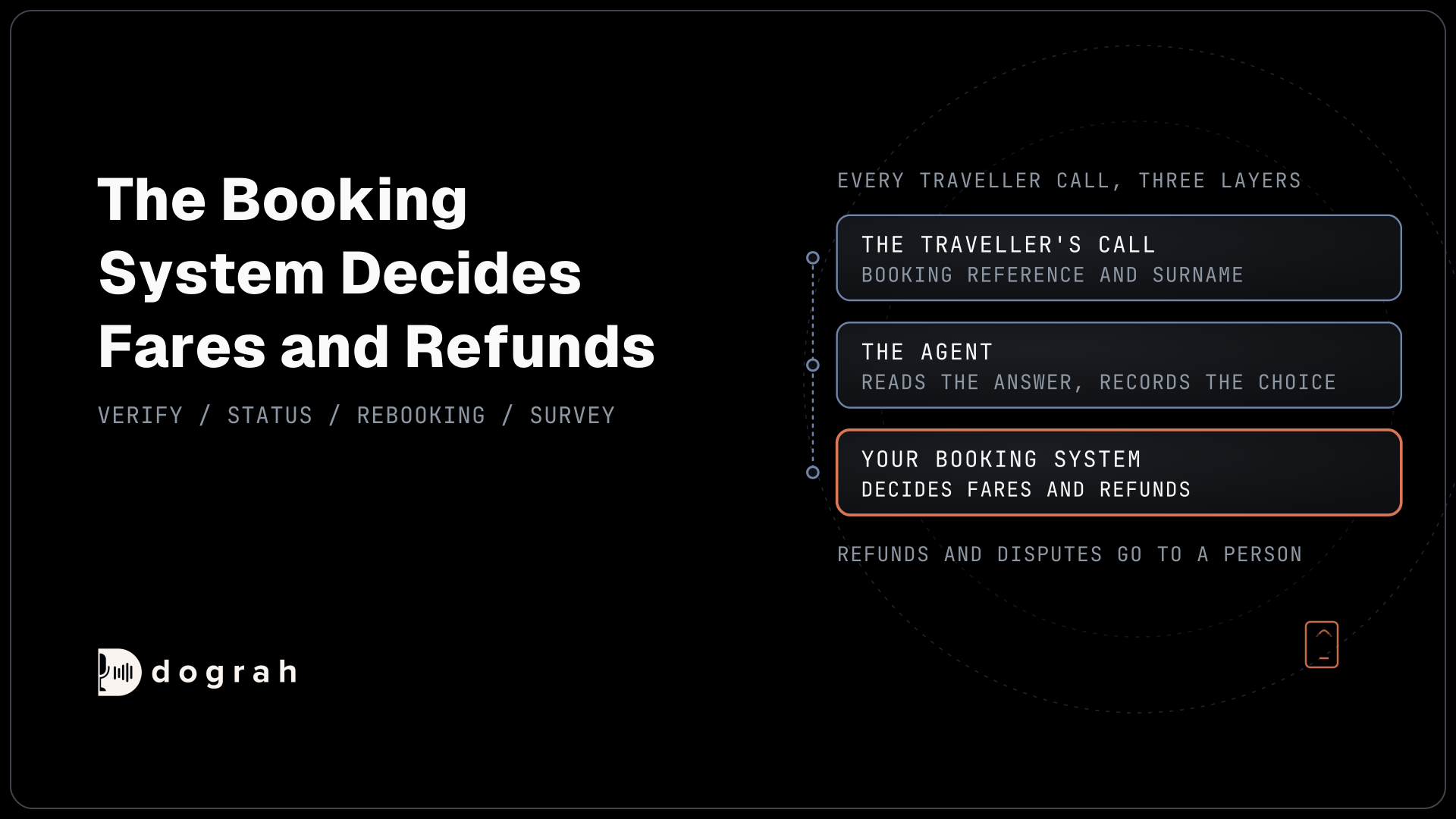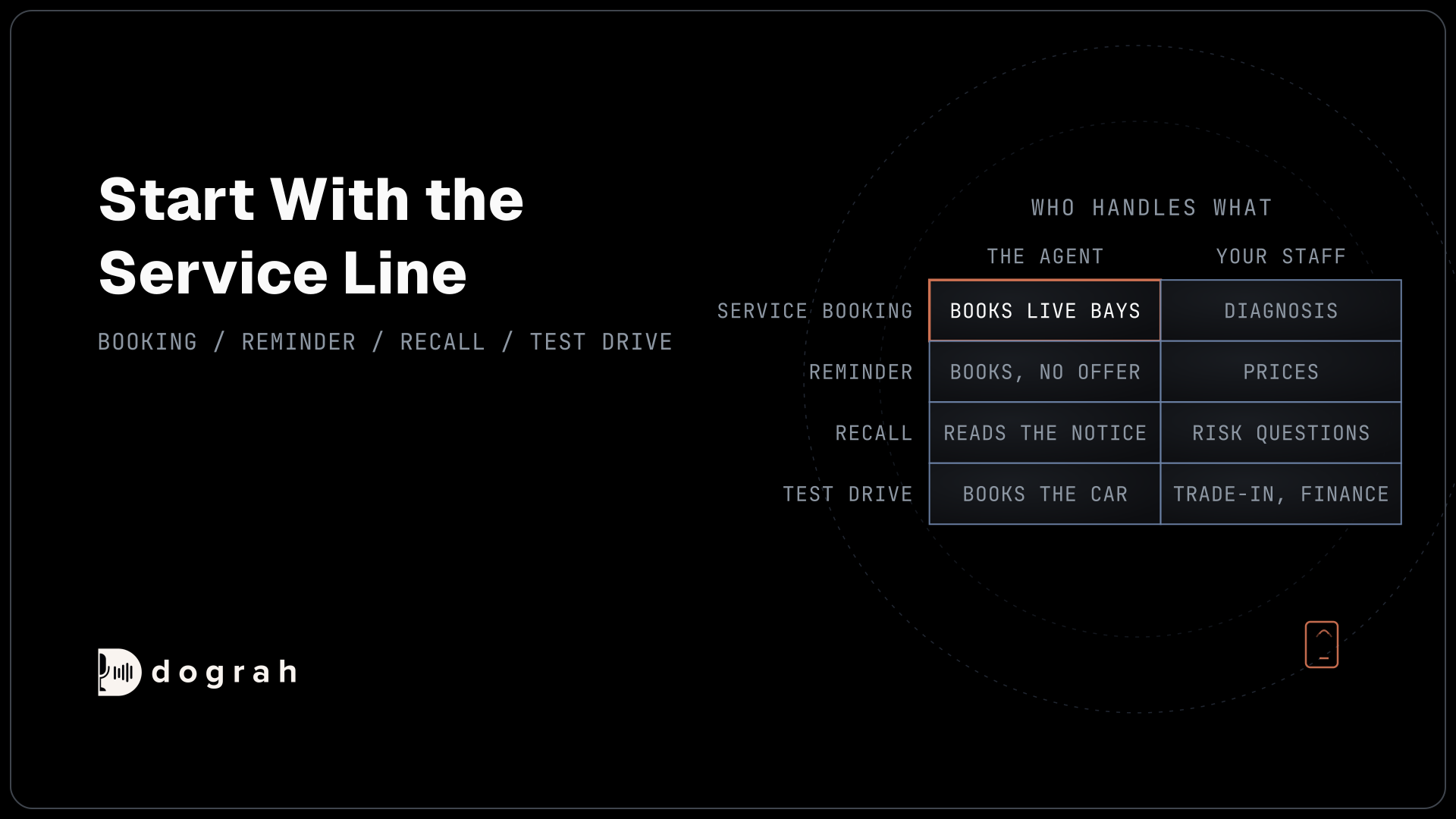

AI voice agents for hotels and hospitality are phone agents that handle routine guest calls: new reservations, booking confirmations, date changes and cancellations, upgrade offers and the post-stay survey. During the call they read live availability and the hotel's policies from the property management system and write every change back to it. They never take card numbers by voice.
Key Takeaways
- The agent reads every booking from the property management system and writes each change back to it.
- Verify the confirmation number and surname before naming any booking detail.
- No card number on any call; the hotel's own system sends the payment link.
This guide follows the guest's stay from the first call to the survey after checkout, then sets out the rules for every call and how each one runs in Dograh, an open-source voice agent platform that reads and writes your property management system during the call. You can self-host it or run it on Dograh Cloud.
Most hotel calls are not bookings
Booking calls are only a share of what the phone brings in, so a voice agent has to cover the whole call mix. Revinate's 2026 Hospitality Benchmark Report puts lead calls, meaning people asking to book, at 16 to 34% of inbound hotel call volume in North America, depending on the season. Revinate sells reservation-call software, so this is vendor data. The rest come from guests who already have a booking and want to confirm, change, cancel or ask about it.
Answered booking calls convert well: in the same report's 2025 data, lead calls became bookings 49 to 53% of the time in winter and spring, and 44 to 46% in summer. An unanswered phone can lose that call to another hotel or a booking site.
Adding AI does not guarantee less work. In the State of Distribution 2026, from the NYU School of Professional Studies Tisch Center of Hospitality with RateGain and HEDNA (more than 58,000 properties), as Lodging Magazine reported, more than half of hotels use or are procuring generative AI, yet fewer than one in ten say it has cut their manual work by more than 30%. RateGain sells a hotel voice agent itself. Our reading is simple: an agent saves work when it completes the task in the hotel's own systems, and it saves little when it only takes messages that staff then retype.
Guests are clear about where they want a person. In a July 2026 Mews survey of 3,250 travelers in eight countries, 89% wanted a blend of AI and human service or AI working in the background, and 58% preferred a human for check-in and key. Mews sells a property management system, so this is vendor data too, but it points to a split: phone work goes to the agent, and the welcome at the desk stays with your team.
The PMS holds every booking, and the agent works through it
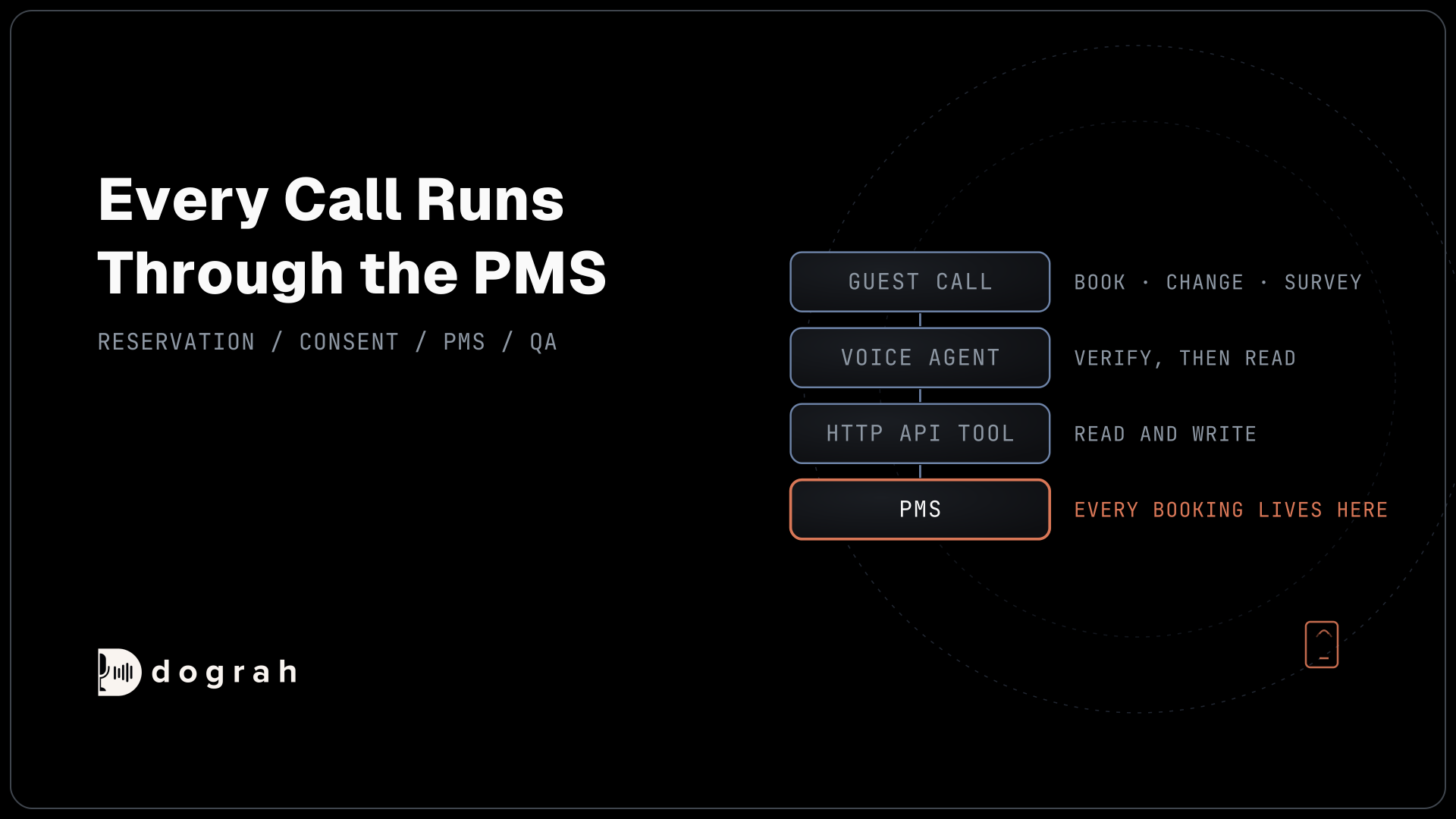
Every call in this guide reads from the property management system (PMS) and writes back to it, and the agent never keeps its own version of a booking. Rooms, rates, policies and guest details stay there.
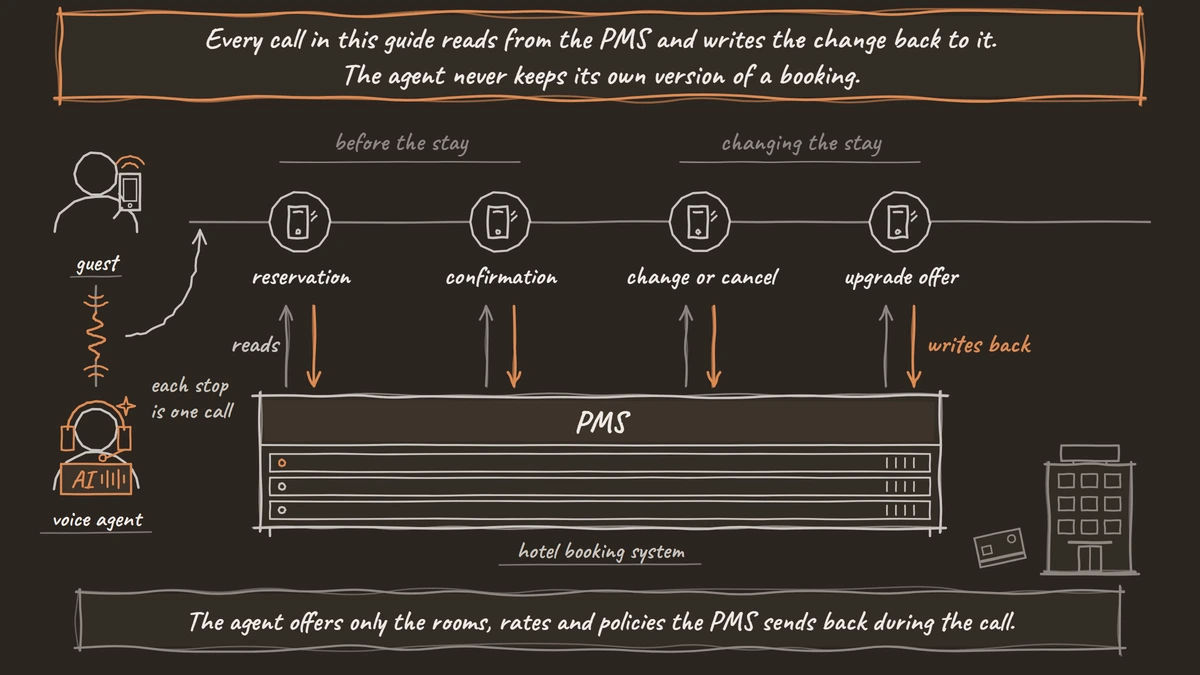
Dograh runs each call as a flow you draw in its visual workflow builder. During the call, an HTTP API tool asks the PMS or booking engine for live availability, rates, a guest's booking or the cancellation policy, and the agent offers only what comes back. Once the guest agrees, a second HTTP API tool writes the change back. After the call, a webhook sends the outcome and transcript link onward, retrying automatically on a temporary failure.
Dograh has no built-in PMS integration. Your systems connect through HTTP API tools, Model Context Protocol (MCP) tools, the Webhook node, Pre-Call Data Fetch or the API Trigger (n8n and similar tools connect through these), pointed at your PMS or booking engine's own API. Our guide to Integrating Voice Agents With Your Stack covers those mechanics.
Two details keep the PMS clean. If it only allows reads, the agent writes a booking request to the hotel's system and staff confirm it. When a write can be sent twice, add the call's workflow_run_id to the tool as a preset parameter. Dograh adds no idempotency header of its own, so the PMS uses that ID to ignore a duplicate.
Every call runs greet, verify, then disclose. A phone number can find a reservation but does not prove who is calling, so before the agent names dates, a room type, a price or anything about payment, it asks for the confirmation number and the surname on the booking. Pre-Call Data Fetch, at the bottom of the Start Call node, can look up a record by the caller's number as the call connects, but the verify step still runs before the agent uses it.
Transfer Call hands the guest to the front desk. It works on Twilio only and passes no summary, so the agent writes the details to the hotel's system first. If nobody answers within the 30-second default, the guest stays with the agent, which writes a callback request through an HTTP API tool.
Before the stay: reservations and confirmations
Two calls come before arrival: one creates the booking, the other checks it.
New reservations
The reservation call books a new stay from live availability and writes it straight to the PMS. Most callers are new, with no record to find, so the agent collects dates, guest count and room type, reads availability and rates through an HTTP API tool, and offers only rooms and prices the PMS returned. Before booking, it reads back dates, room type, guest count, name and rate. Group bookings and unusual requests go to a person. AI voice agents for hotel reservations covers the full call, including read-only PMSs.
Booking confirmations
The confirmation call checks an existing booking before arrival, and it is kept for the bookings that need a decision. The hotel's own system already sends the confirmation message (Dograh has no SMS tool), so the call is for the booking with no reply, a late arrival, a missing guarantee or a special request. The hotel's system starts it through the API Trigger; the agent verifies the guest, confirms the dates and arrival time, writes back any change as the guest stated it.
This call carries no offer, not even an upgrade. An offer turns an informational call into a marketing call, with stricter consent rules. AI voice agents for booking confirmations in hotels sets out when a call earns its place over a message.

Open Source Alternative to Vapi / Retell
Self-hosted voice agent platform — no per-minute fees
dograh-hq/dograh
Star on GitHub
Changing the stay: cancellations, date changes and upgrades
Once a booking exists, guests call to move or cancel it, and some will accept a better room. These calls touch money, so every figure comes from the hotel's system.
Cancellations and date changes
A change call moves or cancels a stay under the hotel's own policy, which the agent reads and never decides. After verification, an HTTP API tool returns the booking, its rate, the cancellation policy and any fee. For a date change, the agent offers only dates the PMS shows open, reads the new booking back and writes it. For a cancellation, it states the fee exactly as returned, confirms, writes the cancellation and reads out its number.
Online travel agency (OTA) bookings usually follow that platform's own process, so the agent explains the route without promising an outcome. Refunds, fee waivers, disputes and complaints go to a person. The details are in AI voice agents for cancellations and rescheduling in hotels.
Room upgrades
An upgrade offer is a sales moment, so it follows the rules for marketing calls. The agent offers only upgrades and prices the hotel's system returns, makes one clear offer and records the guest's answer as stated. A no ends the topic. On an inbound call, the offer comes only after the guest's own question is answered.
An outbound upgrade call generally needs the guest's prior express written consent, so the call list includes only guests with it on file. France has its own consent rule for sales calls, which the French post covers. The full design, inbound and outbound, is in AI voice agents for room upgrade upsell.
After the stay: the survey call
The survey call asks one rating and one open question, and its real job is catching a problem while the guest can still be won back. The agent records both answers as stated and sends them by webhook to the review or customer relationship management (CRM) system. A low rating or a complaint goes to a person: Transfer Call while the desk is staffed, otherwise a callback request in the hotel's system.
No review gating: if the hotel invites guests to post a public review, it invites every guest in the same words, whatever their rating, because Google's review policy bars asking only happy customers. The "one rating, one question" pattern is explained in AI Voice Agents for Delivery Feedback and CSAT Surveys, and the hotel version is AI voice agents for post-stay surveys. Our page on open-source voice AI for survey calls shows the setup.
Join the Dograh Community
Dograh is an OSS alternative to Vapi. Join our Slack community for queries, releases, best practices & community interactions.
Building the agent and serving French-speaking guests
Two posts take this from plan to a working phone line.
Our tutorial on how to build a voice agent for hotels builds a Dograh reservations agent for callers with no record: the hotel's own Greeting Text, an availability tool (check-in, check-out, adults, children, room type), a Knowledge Base holding the hotel's FAQ document for questions like parking and pets (PDF, DOCX, DOC, TXT or JSON, up to 5 MB each), a read-back before the booking, and a payment-link tool that asks the hotel's own system to send the link. Test it on a web call first, then on a real phone line: most phone calls reach the agent as 8 kHz audio, while a browser test runs at 16 kHz.
French-speaking guests can switch to English mid-call. In the agent's Model tab, set speech-to-text to Multilingual (Auto-detect), tick French and English as Language Hints, and choose a voice that speaks French. Greeting Text plays before Dograh can hear the caller's language, so write it in both, for example "Bonjour, hello". If unsure which language it heard, the agent asks and switches only once the guest confirms. Dograh supports more than 70 languages. French AI voice agents for hotels covers the "vous" form and the French rules on recording and sales calls.
Dograh is the orchestration layer (call flow, tools and telephony); the speech and language models are a separate layer you choose. For EU guests, whose data falls under the General Data Protection Regulation (GDPR), recordings and transcripts stay on the hotel's servers only when Dograh and those models all run there.
Card numbers never go through the call
No call in this guide takes a card number by voice. The PCI Security Standards Council, which sets the Payment Card Industry Data Security Standard (PCI DSS), says in its guidance on protecting telephone-based payment card data: "Accepting spoken account data over the telephone puts personnel, the technology used, and the infrastructure to which that technology is connected into scope of PCI DSS." For a voice agent, that scope would generally take in the call recording and every model that heard the number.
So payment happens elsewhere: an HTTP API tool asks the hotel's own system or payment provider to send its secure payment link by text or email, or the guest pays at the front desk. Dograh has no feature for taking customer payments on a call and no keypad (DTMF) tool, so nothing about the card is spoken or keyed on the call. Before the verify step, the agent says nothing about the booking's payment at all, not even the last digits of a card on file.
Consent and AI disclosure
The rules depend on the call's direction and whether it sells. This is general information, not legal advice.
In the US, the Telephone Consumer Protection Act (TCPA) covers calls made with an artificial or prerecorded voice, and the Federal Communications Commission's February 2024 declaratory ruling, FCC 24-17, confirmed that this covers current AI technologies that generate human voices. The rule text at 47 CFR 64.1200 draws the line at selling. Paragraph (a)(2) covers "any telephone call that includes or introduces an advertisement or constitutes telemarketing" and allows it with "the prior express written consent of the called party". Paragraph (a)(3)(iii) allows a residential-line call that is "made for a commercial purpose but does not include or introduce an advertisement or constitute telemarketing and the caller makes no more than three calls within any consecutive 30-day period to the residential line".
Read together, a confirmation or survey call with no offer is generally informational, while an upgrade offer generally makes the call telemarketing. Campaigns in Dograh has no per-guest call cap, so the hotel's own call list enforces the limit, or retries are set to zero. A guest can ask to stop by voice, and the agent writes that to the hotel's system at once.
Disclosure starts in the Greeting Text. If you want to tell guests they're speaking with an automated assistant, or your location requires it by law, write it there along with the hotel's name. Dograh plays it exactly as written. Because it plays before verification, it names no booking. Rules outside the US differ, and the French post covers France. Confirm your own position with counsel before the first outbound campaign.
Which hotel call to hand over first
Start with the inbound reservation line, because it reads before it writes and raises no outbound consent questions. A good first window is the night shift, when the desk is thin; AI voice agents for after-hours coverage covers that handover. For one agent answering every call at the desk, The Ultimate Guide to AI Receptionists is the wider view. We built a dedicated landing page for self-hosted voice agents for hotels covering reservations, confirmations and changes on your own PMS.
Put the agent on a real phone number before any guest hears it, and follow the test order in Testing Voice Agents Before You Go Live. Once live, run QA on a random 5 to 10% sample of calls and fix what the transcripts show. Add confirmations and change calls next, then the survey, and leave outbound upgrade offers for last, once consent is recorded in your own system.
Self-hosted Dograh has no per-minute platform fee (servers, model keys and phone minutes still cost); Dograh Cloud has a 1¢-a-minute platform fee.
Each call above has its own deep dive:
- AI Voice Agents for Hotel Reservations
- AI Voice Agents for Booking Confirmations in Hotels
- AI Voice Agents for Cancellations and Rescheduling in Hotels
- AI Voice Agents for Room Upgrade Upsell
- AI Voice Agents for Post-Stay Surveys
- How to Build a Voice Agent for Hotels
- French AI Voice Agents for Hotels
Glossary
- Property management system (PMS)
- The hotel's core system for rooms, rates, bookings and guest records. In this guide it holds every booking: the voice agent reads availability and policies from it during the call and writes every booking or change back to it.
- PCI DSS
- The Payment Card Industry Data Security Standard. Spoken card data brings the people and systems that handle it into its scope, which is why a hotel voice agent never takes a card number by voice.
- Prior express written consent
- Under the TCPA, a signed written agreement that authorizes a business to deliver advertisements or telemarketing using an artificial or prerecorded voice. An outbound upgrade offer from an AI voice agent generally needs it.
- Review gating
- Asking only satisfied customers to post a public review, or steering unhappy ones away from it. Google's review policy bars it, so a survey call invites every guest in the same words or none at all.