
AI voice agents for restaurants are phone agents that answer questions about hours and the menu, book tables, take takeaway orders and make follow-up calls such as order confirmations. They read and write the restaurant's own reservation system and point-of-sale (POS) system during the call, confirm only after that system accepts, and pass allergy questions to staff.
Key Takeaways
- Start with questions and bookings; guests accept AI there more than for orders.
- Confirm a booking or order only after your own system accepts it.
- Allergy questions go to staff, and no card number is ever taken by voice.
A restaurant phone rings mid-rush, with one host and a full floor. This guide covers which calls to hand a voice agent, in what order, the rules that keep your own systems in charge, and how each call runs in Dograh, an open-source voice agent platform that reads and writes your reservation system and POS during the call. You can self-host it or run it on Dograh Cloud.
Which restaurant calls to hand over first
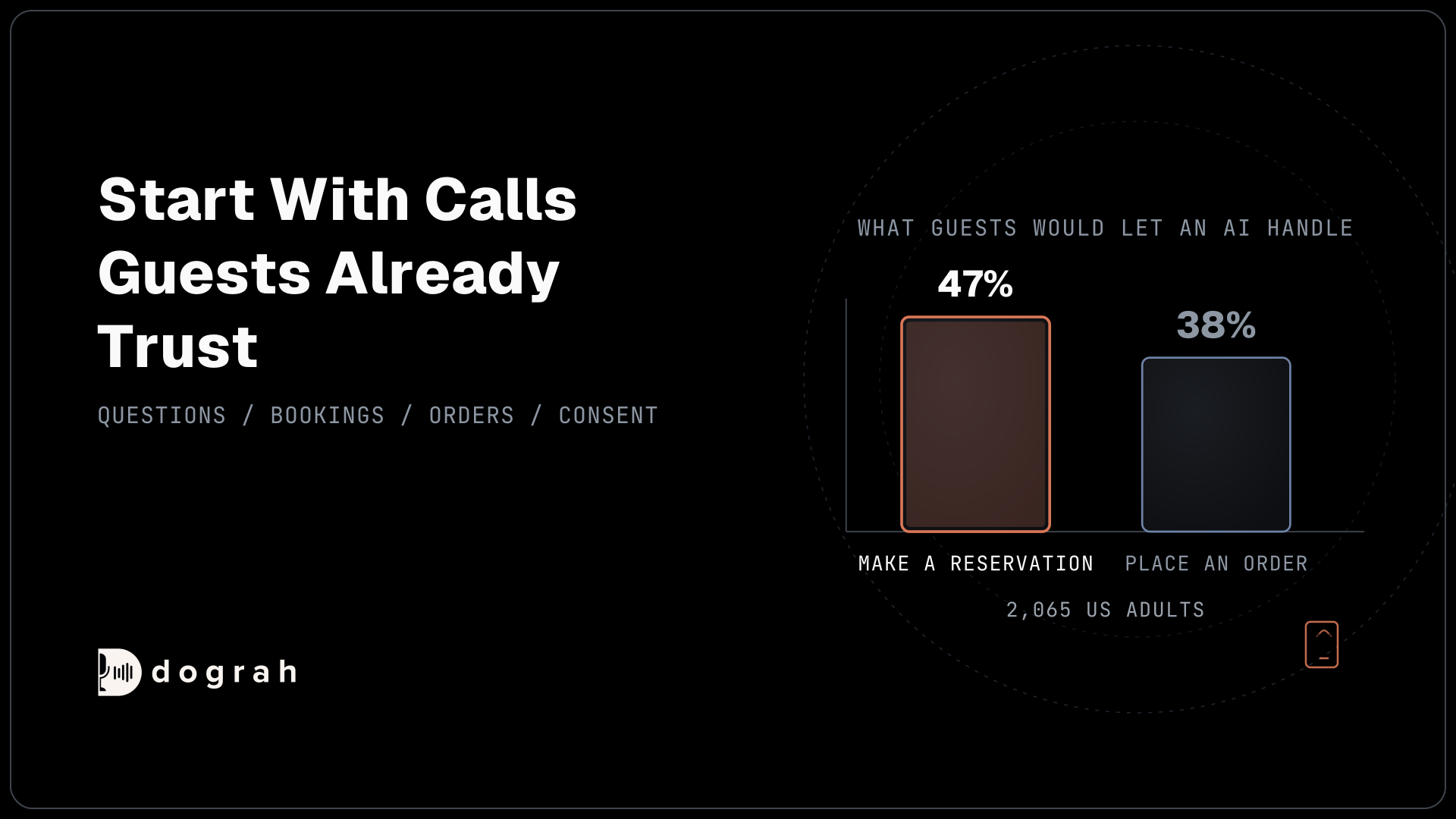
Hand over the calls guests already trust a machine with: questions first, then table bookings, then phone orders. Guests still phone. In a survey The Harris Poll ran for Hostie, a company that sells restaurant AI, fielded in May and June 2025, 63% of 2,065 US adults said a phone call is their preferred way to contact a restaurant, and 69% said they would likely give up on going if nobody answered. Asked which tasks they would let an AI agent handle, 47% chose making a reservation and 38% placing a pickup or delivery order.
Restaurant Dive's report on the National Restaurant Association's 2026 State of the Restaurant Industry found that 26% of operators use AI-related tools, and only 6% use AI for customer orders. Staff time is the pressure. In the National Restaurant Association's 2026 outlook, 42% of operators said their restaurant was not profitable last year, and nearly three quarters plan to hire but expect difficulty finding experienced managers and chefs.
Dograh runs these calls as a call flow you design. What a very large deployment looks like in practice is covered in What 1 Million AI Voice Calls Reveal for Restaurants and Home Services; this guide is about which calls to design and how.
Questions about hours and the menu
The safest first call only reads. Guests ask about opening hours, parking, the kids' menu and walk-ins. The agent answers from its Knowledge Base, which takes PDF, DOCX, DOC, TXT and JSON files up to 5 MB each, so your existing menu and FAQ sheet can feed it. Answers come from that file, never the model's memory, so update it the day the menu changes. Specials and sold-out dishes change faster than any file, so those come from the POS through an HTTP API tool.
For groups with several locations, Pre-Call Data Fetch, at the bottom of the Start Call node, can be set to Inbound calls only. When the call connects it sends the caller and called numbers to your endpoint, so the agent loads the menu and hours of the branch the guest dialled. General reception design, including when to hand a caller to a person, is in The Ultimate Guide to AI Receptionists.
Table reservations
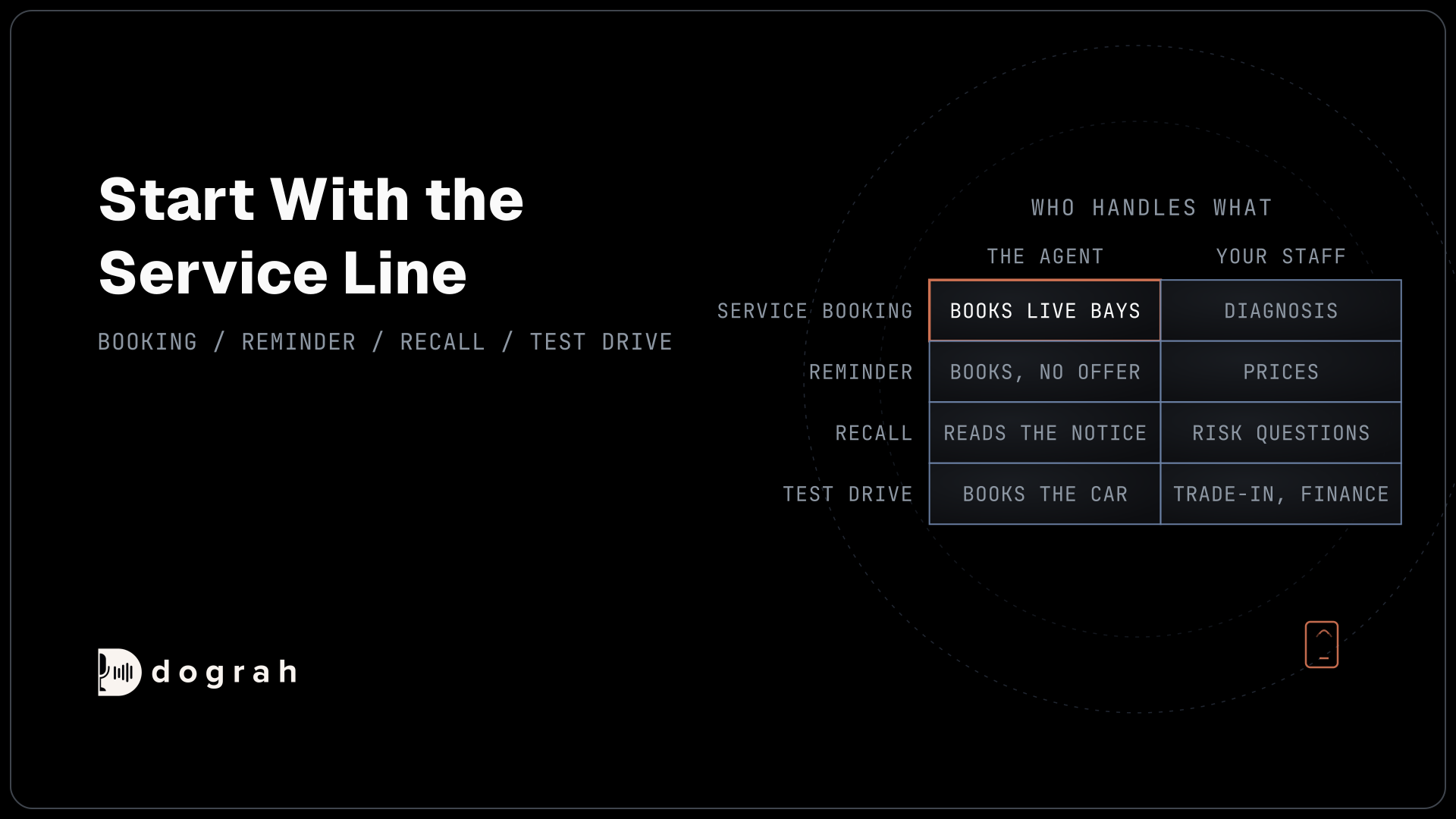
Bookings come next, against live availability. The agent asks for the date, time, party size and name, checks the reservation system through an HTTP API tool, reads the details back and confirms only after the system accepts. Changes and cancellations follow greet, verify, disclose: the agent asks for the name, date and time on the booking, which is enough when the call comes from the booking's phone number. If the number does not match, it also asks for the party size before it cancels anything.
Check your booking platform's API access before you plan this step. OpenTable's own API documentation sends developers to a partnership application, and other platforms have their own terms. Where the agent cannot write to the book, it records the request in your system and tells the guest a person will confirm it, or an HTTP API tool asks the restaurant's own messaging system to send the booking link, since Dograh sends no texts itself.
Large parties and special events go to staff: a party of 12 tonight is a reservation, and lunch for 60 next Thursday is catering. Day-before confirmation calls belong here too. The resOS No-Show Index, built from that reservation-software company's own data, recorded a 3.17% no-show rate across 309,604 US reservations between August 2025 and July 2026. That target is real but small, so keep confirmation calls short. AI voice agents for restaurant reservations covers bookings, changes and confirmation calls in full.
Phone orders
Takeaway and delivery orders come third, because an order has more ways to go wrong than a booking. Menu and prices come from the POS or the Knowledge Base, and the agent reads back every item and modifier with the total before it sends the order to the POS through an HTTP API tool. Add dish names to the agent's Dictionary, which works with Deepgram and Dograh speech-to-text; how much it helps depends on the provider. The full flow is in AI voice agents for phone ordering.
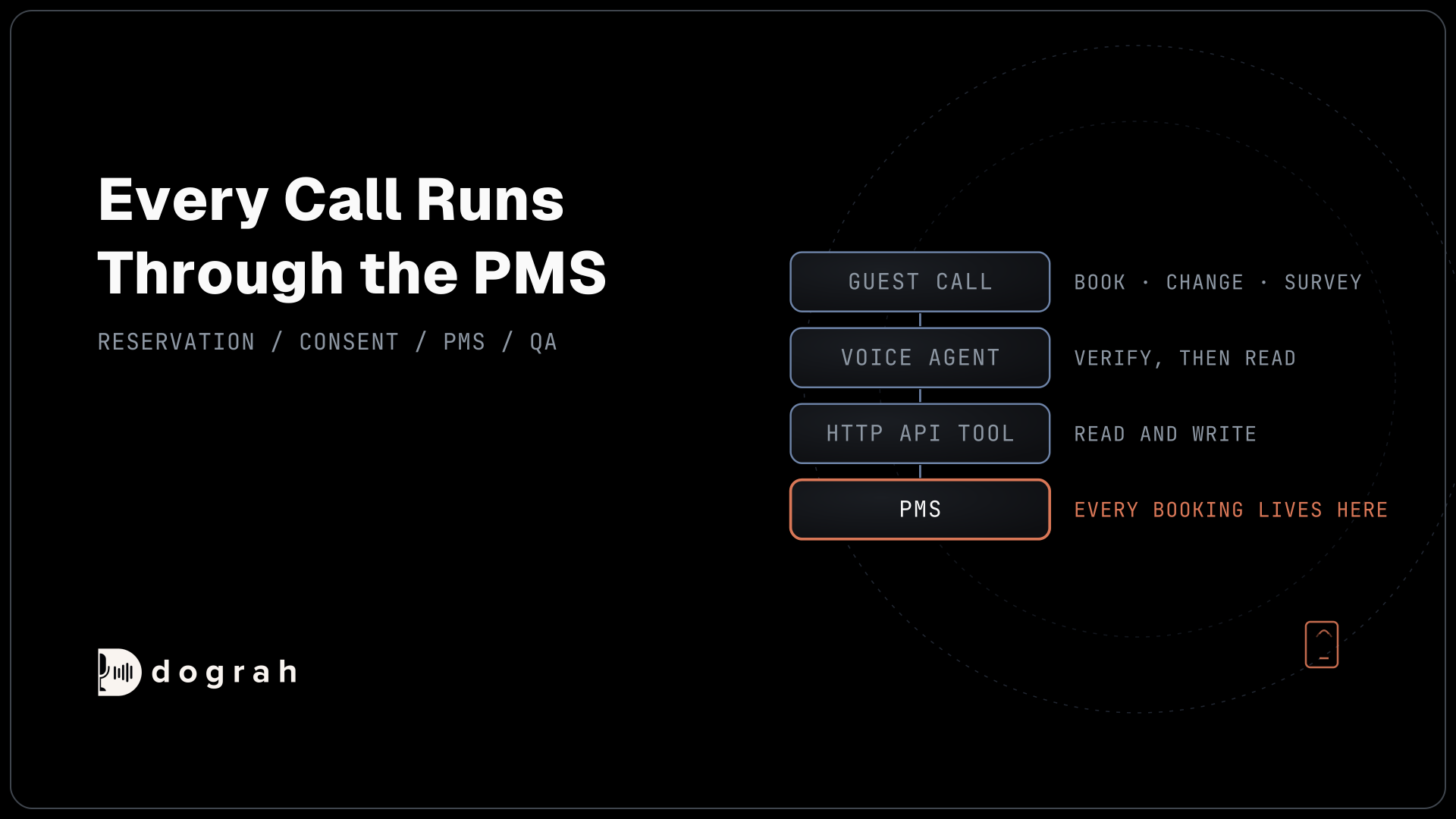
The reservation book and POS hold every booking and order
The reservation book and the POS are the system of record; the agent only reads and writes them. If the agent and the POS ever disagree, the POS wins, and the guest is never told something the POS has not stored.
Dograh has no built-in POS or reservation integrations. Your systems connect through HTTP API tools, MCP tools, the Webhook node, Pre-Call Data Fetch or the API Trigger (n8n and similar tools connect through these), pointed at your POS's API or a small service your team runs in front of it. During the call, a tool reads availability, sold-out items or an order's status; when the guest agrees, a tool writes the booking or order and returns the system's reply.
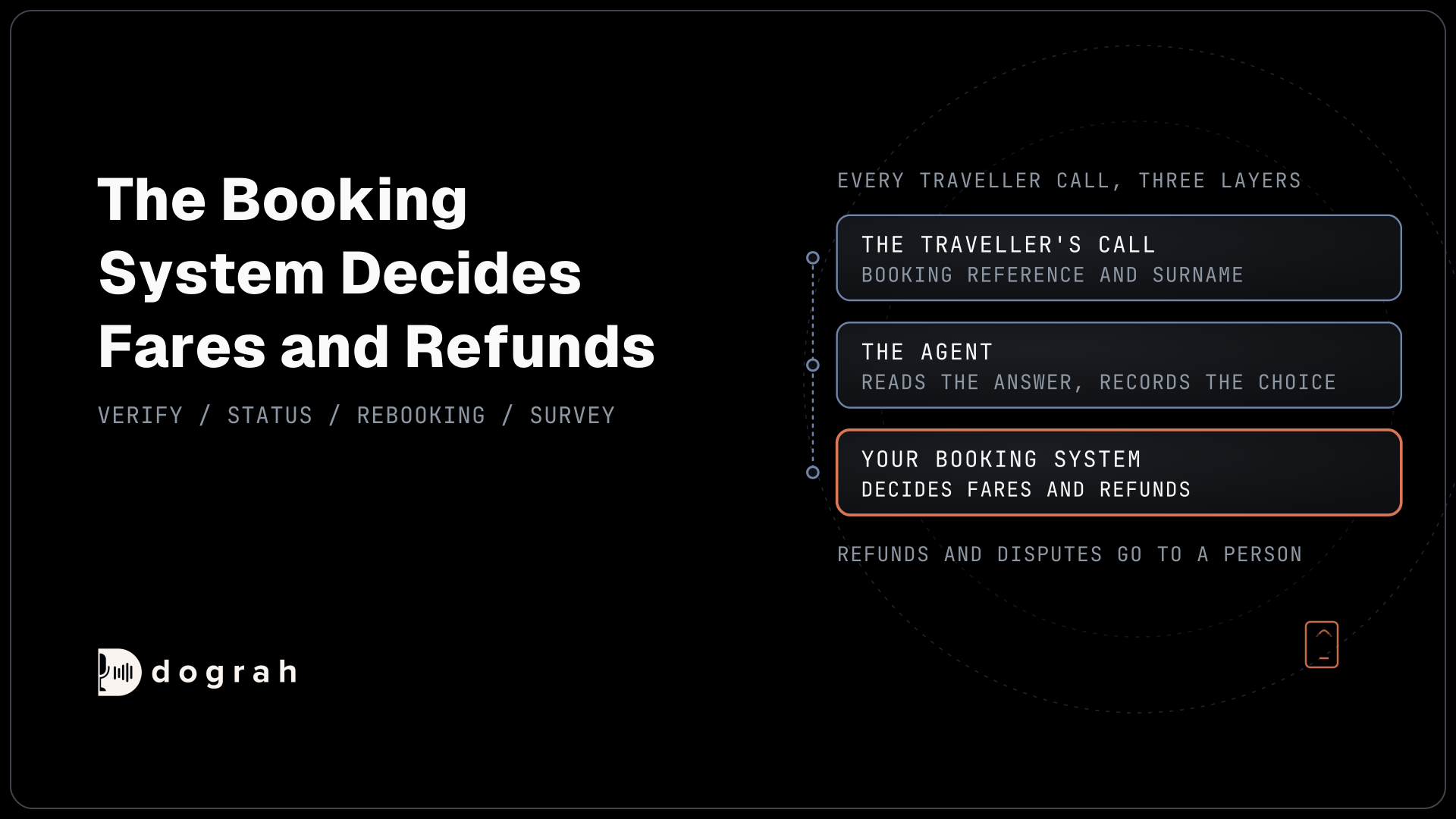
The reply decides what the agent says. If the POS accepts and returns an order number, the agent reads the number and pickup time. If it rejects the order or does not answer, the agent says the order is not placed yet and offers a person or a callback. Telling a guest "you're all set" for an order the kitchen never got is worse than a missed call.
A slow network can also make a tool send the same order twice. Add a Preset Parameter named workflow_run_id to the HTTP API tool, with the value {{initial_context.workflow_run_id}}. Dograh adds no Idempotency-Key header itself, so the receiving system uses that ID, with the slot or order, to ignore a duplicate.
After the call, a webhook sends the outcome, transcript link and recording link to your system. A temporary failure such as a timeout is retried automatically, up to 5 attempts, while a wrong URL or credential is not. Our guide to Integrating Voice Agents With Your Stack covers the read-during, write-after pattern.

Open Source Alternative to Vapi / Retell
Self-hosted voice agent platform — no per-minute fees
dograh-hq/dograh
Star on GitHub
Allergens, card numbers and refunds stay with people
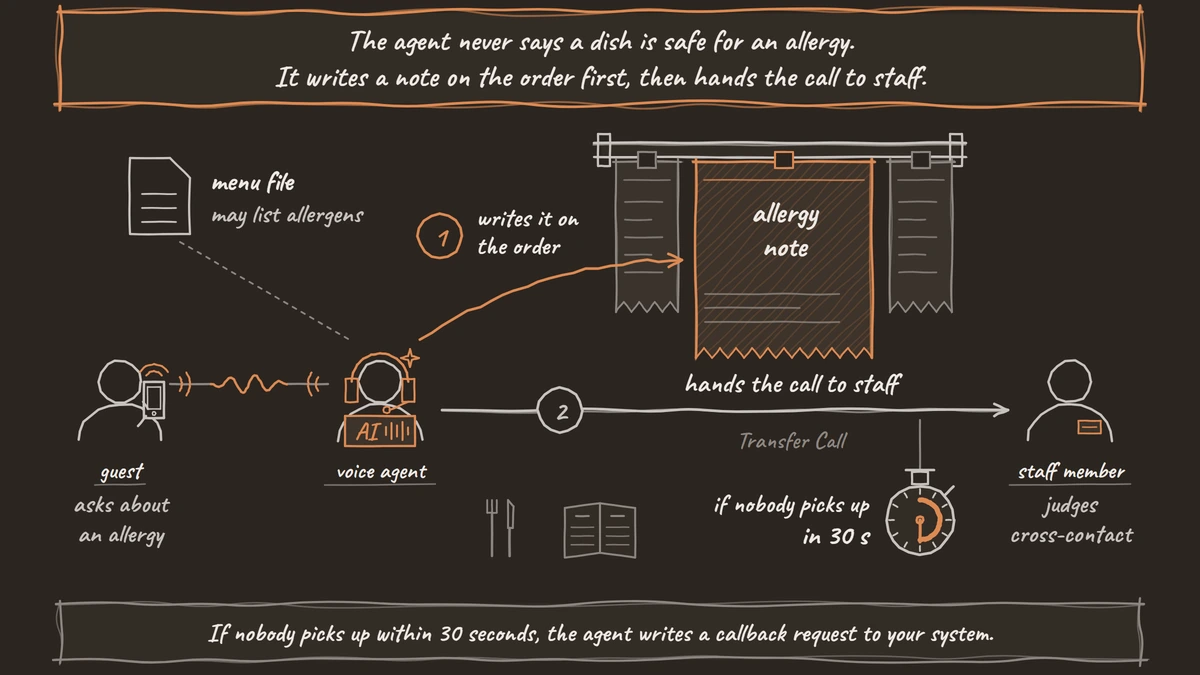
Some questions the agent hears but never settles. A wrong allergen answer can put a guest in hospital, and a spoken card number ends up in a recording, so these and refunds each have a fixed path to a person.
The agent never says a dish is safe for an allergy. The menu file may list allergens, yet cross-contact in the kitchen is a judgement only staff can make. On any allergy question, the agent writes a note on the order or booking first, then hands the call to a staff member. Put the handover line in the allergy pathway's Transition Speech, which plays word for word on a cascade agent, because anything a node prompt asks for is still worded by the model. Transfer Call works on Twilio only and passes no summary, hence the note first. If nobody picks up within 30 seconds (the default), the agent writes a callback request to your system instead.
No card number is ever taken by voice. Dograh has no keypad tool and no feature for taking customer payments on a call, which suits the rule. The guest pays at pickup, or an HTTP API tool asks the restaurant's own system or payment provider to send its secure payment link by text or email. Dograh also has no retention setting, so a spoken card number would sit in the recording and transcript until your team deletes it.
Refunds, comps and credits go to a manager. When a guest complains about a cold or wrong order, the agent records the complaint as stated and writes a manager callback request. It offers no refund, discount or free dish, because the agent never decides money.
Calls around the order: confirmations, catering and feedback
The restaurant also calls guests, and each call needs a good reason and consent.
Order confirmations
Call only when a decision is needed: a large or catering order, a delivery address that failed validation, a scheduled order for later in the week, or a dish the kitchen ran out of. Every other order gets the ordering system's own text receipt. The ordering system starts the call through Dograh's API Trigger, and Pre-Call Data Fetch, set to Outbound calls only, refreshes the order when the call connects. The agent confirms the name on the order and the order time before it reads the items or the address. A voicemail never carries order details. See AI voice agents for order confirmation in restaurants.
Catering inquiries
A catering call is worth many covers, so it reaches the events team fast. Monkey's 2026 State of Catering report, built from that catering platform's own transaction data and covered by Food On Demand, put the average catering order at about $416 in 2025 and found that 60% of catering orders come from 5% of customers. The agent's job is a complete lead, not a quote: it collects the date, headcount, budget range, dietary needs and contact details as stated, reads them back and sends them to the events team by webhook. It never invents a price or confirms a date the system has not returned. After-hours inquiries gain the most. Read AI voice agents for catering inquiries.
Feedback calls
A same-day call catches a food or delivery complaint before it turns into a public review. The agent asks for one rating and one open question, records the answers as stated and sends them to the review or customer relationship management (CRM) system by webhook. If the call offers a review link at all, it offers it with the same words to every guest, whatever their rating. A quality assurance (QA) node reviews a sample of these calls afterwards. The design is in AI voice agents for feedback surveys in restaurants.
Join the Dograh Community
Dograh is an OSS alternative to Vapi. Join our Slack community for queries, releases, best practices & community interactions.
Consent before any outbound call
Outbound calls with an AI voice generally need the guest's prior consent. This is general information, not legal advice. In its February 2024 declaratory ruling, the Federal Communications Commission (FCC) confirmed that "the TCPA's restrictions on the use of 'artificial or prerecorded voice' encompass current AI technologies that generate human voices." Under the Telephone Consumer Protection Act (TCPA), a confirmation call to a mobile number generally needs prior express consent, which usually means the number the guest gave for that booking or order. Add an offer, such as a dessert discount, and the call generally becomes telemarketing, which needs prior express written consent.
Dograh's Campaigns set calling hours by weekday and retry settings, but have no per-guest call cap, so your own call list enforces frequency, or retries stay at zero. A guest who says "stop calling me" is recorded and written back to your list at once. State rules and a call-by-call consent map for US restaurants are in AI voice agents for restaurants in the US.
Cost, and who owns the call data
Self-hosted Dograh has no per-minute platform fee (servers, model keys and phone minutes still cost); Dograh Cloud is a 1¢-a-minute platform fee. Dograh is the orchestration layer, running the call flow, tools and telephony; the speech and language models are a separate layer you choose.
Self-hosting Dograh keeps recordings and transcripts on your servers, but the guest's audio stays there only when the speech and language models also run there; with model API keys, the audio still reaches those providers. Dograh has no retention setting, so your own policy decides how long recordings and transcripts are kept. Self-hosted, recording can be switched off only server-wide, and transcripts are still saved.
Plan for the Friday rush. Dograh Cloud's Pay as you go plan includes 10 concurrent calls; for higher concurrency, contact Dograh. Self-hosted Dograh runs 10 concurrent calls by default, raised with DEFAULT_ORG_CONCURRENCY_LIMIT, and your servers and phone provider set the real ceiling.
A voice agent is the wrong tool for some restaurants. If the phone rings a few times a day, if most calls are about bespoke private-event menus, or if there is no reservation system or POS the agent can write to, a person with a notepad does the job better. For a restaurant that wants restaurant voice AI without vendor lock-in, the open-source route keeps the call flow, the data and the price in its own hands.
Build it: start with a phone-ordering agent
The phone-ordering agent is the best first build, because it uses every rule in this guide. Our tutorial on how to build a voice agent for restaurants walks through it in Dograh, from the Greeting Text that names the restaurant to the read-back, the POS write that confirms only on success, the allergy handover and the post-call webhook.
Test it on a web call first, then on a real phone line. Most phone calls reach the agent as 8 kHz audio, while a browser test runs at 16 kHz, which changes what the speech model hears, especially with kitchen noise. Once live, run QA on a sample of calls, around 5 to 10%, and fix what the transcripts show. Our post on Testing Voice Agents Before You Go Live gives the test order.
Then widen it in this guide's order: questions for a week, bookings once transcripts look clean, then orders, and outbound calls only once consent is recorded.
Each call above has its own deep dive:
- AI Voice Agents for Restaurant Reservations
- AI Voice Agents for Phone Ordering
- AI Voice Agents for Order Confirmation in Restaurants
- AI Voice Agents for Catering Inquiries
- AI Voice Agents for Feedback Surveys in Restaurants
- How to Build a Voice Agent for Restaurants
- AI Voice Agents for Restaurants (US)
Glossary
- Read-back
- The agent repeats a booking or order to the guest, item by item with the total, before anything is written to the restaurant's system. It catches mishearing while the guest can still correct it.
- System of record
- The reservation system or POS whose stored data counts as the truth. The agent reads and writes it, and tells the guest only what that system has accepted.
- Pre-Call Data Fetch
- A setting at the bottom of Dograh's Start Call node that requests fresh data from your endpoint once the call connects, sending the caller and called numbers. A multi-location group can use it to load the right branch's menu.
- Prior express written consent
- The signed consent that TCPA rules generally require before a telemarketing call with an artificial or AI voice reaches a mobile number. Adding an offer to a confirmation call can make it telemarketing.