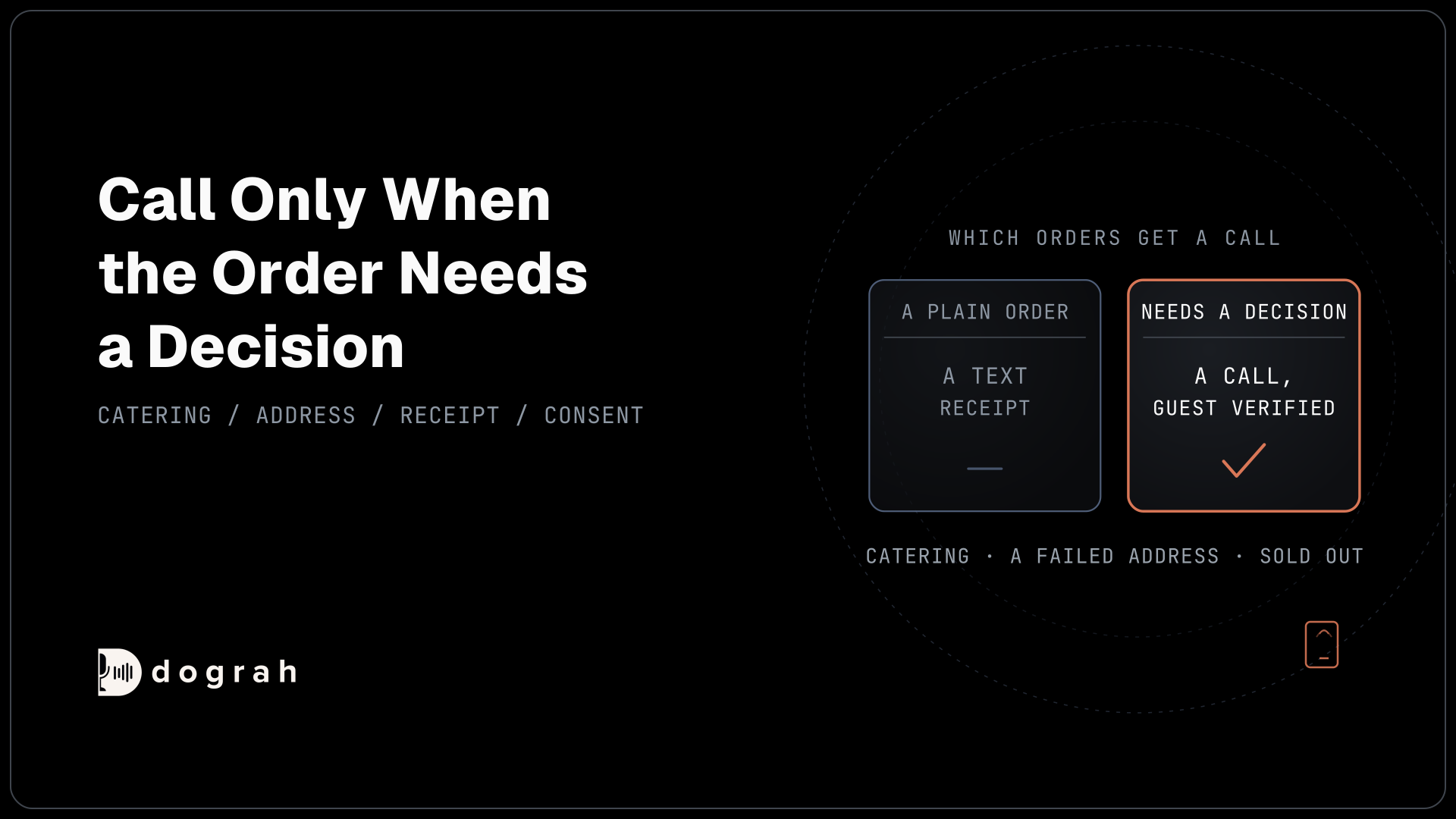

AI voice agents for order confirmation in restaurants call a guest only when an order needs a decision, such as a catering order or a dish the kitchen ran out of. They verify the guest, read back the items, time and address, record any change as stated and write it back to the restaurant's system.
Key Takeaways
- Call only when the order needs a decision; text a receipt otherwise.
- Verify the guest before reading any order details aloud.
- Keep every offer out of the call, or the consent it needs changes.
This post is part of our guide to AI voice agents for restaurants. The guide's section on order confirmations sets one rule: call only when a decision is needed, and let the ordering system text a receipt for everything else. Here is that outbound call in full, built on Dograh, an open-source, self-hostable voice agent platform, which starts from your ordering system and writes the guest's answers back to it.
Call only when the order needs a decision
A confirmation call interrupts a guest's day, so it has to be worth more than a text. Most orders are not. A plain takeaway order needs a receipt, and the restaurant's own ordering system sends that by text with no voice agent involved. Dograh has no SMS tool and sends no texts itself.
Four kinds of order earn a call. The first is a catering or large order, where a wrong headcount or delivery window ruins an event. Monkey's 2026 State of Catering report, built from that catering platform's own transaction data across more than 100 restaurant brands and covered by Food On Demand, put the average catering order at about $416 in 2025. The second is a delivery address that failed validation in the ordering system. The third is an order scheduled for later in the week, where plans change. The fourth is a dish the kitchen ran out of after the order came in.
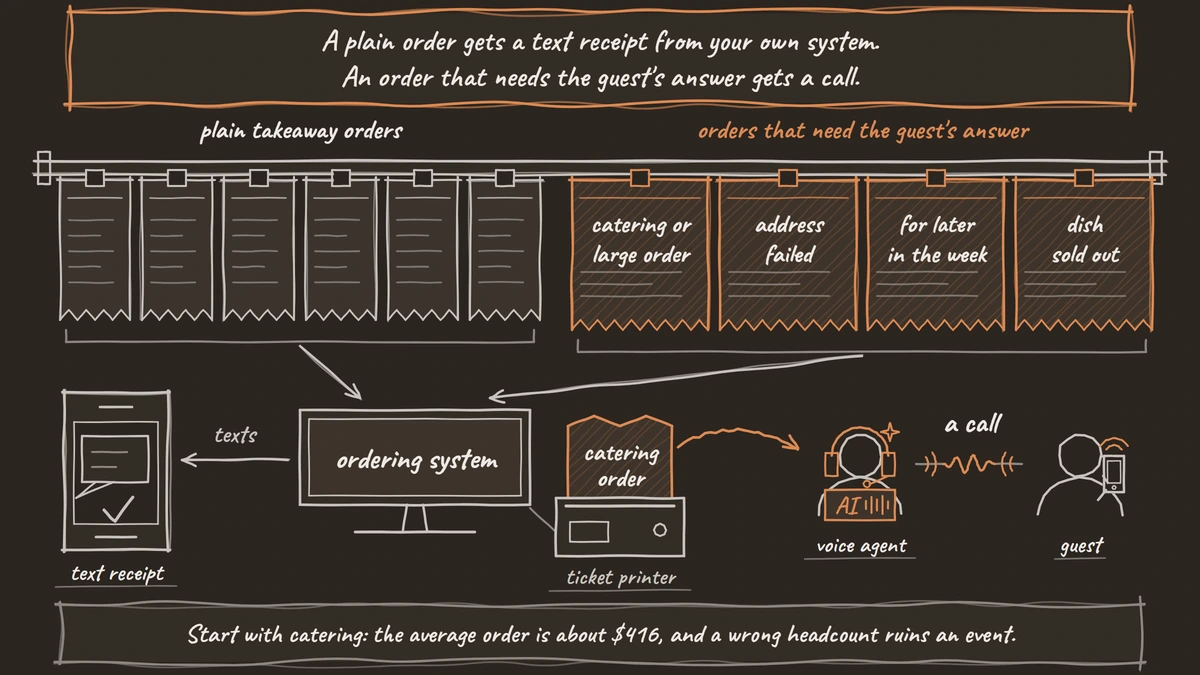
Each of these needs the guest to say something back. The inbound order call itself is covered in AI voice agents for phone ordering, and table confirmations belong to the reservations post, since a booking is not a food order.
Start the call from the ordering system
The ordering system knows when an order needs a call, so it should start the call. Dograh's API Trigger takes a request from your system with the guest's number and the order details, and the agent starts with those details in hand. The setup is in API Triggers: Start a Voice Agent Call From Any System.
For a list, such as tomorrow's catering orders, upload it to Campaigns. Campaigns set calling hours by weekday and retry settings: up to 10 retries (2 by default), a retry delay from 30 seconds to an hour, and switches for retrying on busy, no answer or voicemail. There is no per-guest call cap, so your own list decides how often one guest is called, or retries stay at zero.
Orders change between the trigger and the answer. Pre-Call Data Fetch, at the bottom of the Start Call node and set to Outbound calls only, requests the latest order from your endpoint once the call connects. If the guest already fixed the address online, the agent reads the fixed one.
Verify before you read anything back
An order holds a name and an address, so the agent checks who answered before it says any of it. The call runs greet, verify, disclose. The Greeting Text, spoken word for word, names the restaurant. If you want to tell guests they're speaking with an automated assistant, or your location requires it by law, write it there too. Naming the restaurant generally covers the rule in 47 CFR 64.1200(b)(1) to "state clearly the identity of the business, individual, or other entity that is responsible for initiating the call" at the beginning of the message.
Then the agent asks for the guest by the name on the order. Asking for the name only finds the right person; it does not prove who they are. So the agent asks the guest to say what time the order is for, and only after a match does it read the order. A phone number on the order finds it. It never proves who picked up.
The read-back covers what the decision needs: the items, the time and, for delivery, the address with the flat number. For a catering order that means the headcount and the delivery window. The agent reads each part and asks whether it is right.
If the call reaches voicemail, the message carries no order details. It gives the restaurant's name and a number to call back, nothing about what was ordered or where it is going.

Open Source Alternative to Vapi / Retell
Self-hosted voice agent platform — no per-minute fees
dograh-hq/dograh
Star on GitHub
Record changes as stated, then write them back
The guest's answer is the point of the call, so the agent records it as the guest stated it and writes it to your system before the call ends. For a sold-out dish, the agent offers only the swaps your point-of-sale (POS) system returns as available through an HTTP API tool, never a dish from memory. For an address or time correction, it reads the new value back before writing it.
The write goes through an HTTP API tool to your ordering system or POS. The agent tells the guest the change is made only when the system accepts it. If the system rejects the change or does not answer, the agent says so and offers a callback from staff. Add a Preset Parameter named workflow_run_id with the value {{initial_context.workflow_run_id}}, so a request sent twice does not change the order twice. Dograh adds no Idempotency-Key header itself; the receiving system uses that ID to ignore the duplicate.
Money stays with people. If a change means a refund on a prepaid order, or a catering guest asks to cancel, the agent records the request and writes it to your system for staff, who apply the restaurant's own terms. It offers no credit or discount. A new catering inquiry, as opposed to a confirmation of one already placed, belongs in AI voice agents for catering inquiries.
When a guest needs a person on the spot, Transfer Call hands the call over on Twilio only, with no summary, so the details are written first. After every call, a webhook sends the outcome and the transcript link to your system.
Join the Dograh Community
Dograh is an OSS alternative to Vapi. Join our Slack community for queries, releases, best practices & community interactions.
Consent before the first confirmation call
An outbound call with an AI voice generally needs the guest's consent before it is made. This is general information, not legal advice. In its February 2024 declaratory ruling, the Federal Communications Commission (FCC) confirmed that "the TCPA's restrictions on the use of 'artificial or prerecorded voice' encompass current AI technologies that generate human voices." Under the Telephone Consumer Protection Act (TCPA) rules in 47 CFR 64.1200(a)(1), a call to a mobile with an artificial voice needs "the prior express consent of the called party". For an order confirmation, that generally means the number the guest gave for that order.
The consent bar rises the moment the call sells something. Under 64.1200(a)(2), a call "that includes or introduces an advertisement or constitutes telemarketing" generally needs "the prior express written consent of the called party". "Would you like to add dessert?" can be enough to cross that line, so keep every offer out of the confirmation call.
A guest who says "stop calling me" is recorded as stated and written back to your list at once, so no later campaign rings them. The state rules and the call-by-call map are in AI voice agents for restaurants in the US. Confirm your own position with counsel before the first call.
Where the order data lives
A rented calling product keeps recordings of guests' names, addresses and orders on the vendor's side. Self-hosting Dograh keeps recordings and transcripts on your servers. The guest's audio stays there too only when the speech and language models also run on your servers; with model API keys, it still reaches those providers. Dograh has no retention setting, so your own policy decides how long recordings and transcripts are kept.
Self-hosted Dograh has no per-minute platform fee (servers, model keys and phone minutes still cost); Dograh Cloud is a 1¢-a-minute platform fee.
Start with catering orders, which carry the most at stake per call, and read a week of transcripts before adding address and sold-out calls.
Glossary
- Prior express consent
- The consent TCPA rules generally require before a call with an artificial or AI voice reaches a mobile number. For an order confirmation, it usually comes from the guest giving that number for the order.
- Prior express written consent
- The signed consent TCPA rules generally require once a call includes an advertisement or constitutes telemarketing. A confirmation call that adds an upsell can need it.
- API Trigger
- Dograh's way for another system, such as an ordering system, to start an outbound call with a request that carries the guest's number and the order details.
- Pre-Call Data Fetch
- A setting at the bottom of Dograh's Start Call node that requests fresh data from your endpoint once the call connects. Set to Outbound calls only, it reloads the latest order before the agent speaks.