
AI voice agents for catering inquiries answer a restaurant's catering line at any hour and turn each call into a complete lead. The agent collects the event date, headcount, budget range, dietary needs and contact details as the caller states them, reads them back and sends them to the events team. Quotes and date holds stay with a person.
Key Takeaways
- A catering lead needs the date, headcount, budget and diet, read back.
- Prices come from your menu file or your events team, never the model.
- After-hours catering calls gain the most, because nobody waits by the phone.
This post is part of our guide to AI voice agents for restaurants. The guide's section on calls around the order gives catering one paragraph: collect a complete lead, send it to the events team, never quote. Here is that call in full, built in Dograh, an open-source, self-hostable voice agent platform, with the lead written to your own systems before anyone rings the caller back.
Why every catering call deserves an answer
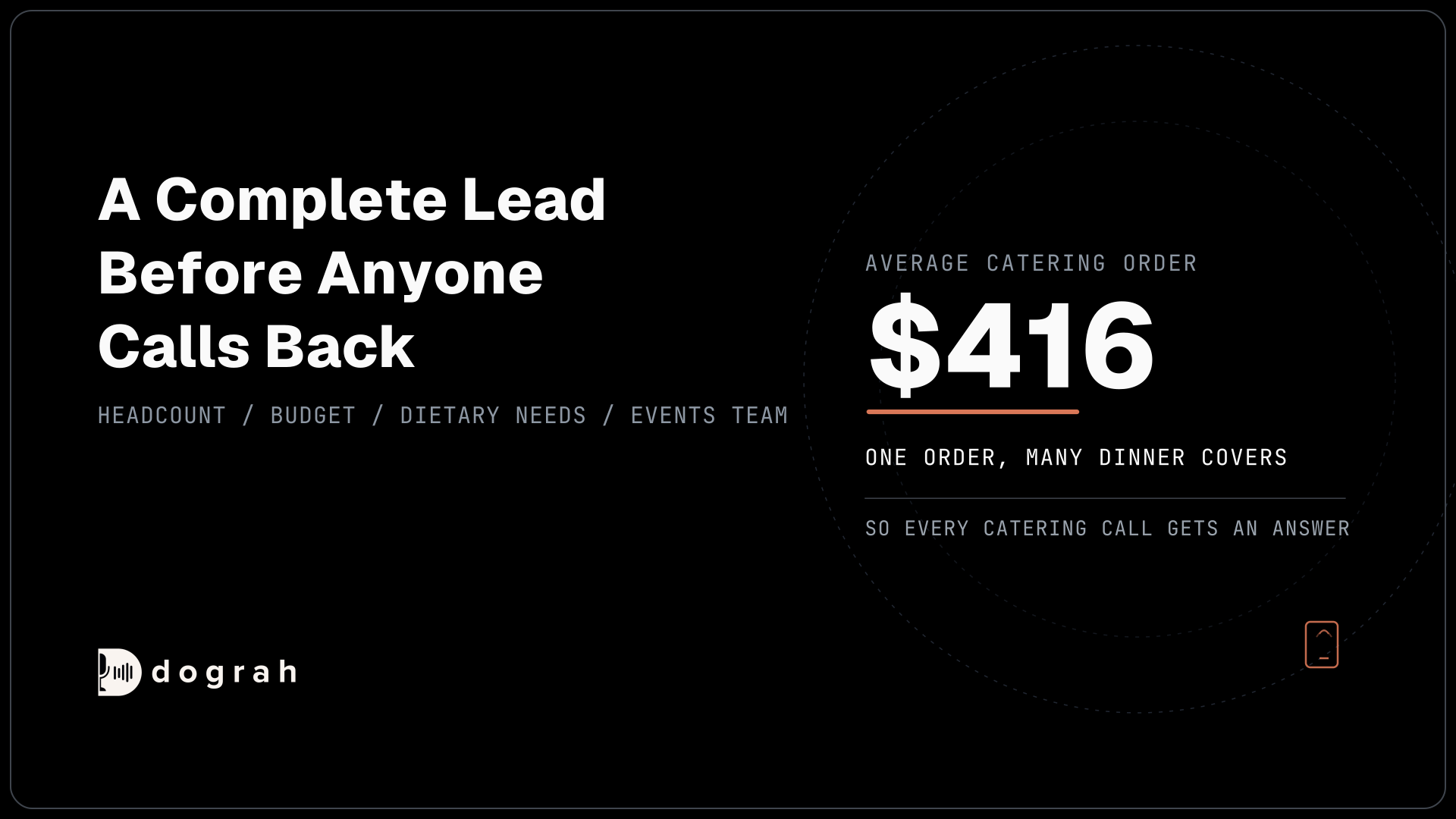
One catering order is worth many dinner covers, and a small group of buyers places most of them. Monkey's 2026 State of Catering report, built from that catering software company's own transaction data across more than 100 restaurant brands and covered by Food On Demand, put the average catering order at about $416 in 2025. It also found that 60% of catering orders come from just 5% of customers. Miss the first call from an office manager who orders every month, and the year of orders that would have followed goes with it.
The same vendor report projects that marketplaces will handle 36% of catering orders in 2026, up from 12.8% in 2021. An inquiry that reaches your own phone line is one you keep for yourself, so the direct line is worth answering well.
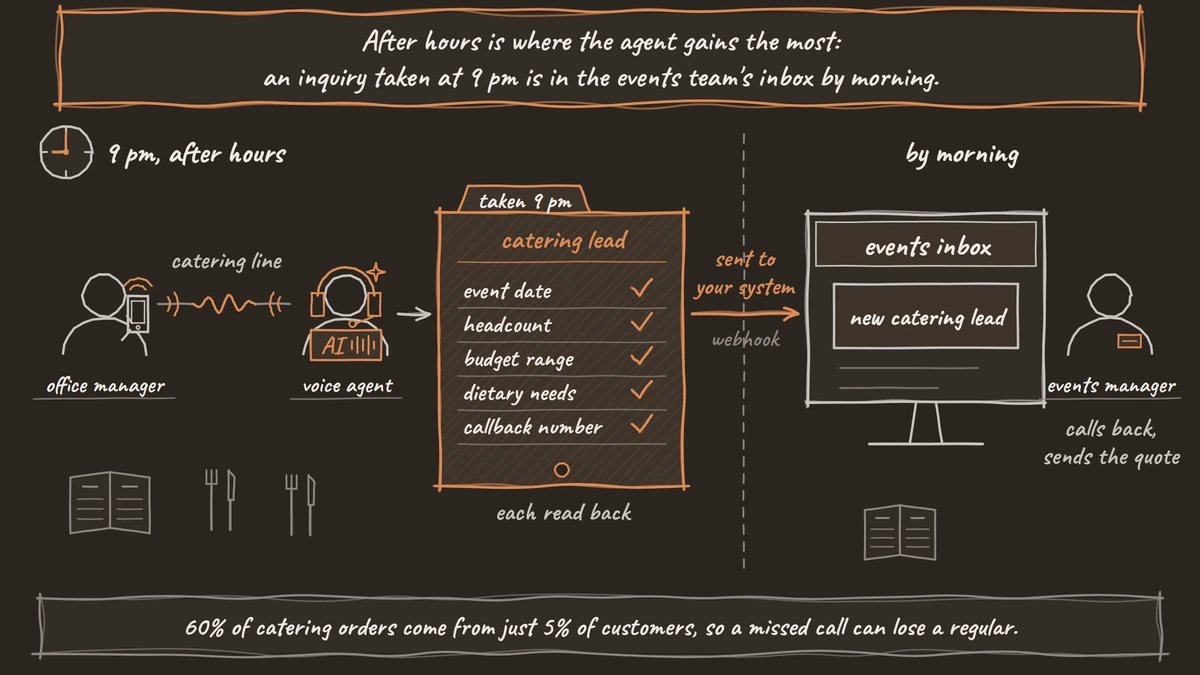
Catering calls are also easy to miss, because they come in rarely and often during the lunch rush. In a 2025 survey The Harris Poll ran for Hostie, a company that sells restaurant AI, 69% of 2,065 US adults said they would likely give up on a restaurant if nobody answered the phone. That question was about restaurants in general, not catering. After hours is where the agent gains the most: an inquiry taken at 9 pm is in the events team's inbox by morning.
Where a reservation ends and catering begins
The boundary is simple: a party of 12 tonight is a reservation, and lunch for 60 next Thursday is catering. A reservation is a table the book shows as free, and the agent can book it against live availability, as our post on AI voice agents for restaurant reservations explains. Catering covers food that leaves the building, office lunches, private-room buyouts and events with a menu built for them. Each of those needs a person to plan and price it, so the agent's job ends at a complete lead.
Two calls sit close to the line. A group that wants a set menu or the private room is a catering inquiry even when it eats on site, because the menu and any minimum spend need a person. A caller asking about a catering order that is already placed is a different call again. The agent asks for the name on the order plus the event date and time before it reads out any detail, and asks for the headcount too when the call comes from a number that is not on the order. Outbound calls that confirm a placed catering order are covered in AI voice agents for order confirmation in restaurants.
The details the agent collects, read back as stated
A complete catering lead answers every question the events manager would otherwise ask on the callback. The agent asks for the type of event, the date and whether it can move, the headcount or a range, the budget range or price per head, dietary needs, the service style (drop-off or staffed) and the delivery address or venue. Then it takes the caller's name, company, phone number, email and the best time to call back.
Ranges are fine. A planner who says "somewhere between 50 and 70" gets that range written down.
Dietary needs are recorded, never assessed. The caller may say four vegetarians, two gluten-free guests and one guest with a severe nut allergy. The agent writes exactly that and says the events team will confirm how the kitchen handles each need. It never says a dish is safe for an allergy, because cross-contact, which the FDA describes as "the inadvertent introduction of a major food allergen into a product", is a kitchen judgement only staff can make.
The read-back comes before the call ends. The agent repeats the date, headcount, budget, dietary needs and callback number, and the caller corrects anything it misheard. Dograh's variable extraction then records each answer as the caller stated it. Extraction is an AI step, so the transcript and the recording stay the exact record, and the events manager can check a figure against them.

Open Source Alternative to Vapi / Retell
Self-hosted voice agent platform — no per-minute fees
dograh-hq/dograh
Star on GitHub
Menus and prices come from your data or a person
A catering price depends on the menu, the headcount, staffing and the date, so a custom quote is a person's job. The agent answers only what the restaurant has written down. Put the catering menu, packages, minimum headcounts, lead times and delivery area in the agent's Knowledge Base, which takes PDF, DOCX, DOC, TXT and JSON files up to 5 MB each.
If the menu lists a boxed lunch at a set price per head, the agent can read that price out exactly as written. A total for 60 guests with staff and a dessert table is a quote, and the events team sends it.
Dates work the same way. If your events calendar has an API, an HTTP API tool can ask whether a date is open, and the agent repeats only what the calendar returns. Without that, the agent says the events team will confirm the date. It never promises to hold a date or a room. A promised date that later falls through costs more than a callback.
Where every call is a bespoke quote, the agent adds little during office hours. It still earns its place at night and during service, when nobody else can take the details.
Getting the lead to the events team fast
A lead is only useful once the events team has it. When the call ends, a webhook sends the lead to your system: the recorded fields plus the transcript and recording links. The Webhook node takes an endpoint URL, an HTTP method, authentication and a payload template, which can carry values such as {{gathered_context.headcount}}. A temporary failure such as a timeout is retried automatically, up to 5 attempts, while a wrong URL or credential is not. Our post on Webhook-Driven Voice Agents: Real-Time Data In and Out covers the setup.
Dograh has no built-in CRM integrations, so the webhook points at your CRM's API or an n8n workflow. Dograh sends no texts either, so any text alert to the events manager comes from the receiving system.
During service hours, a caller who wants to speak to someone now can be passed to the events manager with Transfer Call, which works on Twilio only. The transfer carries no summary, so the agent first writes the lead to your system through an HTTP API tool. If nobody picks up within 30 seconds, the default, the caller stays with the agent, which records a callback request with the best time to call. After hours, the agent tells the caller when the events team usually returns calls, from the hours written into its prompt, and promises nothing faster. The wider after-hours design is in AI Voice Agents for After-Hours Coverage.
Join the Dograh Community
Dograh is an OSS alternative to Vapi. Join our Slack community for queries, releases, best practices & community interactions.
Who keeps the catering leads
Catering leads hold names, company names, phone numbers, addresses and sometimes a guest's allergy. Self-hosting Dograh keeps the recordings and transcripts on your servers. The callers' audio stays on your servers too only when the speech and language models also run there; with model API keys, the audio still reaches those providers. Dograh has no retention setting, so your own policy decides how long recordings and transcripts are kept.
Self-hosted Dograh has no per-minute platform fee (servers, model keys and phone minutes still cost); Dograh Cloud is a 1¢-a-minute platform fee.
Start with the after-hours line. Read a week of transcripts with the events manager, add the questions the callbacks still had to ask, then switch the agent on during service as well.
Glossary
- Catering lead
- The record of one catering inquiry: event type, date, headcount, budget range, dietary needs, service style and contact details, as the caller stated them. The events manager prices and confirms from it.
- Read-back
- The agent repeats the details to the caller before the call ends, so a misheard date or headcount is corrected before the lead is sent.
- Knowledge Base
- The files a Dograh agent answers from, such as the catering menu, packages and minimum headcounts. It takes PDF, DOCX, DOC, TXT and JSON files up to 5 MB each.
- Webhook
- The request Dograh sends to your system when a call ends, carrying the recorded fields and the transcript and recording links. Temporary failures are retried automatically.