
AI voice agents for restaurant reservations answer the booking line, check live availability in the restaurant's reservation system, read the name, party size, date and time back, and confirm only after that system accepts the booking. They verify the guest before changing or cancelling a table, and they pass large parties and special events to staff.
Key Takeaways
- Confirm a table only after the reservation system accepts the booking.
- Check the name, date and time before any change or cancellation.
- Large parties, private events and allergy notes go to a person.
This post is part of our guide to AI voice agents for restaurants. The guide's section on table reservations puts bookings second, after menu questions, because every booking has to match live availability. Here is the full booking call, built on Dograh, an open-source, self-hostable voice agent platform, which reads and writes your reservation system during the conversation.
Book only from live availability
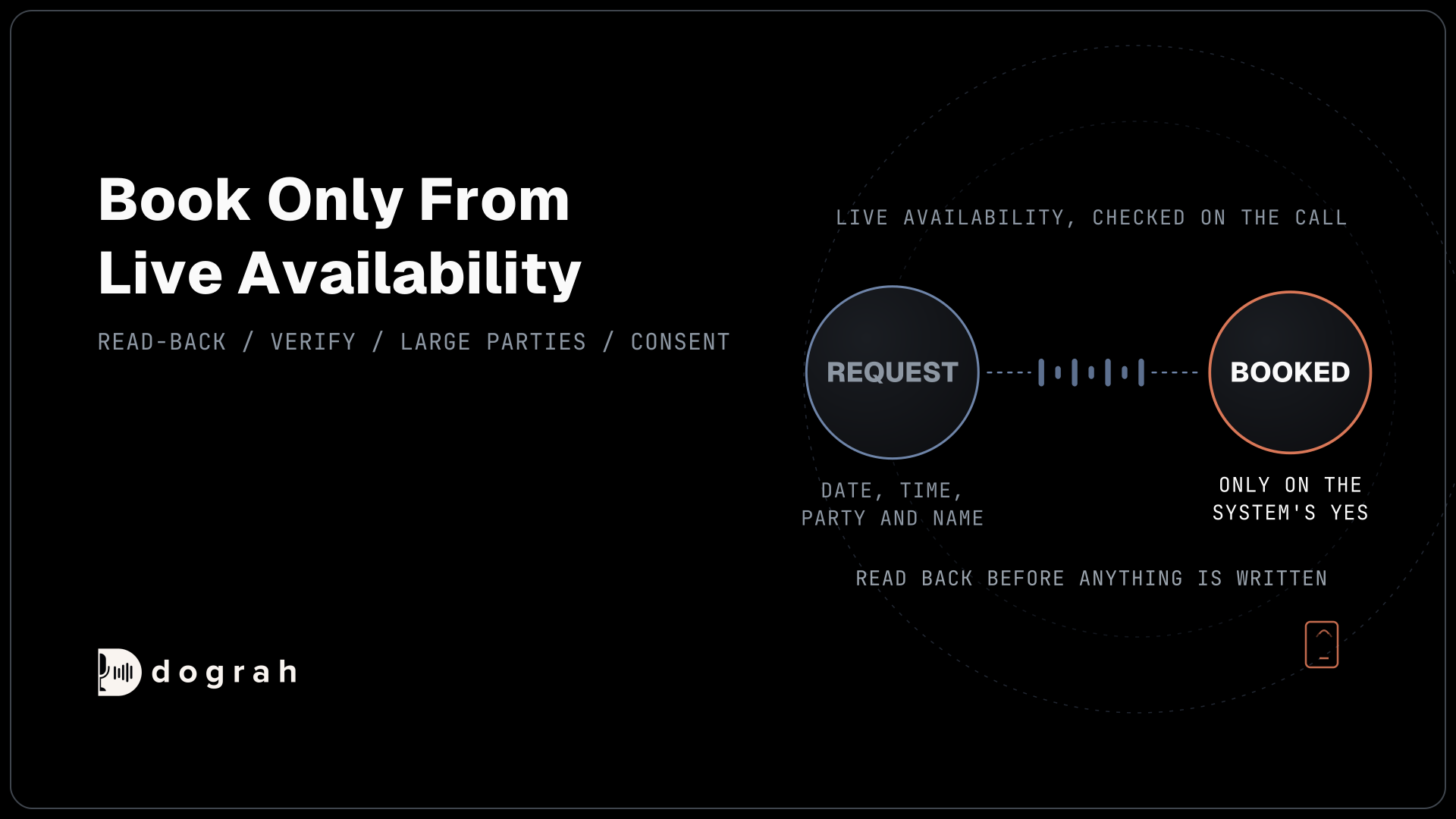
A booking is real only once the reservation system holds it, so the agent checks and writes it during the call. The guest gives a date, a time, a party size and a name. An HTTP API tool asks the reservation system which tables are open for that slot. If the slot is full, the agent offers the nearest times the system returned, never a time it guessed.
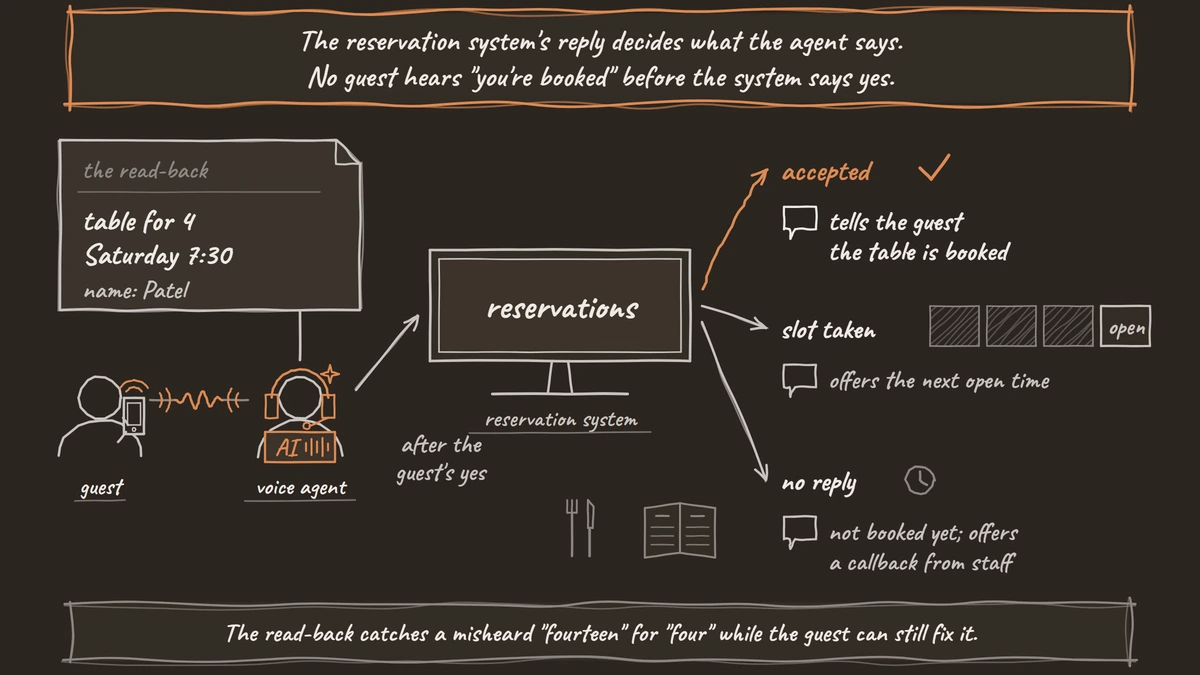
Before it writes anything, the agent reads the booking back: "A table for four, this Saturday at 7:30, under the name Patel. Is that right?" The read-back is where a misheard "fourteen" for "four" comes out, while the guest can still fix it. Only after a yes does a second request create the booking.
The system's reply decides the next sentence. If the reservation system accepts the booking, the agent tells the guest the table is booked. If it rejects the booking because someone took the slot a moment earlier, the agent says so and offers the next open time. If the system does not answer, the agent says the booking is not made yet and offers a callback from staff. A guest never hears "you're booked" before the system has said yes.
Slow networks cause a quieter problem, the same booking sent twice. Add a Preset Parameter named workflow_run_id to the HTTP API tool, with the value {{initial_context.workflow_run_id}}. Dograh adds no Idempotency-Key header itself, so your reservation system, or the small service in front of it, uses that ID with the slot to ignore a duplicate. Our tutorial on booking a slot mid-call through an HTTP API tool shows the setup.
When your booking platform has no open API
Before you plan the booking step, check whether your booking platform offers API access, because writing a booking needs an API the agent can call. OpenTable's API documentation asks developers to apply for a partnership, and it grants access to production data only after an agreement is signed.
Dograh has no built-in reservation integrations. Your systems connect through HTTP API tools, MCP tools, the Webhook node, Pre-Call Data Fetch or the API Trigger (n8n and similar tools connect through these), pointed at your platform's API or at a small service your team runs in front of the book.
Where the agent cannot write to the book, it records the request as the guest stated it, writes it to your system and says a person will confirm the table. Or an HTTP API tool asks the restaurant's own messaging system to text its booking link, since Dograh sends no texts itself. In both cases the agent never says the table is booked.

Open Source Alternative to Vapi / Retell
Self-hosted voice agent platform — no per-minute fees
dograh-hq/dograh
Star on GitHub
Changes and cancellations: verify, then write back
A change touches a booking that already exists, so the agent checks who is calling before it reads the booking out or alters it. The call runs greet, verify, disclose. Pre-Call Data Fetch, at the bottom of the Start Call node and set to Inbound calls only, can look up bookings under the caller's number as soon as the call connects. That finds the likely booking. It does not prove who is calling.
The check stays light, because a table booking holds little personal data. The agent asks for the name on the booking plus its date and time, and accepts those when the call comes from the phone number on the booking. If the number does not match, it also asks for the party size before it changes or cancels anything. A phone number alone is never enough to cancel.
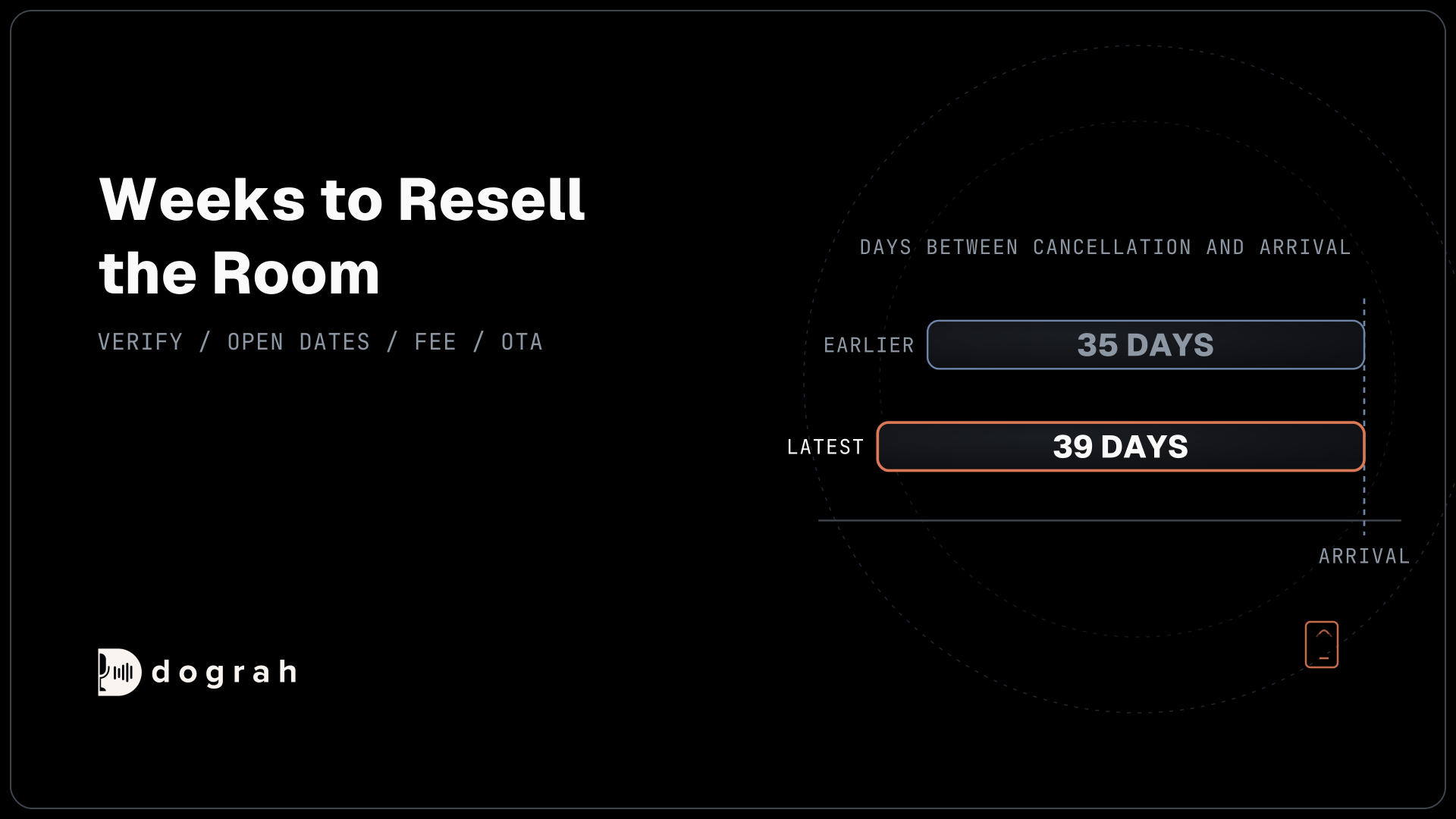
Write the change back the moment the guest confirms it. The resOS No-Show Index, built from that reservation-software company's own platform data, counted 566,049 cancellations between August 2025 and July 2026, and 56% of them came within 24 hours of the booking or after it had started. A late cancellation is a table you can still fill, but only if the book shows it free straight away. A webhook after the call sends the outcome and the transcript link to your system.
Large parties and special events go to staff
Some bookings need a person's judgement, and the agent's job there is a clean handover. Set the threshold in the prompt, for example any party above eight, plus private events and requests for a particular table. The boundary with catering is simple: a party of 12 tonight is a reservation, and lunch for 60 next Thursday is catering, which our post on AI voice agents for catering inquiries covers.
Large groups rarely fail to turn up. resOS recorded a 1.15% no-show rate for parties of 10 or more, against 2.63% for parties of one or two. When one does, a whole section sits empty, and these bookings often carry set menus or seating plans the floor team owns. So the agent collects the date, time, headcount and name, writes them to your system and hands the call to the host through Transfer Call.
Transfer Call works on Twilio only and passes no summary, which is why the details are written first. If nobody answers within 30 seconds (the default), the guest stays with the agent, which writes a callback request to your system through an HTTP API tool. Allergy notes follow the same rule. The agent adds the note to the booking and never says a dish is safe, because only the kitchen can answer that.
Join the Dograh Community
Dograh is an OSS alternative to Vapi. Join our Slack community for queries, releases, best practices & community interactions.
Day-before confirmation calls
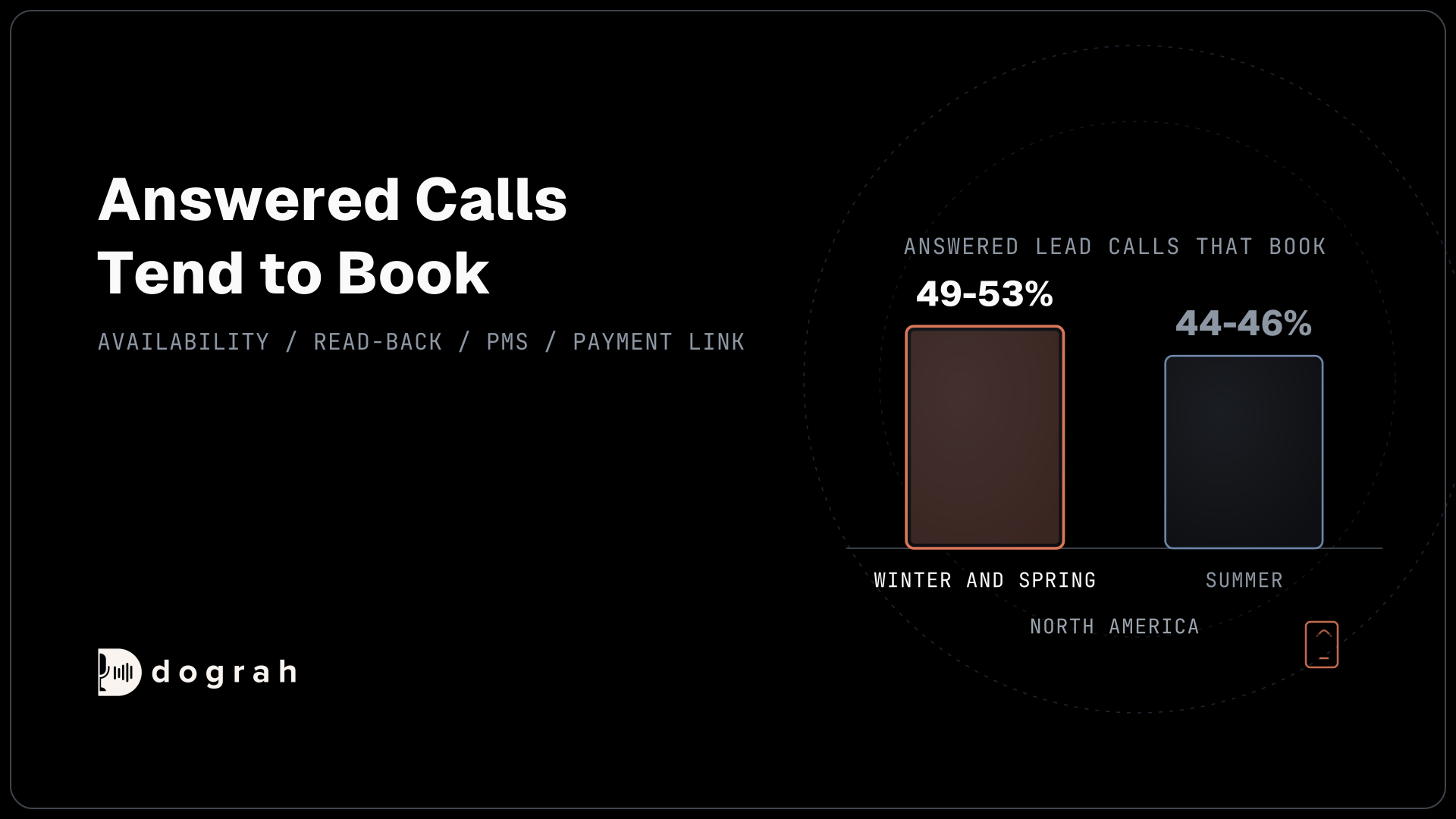
Confirmation calls should be short. resOS recorded a 3.17% no-show rate across 309,604 US reservations at 316 restaurants over the same twelve months, so the target is real but small. One question, keep or cancel, is enough.
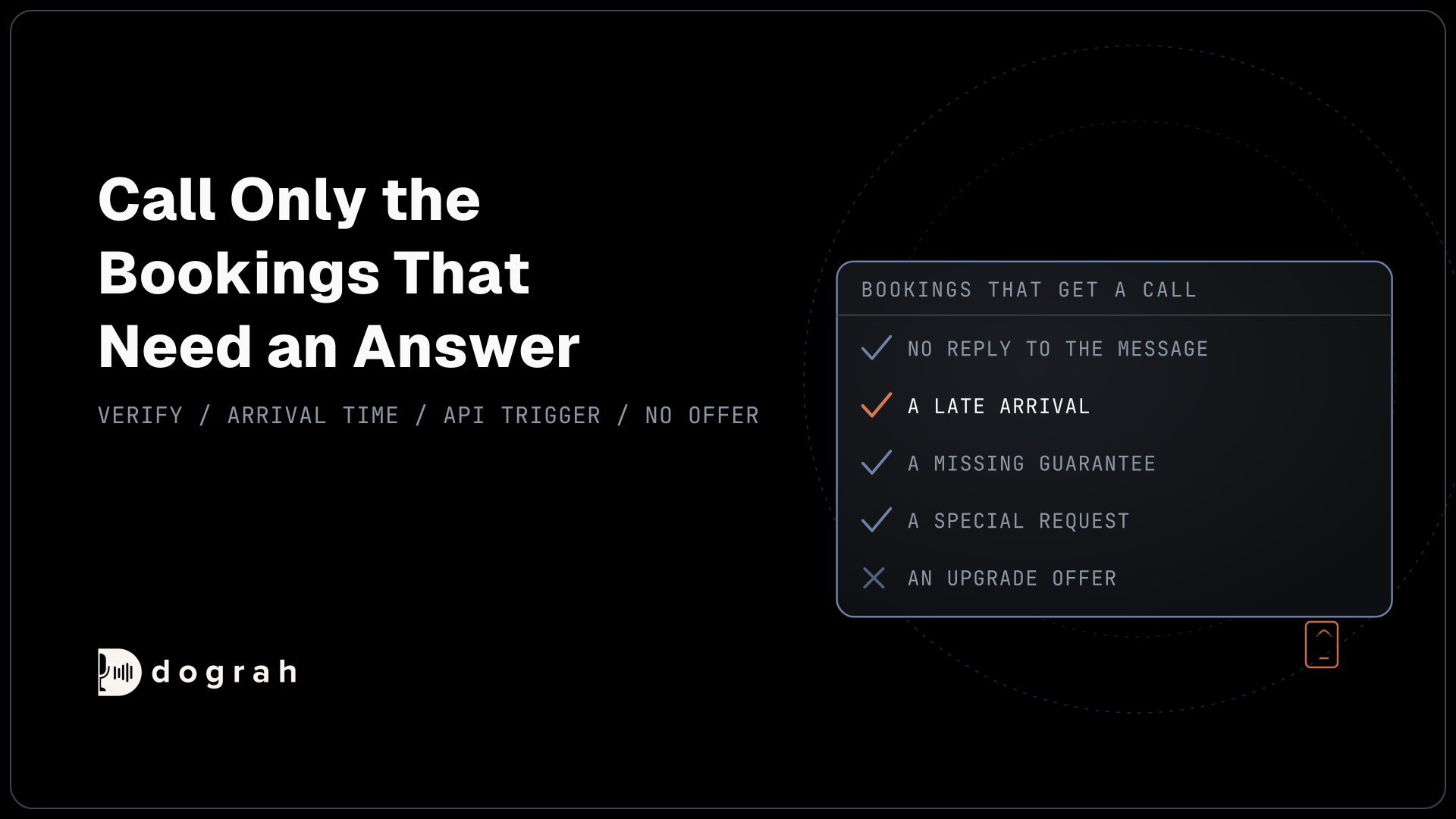
Your reservation system starts each call through Dograh's API Trigger, or you upload the next day's list to Campaigns. Pre-Call Data Fetch, set to Outbound calls only, refreshes the booking when the call connects, so a table cancelled overnight is never confirmed by mistake. The agent names the restaurant and asks for the guest by name. Because the restaurant dialled the number on the booking, it then reads the date and time and asks whether to keep the table, and it confirms the party size before it cancels. A cancellation is written back at once. A voicemail carries no booking details, only the restaurant's name and a number to call back.
Consent comes before the first call. This is general information, not legal advice. Under the Telephone Consumer Protection Act (TCPA) rules in 47 CFR 64.1200(a)(1), a call to a mobile number "using an automatic telephone dialing system or an artificial or prerecorded voice" needs "the prior express consent of the called party", and in a February 2024 ruling the Federal Communications Commission (FCC) confirmed that AI-generated voices count. A confirmation for a booking made with that number generally rests on that consent. Add an offer, such as a set menu or a discount for next time, and the call generally becomes telemarketing, which needs prior express written consent. Campaigns have no per-guest call cap, so keep retries low and record any "stop calling" at once. The state detail is in AI voice agents for restaurants in the US; confirm your own position with counsel.
Where the booking data lives
A rented reservation phone product keeps the call flow and the recordings on the vendor's side. Self-hosting Dograh keeps recordings and transcripts on your servers. The guest's audio stays there too only when the speech and language models also run on your servers; with model API keys, it still reaches those providers. Dograh has no retention setting, so your own policy decides how long recordings and transcripts are kept.
Self-hosted Dograh has no per-minute platform fee (servers, model keys and phone minutes still cost); Dograh Cloud is a 1¢-a-minute platform fee.
Start with new bookings, read a week of transcripts, then add changes, and add confirmation calls once consent is in your records.
Glossary
- Live availability
- The open tables your reservation system reports at the moment of the call. The agent offers only these times and never a time it worked out itself.
- Read-back
- The agent repeats the booking to the guest, with the name, party size, date and time, before anything is written. It catches mishearing while the guest can still correct it.
- Pre-Call Data Fetch
- A setting at the bottom of Dograh's Start Call node that requests fresh data from your endpoint once the call connects, sending the caller and called numbers. It finds the likely booking but does not prove who is calling.
- Prior express consent
- The consent TCPA rules generally require before a call with an artificial or AI voice reaches a mobile number. A call that adds an offer generally needs prior express written consent instead.