
AI voice agents for cancellations and rescheduling in hotels take guest calls to move or cancel a stay. After checking the confirmation number and surname, the agent reads the booking, its policy and any fee from the property management system, offers only open dates, states the fee as returned and writes the change back. Refunds go to a person.
Key Takeaways
- The agent states the fee the PMS returns and never computes one.
- New dates come only from live availability, read back before writing.
- Refunds and waivers go to a person; OTA changes go to the platform.
This post is part of our guide to AI voice agents for hotels and hospitality. The guide's section on changing the stay sets the rule for this call: the agent reads the hotel's cancellation policy and never decides it. Here is how that call runs on Dograh, an open-source, self-hostable voice agent platform, with every fee and every open date coming from the hotel's property management system (PMS).
Most cancellations arrive weeks before the stay
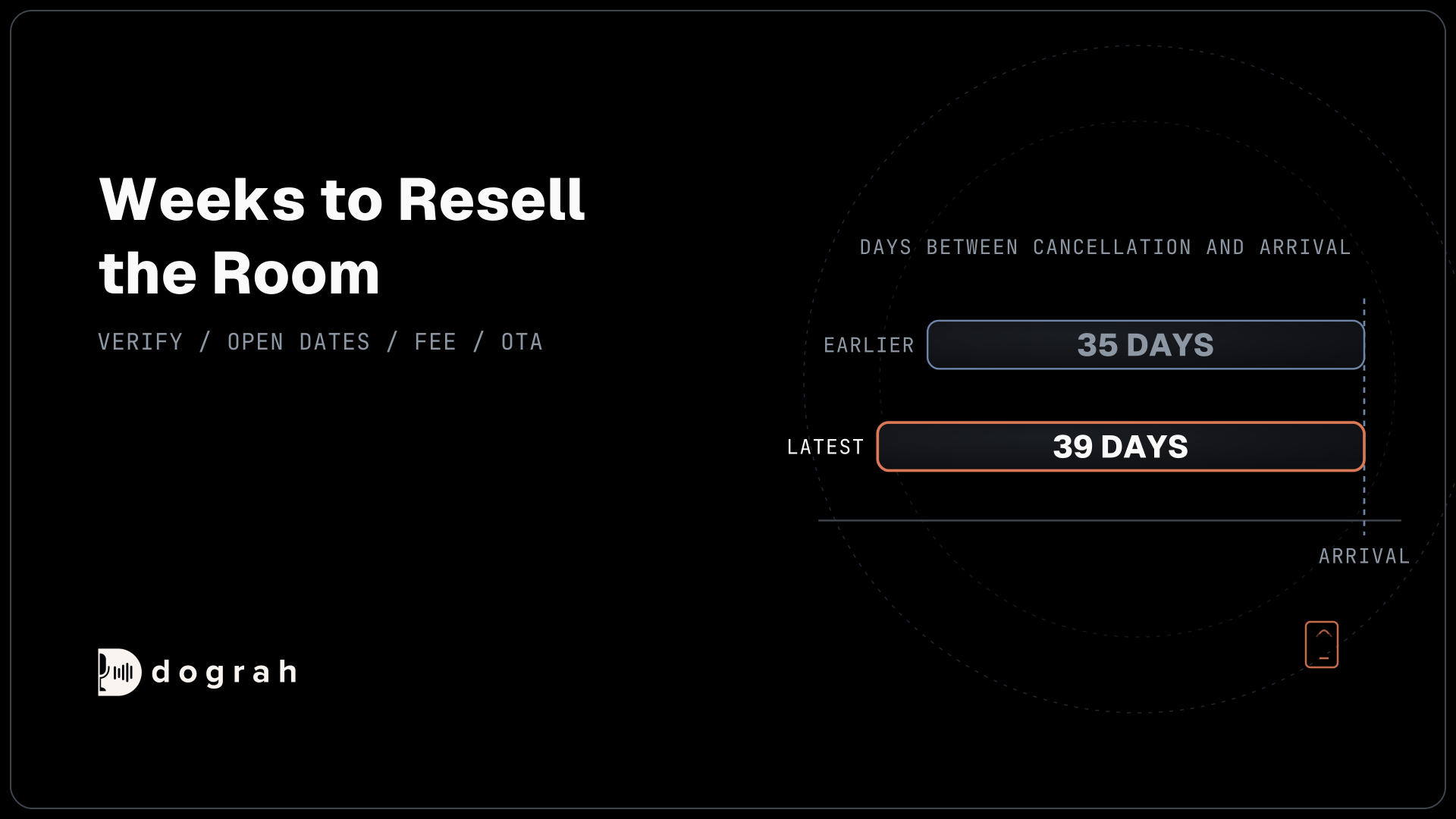
A cancellation call usually comes early enough to resell the room, which makes speed on the phone worth something. Cloudbeds, which sells a hotel management platform, reported in its 2026 State of Independent Hotels Report that the average cancellation window reached 39 days in 2025, up from 35 in 2023, across 90 million bookings. That is vendor data. A room released five weeks out goes straight back on sale.
The same report found that bookings made through an online travel agency (OTA) were cancelled 21.8% of the time, against 10.6% for direct bookings. Those OTA bookings are the ones a hotel's own agent can change least, because the platform runs its own process. A guest who calls to cancel a direct booking is also a guest who might move it instead, and a moved booking is revenue the hotel keeps.
Verify, then read the booking from the PMS
Nothing about the stay is said until the caller is verified. The call opens with Greeting Text, the fixed line Dograh plays word for word, naming the hotel. If you want to tell guests they're speaking with an automated assistant, or your location requires it by law, write it there too. Then the agent asks for the confirmation number and the surname on the booking.
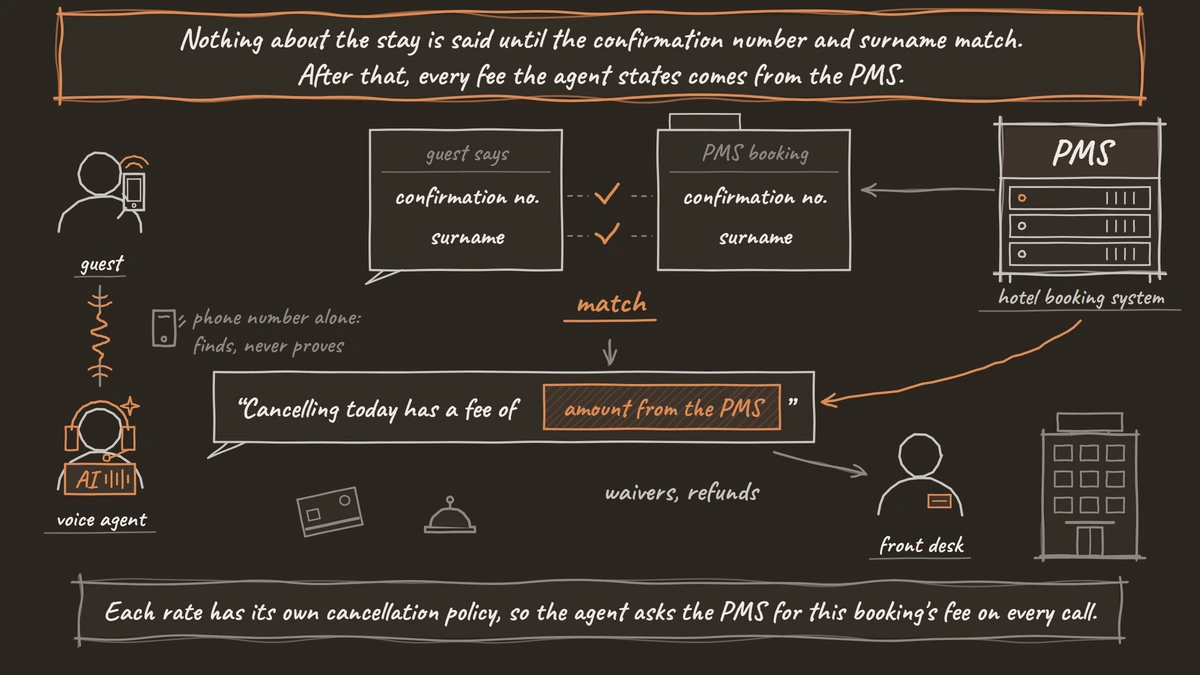
A phone number is not enough. Pre-Call Data Fetch, at the bottom of the Start Call node, can find a booking from the caller's number as the call connects, but anyone can call from a shared or old number. If the confirmation number and surname do not match, the agent names no dates and no amounts, and offers to pass the caller to the front desk.
Once the guest is verified, an HTTP API tool asks the PMS for the booking, its rate, the cancellation policy for that rate and any fee that applies today. The rate policy differs from rate to rate, and often with how close the stay is, so the agent reads it for each booking. It never applies a general rule from its prompt. Then it asks whether the guest wants to move the stay or cancel it.
Moving the dates
A date change offers only what the PMS shows as open, at the rate the PMS quotes. The agent asks for the new dates, and an HTTP API tool checks live availability for the same room type. If the new dates cost more or less, the agent reads out the new total exactly as the PMS returned it. It never estimates the difference.
Before writing, the agent reads the new booking back: the new dates and the new total for the same room type. When the guest agrees, a second HTTP API tool writes the change. Add a Preset Parameter named workflow_run_id with the value {{initial_context.workflow_run_id}}, so the PMS can ignore a duplicate if the request is sent twice; Dograh adds no Idempotency-Key header itself. The agent then reads out the updated confirmation the PMS returns.
If your PMS only allows reads, the agent takes the request and staff confirm it. The agent says so plainly and does not promise the new dates.
Some rates need a new deposit when the dates move. No card number is taken on the call, in line with the PCI Security Standards Council's guidance on telephone-based payment card data. Instead, an HTTP API tool asks the hotel's own system to send a secure payment link by text or email.

Open Source Alternative to Vapi / Retell
Self-hosted voice agent platform — no per-minute fees
dograh-hq/dograh
Star on GitHub
Cancelling and stating the fee
The agent states the cancellation fee exactly as the PMS returns it, after verification, and makes no money decision of its own. A line such as "Your rate allows free cancellation until two days before arrival, so cancelling today has a fee of", plus the amount and currency from the PMS, is all the agent says about money. The agent does not compute the fee, waive it, round it or promise a refund.
Before cancelling, the agent may ask once whether other dates would work. A no ends the topic. Then it confirms the cancellation with the guest, an HTTP API tool writes it to the PMS, and the agent reads out the cancellation number the PMS created.
Dograh has no SMS tool, so the written confirmation comes from the hotel's own system, triggered by the cancellation in the PMS. After the call, a webhook sends the outcome and the transcript link to the hotel's system, and a temporary failure is retried automatically. Our post on webhook-driven voice agents covers that data flow in and out of a call.
Join the Dograh Community
Dograh is an OSS alternative to Vapi. Join our Slack community for queries, releases, best practices & community interactions.
Refunds, waivers and OTA bookings go to a person
Anything that bends the policy needs a person, because a waiver is a judgement about this guest and this stay. Refund requests, fee waivers, billing disputes and complaints all leave the agent. Transfer Call hands the guest to the front desk. It works on Twilio only and passes no summary, so the agent first writes the guest's request to the hotel's system through an HTTP API tool.
If nobody answers within 30 seconds, the default timeout, the guest stays with the agent, which offers a callback and writes that request to the hotel's system. At night that callback is often the only route, and our post on AI voice agents for after-hours coverage covers how a morning team picks those up.
OTA bookings follow the platform's own change and cancellation process. The agent explains that the change has to go through the site the guest booked on, offers to note the request for the hotel, and promises no outcome.
This call often follows another. A guest who decides to cancel during a pre-arrival check is handed here from AI voice agents for booking confirmations in hotels, and a guest who cancels and wants a fresh booking goes to the flow in AI voice agents for hotel reservations. Self-hosted Dograh has no per-minute platform fee (servers, model keys and phone minutes still cost); Dograh Cloud has a 1¢-a-minute platform fee.
Glossary
- Cancellation window
- The time between a cancellation and the planned arrival date. A long window gives the hotel time to resell the room.
- Rate policy
- The cancellation and change rules attached to the rate a guest booked, such as a free-cancellation deadline or a non-refundable rate. The agent reads it from the PMS for each booking.
- Fee waiver
- A decision to drop a cancellation fee the policy would charge. It is a judgement about one guest and one stay, so it stays with hotel staff.
- Online travel agency (OTA)
- A booking site such as Booking.com or Expedia that sells hotel rooms for a commission. Changes to its bookings follow the platform's own process.