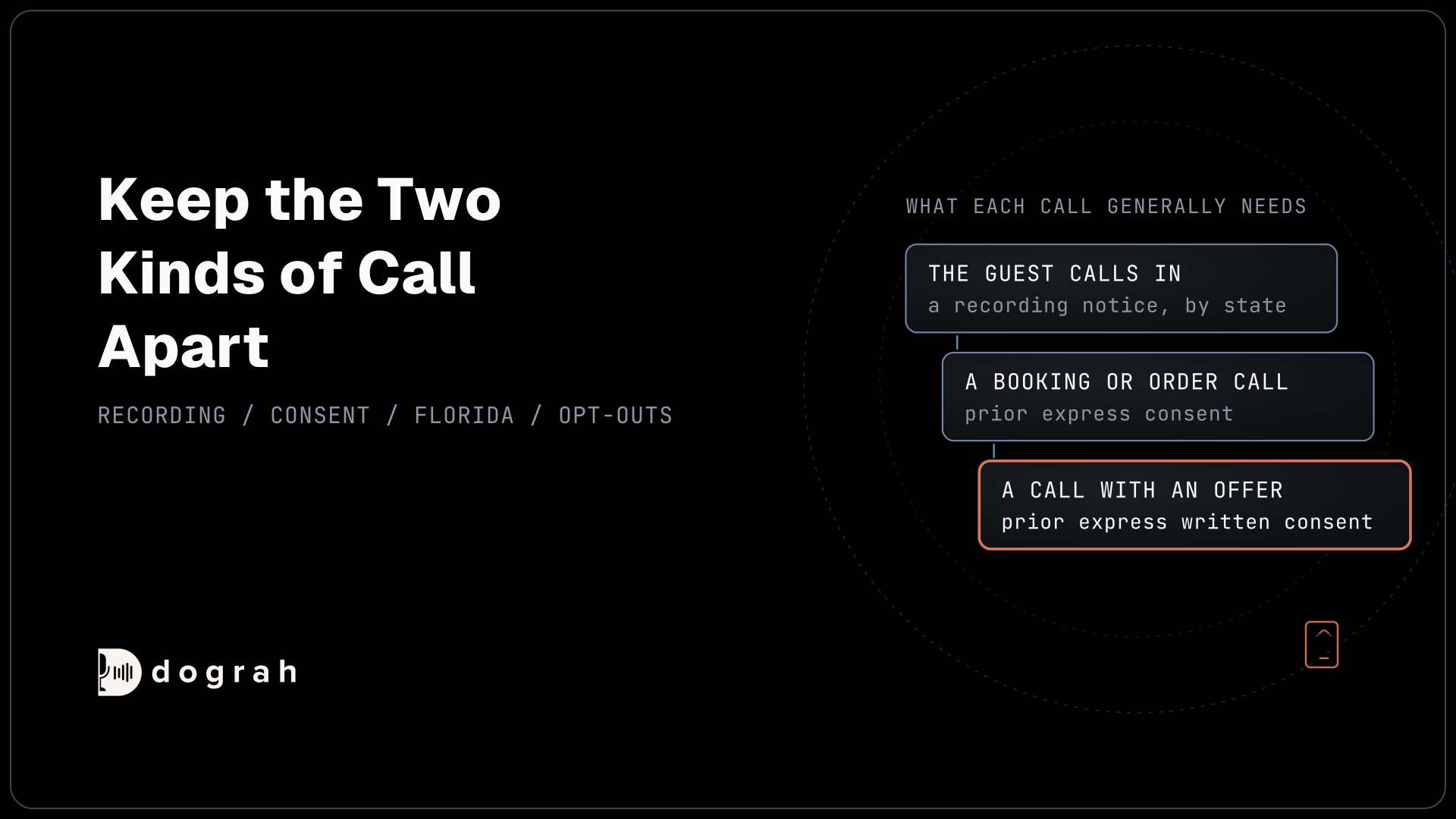

In the US, a restaurant's AI voice agent can tell inbound callers it is automated, which some places require, and, under all-party consent laws, that calls are recorded. Outbound calls about a booking or order generally need the guest's prior express consent. Any offer generally makes it telemarketing, which needs prior express written consent. General information, not legal advice.
Key Takeaways
- Inbound calls: an optional automated-assistant line and, in some states, recording notice.
- A past order is not written consent for a promotional AI call.
- Florida bars sales calls after 8 p.m. and over three in 24 hours.
This post is part of our guide to AI voice agents for restaurants. The guide's consent section gives the short version: a confirmation call needs the guest's prior consent, and an offer turns it into telemarketing. This post maps each US restaurant call to the rule it falls under, for an agent built in Dograh, an open-source, self-hostable voice agent platform. It is general information, not legal advice.
When the guest calls you: the recording notice and AI disclosure
Most restaurant calls are inbound, and they raise a different question from the calls you make. In a survey The Harris Poll ran for Hostie, a company that sells restaurant AI, 58% of 2,065 US adults said their calls to restaurants go unanswered in many cases.
The Telephone Consumer Protection Act (TCPA) consent rules govern calls a business places, so a guest who dials you is generally outside them. Two points remain. The first is AI disclosure: if you want to tell guests they're speaking with an automated assistant, or your location requires it by law, say so at the start. The second is recording. Some states require every party to agree before a call is recorded. Florida's wiretap law, Fla. Stat. 934.03, makes interception lawful "when all of the parties to the communication have given prior consent to such interception." A Dograh agent records calls and saves transcripts, so a guest calling from Florida generally needs to hear that at the start. Check the recording law of each state your guests call from.
Put both lines in the Start Call node's Greeting Text, optional fixed text that Dograh speaks word for word: "Thanks for calling Harbor Grill. You're speaking with our automated assistant, and this call is recorded." A line written in a node prompt is worded by the model each time, so it cannot guarantee the notice. If you self-host Dograh and cannot give the notice, recording can be switched off only for the whole server, and transcripts are still saved.
Calls you make about a booking or an order
A call you place with an AI voice is a call with an "artificial voice" under the TCPA. The Federal Communications Commission (FCC) settled that in its 2024 declaratory ruling, confirming that the TCPA's restrictions "encompass current AI technologies that generate human voices."
For a mobile number, 47 CFR 64.1200(a)(1) allows such a call only "for emergency purposes" or "with the prior express consent of the called party." For a booking confirmation or a catering follow-up the guest asked for, that consent is generally the number the guest gave you for that booking or order. Record where each number came from.
The rule also fixes how the call opens. Under 64.1200(b)(1), the message must "state clearly the identity of the business" at the beginning, and (b)(2) asks for a telephone number during or after it. Put both in the Greeting Text: "This is the automated assistant for Harbor Grill on Bay Street, calling about a booking with us. You can reach us at 305-555-XXXX." The greeting names no booking details. The agent asks for the name on the booking and its date and time, and accepts them when the call reached the number on the booking. Only then does it discuss the reservation.
Make fewer calls in the first place. The resOS No-Show Index, built from that reservation-software company's own platform data for August 2025 to July 2026, found that reservations with a delivered text reminder had a 16% lower recorded no-show rate, while confirmation prompts showed a near-neutral association. Let the restaurant's own system send the reminder, and call only when the guest has to decide something. The order-side version of that call is in AI voice agents for order confirmation in restaurants.

Open Source Alternative to Vapi / Retell
Self-hosted voice agent platform — no per-minute fees
dograh-hq/dograh
Star on GitHub
An offer turns the call into telemarketing
One sentence can move a service call into the strictest tier. Under 64.1200(a)(2), an artificial-voice call to a mobile that "includes or introduces an advertisement or constitutes telemarketing" needs "the prior express written consent of the called party", a signed agreement that names the number. A confirmation call that ends with "and 10% off your next visit" generally qualifies.
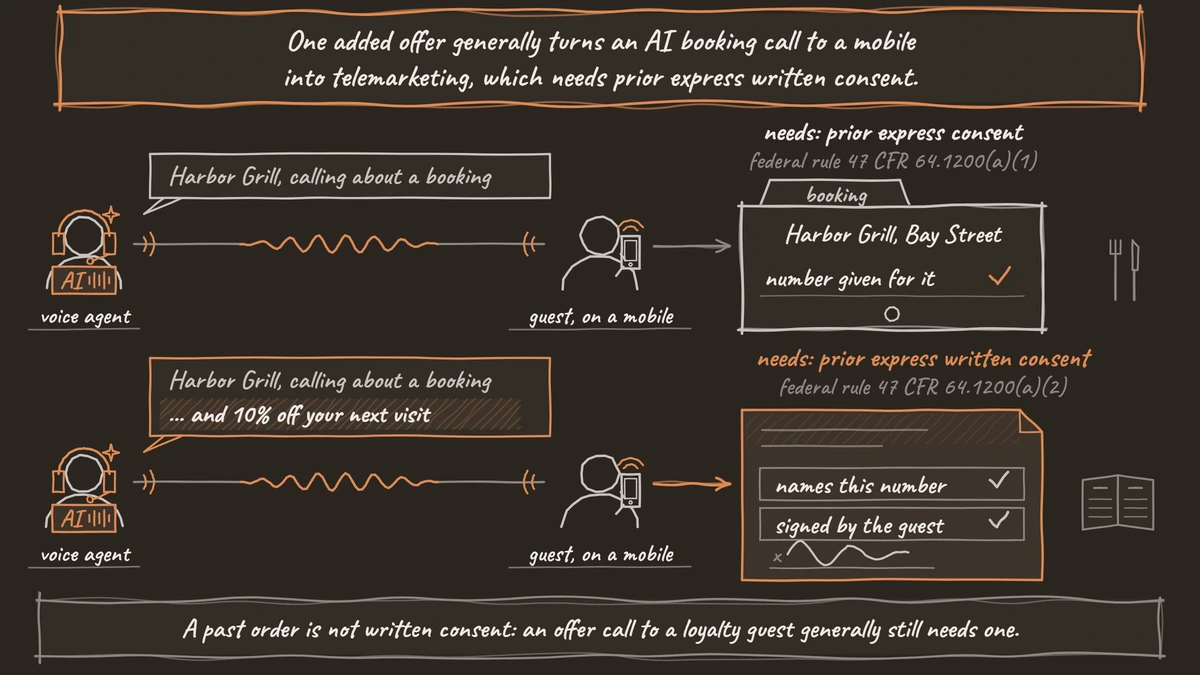
Loyalty lists are where restaurants slip. A guest who ordered last month has an "established business relationship" with you, and that relationship takes their number out of the Do Not Call registry rule for telephone solicitations. It is not on the list of exemptions from written consent for an artificial-voice call. So a promotional AI call to that guest generally still needs signed written consent.
Marketing messages draw class actions. TCPAWorld reported that a plaintiff sued Pizza Hut in Brennan v. Pizza Hut, alleging three promotional texts to a number on the National Do Not Call Registry, and that the case moved to the Northern District of Texas in May 2025. Those are allegations, about texts, but calls carry the same risk.
Keep the two kinds of call apart. Run confirmations from one agent and list, with no product information and no offer to make. Run promotions, if at all, from a separate agent whose list holds only guests with written consent and no Registry match. The same split for delivery calls is in AI Voice Agents for Logistics and Delivery (US): Consent Before the Call.
Florida adds hours, a call limit and its own consent rule
Florida is the clearest example of a state that adds its own rules on top of the federal ones. Under Fla. Stat. 501.059(8)(a), "A person may not make or knowingly allow to be made an unsolicited telephonic sales call" using automated dialing or "the playing of a recorded message when a connection is completed" without "the prior express written consent of the called party." A plain booking confirmation sells nothing and is generally outside that definition. A call with an offer is generally inside it.
Florida's telemarketing law adds limits on when and how often. Fla. Stat. 501.616(6) bars a commercial telephone solicitation call "before 8 a.m. or after 8 p.m. local time in the called person's time zone", and more than three such calls from any number to a person "over a 24-hour period on the same subject matter or issue". The federal window runs to 9 p.m., so the Florida rule is the stricter one. Many restaurants fall under one of the act's exemptions, such as the one for a business that has run a retail establishment for at least a year under the same name. Fla. Stat. 501.604 opens that list with "The provisions of this part, except ss. 501.608 and 501.616(6) and (7), do not apply to:", so the hours and the call limit generally still bind them.
Dograh's Campaigns set calling hours by weekday, so set them to the strictest rule that applies to the list. Retries count as calls. Campaigns allow up to 10 retries, 2 by default, and have no per-guest cap, so your own list enforces how often a guest is called, or retries stay at zero. Other states have their own versions of these rules, so check each state you call into.
Join the Dograh Community
Dograh is an OSS alternative to Vapi. Join our Slack community for queries, releases, best practices & community interactions.
Opt-outs, and where the call record lives
A guest can withdraw consent in the middle of a call, and the agent has to catch it. Under 64.1200(a)(10), consent may be revoked "using any reasonable method to clearly express a desire not to receive further calls or text messages."
Give the agent an extraction field for that request, recorded as the guest stated it, with the transcript as the exact record. A webhook sends it to your guest list after the call, and your trigger checks the list before any new call goes out. The pattern for starting calls from your own system is in API Triggers: Start a Voice Agent Call From Any System. An FCC order adopted in autumn 2026 changes how far a revocation reaches; the detail is in the FAQs.
Self-hosting Dograh keeps recordings and transcripts on your own servers, and the audio stays there too only when the speech and language models also run on your servers. Dograh has no retention setting, so your own policy decides how long recordings and transcripts are kept. Self-hosted Dograh has no per-minute platform fee, though servers, model keys and phone minutes still cost money. Dograh Cloud has a 1¢-a-minute platform fee.
Confirm your own position with counsel before the first outbound call.
Glossary
- Prior express written consent
- A signed written agreement naming the guest's number that authorises telemarketing calls with an artificial or AI voice. It is generally needed as soon as a call includes an offer.
- Established business relationship
- A relationship formed by a purchase or transaction in the past 18 months, or an inquiry in the past three months. It takes a number out of the Do Not Call registry rule for telephone solicitations, but it is not an exemption from written consent for an artificial-voice telemarketing call.
- All-party consent
- A state recording rule under which every person on a call must agree before it is recorded, as in Florida's wiretap law. It is why the greeting says the call is recorded.
- Revocation
- A guest's request to stop receiving calls or texts. Under the federal rules it can be made by any reasonable method, including saying so during the call.