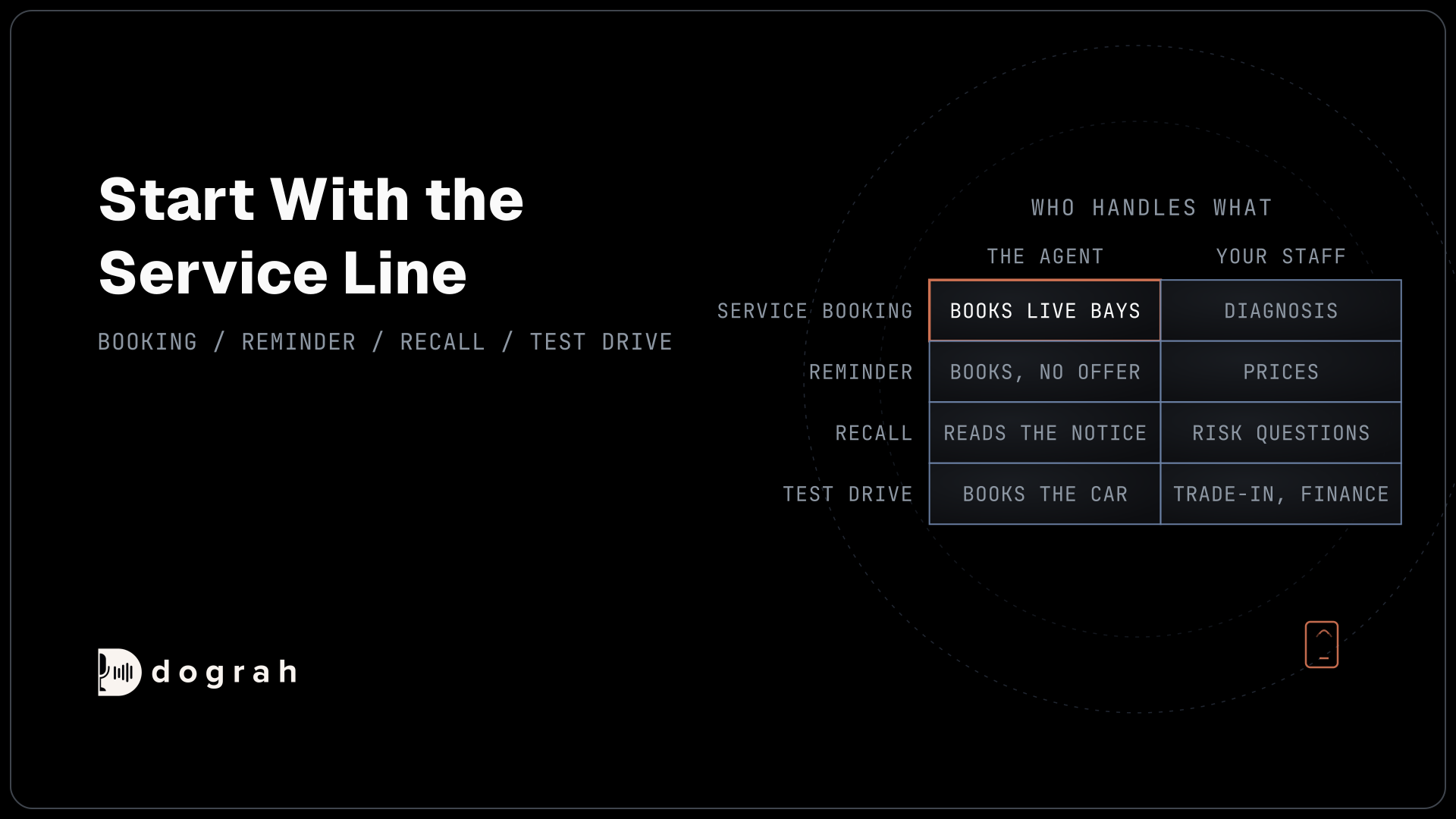

AI voice agents for automotive dealerships are phone agents that take a dealership's routine calls: service bookings from live bay capacity, service reminders, recall notices and test-drive bookings, reading and writing the dealer management system during the call. They repeat what the dealer's systems say. Repair prices, diagnosis, trade-ins and finance stay with service and sales staff.
Key Takeaways
- The agent reads every booking from the dealer management system and writes each change back to it.
- Verify the VIN's last four characters or the postcode before naming a vehicle.
- Repair prices and trade-in offers always come from your staff, never the agent.
This guide covers each dealership call a voice agent can take, starting with the one that keeps the service bays full, and how each one runs in Dograh, an open-source voice agent platform that reads and writes your dealer management system during the call. You can self-host it or run it on Dograh Cloud.
Why dealers hand service calls to a voice agent
Service is the dealership's steady income, and its share is shrinking. Cox Automotive's 2025 Service Industry Study puts average dealer service and parts revenue at about $9.23 million in 2025, citing the National Automobile Dealers Association (NADA). Yet dealers held only 29% of US service visits that year, down from 33% in 2018.
Loyalty is fading fastest on the newest cars. In the same survey of 1,974 vehicle owners, fielded in April and May 2025, only 54% of dealership service visits for cars under two years old went to the dealer that sold the car, against 72% in 2023. Owners' top reason for not going back was an inconvenient location.
Convenience starts with the phone. Car Wars, a call-tracking company, said about 53 million inbound service calls across its dealer network in 2025 ended in about 4 million booked appointments, with about 19 million counted as missed opportunities, as reported by CBT News in March 2026. That is one vendor's data, and its method is not published. Still, a service line that rings out after hours sends the customer to whoever answers.
The service call also sells the next car: in the Cox study, 88% of owners said the service experience affects whether they buy from that dealer again.
Dograh runs these calls on the dealership's own phone numbers. It is the orchestration layer (call flow, tools and telephony); the speech and language models are a separate layer you choose. Calls follow the order a dealership would hand them over, with the dealer management system (DMS) behind every one.
Inbound service booking from live bay capacity
The first call to hand over is the inbound service booking, because the agent only reads and writes the schedule.
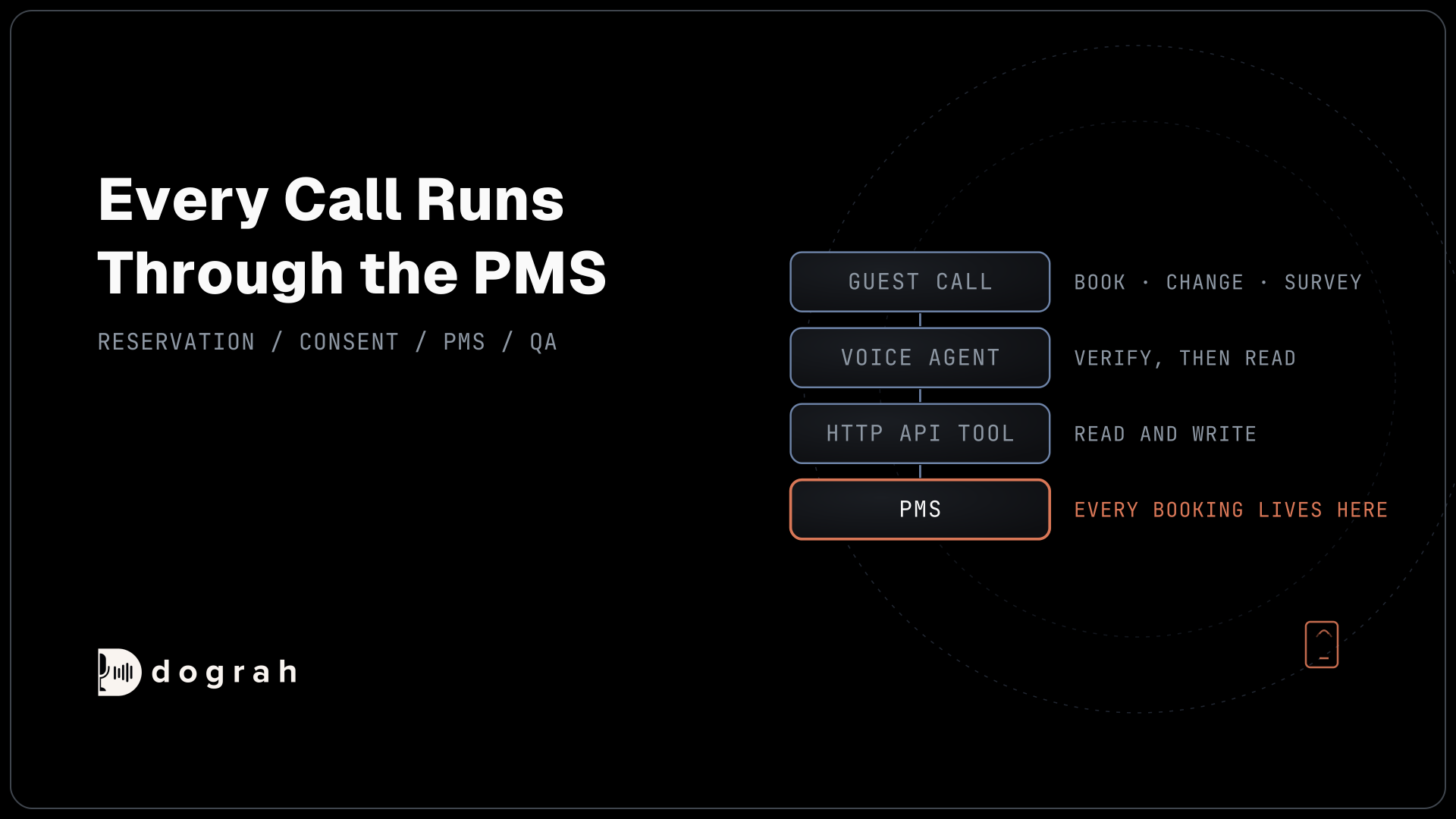
The answer has to come from live capacity. Bay space and technician hours change through the day, so fixed opening hours would promise slots the shop cannot fill. During the call, an HTTP API tool asks the scheduling system or the DMS for open slots, the agent offers two, and the same tool writes the chosen one back. The full call is in AI Voice Agents for Service Appointment Booking in Automotive, including what the agent may never say when a customer describes a fault. We built a dedicated landing page for dealership service departments covering service booking, reminders and recall calls on your own servers.
Every call runs greet, verify, disclose. The Greeting Text names the dealership; add an automated-assistant line there if you want one or your location requires it by law. It plays the moment the call connects, so it never mentions a vehicle or an appointment. Pre-Call Data Fetch can look up a likely customer record from the caller's number, but a number does not prove who is calling: a spouse or a fleet manager may be on the line. Before naming a vehicle or an open recall, the agent asks for the last four characters of the vehicle identification number (VIN) or the postcode on file.
The customer's description is recorded as said. "A grinding noise when I brake" goes to the service advisor in those words, with no guess at what it means.
To build this agent yourself, How to Build a Voice Agent for Automotive Dealerships walks through it screen by screen in Dograh, including a booking that is not made twice when a request is retried.
The main switchboard is a broader job. Routing calls to parts, sales or a named person is covered in The Ultimate Guide to AI Receptionists, and calls after the service drive closes follow the same booking pattern, covered in after-hours coverage.

Open Source Alternative to Vapi / Retell
Self-hosted voice agent platform — no per-minute fees
dograh-hq/dograh
Star on GitHub
Outbound service calls: reminders and recalls
Outbound calls win service visits back, under two different rule sets: maintenance reminders keep a customer, recalls are safety notices.
Service reminders
A reminder call tells an owner a service is due and offers to book it. The due list comes from the DMS, by mileage or time since the last visit, and reaches Dograh through Campaigns as a CSV upload or through the API Trigger, so the DMS can start each call itself.
The agent verifies the owner before naming the car or the service, then books through the same HTTP API tool as the inbound line. The call carries no offer: a discount or a package turns a reminder into a marketing call, which changes the consent it needs.
Frequency is your rule to enforce. Campaigns retry a busy line or a missed call up to the limit you set (0 to 10, default 2), but there is no per-customer cap, so your own list must stop a customer being called every week. AI Voice Agents for Service Reminders in Automotive covers the due-list rules and how often to call.
Recall notices
A recall call adds to a notice the manufacturer must already send. Under 49 CFR 577.7, a vehicle manufacturer's recall notice goes "by first class mail to each person who is registered under State law as the owner." The dealer's call is an extra prompt to book the repair and never replaces that letter.
The recall itself comes from the manufacturer's notice and the dealer's open-recall list, never from the model. The agent verifies the owner, reads the recall description as the manufacturer wrote it, including that the repair is free where the notice says so, and books the visit. Questions about the defect or the risk go to the service advisor.
A safety call is never a sales call: no trade-in values and no extras on the repair visit. AI Voice Agents for Recall Notifications covers the fixed manufacturer wording.
Consent before the first outbound call
This section is general information, not legal advice. The Telephone Consumer Protection Act (TCPA) rule at 47 CFR 64.1200 bars calls made "using an automatic telephone dialing system or an artificial or prerecorded voice" to a mobile number "(other than a call made for emergency purposes or is made with the prior express consent of the called party)". The Federal Communications Commission (FCC) treats an AI-generated voice as an artificial voice, so an AI reminder or recall call to a mobile generally needs the customer's prior express consent.
A customer who gave their number when buying or servicing the car has generally consented to related informational calls, such as a service reminder or a recall notice. A call that "includes or introduces an advertisement or constitutes telemarketing" is different: it needs "the prior express written consent of the called party", which is why a reminder with a discount in it is a marketing call.
The rule defines emergency purposes as "calls made necessary in any situation affecting the health and safety of consumers." Whether a safety recall call qualifies is not settled, so do not build a recall campaign on that exemption. Keep your own consent records, and confirm your position with counsel before the first campaign.
Test drives and the sales floor
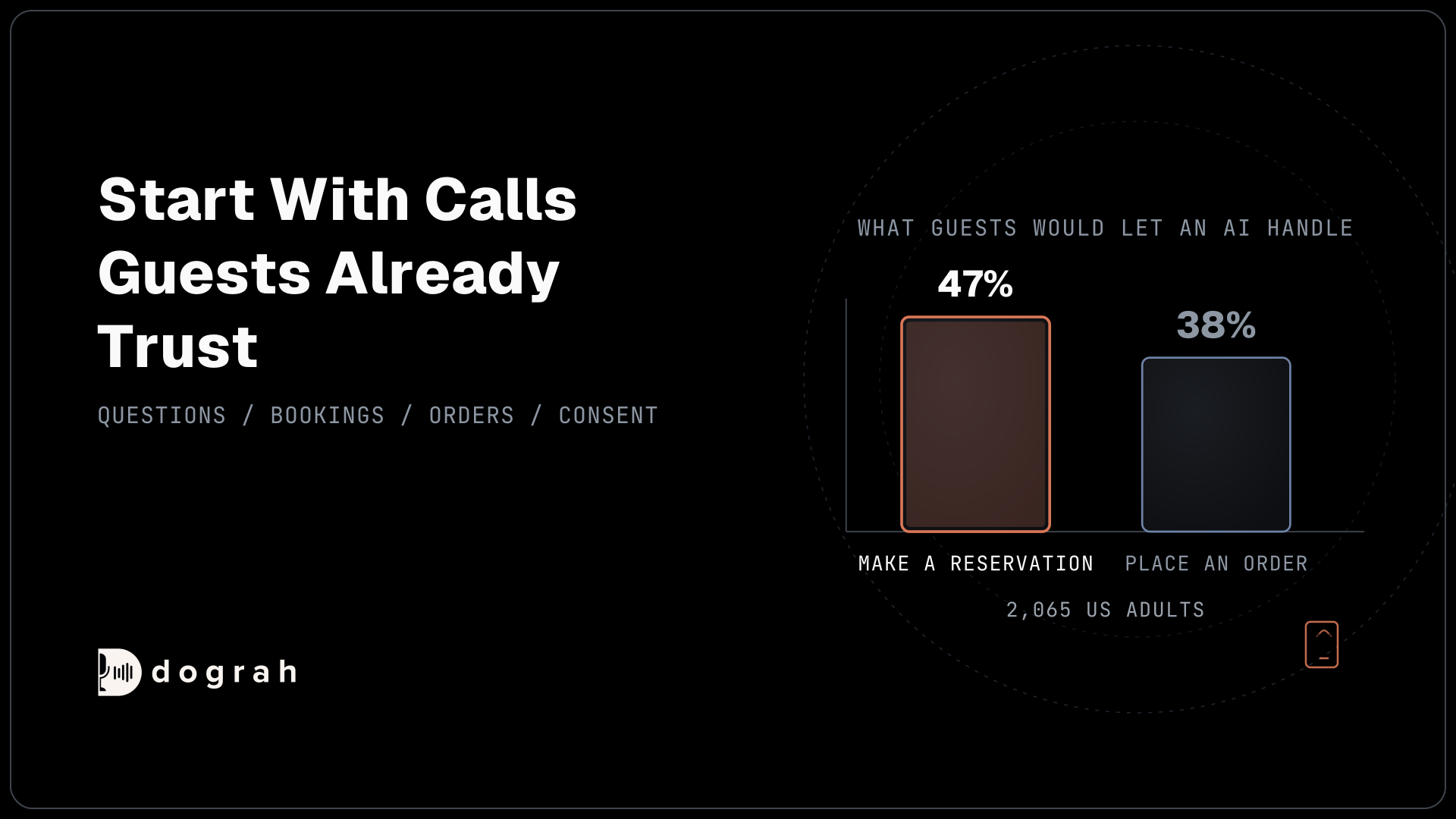
On the sales side, the call a voice agent can take is the test-drive booking. Buyers already use AI in the purchase: in Cox Automotive's 2025 Car Buyer Journey study of 2,300 recent buyers, surveyed in fall 2025, 25% of new-vehicle buyers used AI tools such as AI websites or AI overviews while shopping.
A test drive needs a specific vehicle and a salesperson at the same time, so the HTTP API tool checks the inventory system that the stock unit is still on the lot, finds an open slot on the sales calendar, and writes the appointment back. If the car sold this morning, the agent says so and offers a similar unit from the same live list.
Price, trade-in value, finance terms and any negotiation go to a person. Transfer Call puts the customer through to the sales desk. It works on Twilio only and passes no summary, so the agent writes the details to your customer relationship management (CRM) system first. If nobody picks up within 30 seconds (the default), the customer stays with the agent, which logs a callback request through an HTTP API tool.
AI Voice Agents for Test-Drive Scheduling covers booking against a stock unit and the handoff to a salesperson.
Join the Dograh Community
Dograh is an OSS alternative to Vapi. Join our Slack community for queries, releases, best practices & community interactions.
German-speaking customers
A dealership in Germany runs the same calls in German, under different consent law. The agent uses the formal "Sie", with an opening line as plain as "Guten Tag, Sie sprechen mit dem automatischen Assistenten von Autohaus Muster."
In Dograh, set speech-to-text to Multilingual (Auto-detect) in the agent's Model tab, tick German as a language hint, and choose a voice whose provider supports German. The Greeting Text plays before the caller speaks, so for a line serving German and English callers, write a short greeting in both. Model names and German service terms such as "Inspektion" can be added to the agent's Dictionary, which works with Deepgram and Dograh speech-to-text.
In Germany, phone consent comes from the unfair competition law, the Gesetz gegen den unlauteren Wettbewerb (UWG), with the Bundesnetzagentur as the regulator for unwanted calls. German AI Voice Agents for Automotive covers the German consent rules and the AI disclosure line.
How the agent connects to your DMS and CRM
Every call above reads and writes the dealership's own systems, so the DMS and CRM hold every record and the agent keeps nothing of its own, which also keeps it honest: it can only say what those systems returned.
Dograh moves that data at fixed points. Pre-Call Data Fetch sits at the bottom of the Start Call node. Set to Inbound calls only, it sends the caller's and the called number to your Endpoint URL once the call connects, and the reply (a customer name, the vehicles on file) is ready for the agent after verification. HTTP API tools work during the call: open slots, a stock check, the open-recall list, a booking. After the call, a webhook node sends the outcome and the extracted answers to the DMS or CRM, with links to the transcript and recording, retrying a temporary failure such as a timeout up to 5 attempts.
Dograh has no built-in DMS, CRM or calendar integration. Your systems connect through their own APIs using HTTP API tools, Model Context Protocol (MCP) tools, the Webhook node, Pre-Call Data Fetch or the API Trigger (n8n and similar tools connect through these). A retried booking request can carry the call's workflow_run_id as a preset parameter, so the scheduler ignores a duplicate. Integrating Voice Agents With Your Stack covers the read-during, write-after pattern.
A dealership call carries a name, a phone number, a VIN, a postcode and sometimes a finance question. Self-hosting Dograh puts the call platform and its recordings on the dealer group's own servers; the audio stays inside that infrastructure only when the speech and language models run there too. Dograh has no retention setting, so your own policy decides how long recordings are kept.
A dealer group can run many stores on one setup. Self-hosted Dograh handles 10 concurrent calls by default (raised with DEFAULT_ORG_CONCURRENCY_LIMIT; your servers and phone provider set the real ceiling) and has no per-minute platform fee, though servers, model keys and phone minutes still cost. Dograh Cloud's Pay as you go plan includes 10 concurrent calls (contact Dograh for higher concurrency) and has a 1¢-a-minute platform fee.
What the agent never does on a dealership call
Anything that needs a technician's judgement or involves money goes to a person.
It never diagnoses: "That sounds like your brake pads" is a technician's call after seeing the car. It never quotes a repair price or estimate, never decides whether a repair is covered by warranty, and never negotiates on a vehicle. On a recall or reminder call, it never sells.
That last rule answers a fair critique. A September 2026 piece in AutoGuide, a consumer car site, described dealership agents designed to counter a customer's "no" with another package, and a platform that flags recall customers as trade-in leads. Owners notice the push: in the Cox service study, 45% of owners had a frustration at the dealership, and 13% of those named the dealer trying to push additional services.
So a "no" is recorded once and the call ends politely. Any offer belongs on a separate marketing call, made only with written consent. A request for a person is always honoured, by a transfer or a callback request, and the agent offers one itself when a question falls outside its job.
Fixed wording only holds where Dograh speaks fixed text: the Greeting Text, or the Transition Speech that plays when a pathway is chosen. Inside a conversation the model writes its own words, so a prompt that says "never mention trade-ins" can still be paraphrased around. Prove the rule on transcripts instead: a quality assurance (QA) node reviews a sample of calls and scores each step, so a drifting call shows up.
Where a dealership should start
Start with the inbound service booking line: it only reads the schedule, writes one booking, and touches no outbound consent rules. Test it on a real phone number too: most phone calls still arrive as 8 kHz audio, against 16 kHz in a browser test, which changes how well the speech model hears a VIN or a model name.
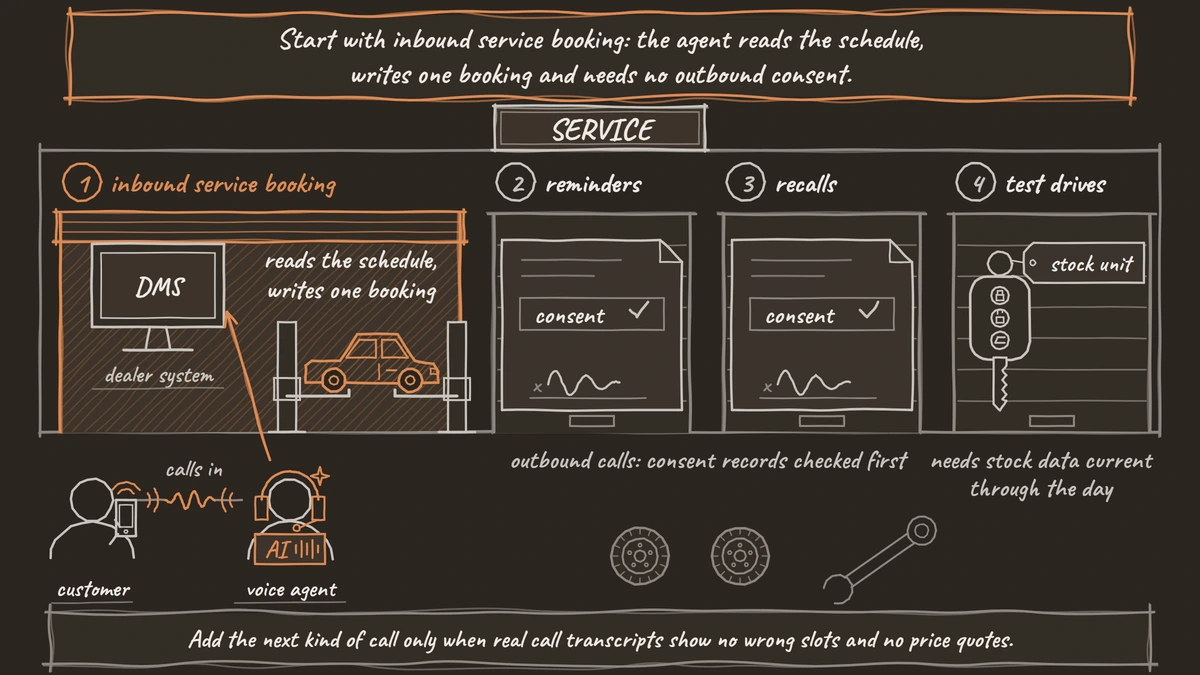
Once it is live, read QA transcripts from real calls for wrong slots and any hint of a price. Add reminders next, then recalls once your consent records are checked. Test drives come last, because they depend on stock data staying current through the day. Testing Voice Agents Before You Go Live gives the test order.
Each call above has its own deep dive:
- AI Voice Agents for Service Appointment Booking in Automotive
- How to Build a Voice Agent for Automotive Dealerships
- AI Voice Agents for Service Reminders in Automotive
- AI Voice Agents for Recall Notifications
- AI Voice Agents for Test-Drive Scheduling
- German AI Voice Agents for Automotive
Glossary
- Dealer management system (DMS)
- The dealership's core software for customers, vehicles, repair orders, parts and sales. For a voice agent it is the record: the agent reads from it during the call and writes the outcome back, and holds no customer data of its own.
- Vehicle identification number (VIN)
- The code that identifies one vehicle. The agent asks for its last four characters, or the postcode on file, before naming a vehicle or an open recall, because a phone number does not prove who is calling.
- Pre-Call Data Fetch
- A Dograh setting at the bottom of the Start Call node that sends the caller's and the called number to your endpoint when the call connects and passes the reply to the agent. It finds a likely customer record; it never proves who is calling.
- Prior express written consent
- The signed written agreement the TCPA rule at 47 CFR 64.1200(a)(2) requires before a telemarketing call or a call with an advertisement is made with an artificial or prerecorded voice. A service reminder with a discount in it falls into this group.