
AI voice agents for service reminders in automotive call owners whose scheduled maintenance is due, working from the dealer system's due list, then verify them and book from live slots. A plain reminder is informational and generally needs the owner's prior express consent. Adding a sales offer makes it a marketing call, which needs prior express written consent.
Key Takeaways
- A due-date reminder earns its keep without a sales pitch.
- One offer turns a reminder into marketing that needs written consent.
- Campaigns have no per-customer cap, so your own list sets the limit.
This post is part of our guide to AI voice agents for automotive and dealerships. The guide's part on service reminders sets the outline: the due list comes from the dealer management system (DMS), and the call carries no offer. This post works through the consent rules and the call itself, run on Dograh, an open-source, self-hostable voice agent platform.
Owners drift away between services
A service reminder exists to keep an owner coming back, and fewer owners come back on their own. In Cox Automotive's 2025 Service Industry Study, which surveyed 1,974 owners in April and May 2025, the selling dealer got 54% of dealership service visits for cars under two years old, down from 72% in 2023. For cars two to five years old it got 51%, down from 70%.
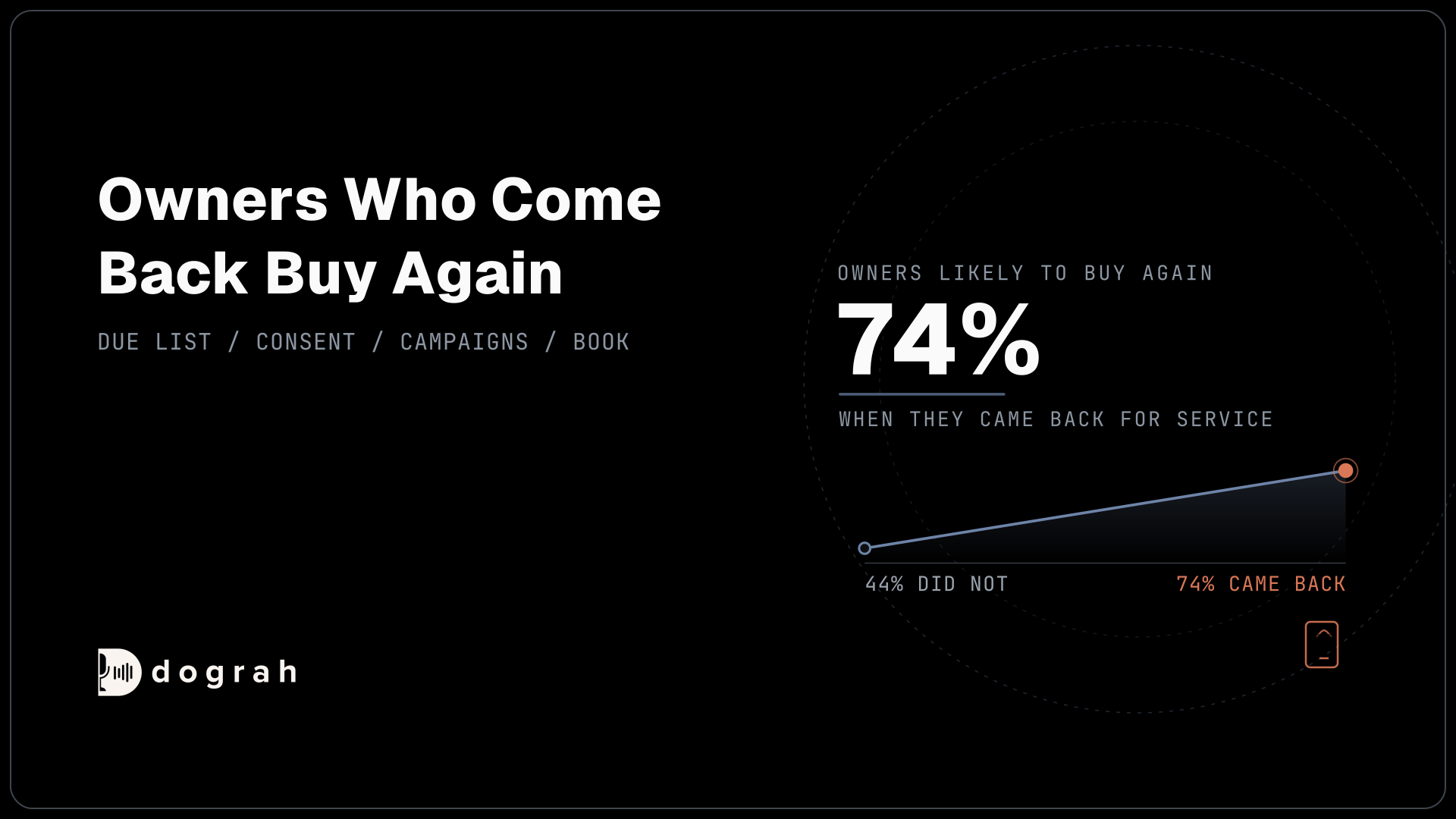
Keeping that owner pays off at the next purchase. In the same study, 74% of owners who had gone back to the dealer for service in the past 12 months said they were likely to buy from that dealer again, against 44% of those who had not. The reminder has done its job once the visit is booked. It needs no pitch to be worth the call.
A reminder is informational until it sells
This section is general information, not legal advice. The consent a reminder needs depends on what the call says, so settle the script before you write the prompt.
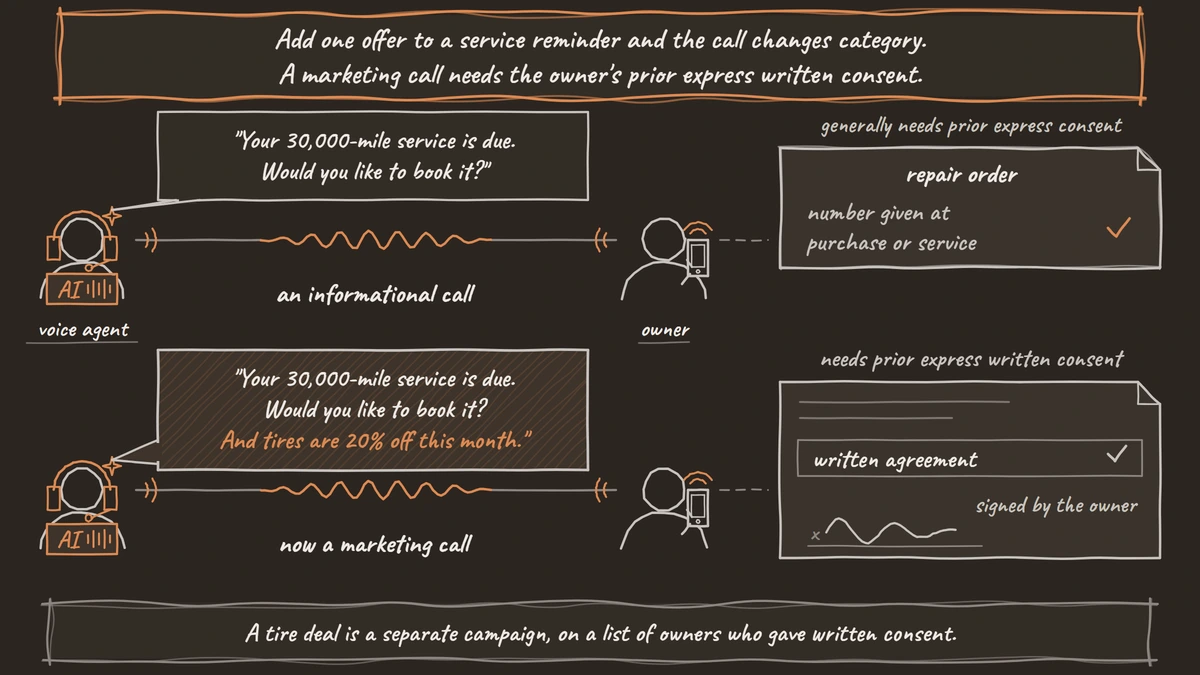
The Telephone Consumer Protection Act (TCPA) rule at 47 CFR 64.1200 bars calls made "using an automatic telephone dialing system or an artificial or prerecorded voice" to a mobile number "(other than a call made for emergency purposes or is made with the prior express consent of the called party)". In a February 2024 declaratory ruling, the Federal Communications Commission (FCC) confirmed that those limits "encompass current AI technologies that generate human voices". So an AI reminder call to a mobile generally needs the owner's prior express consent. An owner who gave their number when buying or servicing the car has generally consented to related informational calls, such as "Your 30,000-mile service is due. Would you like to book it?"
Add "and tires are 20% off this month" and the call changes category. A call that "includes or introduces an advertisement or constitutes telemarketing" needs "the prior express written consent of the called party". The rule defines that as "an agreement, in writing, bearing the signature of the person called" that clearly authorizes such calls. A phone number on a repair order is not that agreement.
Opt-outs need the same care. When an owner says "stop calling me", the agent records it and your list drops them. An FCC order in autumn 2026 revised the rule on how far a single opt-out reaches, so check the current position. Keep consent records next to the due list, and confirm your position with counsel before the first campaign. The wider US consent background is in AI Voice Agents for Logistics and Delivery (US): Consent Before the Call.
Build the due list in your dealer system
The dealer system decides who gets called, and Dograh only places the calls. The due list comes from the DMS or your service customer relationship management (CRM) system: owners whose next service is due by mileage or by time since the last visit.
Filter the list before it leaves the DMS. Take out owners who already have a booking, anyone who opted out, anyone without a consent record for this kind of call, and anyone called about this service recently. An open recall is a different call with different rules, covered in AI Voice Agents for Recall Notifications.
The list reaches Dograh in one of two ways. Campaigns take a CSV upload, one row per owner, with the details the agent needs as columns. The API Trigger lets the DMS start each call itself, which suits a list that changes every day, and API Triggers: Start a Voice Agent Call From Any System shows the request.
Frequency is your rule to enforce. Campaigns can retry an unanswered or busy call up to the maximum you set (0 to 10, default 2), with a delay between tries of 30 seconds to 1 hour (default 2 minutes), and calling hours set by weekday. There is no per-customer cap across campaigns, so the DMS export has to stop an owner being called every week. If you are unsure, set retries to 0.

Open Source Alternative to Vapi / Retell
Self-hosted voice agent platform — no per-minute fees
dograh-hq/dograh
Star on GitHub
The reminder call, from greeting to booking
The call runs greet, verify, disclose, then books from live slots. The Greeting Text plays as soon as the call connects. It names the dealership and asks for the owner by first name, with a fallback such as {{first_name | there}} so a missing name is never read out as a placeholder. If you want to tell owners they're speaking with an automated assistant, or your location requires it by law, write that there too. It names no vehicle and no service.
Asking for the owner by name only finds the right person. Before the agent says which car is due, it asks for the last four characters of the vehicle identification number (VIN) or the postcode on file. If the answer does not match, the agent says the service team will follow up, writes a callback request and ends the call without naming the car.
After a match, the agent says what is due, using the service and mileage from the list, and offers two open slots read from the scheduler through an HTTP API tool. The booking itself works exactly like the inbound line in AI Voice Agents for Service Appointment Booking in Automotive.
A voicemail gets a short message with the dealership's name and a callback number only, since anyone in the household may play it. A "no" is recorded once and the call ends politely. After every call, a webhook node writes the outcome back to the DMS, such as booked, declined, opted out or wrong person. A temporary failure is retried automatically, up to 5 attempts.
Join the Dograh Community
Dograh is an OSS alternative to Vapi. Join our Slack community for queries, releases, best practices & community interactions.
Keep the offer off the reminder call
The reminder agent never sells, and that has to be designed in, because a prompt alone will not hold it. A September 2026 piece in AutoGuide, a consumer car site, described a booking agent that pitched 20 percent off recommended services to a customer who had asked for an oil change, and agents built to counter a customer's "no" with another package.
So the reminder flow carries no offers, and it never quotes a price or guesses at a fault. If the dealer wants to promote a tire deal, that is a separate campaign on a separate list of owners who gave prior express written consent, with its own script checked by counsel.
Fixed wording holds only where Dograh speaks fixed text, such as the Greeting Text. Inside the conversation the model writes its own words, so "never mention offers" in a prompt can be paraphrased around. Check the rule on transcripts instead. A quality assurance (QA) node reviews a share of calls set by its Sample Rate and scores each step, so a reminder that drifts toward a pitch shows up.
Self-hosted Dograh has no per-minute platform fee (servers, model keys and phone minutes still cost); Dograh Cloud has a 1¢-a-minute platform fee. Start with one service interval on one model line, read the first week of transcripts, then widen the list.
Glossary
- Due list
- The export from the dealer management system of owners whose next service is due by mileage or by time. It decides who is called; the voice agent only places the calls.
- Prior express consent
- The permission the TCPA rule at 47 CFR 64.1200(a)(1) requires before an artificial-voice call to a mobile number. An owner who gave their number when buying or servicing the car has generally given it for related informational calls.
- Prior express written consent
- A signed written agreement that clearly authorizes calls with advertisements or telemarketing, defined in 47 CFR 64.1200. A reminder that mentions a discount generally needs it.
- Calling hours
- The Dograh Campaigns setting that limits when calls go out, set by weekday. It controls the time of day, not how often one owner is called.