
AI voice agents for service appointment booking in automotive answer a dealership's service line and book visits against live bay, technician and loaner availability, read from the scheduler during the call. The agent records the vehicle, the problem in the customer's own words and the preferred time. It never diagnoses a fault or quotes a repair price.
Key Takeaways
- Read open slots from the scheduler during the call, never from a copy.
- Verify the VIN's last four characters or the postcode before naming the car.
- Record the symptom as the customer said it; the advisor diagnoses and prices.
This post is part of our guide to AI voice agents for automotive and dealerships. The guide's section on inbound service booking makes the case that every slot has to come from live capacity. Here is that booking call from greeting to written booking, run on Dograh, an open-source, self-hostable voice agent platform, with your scheduler as the only source of slots.
Most service bookings still start with a phone call
The service phone is still where most owners book, and a large share of those calls go unanswered. Car Wars, a call-tracking company, tracked about 53 million inbound service calls across its own dealer network in 2025, as reported by CBT News. About 19 million were missed opportunities, and 53% of the missed calls ended in voicemail. Only about 4 million appointments were booked. That is one vendor's network data, and its method is not published.
Most of what those callers want is routine. In Cox Automotive's 2025 Service Industry Study, a survey of 1,974 owners in April and May 2025, 46% of service visits had just one type of work done, and owners averaged 2.4 service visits a year. An oil change or a tire rotation is a booking an agent can finish on its own, as long as it books against the real schedule.
Book against live bays, technicians and loaners
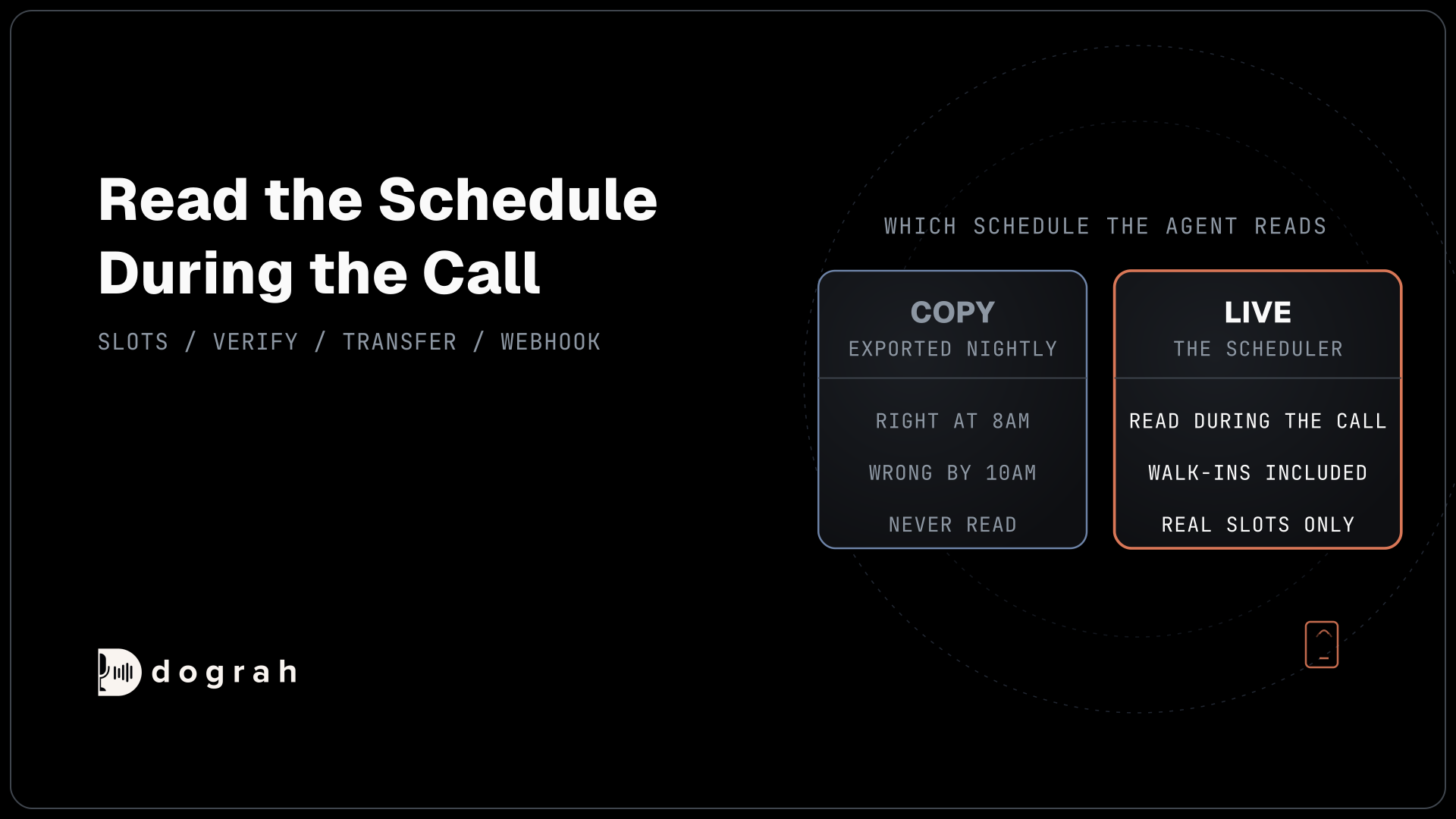
A booking is only as good as the slot data behind it, so the agent reads availability during the call and never from a copy. A nightly export of the schedule looks right at 8am and is wrong by 10am, after two walk-ins and a sick technician have changed the day.
In Dograh, an HTTP API tool asks your scheduler or dealer management system (DMS) for open slots once the agent knows the job. The request carries the service type. The reply should already account for bay time, the technician skills the job needs and whether a loaner car is free, because only the scheduler knows those rules. The agent offers two slots, the customer picks one, and a second request writes the booking. The agent confirms the time only after the scheduler replies that the booking went through.
A lookup can take a moment, so the agent says a short line such as "Let me check what the shop has on Thursday" instead of going quiet. If the write fails, the agent tells the customer the booking is not confirmed yet and writes a callback request through another HTTP API tool, so a person can finish it.
A booking request can also arrive twice when a network call is retried. Sending the call's workflow_run_id with the request lets the scheduler ignore the duplicate. The screen-by-screen build, including that setting, is in How to Build a Voice Agent for Automotive Dealerships. The same live-slot pattern in a clinic is in AI Voice Agents for Patient Appointment Scheduling: Book From Live Slots.

Open Source Alternative to Vapi / Retell
Self-hosted voice agent platform — no per-minute fees
dograh-hq/dograh
Star on GitHub
Greet, verify, then talk about the car
The agent confirms who is calling before it mentions any vehicle, repair order or past visit. The Greeting Text plays the moment the call connects, so it names only the dealership. If you want to tell callers they're speaking with an automated assistant, or your location requires it by law, write that there too.
Pre-Call Data Fetch, at the bottom of the Start Call node and set to Inbound calls only, sends the caller's number to your endpoint as the call connects. The reply might be a customer record with two cars on it. That record only tells the agent who might be calling. A spouse or a fleet manager may be on the line from that number. So the agent asks for the last four characters of the vehicle identification number (VIN) or the postcode on file, and only when the answer matches does it say something like "I can see two vehicles on your account. Is this about the pickup?"
A caller with no record is a new customer. The agent collects a name and the vehicle details, then books, and it reads nothing back from the DMS because there is nothing on file to protect.
Record the symptom, never diagnose or price it
The agent writes down what the customer says is wrong and leaves the meaning to the service advisor. "There's a grinding noise when I brake, mostly in the morning" goes into the booking in those words. The agent never says "that sounds like your pads," because a guess on the phone becomes a promise the shop did not make.
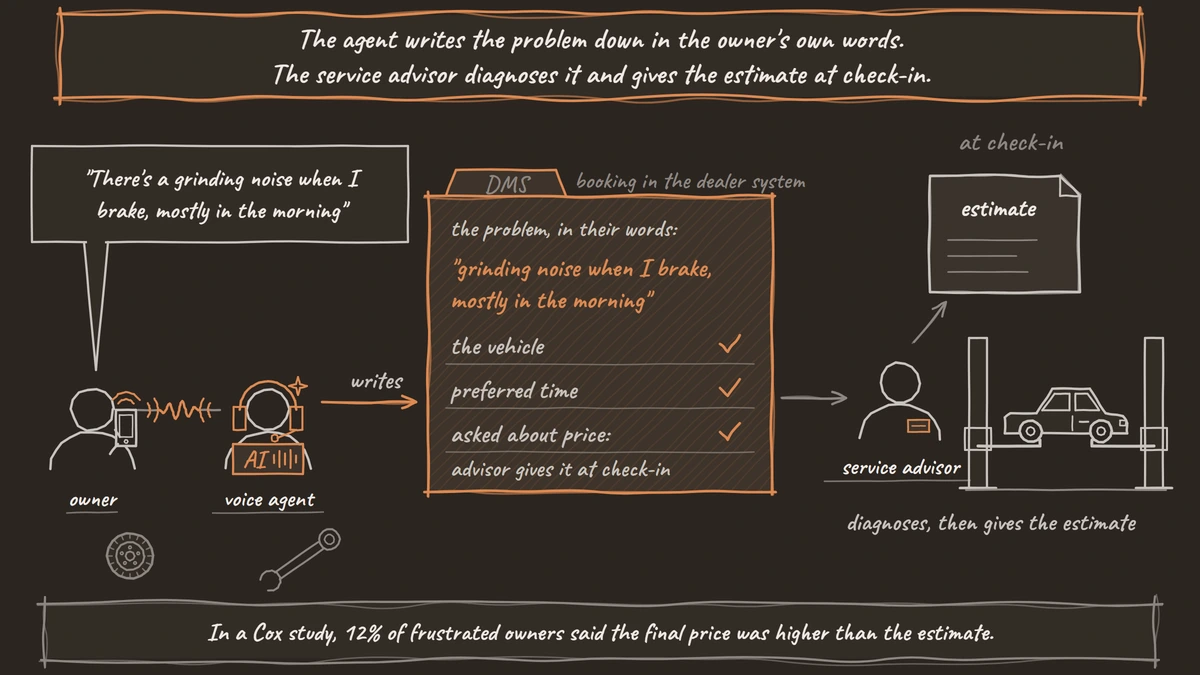
Price works the same way. Nobody knows what the job will cost until a technician has seen the car, so the agent never quotes a repair price or an estimate. If the customer asks, it says the advisor will give an estimate at check-in and notes the question on the booking.
Owners notice when this goes wrong. In the Cox study, 45% of owners had a frustration at the dealership. Among them, 24% said service took longer than expected, 13% named finding out how much the dealer charges, 13% said the dealer tried to push additional services and 12% said the final price was higher than the estimate. A booking call that guesses at a price or slips in a package feeds the last three.
So the booking call carries no upsell either. If the DMS shows other recommended work on the car, the advisor raises it at the counter, where the customer can see the car and ask questions.
When the call goes to the service desk
Some calls need a person, and the agent should hand them over early. Warranty disputes, comebacks (a car back for the same fault after a repair), an angry customer and any job the scheduler cannot book all go to the service desk.
Transfer Call puts the customer through. It works on Twilio only and passes no summary, so the agent first writes the details to your system through an HTTP API tool: which vehicle it is and the problem in the customer's words. On Twilio you can add a short spoken introduction that both sides hear, and it is off by default. If nobody answers within 30 seconds, the default timeout, the customer stays with the agent, which writes a callback request instead.
Calls after the service drive closes follow the same booking flow, because the scheduler is still online. Our post on after-hours coverage covers what changes when nobody is there to take a transfer.
Join the Dograh Community
Dograh is an OSS alternative to Vapi. Join our Slack community for queries, releases, best practices & community interactions.
Every outcome goes back to your DMS
The agent keeps nothing of its own. After the call, a webhook node sends the outcome to your DMS or customer relationship management (CRM) system, whether the slot was booked, transferred or left as a callback request, with the extracted answers and links to the transcript and recording. A temporary failure, such as a timeout, is retried automatically, up to 5 attempts. Extracting answers is an AI step, so the recording stays the exact record of what the customer said.
Dograh has no built-in DMS or scheduler integration. Your systems connect through their own APIs using HTTP API tools, Model Context Protocol (MCP) tools, the Webhook node, Pre-Call Data Fetch or the API Trigger (n8n and similar tools connect through these), so the agent works with whichever DMS the dealership already runs. Self-hosted Dograh has no per-minute platform fee (servers, model keys and phone minutes still cost); Dograh Cloud has a 1¢-a-minute platform fee.
Start with routine jobs such as oil changes. Read a week of transcripts for wrong slots and any hint of a price, then widen what the agent may book.
Glossary
- Service advisor
- The dealership employee who checks a car in, turns the customer's description into a repair order and gives the estimate. The voice agent books the advisor's time and never diagnoses or prices a job itself.
- Repair order
- The DMS record that opens a job on a vehicle, with the work requested, the technician's findings and the charges. The agent reads or mentions an open repair order only after the caller is verified.
- Comeback
- A car returned to the shop for the same fault after a repair. Comebacks go straight to the service desk, because they raise questions about the earlier work and who pays for the next visit.
- Pre-Call Data Fetch
- A Dograh setting at the bottom of the Start Call node that sends the caller's and the called number to your endpoint when the call connects and passes the reply to the agent. It finds a likely customer record; it never proves who is calling.