
AI voice agents for patient appointment scheduling book, reschedule and cancel visits by phone against your live calendar. The agent verifies the patient before naming any appointment, reads open slots through an HTTP API tool during the call, and writes every change back at once. Your scheduling system keeps the rules, and the agent follows them.
Key Takeaways
- The scheduling system is the record. The agent reads it live and never copies it.
- Verify date of birth plus one detail before naming any appointment.
- A cancellation writes back at once, so the freed slot reopens for the next caller.
This post is part of our guide to AI voice agents for hospitals and health systems. The guide's section on calls before a visit starts with the booking itself, made against the live calendar after the patient is verified. This post sets out the design rules for that call, built in Dograh, an open-source, self-hostable voice agent platform that reads and writes your scheduling system during the call.
Most patients still book through a person
Online self-scheduling is growing, but most practices still take most bookings by phone. In a July 2025 MGMA Stat poll of 244 practices, the Medical Group Management Association found that 71% have fewer than a quarter of their patients booking with digital tools. Only 3% have more than three quarters booking that way.
MGMA's own argument is for more online booking, and it is a fair one. When patients book online, it says, call volumes and hold times can drop significantly, and staff move to higher-value work. It also recommends keeping phone and other channels for patients with limited digital access. A voice agent fits that hybrid. It serves the callers who will always phone, plus the bookings an online tool cannot finish, such as a reschedule that needs a conversation.
Phone access is still a priority. In MGMA's December 2025 poll on 2026 patient access priorities, 22% of 236 practice leaders named phone access their top focus, close to online scheduling at 24%.
The calendar is the system of record
Every booking rule lives in your scheduling system, and the agent's job is to respect it, never to reproduce it. Visit types, durations, which provider sees which patients and how far ahead a slot can be booked all stay in the electronic health record (EHR) or practice management system. The agent asks for slots that fit and books the one the patient picks.
In Dograh, that is an HTTP API tool. During the call, the agent sends the visit type and the patient's preferred days to your scheduling endpoint and reads back the open slots. When the patient picks one, a second request books it. Slots fill up while the call is happening, so the agent always reads them live rather than from a list loaded when the call started. If the booking request fails because the slot was just taken, the agent says so and offers the next opening.
The tool's message can fill the pause during a lookup, so the patient hears that the agent is checking the schedule. The mechanics of mid-call reads and post-call writes are covered in Integrating Voice Agents With Your Stack: The Complete Guide.
Verify before you name any appointment
An appointment is health information. Even its date or the clinic it is at can reveal something about the patient. So the call runs greet, verify, disclose. The Privacy Rule under the Health Insurance Portability and Accountability Act (HIPAA), at 45 CFR 164.514(h), requires a covered entity to "verify the identity of a person requesting protected health information" when that person is not known to it.
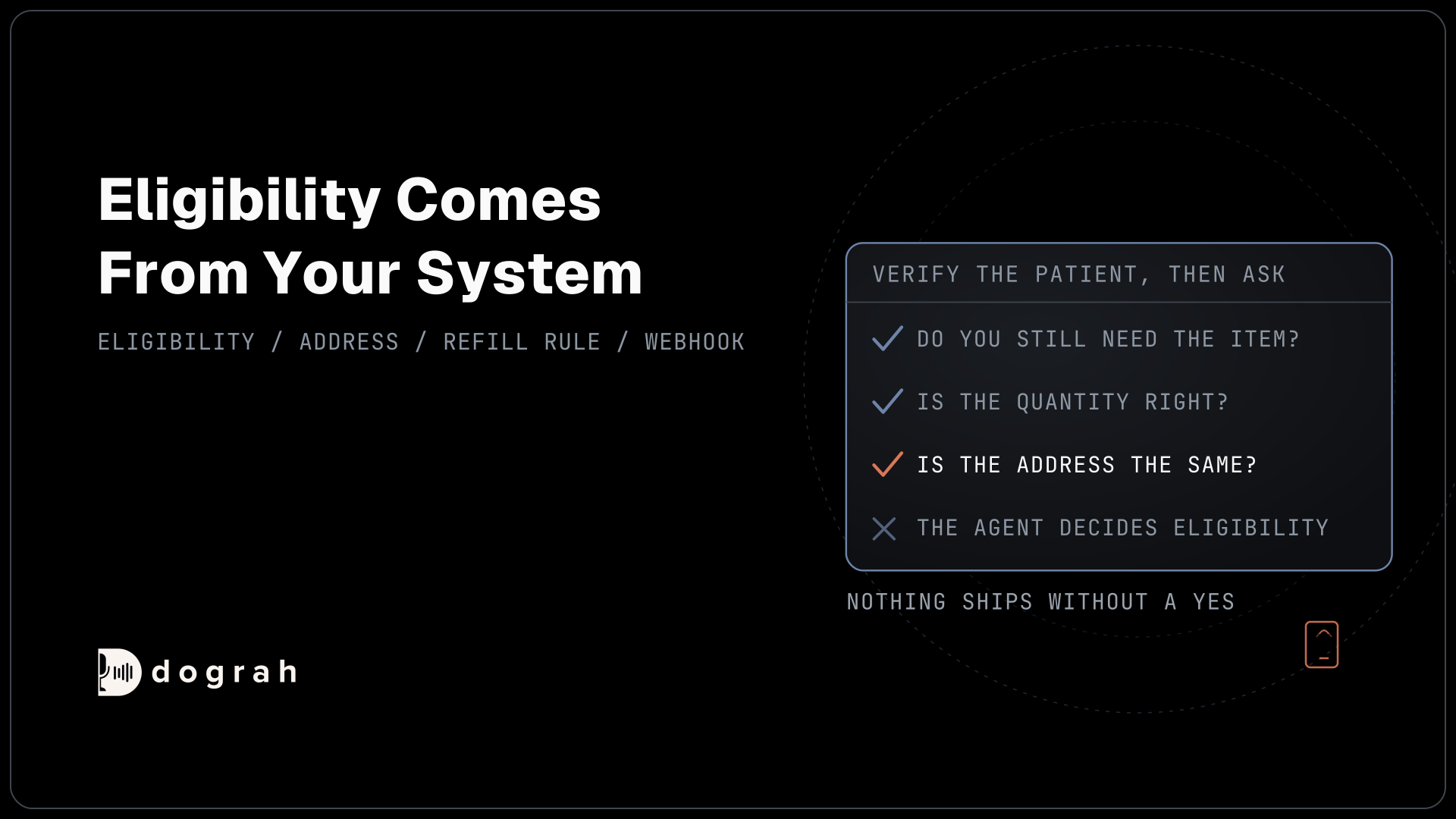
Pre-Call Data Fetch, at the bottom of Dograh's Start Call node, can look up the caller's number when the call connects. That finds a likely record. It does not prove who is calling, since family members share phones. Before the agent names any existing visit, it confirms the patient's date of birth plus one more detail, such as the appointment date or part of the medical record number. It never asks for a Social Security number. A caller who fails the check can still book a new visit as a new caller, without hearing anything already on file.
Many calls come from someone booking for another person, such as a parent for a child or an adult child for an elderly parent. The agent verifies the patient's details in the same way and records who called and their relationship to the patient. Who may book or change a visit on someone else's behalf is your policy, written into the prompt, and anything outside it goes to staff.

Open Source Alternative to Vapi / Retell
Self-hosted voice agent platform — no per-minute fees
dograh-hq/dograh
Star on GitHub
Booking, rescheduling and cancelling on one call
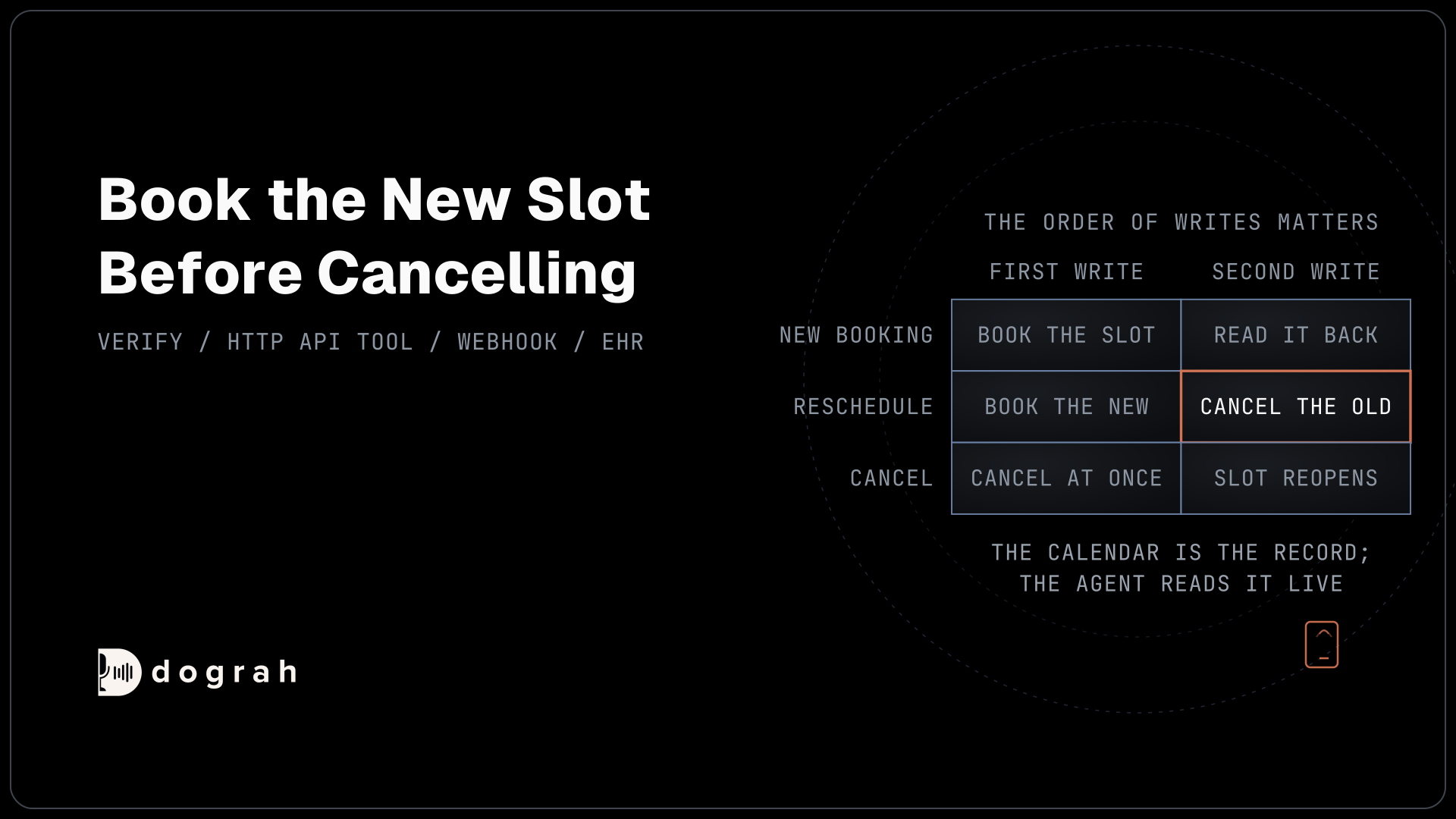
The three requests share one flow, and the order of writes matters. A new booking reads slots and writes the patient's choice. A reschedule books the new slot first and cancels the old one only once the new booking has succeeded, so the patient is never left with no appointment. A cancellation writes back straight away, so the slot reopens for the next caller or the waitlist.
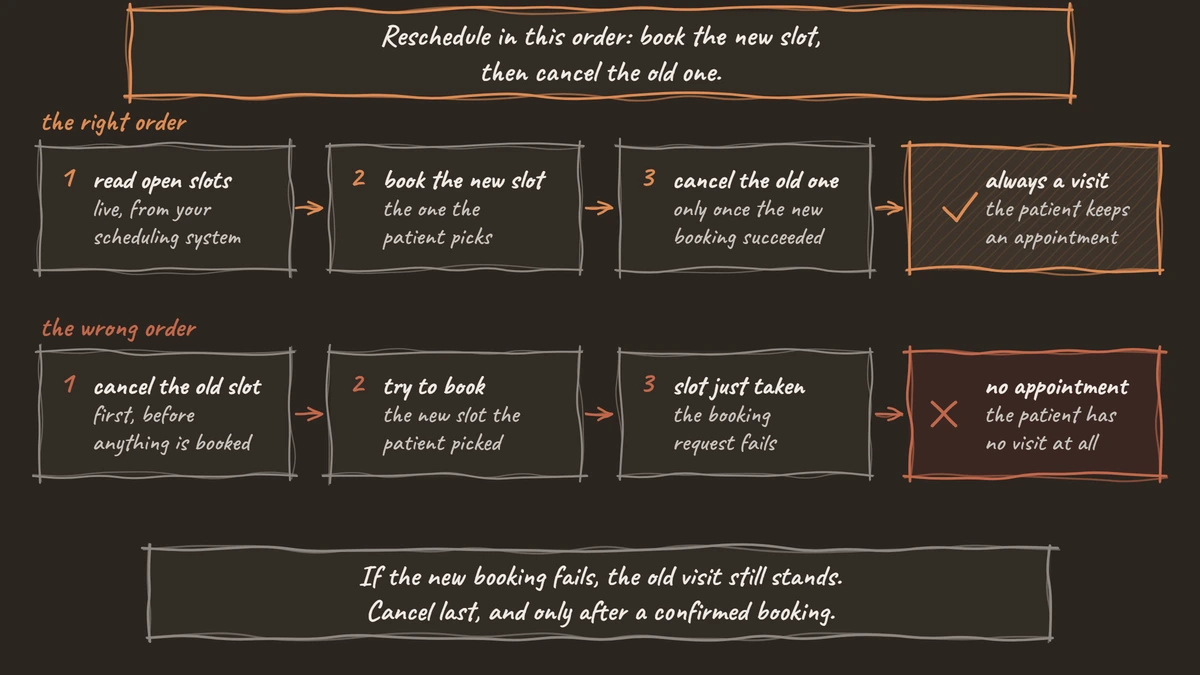
After the call, a webhook sends the outcome to your system: booked, rescheduled, cancelled or handed to a person, with the transcript and recording links. Temporary failures are retried automatically, up to five attempts. The agent reads the confirmed details back before the call ends, including the date and time. Any text confirmation comes from your own system, because Dograh has no SMS tool.
Reminder calls for the visits you book are a separate job, covered in Healthcare No-Show Reduction: Why AI Voice Agents Beat Reminders.
What the agent hands to a person
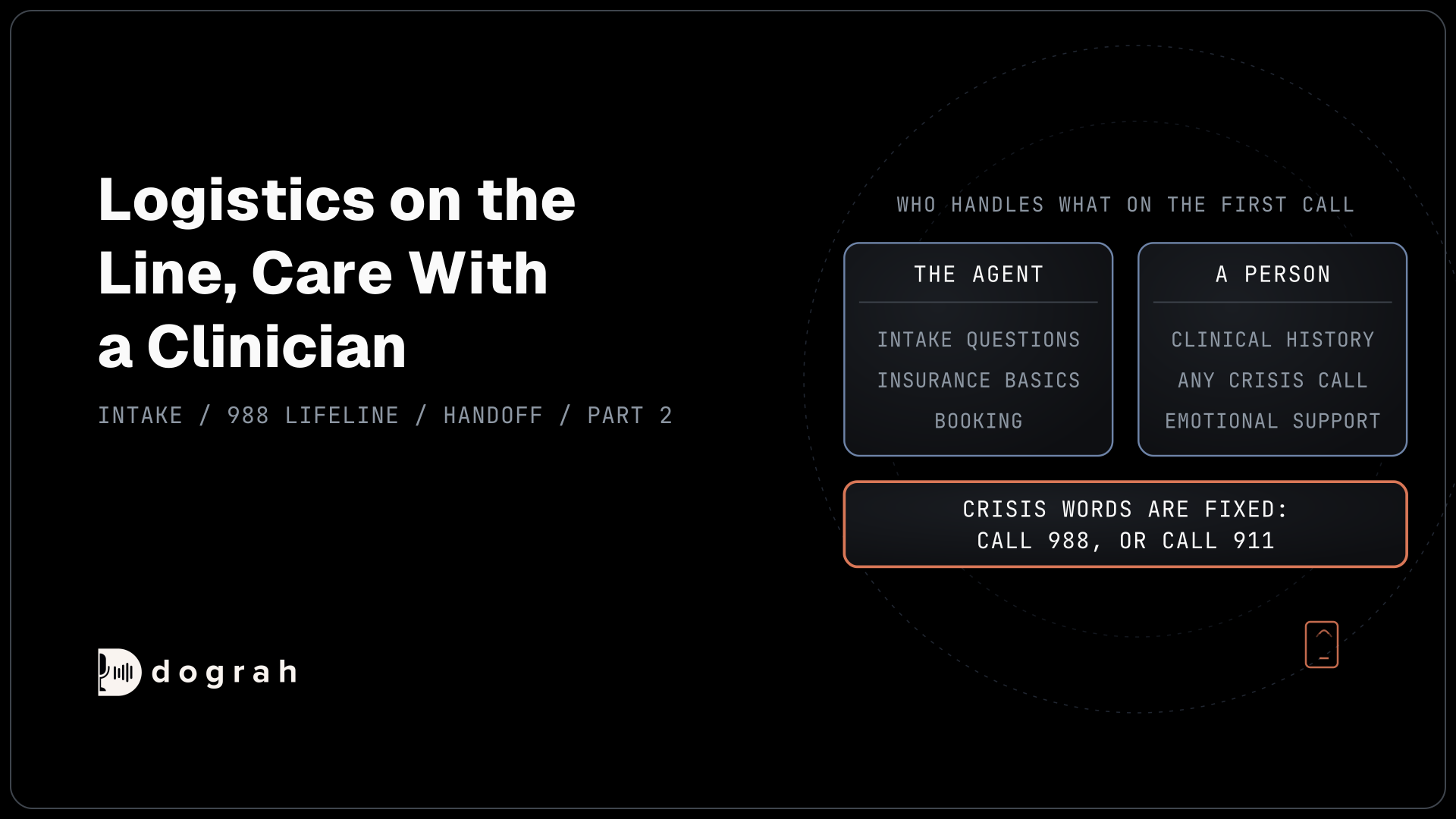
The agent books what the rules allow and hands over the rest. New-patient registration usually needs insurance and history details that belong with staff. A referral or a visit that needs prior authorization depends on paperwork the agent cannot see. A patient who insists on one provider whose calendar is full needs someone who can make an exception. Any clinical question, including whether a symptom needs an earlier slot, goes to a nurse.
Transfer Call hands the patient to the front desk on Twilio. It passes no summary, so the agent writes the details to your system first and staff see them on screen. The transfer waits 30 seconds by default, settable from 5 to 120. If nobody answers, the patient stays with the agent, which offers a callback and writes the request to your system through an HTTP API tool. Larger systems that run this through a contact center are covered in AI Voice Agents for Healthcare Call Centers: Patients Still Call.
Join the Dograh Community
Dograh is an OSS alternative to Vapi. Join our Slack community for queries, releases, best practices & community interactions.
Outbound booking calls and what to measure
Some bookings start with the practice calling out, such as offering a cancelled slot to the waitlist or booking a visit after a referral arrives. Your scheduling system starts each call through the API Trigger with the slot or referral passed in, and the agent verifies the patient before saying what the call is about. Outbound calls to mobiles fall under the Federal Communications Commission's (FCC) healthcare exemption only when every condition is met, including no financial content, and the guide's consent section sets those out. The patient can opt out by voice on any of these calls, and the webhook writes that answer to your list at once.
Once the agent is live, MGMA's suggested phone metrics are a good start: average speed to answer, abandonment rate and call transfer rate. Add one of your own, the share of booking calls that end with a confirmed slot written back.
Test on a real phone line before go-live. Most phone calls still reach the agent as 8 kHz audio, while a browser test runs at 16 kHz, and dates of birth and surnames are exactly what a speech model mishears on a narrow line. Read the extracted dates against the recordings for the first week of calls.
Self-hosted Dograh has no per-minute platform fee, though servers, any paid model keys and phone minutes still cost money. Dograh Cloud has a 1¢-a-minute platform fee. Self-hosting means no business associate agreement with Dograh is needed, while the model providers still need their own and the phone carrier may, depending on what it stores. For the build itself, step by step, see how to build a voice agent for healthcare.
Glossary
- System of record
- The one system whose data counts when two copies disagree. For scheduling it is the EHR or practice management calendar, never the voice agent.
- HTTP API tool
- A Dograh tool that calls your own endpoint during the call, for example to read open slots or book one, and returns the answer to the agent before its next sentence.
- Pre-Call Data Fetch
- A Dograh setting at the bottom of the Start Call node that looks up fresh data, such as the record behind the caller's number, as soon as the call connects. It finds a record; it does not verify the caller.
- Prior authorization
- An insurer's approval required before certain visits or procedures. A booking that needs it goes to staff, because the agent cannot see the paperwork.