
AI voice agents for DME order and resupply reminders call patients about supplies such as continuous positive airway pressure (CPAP) masks or diabetic test strips. They read resupply eligibility from the supplier's system rather than deciding it, verify the patient, confirm the item and the delivery address, and write the patient's answer back with the details Medicare's refill rule expects.
Key Takeaways
- Eligibility comes from your system. The agent never decides it.
- Check the Medicare telephone rule before the call is placed.
- Write back the date, item and the patient's affirmative response.
This post is part of our guide to AI voice agents for hospitals and health systems. The guide's section on specialty care sets the rule for durable medical equipment (DME): eligibility is read from the supplier's system and never decided by the agent, which confirms the order and the delivery address and writes the result back. This post builds that call in Dograh, an open-source, self-hostable voice agent platform, with the Medicare rules quoted from the regulation itself.
Eligibility is read, never decided
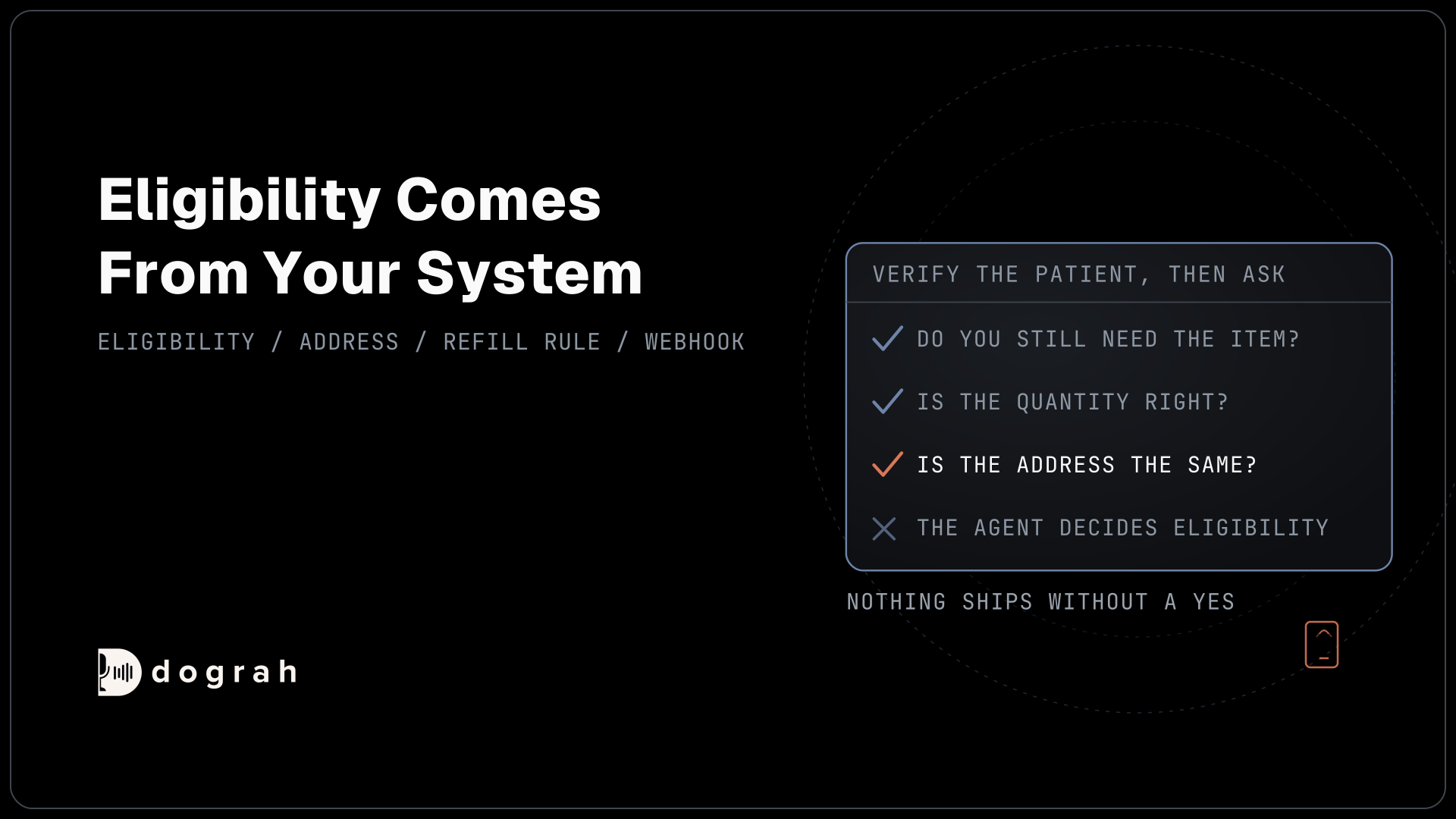
Whether a patient can have new supplies is a billing and coverage decision, and it belongs to your system. Your DME software already knows the item, the last delivery, the expected end of the current supply and the patient's coverage. It decides who is due. The agent reads that answer and never works it out for itself.
So the supplier's system builds the call list and starts each call through the API Trigger or a Campaigns list. When the call connects, Pre-Call Data Fetch, set to Outbound calls only at the bottom of the Start Call node, loads that patient's due items. The agent then only offers what the record says the patient is due. If a patient asks for something that is not on the list, such as an extra mask cushion, the agent records the request for staff. It never says yes on its own.
Resupply reminders work like prescription refill reminders, with the equipment and the Medicare rules on top. The pharmacy version of the call is in AI Voice Agents for Prescription Refill Reminders in Pharmacy.
The telephone contact rule sits in the trigger, not the agent
Medicare's telephone contact rule restricts when a DME supplier may phone a beneficiary at all, so the check happens before any call is placed. Under 42 U.S.C. 1395m(a)(17), "A supplier of a covered item under this subsection may not contact an individual enrolled under this part by telephone regarding the furnishing of a covered item to the individual unless 1 of the following applies". The three exceptions are written permission from the patient, a call about an item the supplier has already furnished, or a call about another item when the supplier has furnished at least one covered item in the previous 15 months. The supplier standard at 42 CFR 424.57(c)(11) repeats the rule. The penalty is steep: if a supplier knowingly breaks it, "no payment may be made under this part for any item subsequently furnished to the individual by the supplier."
For a voice agent, the practical conclusion is generally simple. An AI caller is the supplier's call, so the rule applies to it. The check belongs in the logic that builds the call list, because by the time the agent is speaking, the contact has already happened. The Telephone Consumer Protection Act (TCPA) and state telemarketing rules also apply, for Medicare and non-Medicare patients alike, and the guide's consent section covers the TCPA. This is informed commentary, not legal advice; confirm your own position with counsel.

Open Source Alternative to Vapi / Retell
Self-hosted voice agent platform — no per-minute fees
dograh-hq/dograh
Star on GitHub
Verify, then confirm the item and the address
The item is health information. A CPAP mask or an insulin pump supply names a condition, so the agent names nothing until the patient is verified. Write the Greeting Text to name the supplier and say the patient is speaking with an automated assistant; Dograh plays exactly what you write. It plays before verification, so it never mentions the equipment.
The agent verifies with the date of birth plus one reference, such as the first line of the address. A phone number finds a record; it does not prove who answered. A carer who manages the patient's supplies can take the call if your system lists them as the patient's representative.
Then the agent confirms three things, each recorded as the patient stated it. Does the patient still need the item? Is the quantity right? And is the delivery address the same? The agent reads the address on file back and asks the patient to confirm it, because a box sent to an old address is a lost order and a second shipment. A new address is recorded for staff to check before anything ships. If the patient says they do not need supplies yet, that answer is recorded too and nothing ships; your system plans the next contact inside the window.
The refill record Medicare expects
The answer the agent collects is the evidence your claim needs, so the write-back is part of the design. Under 42 CFR 410.38(d)(4), the supplier must document contact with the beneficiary or their representative. The record needs evidence of the patient's "affirmative response of the need for supplies", and "Contact and affirmative response must be within 30 calendar days from the expected end of the current supply." For shipped items, the record needs "the beneficiary name, date of contact, the item requested" and the patient's affirmative response before the product is dispensed. The date of service can be "no earlier than 10 calendar days before the expected end of the current supply."
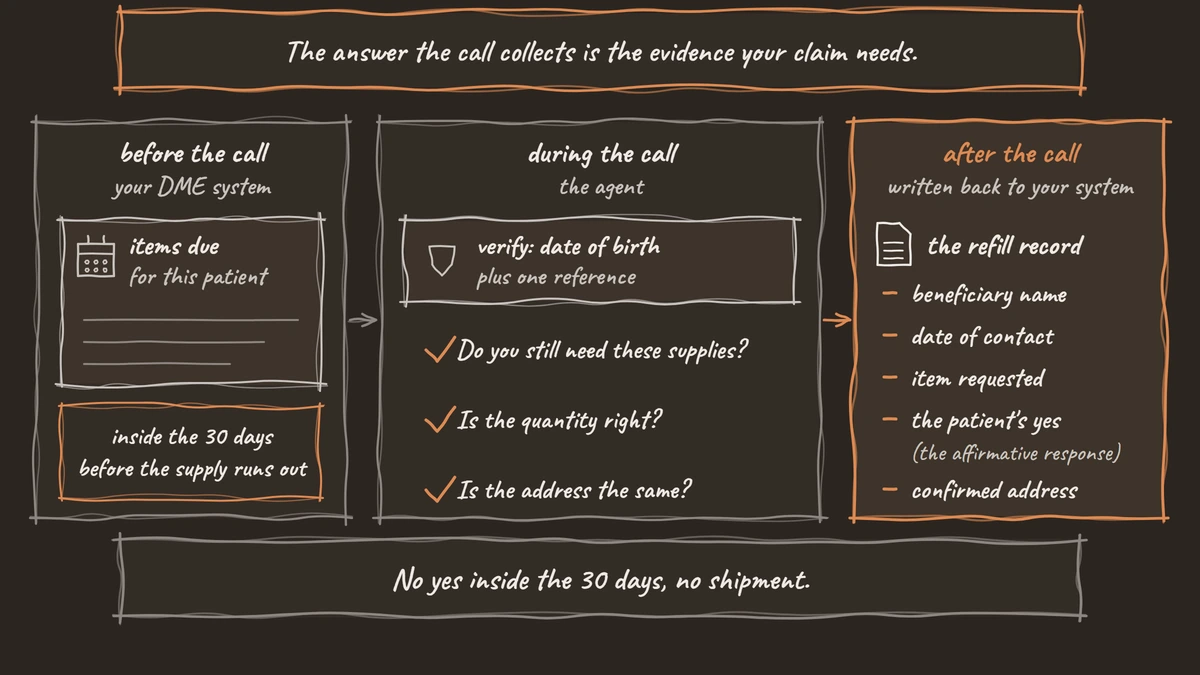
Your system sets the window and starts the call inside it. The agent's job is to get a clear answer to a plain question, "Do you need more of these supplies?", and record it as the patient said it. If a carer answered, the record says so, because the rule accepts a response from the beneficiary or their representative.
After the call, a webhook writes the patient's name, the date of contact, each item requested, the answer and the confirmed address to your DME system, with the recording link. A temporary failure is retried automatically, up to five attempts. The transcript and the recording remain the exact record of the affirmative response, because extraction is an AI step. Our post on Webhook-Driven Voice Agents: Real-Time Data In and Out covers the mechanics.
Join the Dograh Community
Dograh is an OSS alternative to Vapi. Join our Slack community for queries, releases, best practices & community interactions.
Voice is one channel, not the first one
Plenty of resupply confirmations need no call at all. Text and email can go first, with calls kept for the exceptions. A voice call earns its place for patients who do not answer texts, who need help confirming, or who have a question. Dograh has no SMS tool, so the texts come from your own DME system or messaging provider; the agent handles the calls. A patient who asks not to be called again says so by voice, and the agent writes that to your system at once so the next list leaves them out.
Questions about the equipment itself, such as a mask that leaks or a pump alarm, go to your staff. Clinical questions go to the prescriber's office. The agent writes the details through an HTTP API tool, then transfers the call with Transfer Call, which works on Twilio only and passes no summary. If the transfer is not answered within the timeout, 30 seconds by default, the agent writes a callback request to your system.
Before launch: a first product line, quality checks and cost
Start with one product line whose eligibility rules are already built into your system, such as CPAP supplies, and one region. Run quality assurance (QA) on a sample of calls, and read every call where the address changed or the patient declined. Measure the share of due patients who confirmed inside the window, the address corrections caught before shipping, and the orders that shipped without a second call.
Dograh is the orchestration layer: it runs the call flow, tools and phone line, while the speech and language models are a separate layer you choose. Self-host Dograh and the models, and orders, addresses and answers stay on your own servers; with hosted models, each provider needs its own business associate agreement (BAA). Self-hosted Dograh has no per-minute platform fee, though servers, model keys and phone minutes still cost money; Dograh Cloud has a 1¢-a-minute platform fee. Supplies delivered to the home often sit beside home visits, covered in AI voice agents for home health visit coordination. Our page on self-hosted resupply calls for DME suppliers shows the setup.
Glossary
- Durable medical equipment (DME)
- Reusable medical equipment and its supplies used at home, such as CPAP machines and masks, insulin pumps and diabetic testing supplies. Medicare covers it under its rules for suppliers of durable medical equipment, prosthetics, orthotics and supplies (DMEPOS).
- Affirmative response
- The patient's or representative's clear confirmation that they need more supplies. Medicare's refill rule requires it within 30 calendar days of the expected end of the current supply, before the product ships.
- Telephone contact rule
- The Medicare rule at 42 U.S.C. 1395m(a)(17) that bars a DME supplier from phoning a beneficiary about a covered item unless one of three exceptions applies, such as written permission.
- Expected end of the current supply
- The date a patient's current supplies are due to run out, worked out by the supplier's system. Medicare's contact window and the earliest date of service are both counted from it.