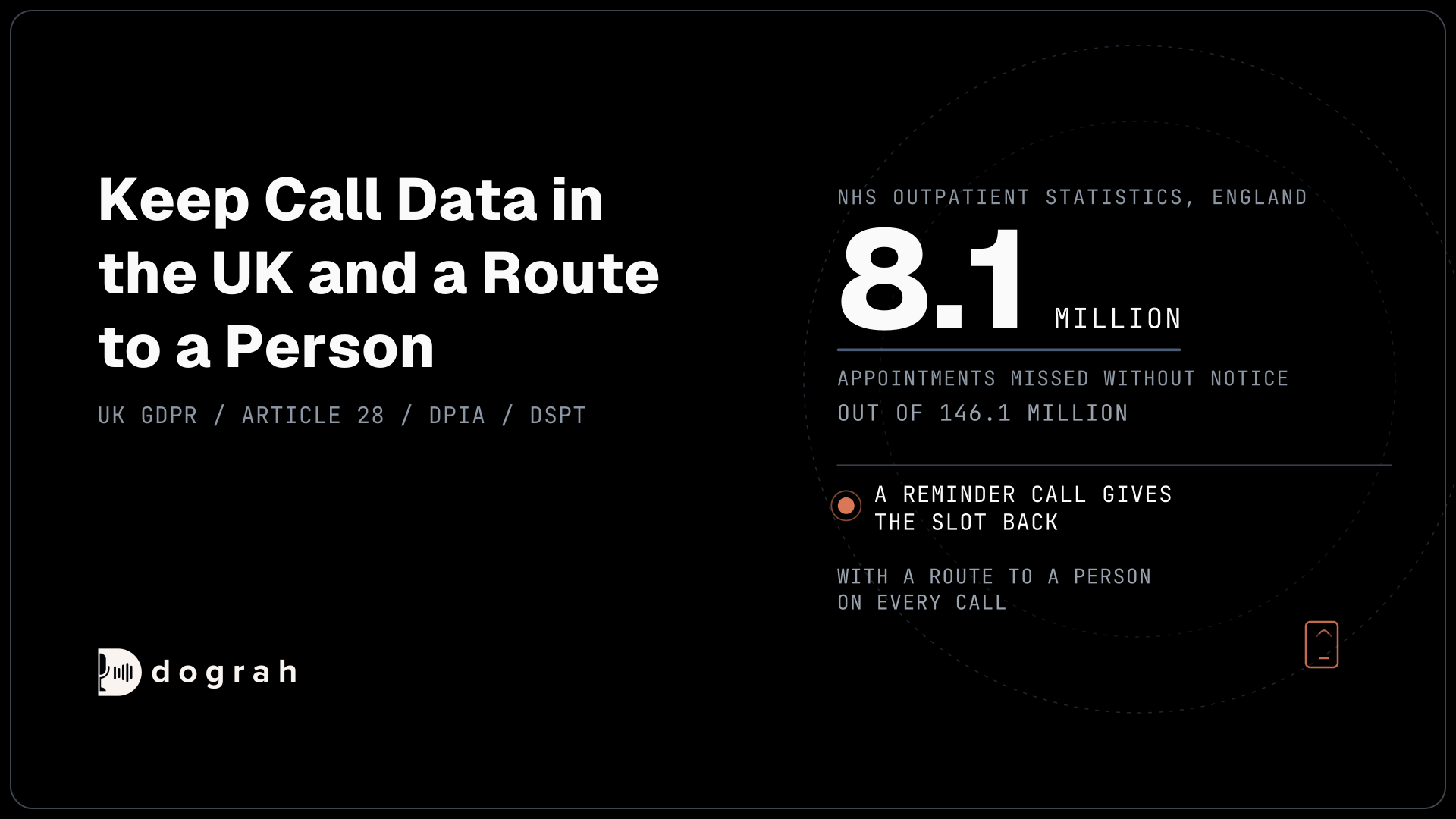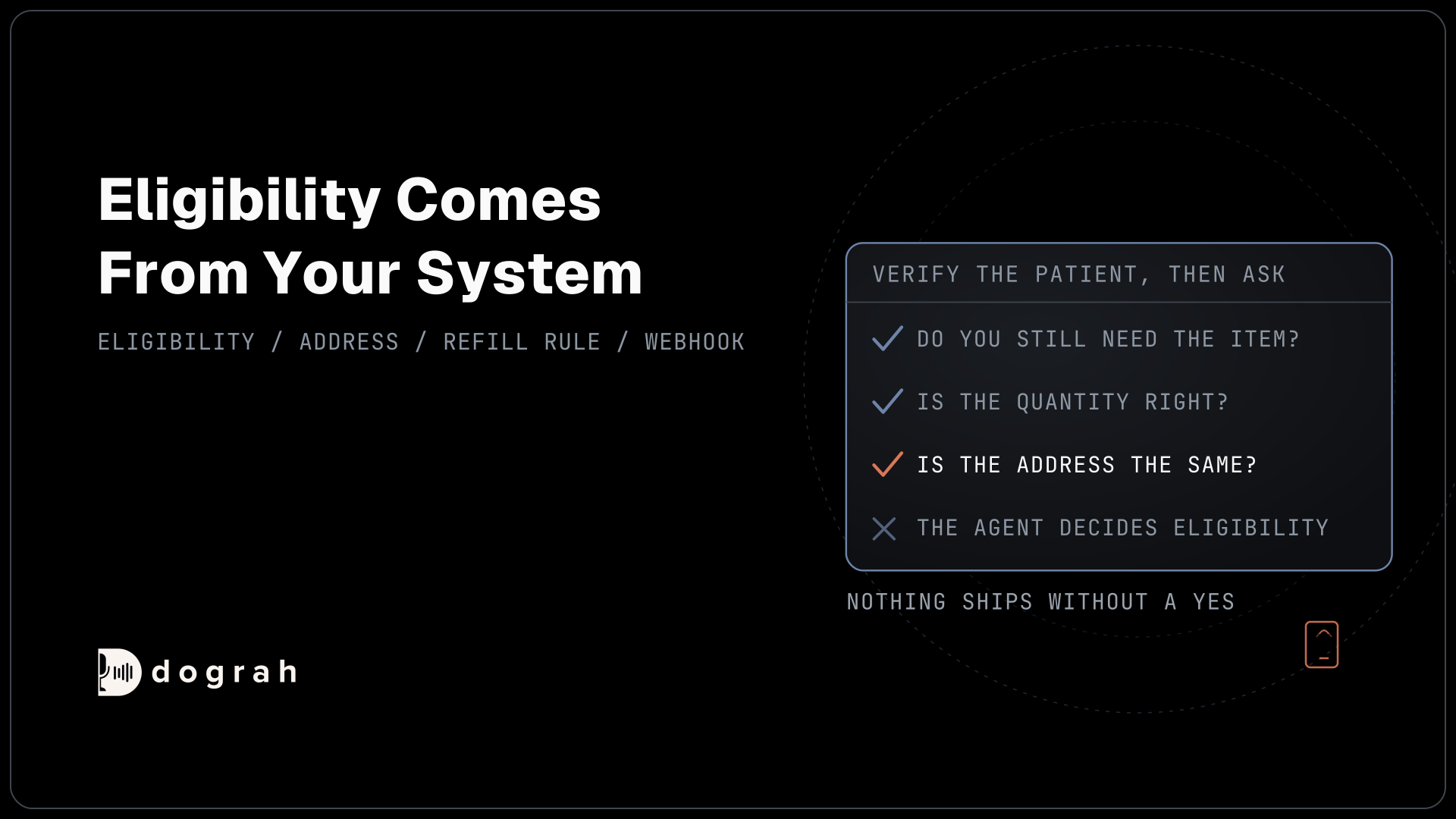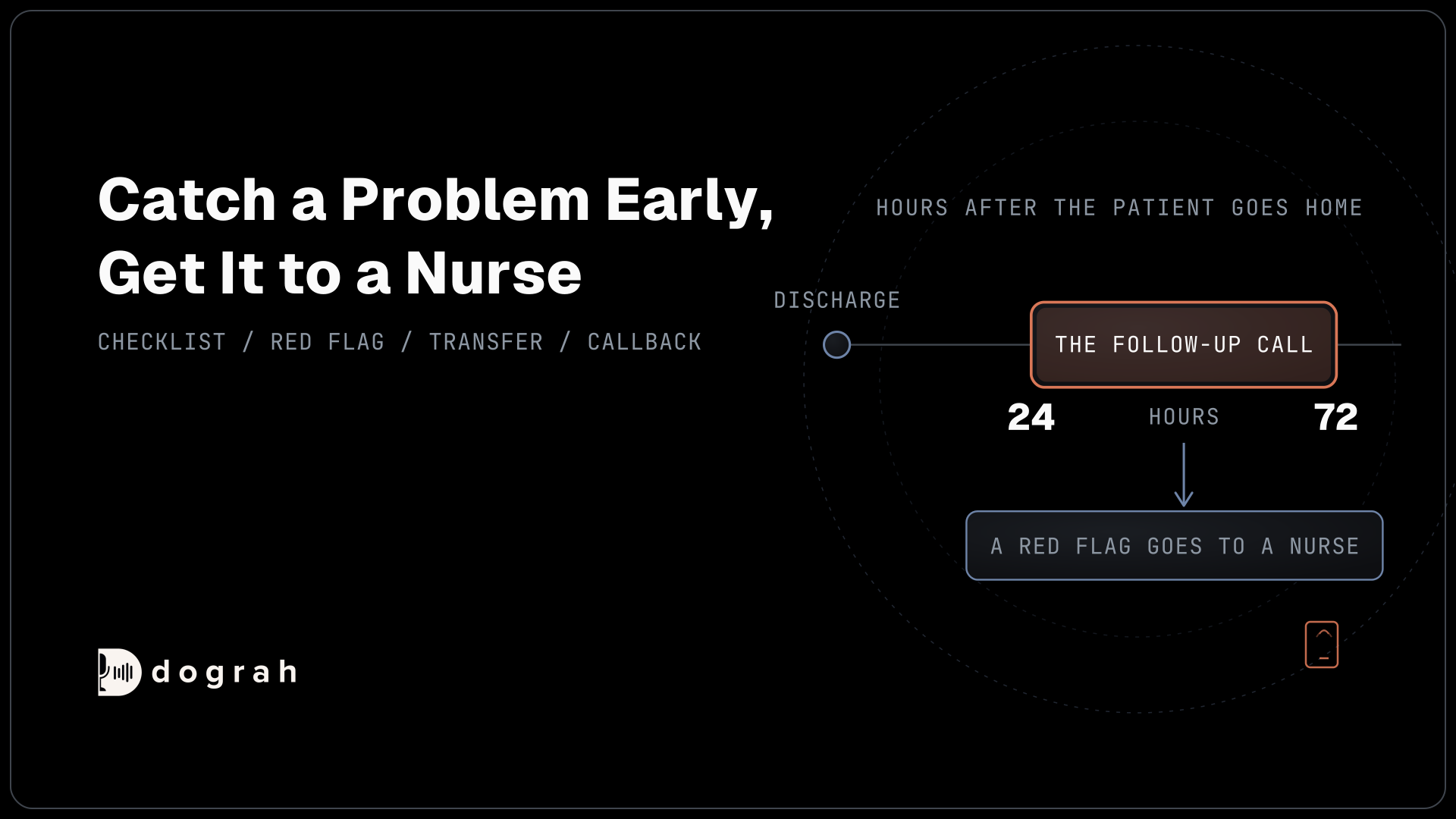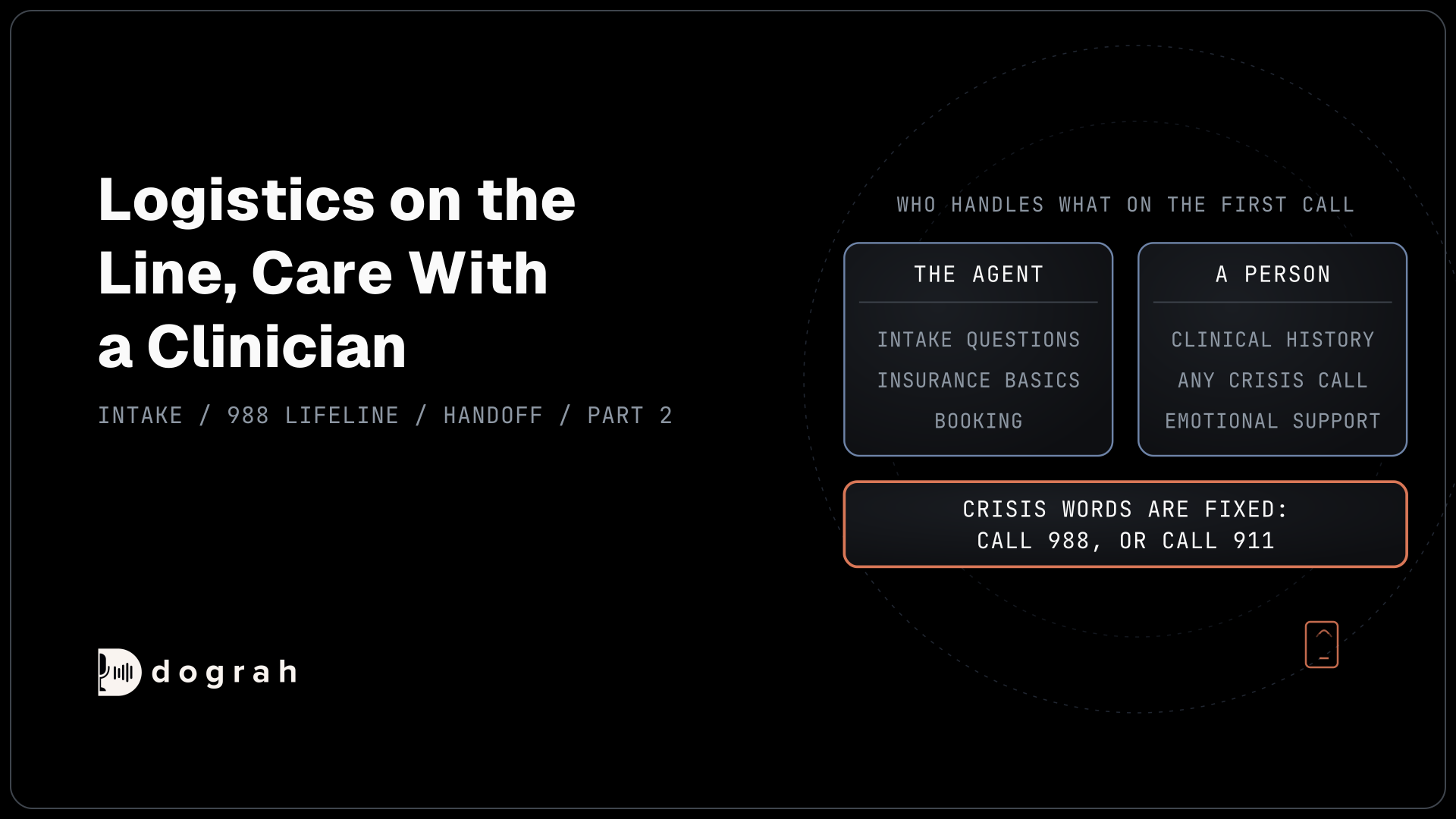

AI voice agents for behavioral health intake and triage answer first-contact calls to mental health practices: intake questions, insurance basics and booking. They handle logistics, never care. Crisis or self-harm language gets fixed wording that gives the 988 Lifeline or 911 and an immediate handoff to staff, and the records stay on the practice's own servers.
Key Takeaways
- The agent handles intake logistics only: questions, insurance basics and booking.
- Crisis language gets fixed 988 or 911 wording and an immediate handoff.
- Self-host this line, because its records are the most sensitive in healthcare.
This post is part of our guide to AI voice agents for hospitals and health systems. The guide places behavioral health under specialty care, where crisis or self-harm language gets an immediate human handoff and the 988 Suicide and Crisis Lifeline. This post shows how a mental health practice runs first-contact calls on Dograh, an open-source, self-hostable voice agent platform, without the agent ever acting as a counselor. It is general information, not legal advice.
First contact is logistics, not care
The person calling a mental health practice for the first time often has been putting off the call for weeks, and too often nobody answers. Clinicians are scarce. In the Health Resources and Services Administration's shortage data, the quarterly summary for the quarter ending 30 September 2026 counts 7,127 mental health Health Professional Shortage Area designations, home to more than 154 million people, with about 26% of the need for practitioners met. A clinician who spends the afternoon returning intake calls is not seeing patients.
An agent can take the logistics of that first call: the intake questions, insurance basics and the booking. It cannot take anything that looks like care, and state law is starting to say so. Illinois's Wellness and Oversight for Psychological Resources Act, as Holland & Knight summarizes it, allows AI for administrative support such as managing appointment schedules and processing insurance claims. It bars AI from therapeutic communication with clients and from detecting their emotions or mental states, with civil penalties of up to $10,000 per violation.
So the agent introduces itself as an automated assistant on every call, keeps to logistics, and never offers emotional support or tries to read the caller's mood. Warmth comes from short questions, a calm voice and a fast route to a person.
Greet, disclose, verify, then ask
The call order is the same as any healthcare call, with less room for error. Write the Greeting Text to name the practice and say the caller is speaking with an automated assistant; Dograh plays exactly what you write. It plays before verification, so it never names a client, an appointment or a service line.
A first-time caller has no record yet, so the agent collects name, date of birth and a callback number. A returning client is verified before anything is named: date of birth plus one reference, such as the date of the next session, and never a Social Security number. Even confirming that someone is a client of a mental health practice discloses health information.
Then the intake stays short. The agent asks whether the caller is looking for therapy, a medication appointment or a substance use program, whether they prefer telehealth or in person, any clinician preference the practice offers, and their insurance plan and member ID. It does not take a clinical history over the phone; the clinician does that in the first session. An HTTP API tool reads open first-session slots from the practice's scheduling system, the caller picks one, and the agent reads the booking back.

Open Source Alternative to Vapi / Retell
Self-hosted voice agent platform — no per-minute fees
dograh-hq/dograh
Star on GitHub
Crisis language gets fixed words and a person
One branch of the call outranks every other: what happens when the caller says they want to harm themselves or someone else, or that they have taken too much of something. The agent stops the intake and says one fixed set of words.
In Dograh, that wording lives in a pathway's Transition Speech, which plays fixed text or a recorded clip exactly as written. A practice might use: "If you are thinking about harming yourself, please call or text 988, the Suicide and Crisis Lifeline, right now. If you are in immediate danger, or someone has taken an overdose, hang up and call 911. I am connecting you to a member of our team." The 988 Lifeline is available around the clock, and conversations are free and confidential. According to the Government Accountability Office, since March 2026 calls have generally been routed to local crisis centers by the caller's approximate location.
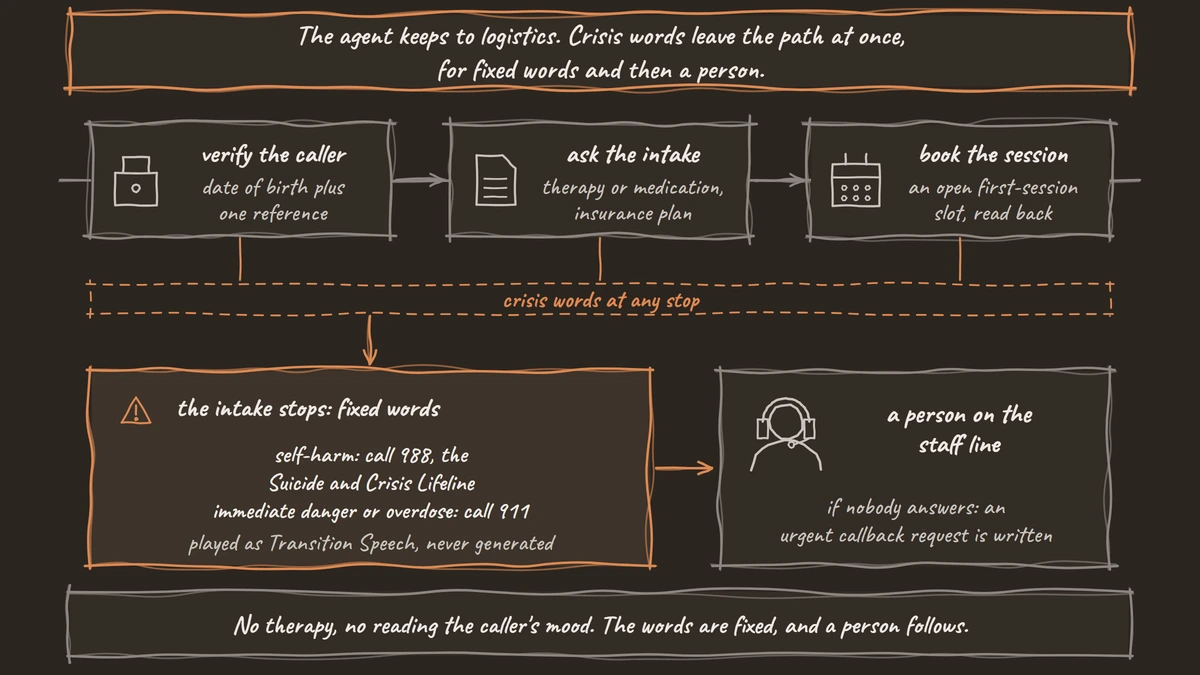
Be exact about what is fixed. The wording is fixed once the crisis pathway is chosen. Choosing the pathway is the language model reading the pathway's written condition, so keep the phrase list short and explicit: suicide, self-harm, wanting to die, harming someone else, overdose. Test every phrase, and the near misses, on real phone calls. In a 2026 structured test, ChatGPT Health's 988 alerts appeared inconsistently, which is why the words are fixed instead of generated. Our post on AI voice agents for patient intake and triage covers that study. Text Transition Speech does not play on speech-to-speech models, so use a standard agent that chains speech-to-text, a language model and text-to-speech, or a recorded clip.
When the staff line does not answer
The handoff after the crisis line must not depend on luck. Dograh's Transfer Call works on Twilio only and passes no summary by default, so the agent first writes a crisis flag and the callback number to the practice's system through an HTTP API tool. Then it transfers to the staff or on-call line.
The transfer rings for 30 seconds by default, settable from 5 to 120. If nobody answers, the agent is told the transfer failed and the caller stays on the call. Dograh has no built-in callback task, so the prompt covers the next step: the agent says a team member will call back and writes an urgent callback request through an HTTP API tool. The fixed crisis line has already given the caller 988 and 911, so nobody is left without a route. After hours, point the transfer at the on-call clinician rather than an empty front desk. Browser test calls cannot run Transfer Call, so test this path on a real phone line.
Join the Dograh Community
Dograh is an OSS alternative to Vapi. Join our Slack community for queries, releases, best practices & community interactions.
Substance use records and 42 CFR Part 2
Federal rules add a layer for substance use disorder (SUD) records, but only for some practices. Under 42 CFR 2.11, a "Program" includes a person, other than a general medical facility, "that holds itself out as providing, and provides, substance use disorder diagnosis, treatment, or referral for treatment". Federally assisted programs of that kind are Part 2 programs, and their records carry duties beyond HIPAA, the Health Insurance Portability and Accountability Act. Many mental health practices are not Part 2 programs at all.
Where Part 2 applies, any vendor that processes the records needs a written qualified service organization agreement. Under that agreement, the vendor acknowledges that in handling the records "it is fully bound by the regulations in this part". Enforcement is current. The compliance date of the 2024 final rule was 16 February 2026, and from that day the Office for Civil Rights began accepting Part 2 complaints, with penalties now aligned with HIPAA's.
For a voice agent, that generally means the intake line of a Part 2 program should collect as little as it can and keep it where the program controls it. Whether your practice is a Part 2 program, and what each agreement must say, is a question for your counsel.
Keep the recordings on your own servers
A behavioral health intake call can hold a diagnosis, a medication or a substance in the caller's own words, so this is the strongest case in healthcare for self-hosting. Run Dograh on your own servers and the recordings and transcripts sit next to your records, not in a vendor's cloud. Patient audio stays inside your infrastructure only when the speech and language models run on your servers too.
Self-hosting Dograh means no business associate agreement (BAA) with Dograh is needed. Model providers you use by API key still hear the audio, so each needs its own BAA, plus a qualified service organization agreement where Part 2 applies. The phone carrier may need a BAA too, depending on what it stores. A BAA delegates obligations to the vendor; it never transfers your liability. Dograh has no retention setting and deletes nothing automatically, so your own retention policy applies. On a self-hosted server, recording can be switched off only for the whole server, and transcripts are still saved.
Self-hosted Dograh has no per-minute platform fee, though servers, model keys and phone minutes still cost money; Dograh Cloud has a 1¢-a-minute platform fee. The privacy argument is in Why Voice Data Needs to Stay Local: Privacy, PII, and Biometric Risk, the model side in Running Voice AI on Local, Self-Hosted Models, and the HIPAA setup in HIPAA-compliant voice AI for hospitals. Our page on self-hosted voice AI for behavioral health practices shows the setup.
Glossary
- 42 CFR Part 2
- The federal confidentiality rules for records of federally assisted substance use disorder programs. They sit on top of HIPAA and apply only to Part 2 programs, not to every mental health practice.
- Qualified service organization
- A vendor that provides services such as data processing to a Part 2 program under a written agreement, in which it accepts that it is fully bound by Part 2 when handling the program's records.
- Transition Speech
- Fixed text or a recorded clip that Dograh plays word for word when the agent moves onto a pathway. It is where the crisis wording lives, so the model never improvises it.
- Health Professional Shortage Area
- A federal designation for an area, population group or facility with too few clinicians. Mental health designations show where first-contact calls are most likely to go unanswered.