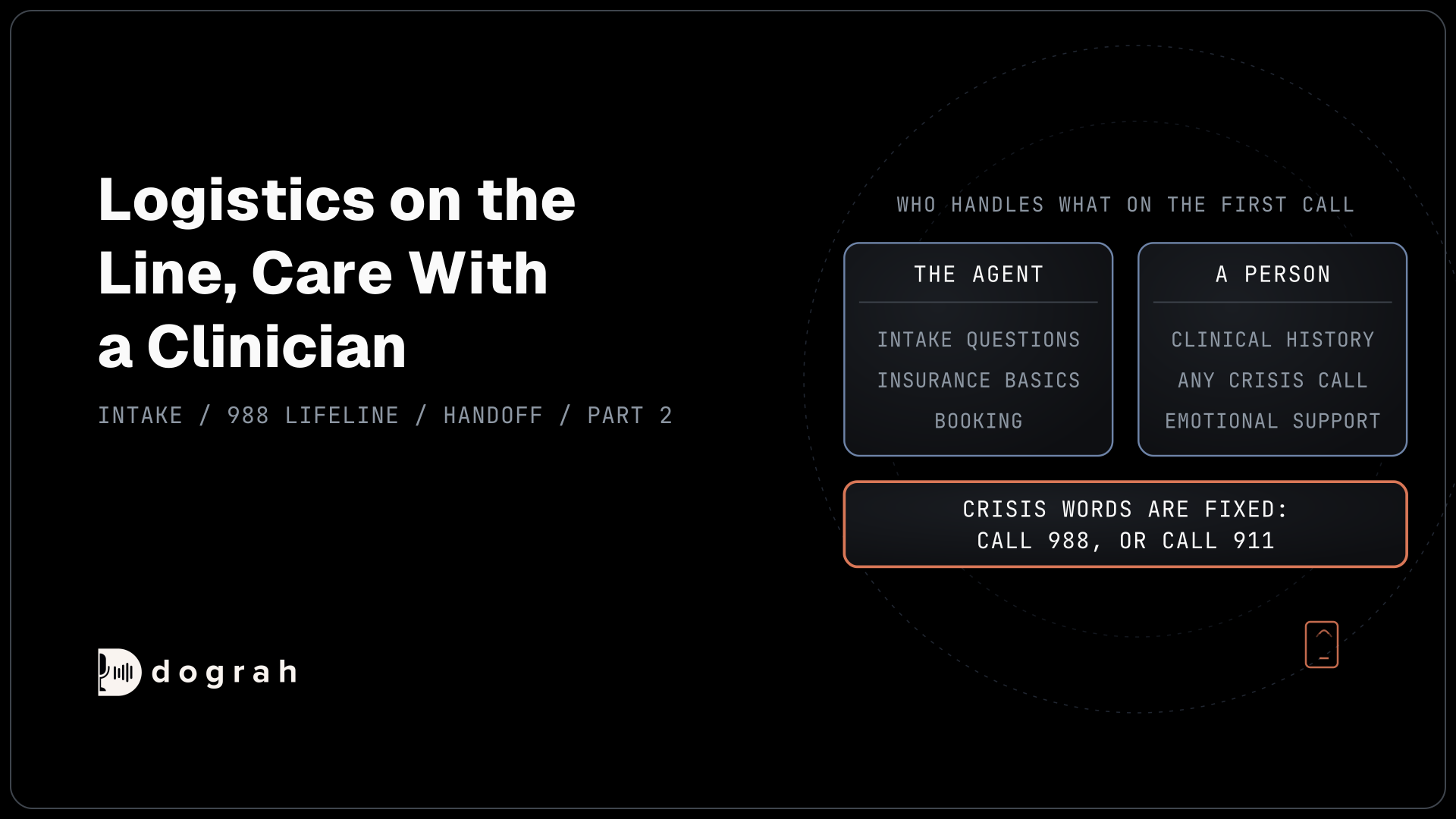

AI voice agents for patient intake and triage take the reason for the visit and the patient's details before an appointment, then route the call by the provider's own written rules: book a slot, transfer to the nurse line or play the emergency instruction. The agent collects and routes. It never judges how serious a symptom is.
Key Takeaways
- The agent asks your intake questions and records answers as stated.
- Clinicians write the routing rules; the agent follows them and never improvises.
- The emergency instruction is fixed wording, played as Transition Speech or a clip.
This post is part of our guide to AI voice agents for hospitals and health systems. The guide places intake among the patient calls before a visit, where the agent collects the reason for the visit and routes by your own triage rules. Here we build that call in Dograh, an open-source, self-hostable voice agent platform, from the first intake question to the emergency instruction.
Why the agent never judges how serious a symptom is
On an intake call, the agent gathers facts and sends the call where your clinicians have already decided it should go. It does not weigh symptoms, and recent evidence shows why.
In February 2026, researchers at the Icahn School of Medicine at Mount Sinai published a structured test of ChatGPT Health's triage advice in Nature Medicine. They wrote 60 clinical scenarios across 21 specialties, ran each in 16 variations (for example, a different patient gender or race) and compared the answers with physician consensus. The tool under-triaged more than half of the cases that physicians judged to need emergency care. Sending an emergency toward a routine appointment is called under-triage, and it is the worst mistake an intake line can make. The tool handled clear-cut emergencies well and struggled with the less obvious ones. A structured test is not a live phone line, and some researchers argue the exam format inflates the error rate. The direction still holds: a model asked to judge urgency will sometimes judge it wrong.
ECRI, the patient safety organization, reached the same place from another angle. It put the misuse of AI chatbots first on its 2026 list of health technology hazards, warning that chatbots are built to sound confident and always give an answer. ECRI tested general-purpose chatbots, not intake agents, but its advice carries over: put AI tools under a governance committee and audit how they perform.
So the agent collects, your rules route, and the judgment stays with people licensed to make it.
Greet, verify, then ask your own questions
Intake starts with identity, because every answer after it is protected health information (PHI). The greeting names the practice and says the caller is speaking with an automated assistant. Dograh's Greeting Text plays word for word as the call connects, before the caller is verified, so it can carry the practice name but never an appointment or a symptom.
Verification comes next. The caller's number finds a record; it does not prove who is calling. The agent asks for the date of birth plus one reference, such as the appointment date or part of the medical record number, and never a Social Security number. The Health Insurance Portability and Accountability Act (HIPAA) Privacy Rule at 45 CFR 164.514(h) requires a covered entity to verify the identity of a person asking for PHI when it does not know that person. Pre-Call Data Fetch, at the bottom of Dograh's Start Call node, can look the patient up by phone number as the call connects.
Then the agent asks your intake questions in your order: the reason for the visit in the patient's own words, how long it has been going on, current medications if your form asks for them, insurance basics and preferred times. Variable extraction records each answer as the patient stated it. Extraction is an AI step, so the transcript and the recording remain the exact record, and the agent never turns a patient's words into a clinical term they did not use. Ask only what the visit needs: the minimum necessary standard applies to a phone call too.

Open Source Alternative to Vapi / Retell
Self-hosted voice agent platform — no per-minute fees
dograh-hq/dograh
Star on GitHub
Write the routing table before the agent takes a call
Routing is a table your clinicians own, written before launch and changed only by them. The agent needs it as a short list of outcomes, each with a plain condition.
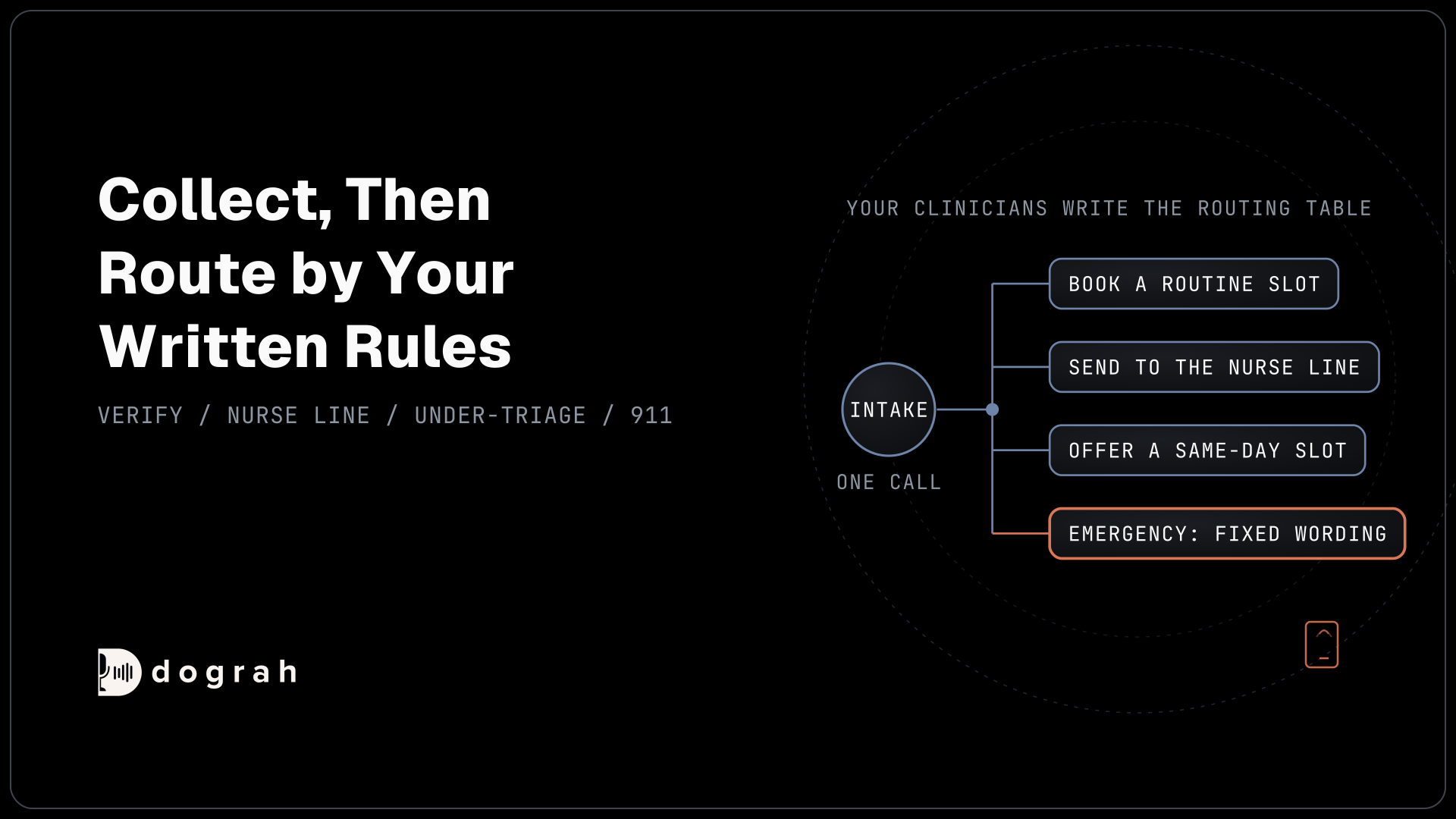
A typical routing table has four outcomes. Book a routine slot when the reason matches a visit type and no warning sign came up. Send the call to the nurse line when the patient describes a new or worsening symptom, asks a clinical question or gives a reason that matches no visit type. Offer a same-day slot when your rules list the reason as same-day. Play the emergency instruction when the patient uses one of the emergency phrases.
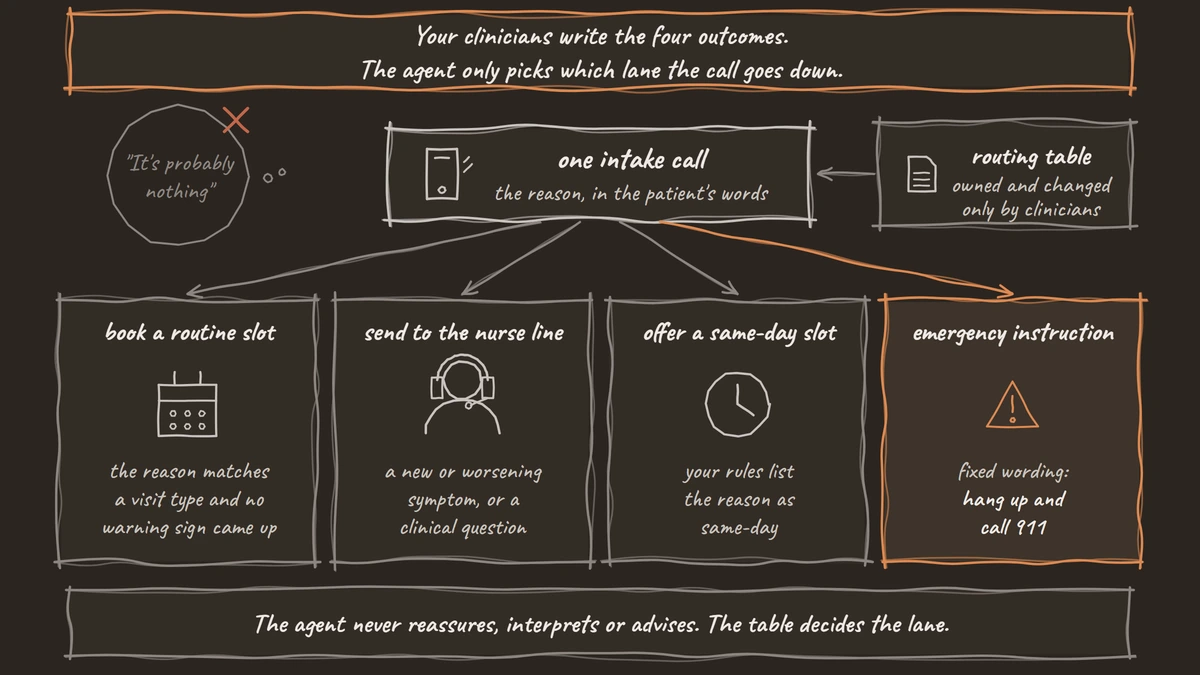
In Dograh, each outcome becomes a pathway out of the intake node, and each pathway's condition is the rule written in plain words. The rules can sit in the prompt, or an HTTP API tool can read the current table from your system, so clinicians can update it without touching the agent. Either way, the agent never invents an outcome.
Write down the banned lines too. "It's probably nothing", "that sounds like a pulled muscle" and "you should be fine until Monday" are diagnoses wearing friendly words. The prompt tells the agent never to reassure, interpret or advise, and quality assurance (QA) checks that it does not. When the table says book, the booking itself works as described in AI voice agents for patient appointment scheduling.
The emergency instruction is fixed wording
One sentence on an intake call must never be improvised: the instruction to hang up and call 911. In Dograh, a pathway's Transition Speech plays fixed text or a recorded clip exactly as written when the agent moves onto that pathway, so the emergency instruction lives there rather than in a node prompt.
Be precise about what is fixed. The wording is fixed once the emergency pathway is chosen. Choosing the pathway is still the language model reading the pathway's written condition, so detection is not a hard rule. Keep the phrase list short and explicit in that condition: chest pain or pressure, trouble breathing, signs of a stroke such as a drooping face or slurred speech, a possible overdose, and any mention of harming oneself or someone else. Test each phrase on real phone calls, along with the near misses.
Text Transition Speech does not play on speech-to-speech models, so use a standard agent that chains speech-to-text, a language model and text-to-speech, or attach a recorded clip. Self-harm language also needs crisis wording with the 988 Suicide and Crisis Lifeline, which our post on AI voice agents for behavioral health intake and triage covers in depth.
Join the Dograh Community
Dograh is an OSS alternative to Vapi. Join our Slack community for queries, releases, best practices & community interactions.
Hand off to the nurse line, even when nobody answers
Anything clinical goes to the nurse line, so the handoff has to work on a busy afternoon. Dograh's Transfer Call puts the patient through to a person. It works on Twilio only and passes no summary by default, so the agent first writes the intake to your system through an HTTP API tool, and the nurse sees the reason for the call on screen.
The transfer rings for 30 seconds by default, settable from 5 to 120. If nobody answers, the agent is told the transfer failed and the patient stays on the call. Dograh has no built-in callback task, so the prompt covers the next step. The agent tells the patient a nurse will call back, writes a callback request to your system through an HTTP API tool, and ends with any safety line your clinicians want, set as fixed Transition Speech like the emergency instruction. Browser test calls cannot run Transfer Call, so test this path on a real phone line before launch. For queues, staffing and routing across a large health system, see AI Voice Agents for Healthcare Call Centers: Patients Still Call.
Check every call went the right way, and decide where recordings live
An intake agent is measured by whether each call reached the right outcome. Dograh's QA node scores each step of a call separately, and its Sample Rate, the share of calls it checks, can be set below 100% to review a random sample. Run it on a sample of live calls, then read every call that took the emergency or nurse-line pathway yourself. A chest-pain mention that ended in a booking means a condition needs rewriting, and the clinician who owns the table rewrites it. Our post on automated QA for voice agents explains the scoring.
Decide where the recordings live before launch. Self-hosting Dograh keeps recordings and transcripts on your servers, and no business associate agreement (BAA) with Dograh is needed, because Dograh never receives the PHI. Model providers you use by API key still hear the audio, so each needs its own BAA unless the models run on your servers too. The phone carrier may need one as well, depending on what it stores. Self-hosted Dograh has no per-minute platform fee, though servers, model keys and phone minutes still cost money. Dograh Cloud has a 1¢-a-minute platform fee. The full setup is in HIPAA-compliant voice AI for hospitals.
Glossary
- Under-triage
- Assigning a call a lower urgency than it needs, such as booking a routine visit for someone who needs emergency care. It is the main reason an intake agent routes by written rules instead of its own judgment.
- Variable extraction
- Dograh's AI step that records each answer the patient gives as a named field, as stated, for your system.
- Transition Speech
- Fixed text or a recorded clip that Dograh plays word for word when the agent moves onto a pathway. It cannot carry per-patient details, which makes it the place for the emergency instruction.
- Minimum necessary
- The HIPAA standard that limits the protected health information used or disclosed to what a task needs. On an intake call, it means asking only the questions the visit requires.