
An AI voice agent in a healthcare call center answers patient calls, books and reschedules appointments in the scheduling system, routes urgent or clinical calls to the right staff member, calls back patients whose calls were missed, and hands over to a person with the details collected. Health systems use them to take routine calls off the front desk.
Key Takeaways
- At 71% of medical groups, more than 3 in 4 patients still don't book online.
- Password resets and bookings suit AI; symptoms go straight to a nurse.
- A good handoff passes the facts, so patients never repeat themselves.
Healthcare spent a decade building patient portals and apps, and patients kept calling anyway. We build Dograh, an open-source voice agent platform, and the phone line is where we see health systems lose the most staff time.
Patients still call, even after a decade of portals
Digital booking has been available for years, and most patients still pick up the phone.
In a July 2025 poll by the Medical Group Management Association (MGMA), 71% of medical groups said that less than a quarter of their patients book appointments online. At those practices, more than three out of four patients still book by phone or in person. When MGMA asked practice leaders in December 2025 what they would focus on in 2026, phone access came in at 22%, close behind online scheduling at 24%.
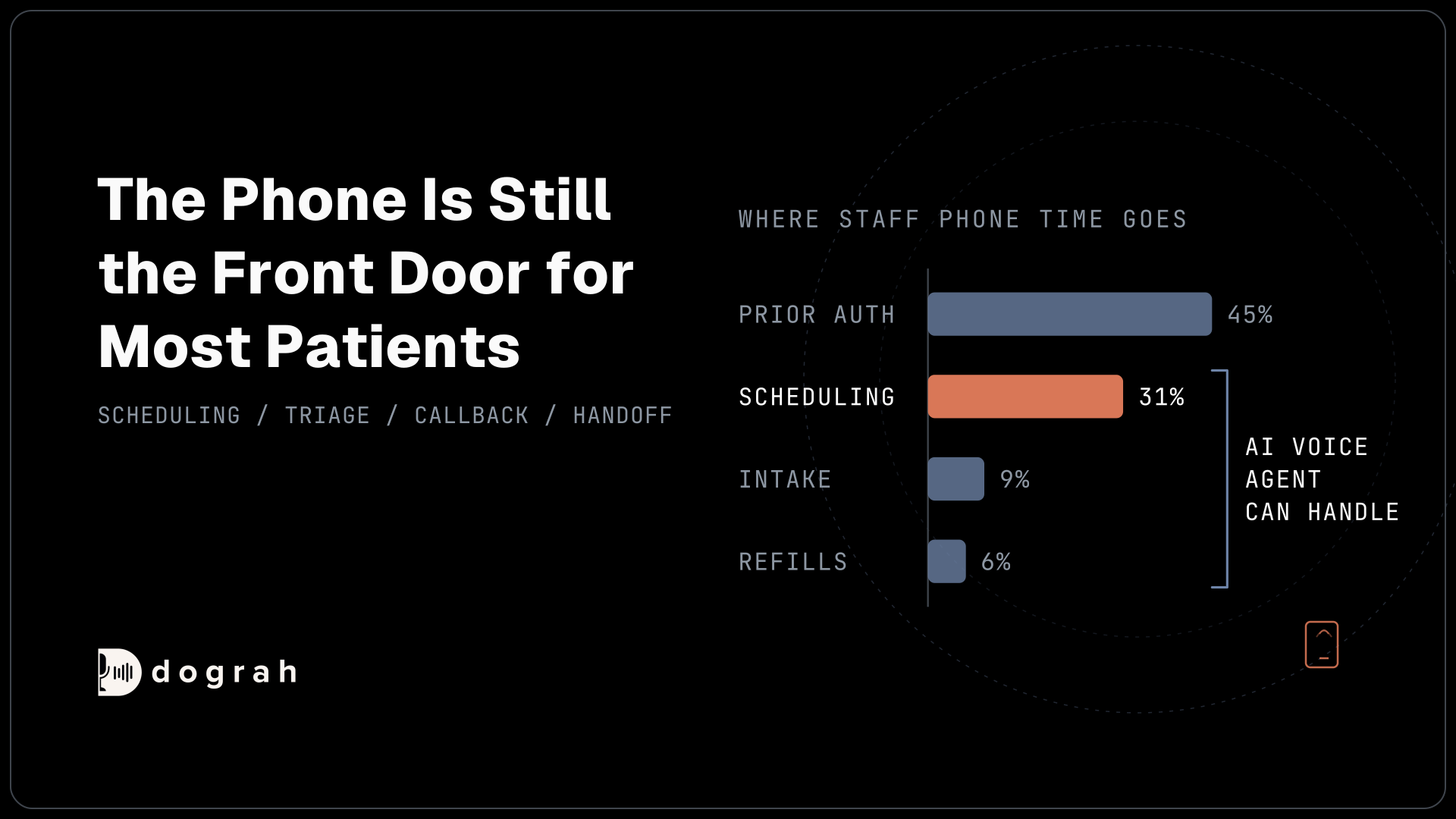
The phone is also where staff time goes. In a March 2026 MGMA poll of 294 practice leaders, the most time-consuming phone work was eligibility and prior authorization at 45%, then scheduling at 31%, intake at 9% and prescription refills at 6%. MGMA wrote that "the phone often remains the real 'front door' for a large share of patients."
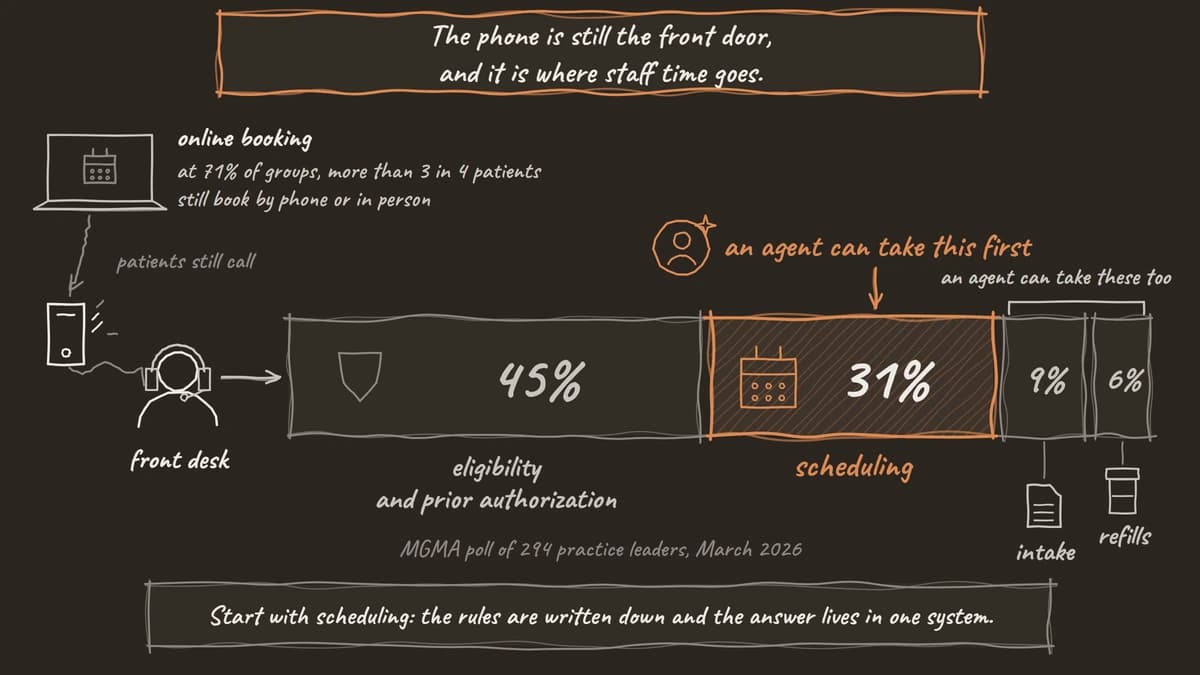
Scheduling takes 31% of staff phone time in the MGMA poll, and it is the slice an agent can take over first because its rules are already written down.
The people answering those calls are also the hardest to keep. In MGMA's May 2026 turnover poll, front-desk and entry-level admin roles were still among the most common churn points. So the busiest channel is often run by the least stable team.
Some large systems moved early. Keck Medicine of USC's patient access center began using AI voice assistants on its most standardized calls, and Virtua Health in New Jersey automated parts of its contact center. The results below come from health systems that have published 2026 numbers.
Scheduling is the first call to hand over
Scheduling suits an agent because the rules are written down and the answer lives in one system.
A scheduling call follows a known path. The agent confirms who is calling, works out the visit type, checks real availability and books the slot. Rescheduling and cancelling both follow the same path. The work runs on accurate data and clear rules, and it involves no clinical judgment.
This is where the largest deployments started. WellSpan Health in Pennsylvania says its AI agent, Ana, now handles more than 160,000 patient calls a month after nearly two years in use. Ana answers inbound calls and books primary care appointments, and WellSpan is now extending it to post-discharge follow-up. Smaller teams can start without a health system's budget by building the same kind of scheduling agent on Dograh, our open-source platform, and growing it one call type at a time.
Practice leaders in the MGMA poll said scheduling calls drag on because openings are scarce, which leads to back-and-forth and phone tag. An agent can stay on that back-and-forth for as long as the patient needs while other callers are answered at the same time. Once the slot is agreed, a tool call writes the booking straight into the scheduling system, so the front desk sees it at once.
Reminder calls and filling cancelled slots are the outbound half of the same problem. We covered them in our post on no-show reduction.

Open Source Alternative to Vapi / Retell
Self-hosted voice agent platform — no per-minute fees
dograh-hq/dograh
Star on GitHub
Triage routing sends the call to the right person
In a voice agent, triage should mean moving the call quickly, while the clinical decision stays with a clinician.
Patients rarely call with only one request. Someone booking a follow-up may mention that their symptoms got worse, or ask whether it is safe to wait. The agent's job at that moment is to notice the question and move the call to a nurse line or an on-call clinician straight away, without trying to answer it.
That means writing escalation rules before launch. Phrases such as chest pain or trouble breathing should trigger a fixed emergency instruction. In Dograh, we set this up as a fixed message in the workflow that plays word for word, because generated wording can drift from call to call. Other clinical questions go to the nurse line with a short summary attached, and the agent keeps the rest.
Catholic Health on Long Island is building in this order. After its first voice agent project, it began moving AI onto a patient access line of about 600,000 calls a year, and the early work there is checking who is calling and sending each call to the right place. We think that order is right, because routing decides who a patient ends up talking to.
The law draws the same line in at least one state. California's AB 3030 covers generative AI communications about "patient clinical information". On a voice call, the disclaimer "shall be provided verbally at the start and the end of the interaction", along with instructions for reaching a human. The law excludes "appointment scheduling, billing, or other clerical or business matters." So in California, a booking and a symptom question generally fall under different rules, even inside one call. Confirm your own position with counsel.
Taking routine calls off the front desk
The strongest 2026 results come from routine calls that used to wait in a queue.
Catholic Health started with its MyChart help desk, which took about 5,000 calls a month at $10 a call. Patients waited 30 to 60 seconds for a live agent, and 10% hung up before anyone answered. The voice agent was set up for routine requests such as password resets and lost usernames. It resolved 54% of calls on its first day against a 30% target, and later reached 64%. Catholic Health saved $60,000 in the first two months and projects $360,000 a year, as Becker's reported in April 2026.
Billing calls show the same pattern. Gastro Health, one of the largest gastroenterology practices in the US, reported to Fierce Healthcare in June 2026 that its billing voice agent had handled more than 60,000 calls. Live agent handle time fell 24%, and call center staffing needs fell 22%.
Refill requests are a smaller slice, 6% of phone time in the MGMA poll, but they interrupt the front desk all day. They fit the same model, and we went through them in our prescription refill post. Intake is another 9%, and an agent can collect a new patient's details during the call, so staff are not calling back just to fill the gaps.
The agent has to finish the task on the call itself. If it only tells the patient to go to the website and then hangs up, the patient will often call back later, and the front desk still ends up handling it.
Missed calls should get a callback the same day
A patient who hangs up on hold usually still wants the appointment, and the practice already has their number.
An agent that answers every call removes most of the problem, because there is no hold queue to give up on. After hours it can still book appointments and note why each patient called, with anything clinical flagged for the morning team. For calls that did drop, the phone system logs the number. A call back the same day can recover a patient who would otherwise book somewhere else.
Put limits on these callbacks. One or two attempts is enough. Stop once the patient books or declines, and drop wrong numbers straight away. Log every attempt. Outbound AI calls carry consent rules, so check yours with counsel before switching this on. The same logic of answering on the first ring runs through our post on citizen helplines.
Join the Dograh Community
Dograh is an OSS alternative to Vapi. Join our Slack community for queries, releases, best practices & community interactions.
The handoff to a person decides how the call feels
Many calls have an exception in them, so the handoff is where the agent earns trust.
Plenty of patients who call could have used the portal. They call because their case is unusual, or because they want a person to confirm that something actually happened. An agent can still finish the routine part of those calls and pass the rest on with the facts already collected.
A good handoff is a warm transfer. The agent tells the patient who they are being passed to and why. Before picking up, the staff member sees a short summary of who called, what was verified, what was done and what is still open. The patient does not have to give their date of birth twice.
Allyson T. Collins, who leads digital strategy at Catholic Health, said "it doesn't matter to the patient whether they're dealing with a live human or AI, as long as they get the help they need." That only holds while the path to a person stays open. If a patient asks for a person, the agent should transfer them, every time.
Measure transfers by call type, and read the transcripts of the ones that went wrong. A high overall resolution rate can hide a scheduling flow that works well next to a refill flow that does not.
Where hosted healthcare voice platforms fall short
Most healthcare voice AI on the market runs as a hosted service, which means patient audio leaves your network on every call.
On a hosted platform, each patient call passes through the vendor's infrastructure. A business associate agreement (BAA) passes some duties to the vendor and gives you a duty to monitor them, while your own liability stays with you. We explained why voice data is harder to protect than text in a separate post.
Cost is the other gap. Most closed platforms charge a platform fee of around 5 to 7 cents a minute, with model usage billed on top. At the call volumes above, that fee becomes a line item finance will ask about.
Dograh is open source under the BSD-2 license, and you can self-host it for free. It is the orchestration layer that runs the workflow, the telephony, the tool calls and the transfers. The models are a separate choice. You can use Dograh's own models or bring keys for any provider. For full data sovereignty, run open-weight models on your own servers, so patient audio never leaves your boundary.
The build uses standard Dograh features. Pre-call fetch pulls the caller's upcoming appointments before the agent says hello. Tool calls book and cancel in your scheduling system. Call transfer hands the patient to a person with the summary attached. Automatic quality checks flag calls that went off script, and your team edits the flow in a visual builder without waiting on engineering.
Start with your own call data. Pull a month of calls, sort them by reason, and pick the largest routine group. For most practices that is scheduling. Write the escalation rules before the first call goes live, then add call types one at a time.
Patients will keep calling. The practices that answer on the first ring, and pass the hard calls to a person who already knows the story, are the ones patients will stay with.
Glossary
- Containment rate
- The share of calls an AI agent completes from start to finish without a transfer to staff. Track it per call type, because a high overall rate can hide one weak flow.
- Prior authorization
- Approval a health plan must give before it covers certain treatments or drugs. Front-desk staff spend long stretches on the phone requesting it and checking its status.
- Patient access center
- A health system's central team for scheduling and patient phone calls across many clinics.
- Patient clinical information
- Under California's AB 3030, information about a patient's health status. The law's AI disclosure rules apply to it, and it excludes scheduling and billing.