

AI voice agents cut healthcare no-shows by settling the appointment during the call. The agent pulls the live schedule before dialing, confirms attendance, moves the visit when the patient cannot make it, and releases the slot to a waitlist. Self-hosting keeps the recorded audio and transcripts inside your own network.
Key Takeaways
- Adding calls to text reminders cut no-shows to 9.6% from 11.3% across 59,994 patients.
- Rebooking or releasing the slot during the call is what moves the number.
- One patient call can touch four vendors, and each one needs its own BAA.
Most clinics already send reminders. The share of booked slots that go unused is still climbing. Dograh, an open-source, self-hostable voice agent platform, lets clinics run these calls on their own servers.
Reminder and rescheduling calls are one part of the wider set covered in our guide to AI voice agents for hospitals and health systems.
Most cancelled slots never get rebooked
Reminder coverage in outpatient care is close to universal, and no-show rates are rising anyway.
MGMA polled 190 medical groups in August 2026 and found that 32% are seeing higher no-show rates this year, against 58% holding steady and 10% seeing improvement. That is five points worse than the same poll a year earlier. Practices pointed at patient costs first. Enhanced ACA premium tax credits lapsed at the end of 2025, and the average deductible climbed 37% to a record $3,786.
The sharper number sits one step later. MGMA's 2025 DataDive operations data put the appointment cancellation rate at 19.95%, and only 27.40% of those cancelled visits were rebooked within thirty days. So one in five booked appointments comes apart, and close to three quarters of those never return to the calendar inside a month. In most cases the reminder did its job. The patient knew, and said they could not attend. What went missing was the step that puts them back on the schedule.
Almost every practice already sends reminders, by text or portal or automated call, and the patients who miss appointments are largely receiving them. The message arrives. The appointment still goes unused.
Adding a call cut no-shows by 1.7 points

That number comes from a trial that changed one thing, whether an automated call went out alongside the text.
A 2026 NEJM Catalyst study ran a four-week trial across 59,994 high-risk patients. One group received text reminders. The other received the same texts plus an automated phone call. The group that also got the call finished at a 9.6% no-show rate against 11.3% for text alone, and completed 77.8% of appointments against 75.9%. Scaled up, that works out to roughly 19,000 additional completed appointments per million slots. The team then tracked more than 244,000 high-risk patients across six months and found the improvement held.
Two details in that result deserve more attention than the headline number. The effect was largest among patients in the highest-risk quartile, which means the call reached the people most likely to miss. The largest gain in appointment completion showed up among Black patients, narrowing a gap that existed before the intervention started. Outreach that works hardest on the patients who are hardest to reach is doing something more valuable than shaving a point off an average.
The lift came from a second attempt arriving on a channel that is harder to ignore than a text sitting in a notification tray. If a recording that cannot hold a conversation is worth 1.7 percentage points, the open question for 2026 is what a call that can finish the job is worth. Nobody has run that trial at this scale yet, so the upside belongs in the untested column rather than the proven one.
Reminders are the outbound half of the phone line. The inbound half, where patients call to book or change a visit, is covered in our post on healthcare call centers.
Rescheduling and waitlist backfill on the same call
A text ends when the patient reads it. A call can end with the slot settled.
Every reminder has a real outcome behind it. The patient is coming, or they are not. If they are not, two moves matter. Reschedule the visit, or release the slot so someone else can take it. A one-way message collects almost none of this. It collects a read receipt.
A voice agent collects all of it in one pass. Before dialing it reads the live appointment record, so it opens with the real date, clinician, and location instead of asking the patient to call the office back. If they cannot attend, it offers open slots from the same schedule and books one on the spot. If they cancel, the released slot goes to the waitlist and the agent starts working down it while the gap is still fillable. A slot released nine days out is a slot you can sell. A slot released at 8am on the day is a loss you find out about earlier.
The same shape shows up outside healthcare. We wrote about rescheduling a failed delivery on the call instead of sending another notification, and the mechanics are close to identical. Settle the exception while you have the person on the line.
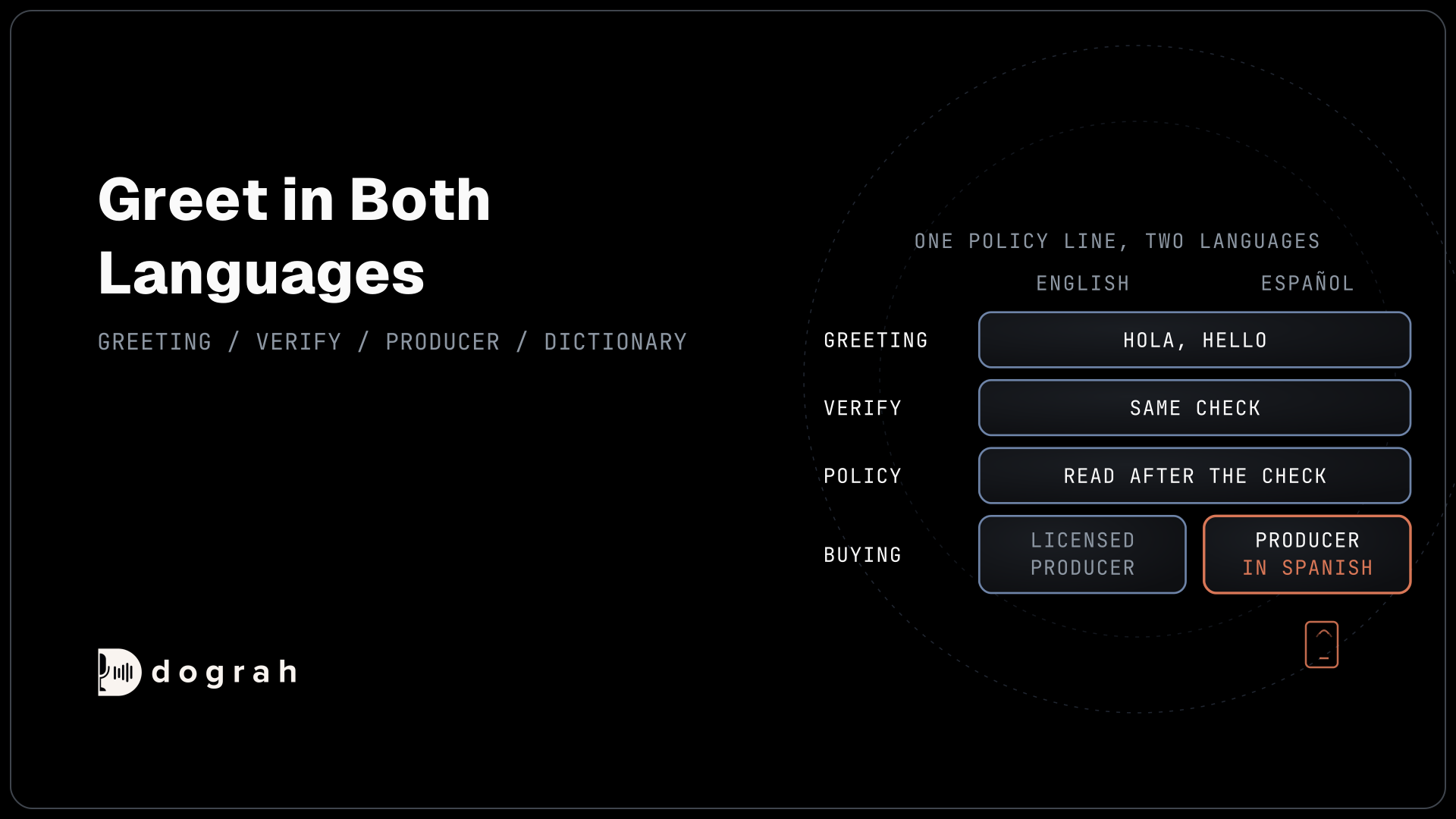
One kind of miss reminders never touch. The patient arrives without the referral, or with a prior authorisation that never cleared. The slot is consumed and the visit still does not happen. An automated, conversational confirmation call can run the prep checklist out loud, in the patient's own language, and catch the problem while there is time to fix it.

Open Source Alternative to Vapi / Retell
Self-hosted voice agent platform — no per-minute fees
dograh-hq/dograh
Star on GitHub
The conversation has to feel like one
A two-way call only earns its keep if the patient stops noticing the machinery.
The bar is latency. End-to-end response under 800ms is roughly where a voice exchange stops feeling like a transaction, and speech-to-text is usually the component that blows the budget rather than the model. For patient calls the tolerance runs tighter than average, because someone who suspects they are talking to a robot about their own healthcare hangs up faster than someone fielding a sales call.
The opening seconds carry most of that risk. The first fifteen seconds decide whether the patient stays on the line, and for a clinic that means naming the practice and saying plainly that the call is automated, then getting to the specific appointment before the patient has written the whole thing off as spam.
Scope discipline matters as much as speed. The agent handles logistics, so dates, directions, prep instructions, and what to bring. Anything clinical goes to a human, and the agent writes the call details to your system first, so staff see them instead of the patient starting over in a queue. A scheduling agent that starts fielding symptom questions is a liability, and the honest version of this technology draws that line early and keeps it.
Every vendor in the call path is a business associate
One patient call usually touches several separate vendors, and HIPAA treats each one that handles protected health information as a business associate.
Walk a single reminder call through the stack. Telephony carries the audio. Speech-to-text turns the patient's voice into a transcript. A language model decides what to say next. Text-to-speech renders the reply. That is four vendors holding audio or text identifying a patient and their appointment, and each one needs its own business associate agreement before it can lawfully touch that data.
Speech-to-text is the one teams forget. It reads as plumbing, and it holds the rawest version of the patient's voice. The gap tends to surface late, during a security review, after the pilot has already run on real patients.
The API key is the other quiet failure. Consumer and standard developer tiers from the major model providers generally do not carry a BAA. Coverage is a contractual and billing-tier arrangement rather than a technical one, so the same model behind the same endpoint may or may not be lawful to send PHI to, depending entirely on which agreement your account sits under. Teams build a working prototype on a personal API key and assume the compliance question is paperwork to sort out later.
Every hosted hop you add is another agreement to negotiate, another vendor to audit, and another copy of patient audio living somewhere you do not control. The case for keeping this inside your own infrastructure is the one we made in why on-prem wins enterprise voice AI, and healthcare is where it bites hardest. Healthcare at least has the instrument to negotiate. A law firm taking the same kind of call has no BAA equivalent at all, because privilege cannot be delegated by contract. A pharmacy running refill reminder calls sits between the two, since the BAA exists but the liability stays with the pharmacy.
Join the Dograh Community
Dograh is an OSS alternative to Vapi. Join our Slack community for queries, releases, best practices & community interactions.
Picking a deployment model
For most clinics the deciding question is where the audio ends up, not which vendor gives the smoothest demo. Patient-facing scheduling tools mostly run as hosted cloud services, which means the patient audio and the transcript both move through infrastructure the practice does not own, and every one of those hops lands straight back in the business associate chain from the previous section.
Self-hosting closes that question rather than managing it. When the platform runs inside the practice's own environment, the recording and the transcript stay there, and there is no data processing addendum to negotiate over retention because no third party is holding the data. For a compliance officer that converts a recurring vendor review into a settled architectural fact, though the speech and language model providers may still need a review of their own unless they run on your servers too.

Cost behaves differently too. Reminder calling is high volume and bursty by nature, a whole week of appointments dialed across a couple of evenings, and per-minute platform pricing punishes precisely that shape of demand. Most hosted platforms charge somewhere around five to seven cents a minute for the platform alone, before the speech and model usage stacked on top, which commonly lands the all-in figure near fifteen cents. Running the platform yourself removes the platform fee outright and lets you point the stack at open models, which pulls the usage cost down as well.
The clinics that move their number this year will treat the reminder call as an operational transaction rather than an announcement. Start with whichever clinic cancels most, and measure one thing. Count how many released slots got refilled before the day of the appointment. That number tells you whether you bought resolution or just another reminder.
Glossary
- Two-way resolution
- A reminder call that ends with the appointment actually settled, meaning confirmed, moved to a new time, or released back to the schedule, rather than simply acknowledged by the patient.
- Pre-call fetch
- The API lookup a voice agent runs before it dials, pulling the patient's live appointment record so the call can name the real date, clinician, and location instead of reading a generic script.
- Business associate chain
- The full set of vendors that handle protected health information during a single voice call, typically telephony, speech-to-text, the language model, and text-to-speech, each of which needs its own BAA.
- Pseudo no-show
- An appointment where the patient arrives but cannot be seen, usually because of missing paperwork, an uncleared prior authorisation, or unmet prep instructions. The slot is consumed even though the visit never happens.