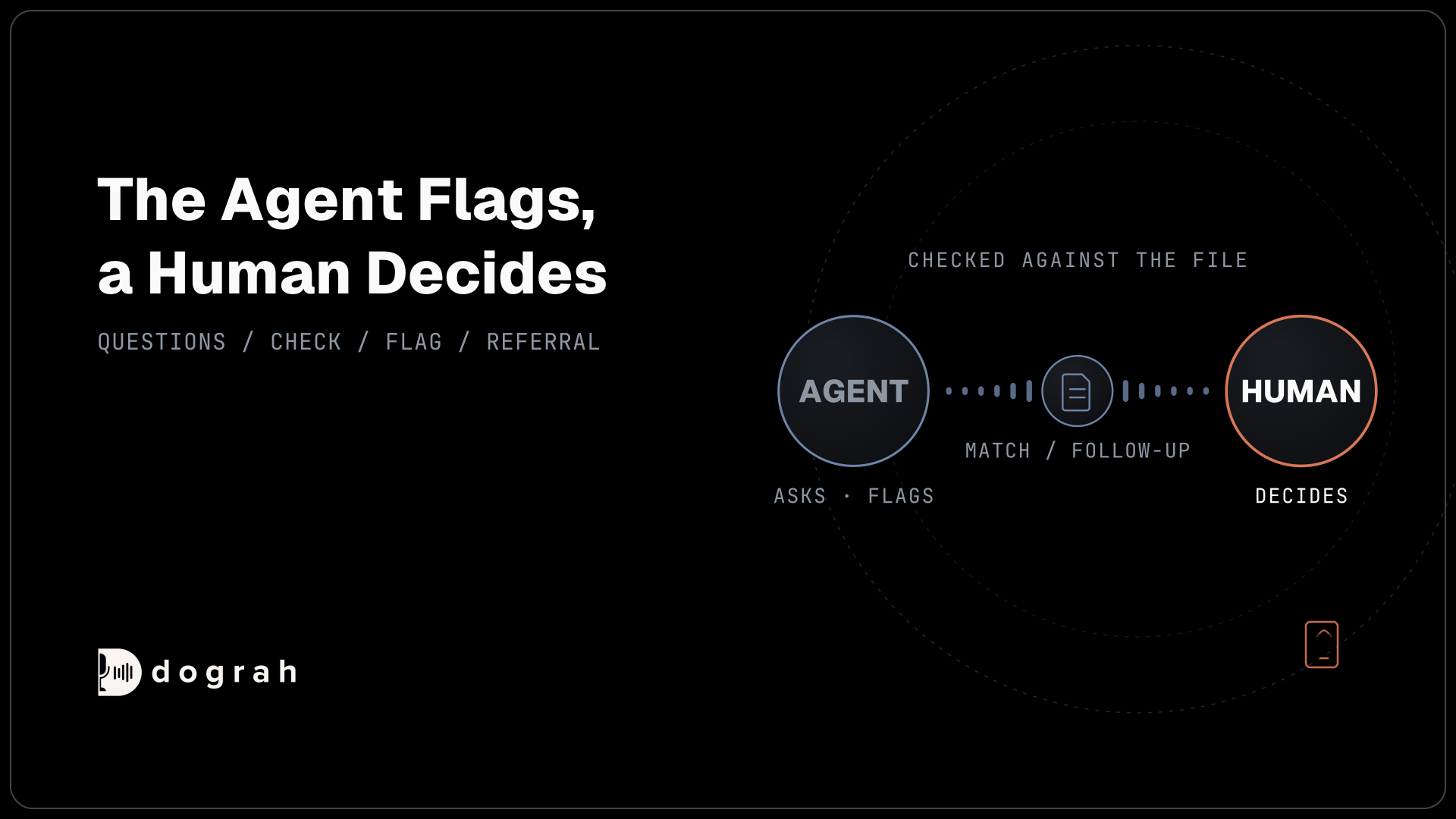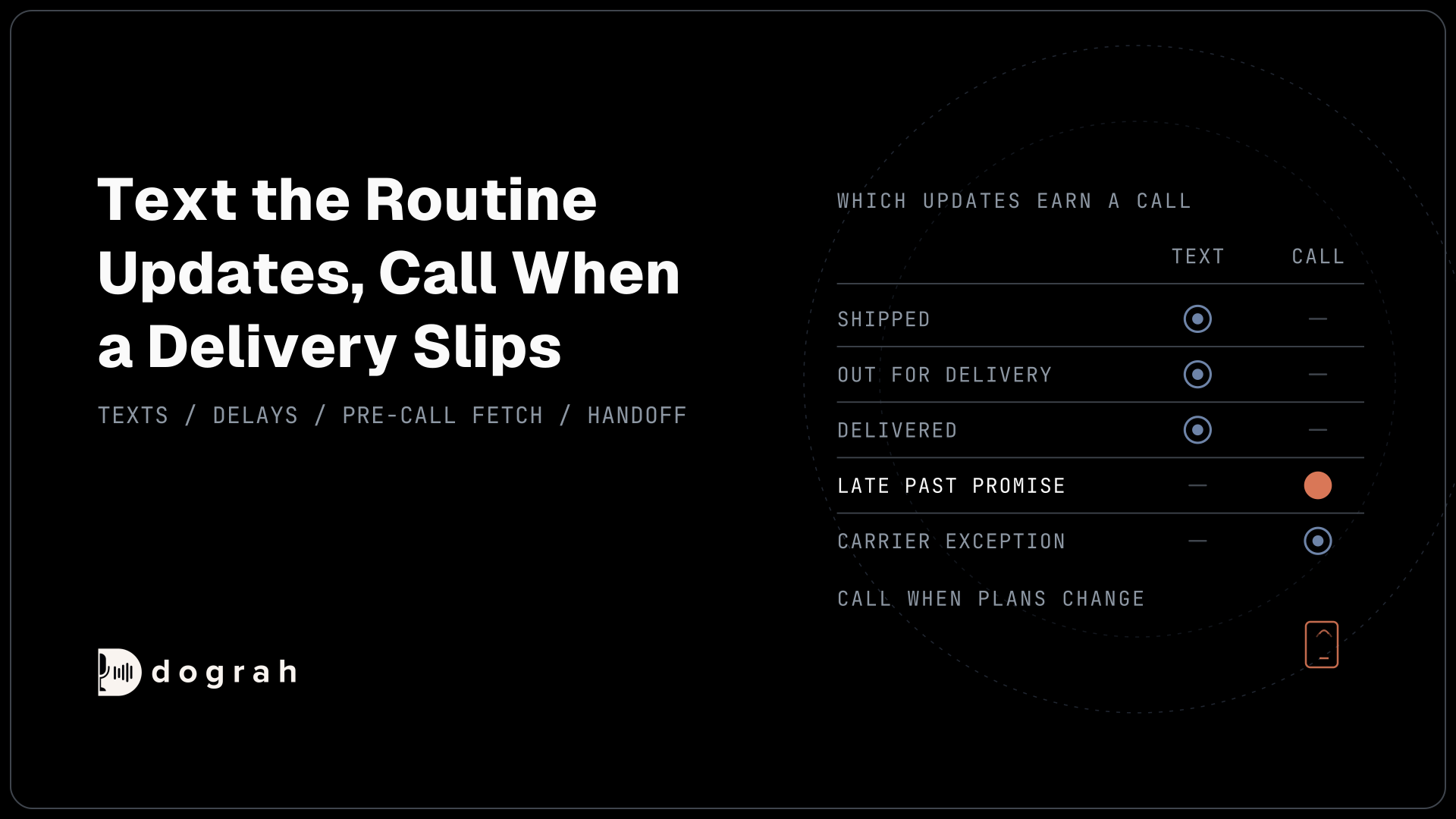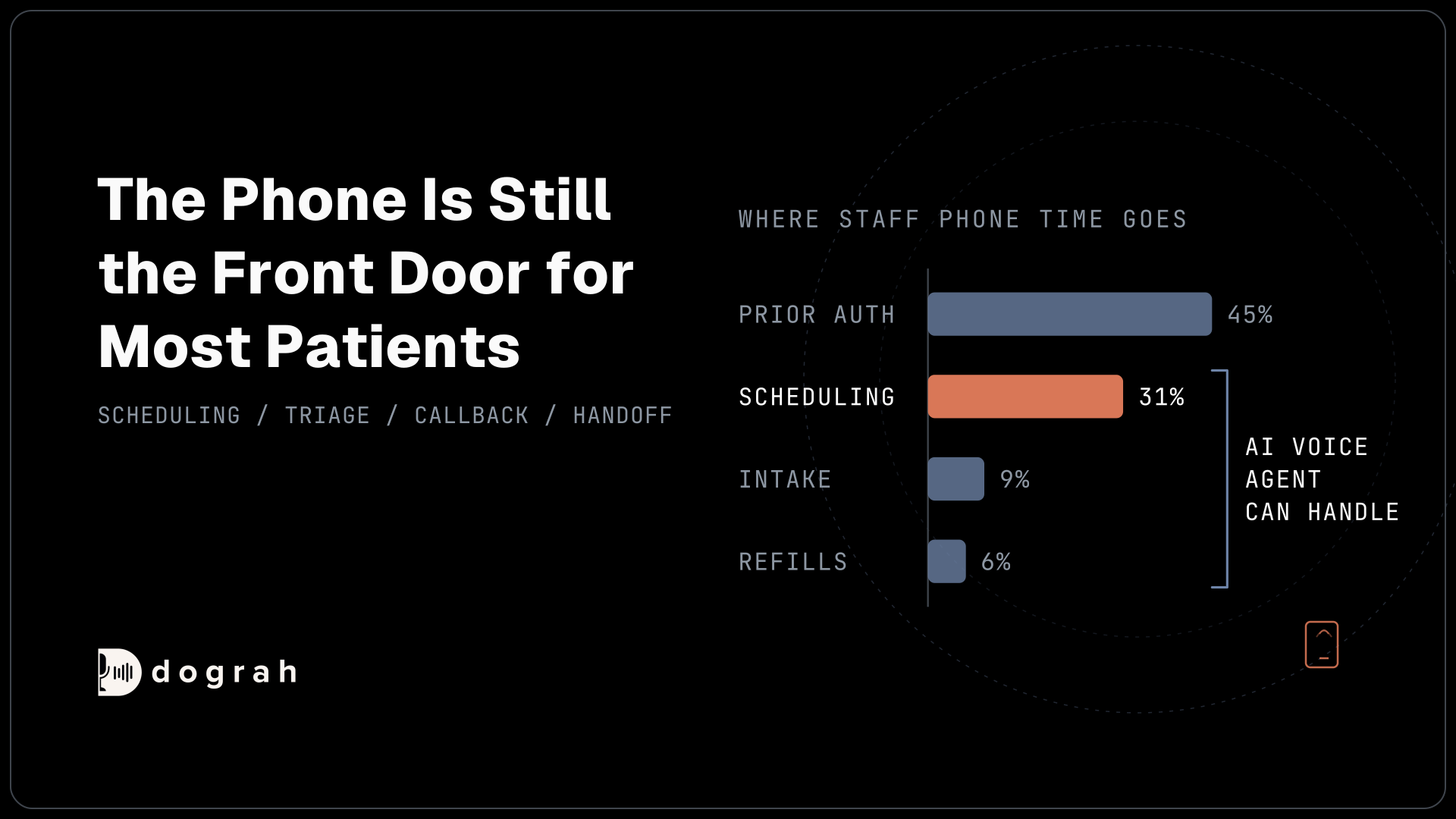


AI voice agents for government are software callers that answer and place phone calls for public agencies. They handle citizen helplines, appointment scheduling, benefit and payment reminders, non-emergency intake, public surveys, and application status updates in many languages, then hand complex cases to human staff. Agencies deploy them to cut per-call cost and long hold times.
Key Takeaways
- Phone support costs $17+ per call; voice agents move routine calls cheaper.
- Self-hosting keeps citizen data and PII inside your country's own infrastructure.
- One voice platform covers six citizen-facing jobs in 70+ languages.
Here is a short look at a Dograh voice agent handling a live call from start to finish.
The economics that make voice AI hard to ignore
The reason agencies automate the phone is cost, and the gap between channels is wide. Phone support runs about $17 or more per contact in 2026, the most expensive channel an agency operates, while self-service resolutions cost a median near $1.84 each. When a benefits office handles hundreds of thousands of calls a year, that spread becomes real budget.
Most of that volume is not complicated. It is a change of address, a question about whether a document arrived, a request to confirm an appointment, or a caller asking why a payment has not shown up. Those are the calls a voice agent answers cleanly, and they are the ones stacking up the longest queues while a caseworker who could resolve them stays stuck on the previous call.
The staffing side is harder than the cost side. The Social Security Administration averaged roughly a 20-minute wait to answer its 800 number in fiscal 2025 and answered fewer than half of all calls, while sitting at its lowest staffing level in 50 years. Citizens do not stop needing answers when an office is short-staffed. They wait longer, call back, or give up.
Agencies know this, and adoption has moved quickly. Gallup found 43% of public-sector employees used AI at least a few times a year by late 2025, up from 28% eighteen months earlier, with 21% reaching for it weekly or daily. The catch is execution. A 2026 index of public servants worldwide reported that more than 70% now use AI while only 18% believe their government uses it effectively. The obstacle is rarely the model. A 2025 Gartner survey of 138 government organizations found 41% blamed siloed strategies and 31% blamed legacy systems for holding back citizen experience, which is why an agent that sits in front of the existing phone line and pulls from the systems already in place moves faster than a full platform rebuild. Public-sector adoption of agentic AI reached 82% by 2026 in IDC's reading, so the appetite is settled. Voice is one of the clearest places to turn that appetite into an answered call.

Open Source Alternative to Vapi / Retell
Self-hosted voice agent platform — no per-minute fees
dograh-hq/dograh
Star on GitHub
Why data sovereignty and self-hosting decide this for government
For a public agency the deployment model matters as much as the demo. Government calls carry protected information, from Social Security numbers to criminal-justice records covered by the CJIS Security Policy, along with systems governed by FISMA. A hosted voice platform ships every recording, transcript, and extracted field to a vendor's cloud, which is the exact data flow most agency security reviews exist to stop.
Self-hosting flips that. When the voice agent runs on agency-controlled infrastructure or a government cloud, the citizen's data stays inside the boundary the agency already accredits, and open-source code lets the security team audit what the agent does with a call instead of trusting a closed vendor's word. This is the same argument that decides enterprise deployments in regulated sectors, which I covered in why on-prem will win enterprise voice AI.
Data residency is where this gets non-negotiable for a government. A public agency cannot let citizen PII cross a national border, so whichever of the six jobs a line is handling, from a first-ring helpline to a status callback, the call data has to stay inside the country. Self-hosting keeps all of it, the recordings, transcripts, and extracted fields, on the agency's own infrastructure and inside its own borders, with no copy handed to a third-party SaaS running somewhere abroad. That one requirement is the first procurement gate each of these six use cases has to clear before cost or features even enter the conversation.
The risk is concrete. A recording of a benefits call holds enough to reconstruct who a person is and how they live, and once that audio sits in a vendor's system the agency no longer controls who can subpoena it, where it gets replicated, how long it lives, and which staff can open it. Running the stack in-house keeps those questions inside the agency's own retention and access rules, where an auditor can actually check the answers.
Dograh is built for that constraint. It is BSD-2 licensed and fully self-hostable, so an agency can run the whole stack in its own environment, bring its own language and speech models, and pay for infrastructure rather than a per-minute platform fee. Most hosted platforms charge roughly 5 to 7 cents a minute just for the platform before any AI usage, which climbs toward 15 cents all-in at volume. Because the agent can run open-source speech and language models when an agency wants them, from Whisper for transcription to open voices for playback, the per-call AI cost drops well below what closed hosted providers meter, and nothing about the call has to travel to a model vendor either. On a line that runs constantly, owning the stack changes the yearly number, and that shift is where automation pulls ahead of legacy systems once call volume is high and predictable.
Citizen helplines that answer on the first ring
The clearest use case is the inbound helpline, where the citizen calls and waits. A voice agent picks up every line at once, so the queue that once stretched past an hour disappears for routine questions, and it answers in the caller's language. That last part is a legal issue, not a nicety. Roughly 26 million Americans are limited English proficient, about 8% of people over five, and many cannot reach a service that speaks only English. Dograh handles 70+ languages out of the box.
What matters most on a government helpline is patience. Older callers and people with disabilities often speak slowly or pause mid-sentence, and they need the agent to wait rather than talk over them. Dograh's agents adjust to the speaker's pace and support barge-in, and when a question needs judgment or empathy the call warm-transfers to a person with the context already gathered.
After hours is where this pays off first. A recorded message and a voicemail box send most callers away, while an agent that runs at 2 a.m. can take a service request, confirm an appointment, answer a policy question, or log a complaint the same way it would at noon. For an agency still running a rigid phone tree, it also replaces the press-one-press-two menu that sends callers in circles before they reach anyone. Deep dive: AI voice agents for citizen helplines.
Scheduling and reminders that cut no-shows and missed deadlines
Two use cases share one engine: booking appointments and reminding people about them. On scheduling, a line that books around the clock takes the DMV, permit, and benefits-office bottleneck off business hours, and Dograh's pre-call fetch pulls the caller's case or permit record before it confirms anything, so the citizen gets a real slot tied to their file instead of a generic callback. It also cuts the no-show problem at the source, because a caller who books by voice can be reminded by the same system a day out, with the agent reading back the exact time and address plus any documents to bring. Deep dive: AI voice agents for government service scheduling.
Reminders are where quiet automation protects benefits. During the Medicaid unwinding, most people who lost coverage were dropped for procedural reasons like a missed form or an outdated address, not because they were found ineligible. An outbound agent that calls ahead of a renewal or payment deadline, pulls each citizen's record before dialing, and respects time-of-day and consent rules keeps eligible people enrolled. Consent and timing sit inside the flow, so the agent calls only within allowed hours and honors opt-outs, and any dispute routes straight to a caseworker rather than looping the citizen back through a menu. Deep dive: AI voice agents for benefit and payment reminders.
Join the Dograh Community
Dograh is an OSS alternative to Vapi. Join our Slack community for queries, releases, best practices & community interactions.
Non-emergency and incident intake without touching 911
This use case needs a hard line: the agent handles non-emergency traffic and never replaces a 911 dispatcher. A large share of calls into public-safety lines are administrative, and each one ties up a call-taker who should have been free for a genuine emergency. A voice agent fields 311-style intake, captures a structured incident record through variable extraction, and absorbs surge and overflow, then warm-escalates anything urgent to a human call-taker or to 911. Self-hosting keeps that incident data inside the agency's accredited environment, which is why the compliance posture weighs as much as the call handling here.
For a small agency the elastic capacity matters as much as the diversion. Call volume spikes during a storm, an outage, a policy deadline, or a benefits cutoff, and a voice layer scales to meet the surge without the agency hiring for a peak it hits only a few days a year. Every call still produces a structured record the agency's systems can read, so a follow-up team is not re-keying notes from a voicemail. Deep dive: AI voice agents for emergency and incident intake.
Surveys and status updates that close the loop
Two more patterns round out the set, and both mix inbound and outbound. Public surveys by phone reach residents that online forms miss, especially elderly and limited-English households, and Dograh turns spoken answers into clean structured data with consistent scripting that does not drift between calls. Because the script stays identical from the first call to the last, the results avoid the interviewer-to-interviewer variation that muddies human phone banks, and the agent works in the respondent's language so the sample is not skewed toward English speakers. It will not match a trained human interviewer on open-ended probing, and it should not claim to. Deep dive: AI voice agents for public surveys.
Status updates answer the single most repetitive question an agency gets, which is some version of "where is my application, refund, or permit." Pre-call fetch is what makes this work, because the agent pulls the live case record before it speaks and gives a real status instead of pointing the caller back to a website. National portals show where this is heading: Portugal's Gov.pt now spans more than 2,300 services with an AI assistant, built on the kind of data-exchange platforms that make a live lookup possible (Deloitte, 2026). The same capability drives proactive outbound calls when a permit clears or a case moves. Deep dive: AI voice agents for government status updates.
What to look for in a government voice AI platform
Buying criteria for the public sector look different from a startup's. Language coverage comes first, because access for limited-English residents is a legal obligation, so a platform that handles 70+ languages with a warm human handoff beats one that speaks two. The hosting model comes next. A hosted-SaaS product keeps citizen recordings and transcripts in a vendor cloud, while a self-hosted, open-source stack keeps that data on infrastructure the agency already accredits inside its own borders and lets the security team read the code. Pricing is the third fault line, because per-minute platform fees punish exactly the high, steady call volume that government lines carry, so owning the stack and bringing your own models scales without a meter running. Automating the routine calls does not empty the call center either; 80% of contact-center leaders said agent headcount held steady or grew through 2025 as virtual agents absorbed repetitive volume and people shifted to the harder cases (Frost & Sullivan). The rest is table stakes: dependable transfer to a human when the agent hits its limit, structured data extraction the agency's systems can ingest, pre-call data fetch so the agent knows who it is talking to, and post-call analysis for quality review. Framed that way, the choice for regulated citizen data leans toward self-hosted open source rather than a metered vendor cloud. We put the full deployment picture, and how citizen data stays in-country, on a dedicated page for self-hosted voice AI for government agencies.
Each citizen-facing use case above has its own deep dive:
- AI voice agents for citizen helplines
- AI voice agents for government service scheduling
- AI voice agents for benefit and payment reminders
- AI voice agents for emergency and incident intake
- AI voice agents for public surveys
- AI voice agents for government status updates
Glossary
- Pre-call fetch
- Pulling a caller's live record from a CRM, case system, or API before or at the start of a call, so the agent answers with the citizen's actual status instead of a generic script.
- Barge-in
- The caller's ability to interrupt the agent mid-sentence and still be understood, which lets the agent slow down for elderly or slow-speaking callers without talking over them.
- PSAP (Public Safety Answering Point)
- The call center that receives 911 and emergency calls. Voice agents relieve a PSAP by handling non-emergency 311 traffic, never by replacing dispatchers.
- CJIS Security Policy
- The FBI security standard governing criminal-justice information, one reason agencies require voice data to stay on accredited, self-hosted infrastructure rather than a vendor cloud.
Frequently Asked Questions
The phone is not going away as the channel citizens trust, and the staffing behind it is not returning to 2015 levels. The agencies that get ahead of this treat voice as core infrastructure they own and audit, not a feature they rent by the minute. Start with the one line that hurts most and keep every call on ground you own inside your own borders. The hard cases still go to people.