

AI voice agents place outbound reminder calls for benefit renewals and payment deadlines. Before dialing, the agent fetches each citizen's live record, so it names the exact form or amount due on the call. It speaks 70+ languages, honors consent and calling-hour rules, and transfers disputes to a human staffer.
Key Takeaways
- Most benefit loss is procedural: missed forms and stale contacts, not ineligibility.
- Pre-call fetch names each citizen's exact form and amount due before dialing.
- Self-hosting keeps benefit records and financial PII on infrastructure you own.
This post is part of our guide to AI Voice Agents for Government & Public Services.
Most benefit loss is a paperwork problem
People lose benefits they still qualify for because a form went unreturned, not because a caseworker found them ineligible.
Federal agencies reported roughly $186 billion in improper payments across 64 programs in FY2025, and a real share of that traces to people who never got a usable prompt to act in time. Field research is blunt about the fix. Light-touch government outreach lifted benefit take-up by 150% to 500% among very low-income families claiming the expanded Child Tax Credit. A reminder that reaches the right person before a deadline is one of the cheapest tools an agency has.
The trigger is almost always a date. A renewal window opens or a seasonal assistance program reopens, and the household has a narrow span to respond before coverage or a payment plan lapses. The catch is reach. Mailers get tossed and portals sit unused. A phone bank cannot hand-dial an entire caseload in the days before a cutoff. That gap is exactly where an outbound voice agent earns its keep.
What an outbound reminder call actually does
An outbound agent works through a list of upcoming deadlines, calls each person, states what is due, and offers the next step.
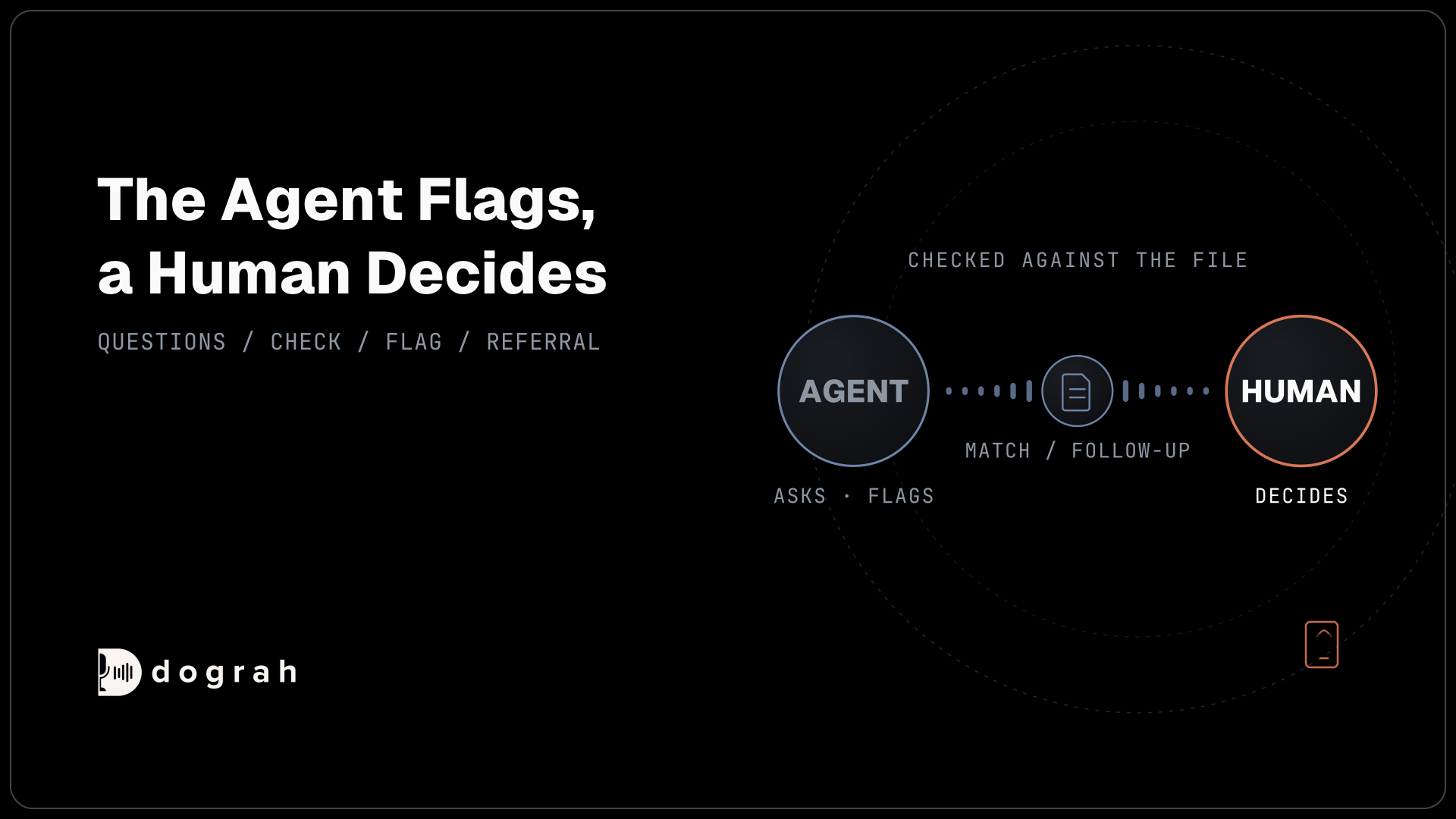
Load the agent with a caseload and its due dates, and it dials through them on a set schedule. On connect it identifies itself as an automated line from the agency and confirms it is reaching the right person before stating the specific reason for the call, whether that is a Medicaid recertification due in nine days or a utility assistance re-enrollment before the winter shutoff. Timing usually runs in two passes. A pre-due call goes out days ahead as a friendly heads-up, and a follow-up reaches anyone who has not acted as the cutoff closes in. Because the agent reads dispositions after every attempt, the list stays clean, and someone who already renewed does not get called again. When a caller asks a question the script cannot handle or wants to dispute an amount, the agent warm-transfers to a caseworker with the full call context attached.
This is the same outbound craft that governs any high-volume calling program. The work of opening lines and reading a caller's intent carries straight over from the private sector, and our guide to making AI outbound calls work covers those mechanics in depth. The payoff here is timing at population scale. A 13-million-person field experiment found that behaviorally-informed reminders cut delinquencies by 0.42 percentage points, the kind of small per-person nudge that adds up fast across a whole caseload.
Pre-call fetch is what makes the call worth taking
A generic "you have a deadline somewhere" call gets ignored; a call that names the exact form and date does not.
The feature that separates a useful reminder from robocall noise is pre-call fetch. Before the agent dials, it pulls the citizen's live record from the eligibility or billing system, so the call already knows the renewal date, the document that is missing, the balance owed, and the language the household prefers. The person hears a concrete answer rather than a nudge to log in and check.
Picture a household nine days out from a Medicaid recertification. Instead of a form letter, they get a call that says the recertification is due on the fifteenth and the income verification page is the one still missing, returnable by portal or by mail. That is a call someone acts on. None of this needs new data collection. The eligibility record and the billing balance already exist in systems the agency runs, so pre-call fetch is mostly a matter of reading them at the moment of dialing. The same lookup that powers a reminder also powers proactive government status updates, so a citizen can learn their permit cleared without ever calling in.

Open Source Alternative to Vapi / Retell
Self-hosted voice agent platform — no per-minute fees
dograh-hq/dograh
Star on GitHub
The compliance rules a reminder agent must enforce
Outbound government calling sits under real rules, and the agent has to build them in rather than route around them.
Automated calls fall under consent and timing law, and the TCPA sets the outer bounds on how and when you can dial. In practice that means holding calls to permitted hours in each recipient's own time zone, scrubbing do-not-call flags, keeping a consent record, and stating up front that the call is automated. A voice agent enforces this more reliably than a room of dialers, because the calling window and the disclosure live in the workflow instead of in someone's memory. For a government agency the lawful basis is usually straightforward, since contacting a recipient about their own open case is part of administering the program. What remains is procedural: honor opt-outs and cap how often you dial, while keeping an audit trail that proves it.
PII is the harder line. Benefit and payment records carry Social Security numbers and health enrollment detail, which is the category of data most agencies are barred from handing to a third-party cloud. Any reminder system touching it needs a clear answer for where recordings and transcripts live and how long they are retained. If the vendor cannot tell you that, the program stops at the security review.
Self-hosting settles the residency question at the root. When the agency runs the voice platform inside its own environment, benefit and payment records and the financial PII attached to them stay on infrastructure the agency owns inside its own country, and never cross a border into a third-party SaaS tenant. There is no data-processing addendum to negotiate over where a cloud vendor keeps a transcript, because the transcript never leaves the building. For a public body accountable to residents for how their data is handled, that is the difference between a defensible deployment and a standing liability.
Join the Dograh Community
Dograh is an OSS alternative to Vapi. Join our Slack community for queries, releases, best practices & community interactions.
Why the open-source, self-hosted route fits this work
For population-scale government reminders, the deployment model matters as much as the voice quality.
Two buyer criteria decide whether a reminder program survives a government procurement review. The first is data residency. If the platform can be self-hosted inside your own environment, citizen PII never leaves infrastructure you control, which turns a hard compliance conversation into a settled one. The second is cost at volume. Reminder work is bursty and large, a whole caseload dialed before a single renewal deadline, and per-minute platform fees punish exactly that shape of demand. An open-source stack you run yourself bills you for infrastructure, not for every minute of every call, so a statewide push does not wreck the budget.
A couple of things round it out. Multilingual reach is a legal access obligation in public service, and an agent that speaks 70+ languages meets people that mailers and portals miss, including offline and older residents. Open code covers the rest: your security team can read exactly how the agent handles a Social Security number before it dials anyone, and human handoff stays in the loop for the disputes and hardship cases where a person has to make the call. Agencies weighing this next to appointment work will find the same self-hosted stack runs government service scheduling on the identical call infrastructure, so reminders and confirmations share one deployment.
The agencies that cut benefit churn this year will treat a reminder as data plumbing rather than a mail-merge. Pull the record, dial the person, name the deadline, and keep the whole pipeline on infrastructure you own. Start with your highest-churn program: load a single caseload and measure completed renewals against your last round of letters.
Glossary
- Pre-call fetch
- An API lookup the voice agent runs before it dials, pulling the citizen's live benefit or payment record so the call can name the specific form, amount, or deadline instead of reading a generic script.
- Procedural disenrollment
- Losing a benefit for a paperwork reason, such as a renewal form that was never returned or an address the agency could not reach, rather than because the person was found ineligible.
- Recertification
- The periodic step where a benefit recipient reconfirms eligibility by a deadline. Missing the recertification window drops coverage even when the person still qualifies.
- Time-of-day gating
- A control that blocks outbound calls outside legally permitted hours in each recipient's own time zone, enforced automatically by the calling workflow rather than left to a human dialer.