
Key Takeaways
- Even Gen Z still prefers the phone for claim updates.
- Promptness and tone build the trust here, more than any feature does.
- Verify who is listening before you read claim details aloud.
The caller already knows their claim is open. They are calling because nobody told them what changed since the last time they asked.
We build Dograh, an open-source voice agent platform. Claims teams come to us for this call because pulling the record is the easy part.
An AI voice agent for claim status updates answers the where is my claim call, verifies the caller against the policy, reads the current status from the claims system, and explains what happens next. The difficulty is not looking up the record. It is proving identity before disclosing anything, and holding the call together when the lookup is slow.
Why the status call still happens
The phone is still the first place a claimant goes, even where a portal already exists.
In a survey of 1,000 US consumers fielded in June 2026, people still name the phone as their preferred channel during a claim at 38%, ahead of email at 36%. The split by age is smaller than most roadmaps assume. Baby Boomers pick the phone at 51%, and Gen Z picks it at 39%, which is higher than you would guess from a decade of self-service investment.
The digital side has grown without closing the gap. J.D. Power's 2026 property claims study, based on 5,093 homeowners claimants, found 45% received updates digitally. Read that the other way and 55% did not. Those people have a claim open and no news about it, with a phone in their hand.
The waiting period gives them plenty of reason to use it. The same study put the average time to final payment at about 41 days, with repairs completing in just under 30. Both improved on the prior year. Neither is short enough for a claimant to sit quietly through, and every week without news is a week where someone decides to call and find out.
Delays draw more complaints than denials
Not knowing is what people escalate over, and eventually what they leave over.
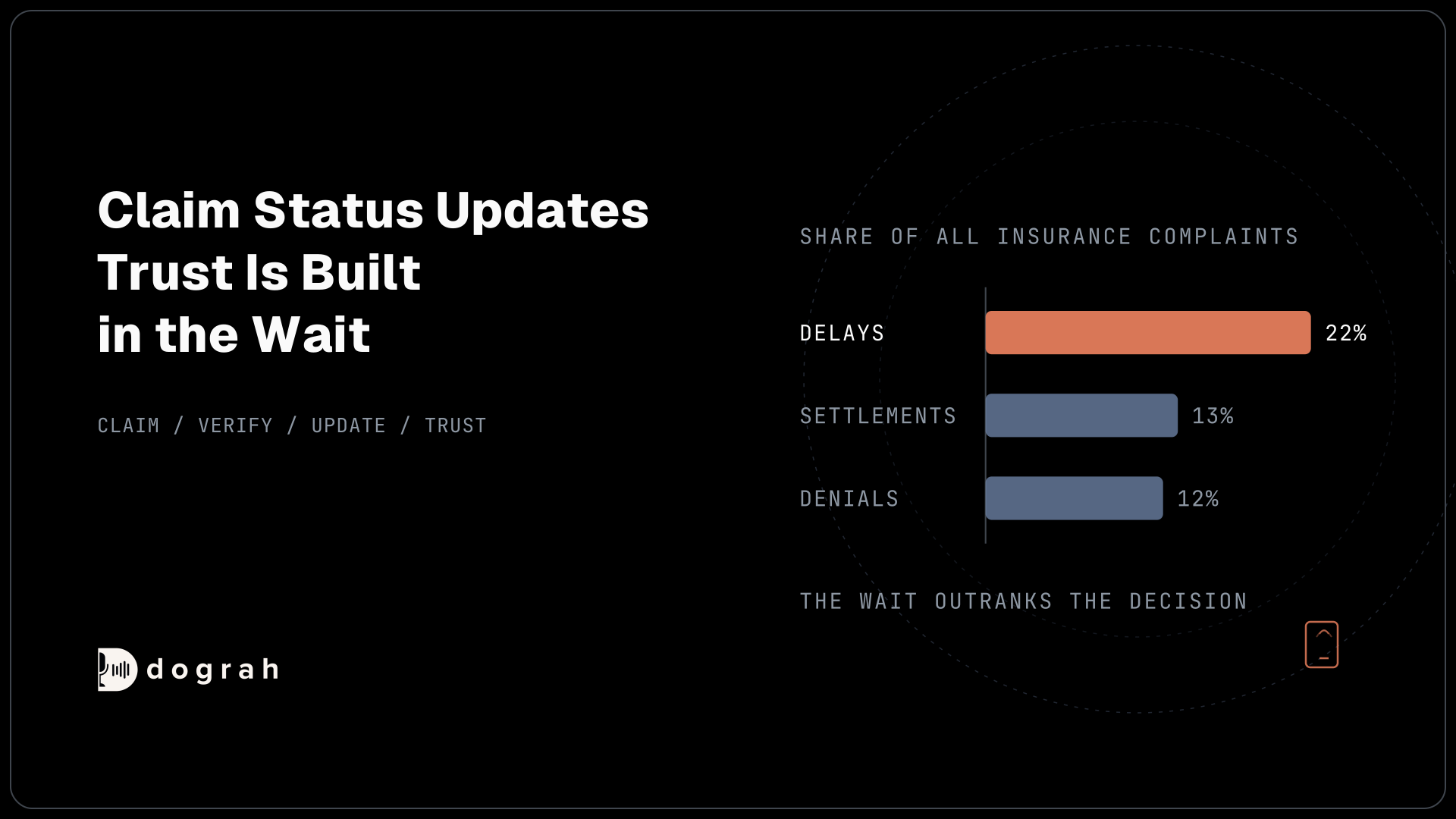
Analyzing NAIC data for 2025, Celent found that delays in claim handling draw 22% of all insurance complaints. Denials draw 12%. The complaint is rarely about the decision itself. It is about not knowing where things stand while that decision is being made.
Retention is where this shows up commercially. In the same June 2026 survey, 75% said slow claims made them very likely to switch carriers.
This is the same mechanic we wrote about for outbound payment reminders. A person who knows what is pending and when to expect the next update will wait. A person who knows nothing will call, and if calling does not help, they will leave.
Our own view, from building these agents, is that the bar here is lower than most teams assume. Promptness and empathy carry most of the weight. An agent that picks up, gives a straight answer about where the claim stands, and can handle the follow-up question is already enough to build trust. That matters most in a high stakes moment, which is exactly what a claim enquiry is.
That is why Dograh plays a real human recording wherever one fits the moment, and why we recommend cloning that same voice for the lines it has to generate. The caller hears one person rather than a handover between a person and a machine, and hears them without the pause full synthesis adds.

Open Source Alternative to Vapi / Retell
Self-hosted voice agent platform — no per-minute fees
dograh-hq/dograh
Star on GitHub
Verify before you tell them anything
A status call is a disclosure event, which makes identity the first problem to solve rather than the last. That sits awkwardly against promptness, because every check you add is time the caller spends waiting.
This is the gap in most claim status builds. The usual shape connects the claims system and reads the result aloud once a trigger fires. What gets skipped is how the agent knows who is listening. A claim file is not a package tracking number. It can hold injury detail, repair estimates, settlement amounts, and the address where someone is living while their house is repaired.
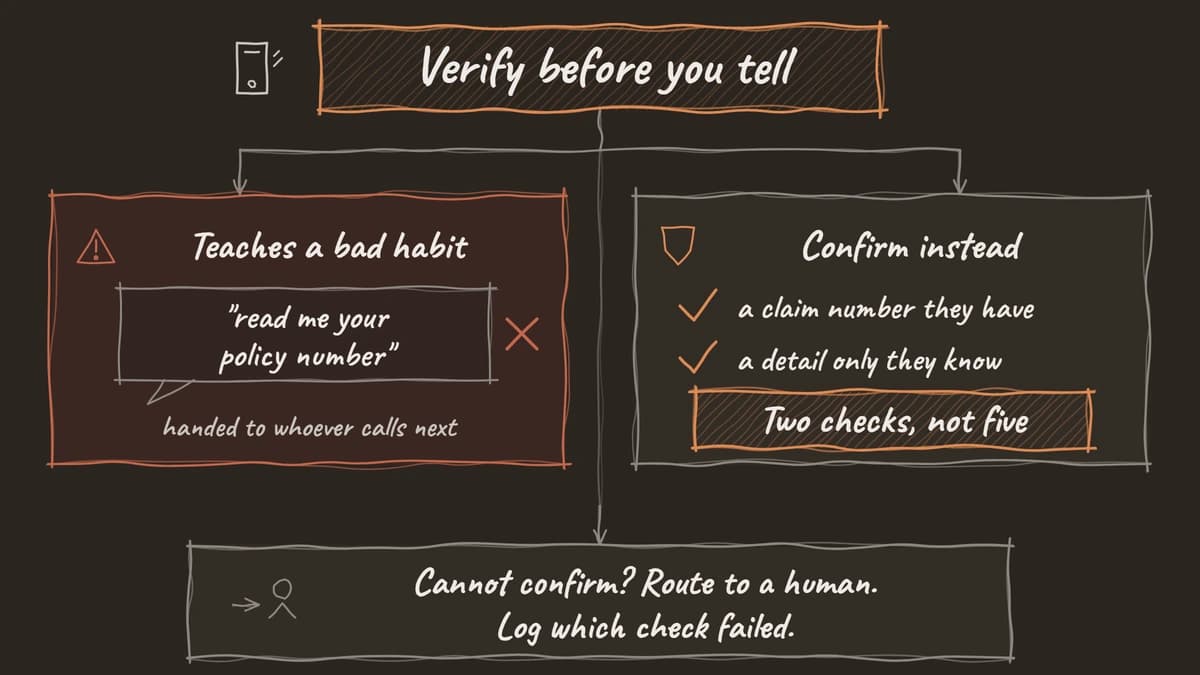
The safe pattern is the one we described for never ask, only tell on fraud callbacks, applied in reverse. The agent should confirm details the file already holds rather than asking the caller to recite anything sensitive. Asking a caller to read out a full policy number trains them to hand that number to whoever calls next. Confirming a claim number the caller already has, then a detail only the claimant would know, gets you to the same confidence without teaching a bad habit. Two checks, not five.
The opening line deserves the same care. Prompts leak by paraphrase, so where the wording carries a policy function, use a fixed utterance the model cannot rewrite. That matters more here than at first notice of loss, because by now the file exists and there is something to give away.
Decide in advance what happens when verification fails, because it will. A caller who cannot confirm the detail you asked for is not always an impostor. They may be a spouse handling the repair, or the policyholder calling from a hospital bed without their paperwork to hand. The agent needs a defined path that moves those callers to a human rather than repeating the question at them, and the transcript should record which check failed so the handoff starts with context rather than from the beginning.
When the claims system is slow mid-call
The lookup is the part of this call most likely to break, and it is the part that tends to get designed last.
Most designs assume the claims system answers immediately. Real ones do not. A colocated database read fits inside the turn budget the agent already has, so the caller hears a normal pause. A call out to a third-party claims API usually does not fit, and the gap has to be handled rather than hidden.
Short waits can be held silently. Longer ones need the agent to say something so the caller knows the line is alive, and there is a ceiling past which people assume the call dropped and hang up. Decide in advance which lookups are fast enough to hold and which need the agent to speak first.
The filler line itself needs care. Something about the step in progress reads as competence, while a generic please hold reads as a queue and invites the caller to give up. This is where empathy stops being decorative. Someone waiting on a claim decision is not someone waiting on a parcel, and the agent should sound like it knows the difference.
Whatever the agent says while waiting should be logged alongside the latency that prompted it. A recurring pattern of long waits on one claim type is an integration problem worth fixing rather than a script worth tuning.
Outbound work avoids the problem entirely. Dograh does this with pre-call fetch, which pulls the claim record before the call connects, so the agent opens already knowing the status instead of querying while someone waits. For a proactive update, where you chose the moment to dial, there is no reason to look anything up mid-call.
One honest limit on colocation. You can only run a model on your own hardware when you have the weights, which means open models. With a closed provider, colocation means choosing a region near your stack and accepting the network hop.
Join the Dograh Community
Dograh is an OSS alternative to Vapi. Join our Slack community for queries, releases, best practices & community interactions.
Where the claim data ends up
A status call transcript carries the same sensitive detail as the claim file it describes.
The recording holds medical detail next to financial detail, spoken by someone with a direct stake in the outcome. Where voice data is processed and how long it is kept only has a comfortable answer when the answer is yours to give.
Self-hosting changes the shape of the question. Running the stack inside your own boundary means the audio and the transcript never leave infrastructure you control, and neither does the claims lookup, which is the argument we made in detail for on-prem voice AI. For health-adjacent lines where protected health information surfaces, a business associate agreement delegates obligations to the voice platform and adds a monitoring duty. It does not move your liability. Generally, keeping that platform out of the audio path altogether is a cleaner position than covering the risk with a contract.
Dograh is open source under BSD-2, so where the audio goes is checkable in the source rather than taken on trust. Open speech and language models can run on the same hardware, keeping the transcript inside the boundary too.
Retention is the quieter half of the question. A status call produces a recording and a transcript, and both can outlive the claim if nobody sets a policy for them. Deciding how long each one lives, and being able to show that deletion actually happened, is considerably easier when the storage is yours.
Consumer willingness is moving in the right direction for this. In an Insurity survey of more than 1,000 US adults fielded in February 2026, confidence in AI touching a claim rose to 51% from 38% a year earlier. The share who believe AI could speed claims processing went from 28% to 42%. Permission is growing faster than most claims roadmaps have caught up with.
The integration is not the hard part
What stops these projects is rarely the connector.
Triggers and channel fan-out get the attention. Two questions stay quiet, and both of them decide the project. The first is how the agent verifies the person on the line before reading out claim detail. The second is what the call does when the claims system is slow to answer. Residency tends to get raised as something to put to a vendor, and then left there.
Those gaps are where an open, self-hosted platform has a straightforward advantage. You can read the traversal logic, because it is your code. The audio lives where you chose to put it, and the transcripts that prove the verification path ran belong to you. We applied the same pattern in public services, where status updates carry the same disclosure problem with different regulators attached.
Start with the verification ladder and the slow-lookup plan. The trigger wiring is the easy part, and it is the part that tends to get done first anyway. Get those right and you are left with the thing that actually earns trust, which is answering quickly and sounding like you understand what the person is waiting for.
Glossary
- Turn budget
- The time an agent has to answer before the caller hears the pause as a problem rather than as thinking.
- Pre-call fetch
- Pulling record data before the call connects, so the agent opens already informed instead of querying while the caller waits.
- Fixed utterance
- A scripted line the model is not allowed to paraphrase, used where the exact wording carries a legal or policy function.
- Knowledge-based authentication
- Confirming a caller using details already held in the file rather than a password or a secret the caller must recite.