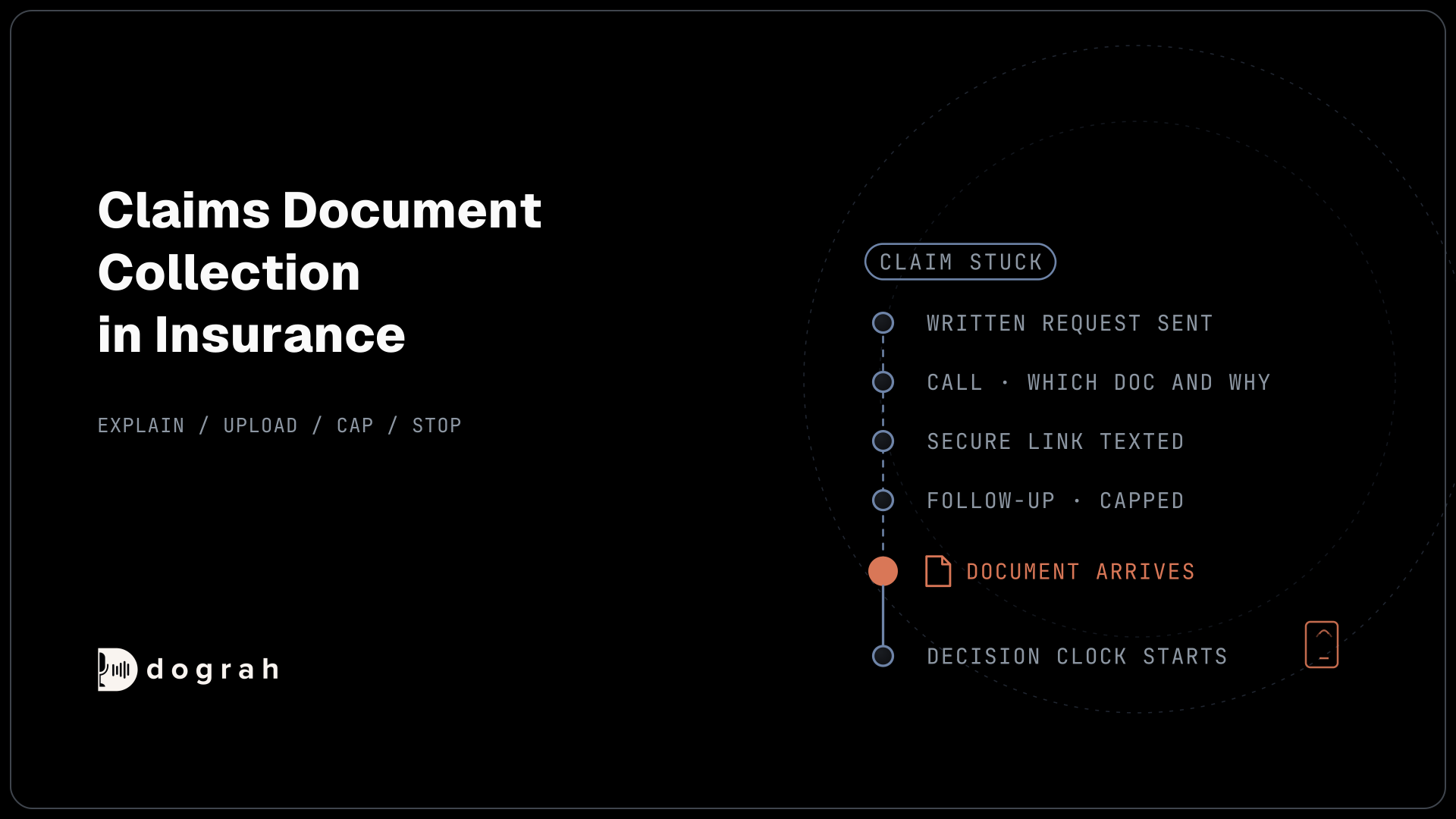

An AI voice agent for claims document collection calls a policyholder whose claim is waiting on paperwork, names the exact document that is missing, explains why the adjuster needs it, and texts a secure upload link during the call. It never takes the document by voice, and it follows up on a capped schedule until the file arrives.
Key Takeaways
- People miss documents because nobody said which one, or why.
- Send a secure upload link. Never take documents over the phone.
- Cap follow-up calls well below what debt collectors are allowed.
A claim that is waiting on a police report does not move, and the claimant often has no idea. We build Dograh, an open-source voice agent platform, and this is the call we most often see claims teams leave to a letter.
Where claims stall between the first call and the payout
Most of the waiting in a claim happens after the first call and before anyone makes a decision.
The claim gets reported at first notice of loss. An adjuster opens the file and works out what they need. That list goes out as a letter or an email, and the claim sits until the paperwork comes back. It might be a police report, photos of the damage, a repair estimate or a set of medical bills.
Digital submission helps, but it does not reach everyone. J.D. Power's 2026 property claims study of 5,093 homeowners found that 49% submitted photos digitally for estimates or payments. That leaves roughly half sending evidence some other way, or not sending it at all. The same study put the average time to final payment at 40.7 days.
Regulators start the clock from the paperwork too. California's fair claims rules give an insurer up to 40 calendar days to accept or deny a claim, counted from when it receives proof of claim. Until the documents arrive, the claim is stuck and the claimant is the one waiting.
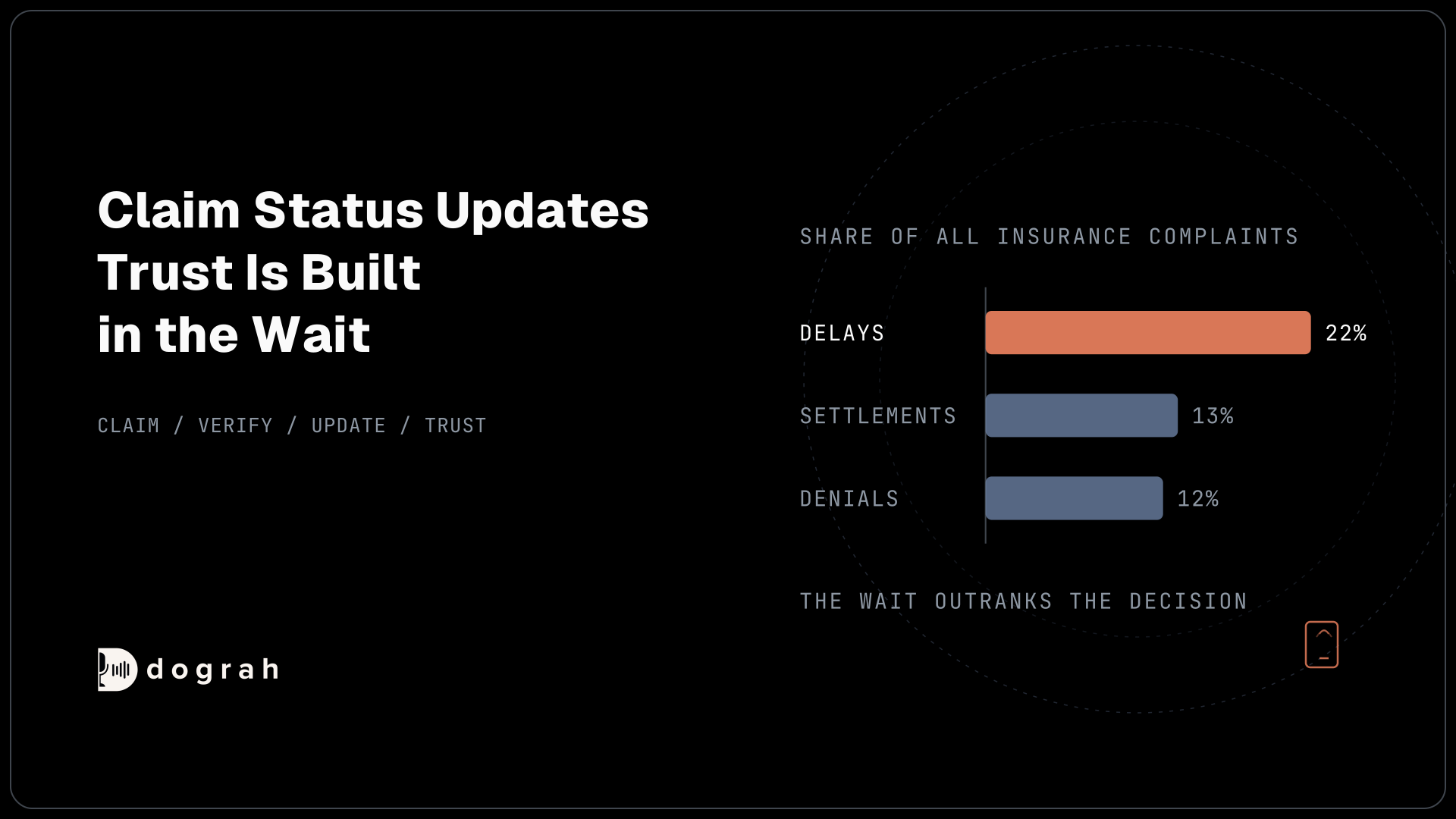
This is the gap between the first call and the status update call. A claimant who phones to ask where their claim is will often hear that it is waiting on them.
Why people do not send the documents
Policyholders rarely hold back documents on purpose. In our experience, they miss them because nobody told them clearly which document is needed and why.
A request letter lists items. It rarely explains them. "Proof of ownership" means little to someone whose car was stolen last week. "Itemized medical bills" sounds like the summary the hospital already sent. So the claimant sends the wrong thing, or puts it off until they can ask someone, and the claim loses another week.
California already requires insurers to name what they need. When an insurer needs more time to decide, its written notice has to spell out the missing information. The regulation reads, "This written notice shall specify any additional information the insurer requires in order to make a determination and state any continuing reasons for the insurer's inability to make a determination."
A voice agent is the spoken version of that duty. It can say which document is missing, what it looks like, where to get it and why the adjuster cannot decide without it. It can also answer the next question, which a letter never can. If the claimant says they never received a police report, the agent can explain how to request one, or pass the call to a person when the answer is outside its script.
The written request should still go first. In a June 2026 survey of 1,000 US consumers, 38% named the phone as their preferred channel during a claim, with email close behind at 36%. That is nearly an even split. The call works best as the follow-up for people who did not act on the email or portal request.
What the agent says on the call
A good document call covers one claim and names each missing item in plain words.
Before dialing, the agent needs the missing-items list from the claims system. Dograh handles this with pre-call fetch, which pulls the claim record and its outstanding documents before the call connects. The agent opens already knowing what it needs, so the claimant never waits while it looks something up.
The opening line should be fixed. Say who is calling and which claim the call is about, in wording the model is not allowed to paraphrase. Then confirm you are speaking with the claimant before discussing the file. Use details the file already holds, and do not ask the claimant to read out a policy number.
After that, take the documents one at a time. For each one, the agent names it and says why the adjuster needs it. Then it asks whether the claimant has it to hand. Some will. Others will need to request it from a police department or a body shop, and the agent should tell them how.
If the claimant disputes why a document is needed, that is a conversation for a person. Hand the call to an adjuster with a short summary and let them decide. California's rules say an insurer "shall not persist in seeking information not reasonably required for or material to the resolution of a claim dispute." An agent should never be the one pushing a request that a person has not reviewed.

Open Source Alternative to Vapi / Retell
Self-hosted voice agent platform — no per-minute fees
dograh-hq/dograh
Star on GitHub
Keep the documents out of the call
A voice agent should never collect sensitive documents inside the call. It should send a secure upload link instead.
Reading a document aloud turns it into audio. A policyholder reading out an itemized hospital bill puts diagnosis codes and amounts into the recording and the transcript. Those files now hold the same detail as the bill, in a form that is harder to redact and easy to keep forever. We have written about why voice data carries more risk than text. For claims, the rule is simple. The call talks about the document, and the upload link carries it.
The link needs as much care as the call. People reported losing $3.5 billion to imposter scams in 2025, according to FTC data released in June 2026, and nearly $1 billion of that went to business impersonators. An unexpected text with a link is exactly what those scams look like.
So announce the link before it arrives. The agent should say which number the text will come from and what the page will ask for. The upload page should sit on the insurer's own domain and ask for the document and nothing else. It should never ask for a password or a payment. This is the same never ask, only tell principle we use for fraud callbacks.
Some calls will surface sensitive detail anyway, because claimants volunteer it. Dograh lets you attach tags to transcription results, so those calls can be flagged and reviewed later instead of getting lost in the call log.
How often to call before it feels like debt collection
Follow-up calls need a firm cap, so a document chase never starts to feel like debt collection.
In a claim, the policyholder is the one who is owed money, often after a bad week. Three calls in two days about a missing estimate reads as pressure, and pressure is the wrong tone for a claim.
Debt collection gives a useful reference point, even though it does not apply here. Regulation F presumes a debt collector complies when it calls no more than seven times in seven days about a debt. That rule governs debt collectors, and insurers are outside it. We mention it only to show where the ceiling sits for an industry that is allowed to push hard. A document chase should sit well below it. We covered how collections calls work within that limit separately.
The exact numbers are a business decision. What the system has to get right is the difference between outcomes. A busy signal or a dropped call is worth retrying later. A wrong number or an opt-out ends the sequence for good. So does the document arriving, and the agent should stop as soon as the upload lands instead of waiting for the next scheduled attempt to notice. Log every attempt, so you can show exactly how often a claimant was called and why.
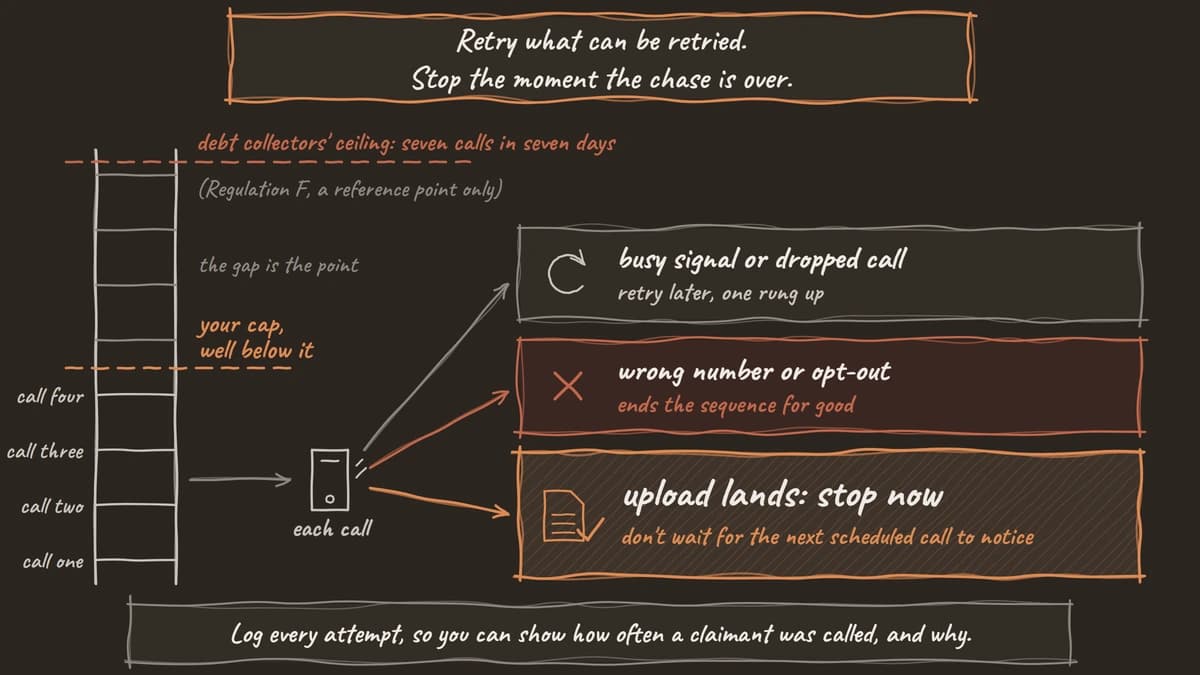
Each call either earns a retry or ends the chase for good, and your cap should sit well below the ceiling that debt collectors work under.
Consent belongs in the same design. The FCC ruled in 2024 that AI-generated voices count as "artificial" under the Telephone Consumer Protection Act. In most cases, that means an outbound AI call needs the recipient's prior express consent. Check how consent was captured when the policy was sold, and confirm your own position with counsel.
Join the Dograh Community
Dograh is an OSS alternative to Vapi. Join our Slack community for queries, releases, best practices & community interactions.
Why this call suits an open-source agent
Document collection touches the most sensitive parts of a claim file, so where the agent runs is a practical question.
Most hosted voice platforms charge a platform fee of around 5 to 7 cents a minute, with model usage billed on top. A document chase is outbound and repeated across a whole claims book, so per-minute fees add up faster than they do on inbound lines. Dograh is open source under BSD-2, and you can self-host it for free.
The bigger difference is where the data goes. With a hosted platform, every call about a medical bill passes through someone else's infrastructure. Bringing your own model keys moves the contract, and the audio still reaches the model provider. Full data sovereignty comes from running Dograh inside your own boundary, with open-weight models on your own hardware. Then nothing about the call leaves your infrastructure.
The build itself is ordinary Dograh work. A webhook from the claims system triggers the call when a document goes overdue. Pre-call fetch loads the missing-items list. One tool call sends the text with the upload link, and another writes the call outcome back to the claim. The workflow lives in a visual builder, so the claims team can reword an explanation without waiting on engineering.
All of that wiring is the easy part. The harder part is the list of what each claim is waiting on, written in words a claimant understands.
Start there. For each document your adjusters commonly request, write one plain sentence on what it is and one on why the claim needs it. Those sentences become the agent's script, and they will probably improve your request letters too. Then set the call cap and decide which outcomes end the sequence.
A claim waiting on paperwork is a claim nobody can work on. A call that says exactly what is missing, and why, is often all it takes to get it moving again.
Glossary
- First notice of loss (FNOL)
- The first report of a claim to the insurer, usually by phone, which opens the file and starts the adjuster's work.
- Regulation F
- The US rule that sets how debt collectors may contact people, including a limit on call frequency. It does not cover insurers.
- Open-weight model
- An AI model whose trained weights are published, so you can run it on your own servers. Its licence may still limit how you use it.
- Claims book
- All the open claims an insurer or team is handling at one time.