
AI cold calling in real estate needs prior express written consent before an AI voice makes a sales call to a mobile or home line, plus a list screened against do-not-call lists. Keep the opening and opt-out as fixed lines. Dograh, the open-source AI voice agent platform you can self-host or run on Dograh Cloud, speaks them word for word.
Key Takeaways
- Expired listings and bought lead lists carry no consent for an AI voice.
- Screen every number against do-not-call lists before it reaches a campaign.
- The greeting and opt-out play as fixed text, never as model-written lines.
This post is part of our guide to AI voice agents for real estate, where every outbound call starts with a record that the person agreed. Below, we cover which lists count as cold and the rules for each call. Then we set up a short script in Dograh.
Which real estate lists are cold
In real estate the list decides the risk before the script does, because most prospecting lists come with no consent at all. An expired listing gives you an owner who wanted to sell, not one who agreed to your calls. A for-sale-by-owner sign or a lead list bought from a data vendor is the same.
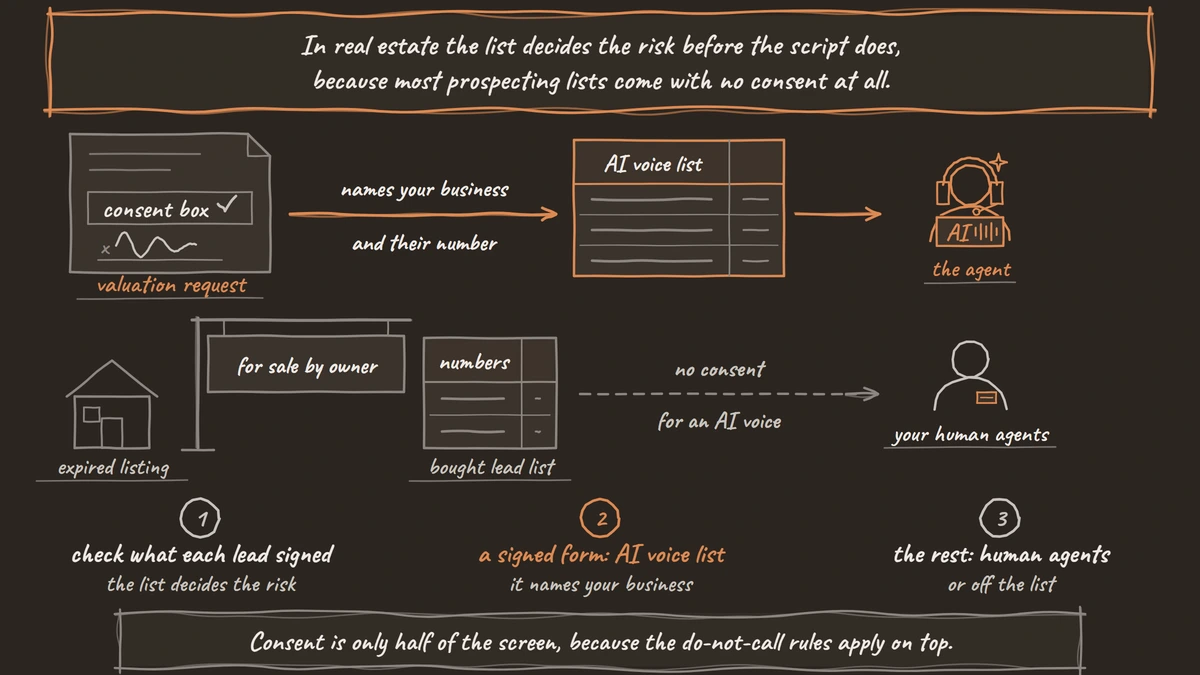
The list you can call with an AI voice is the one where each person signed something that names your business and their number, such as a valuation request with a consent checkbox. Our post on real estate lead qualification covers calling those leads back. Everything else stays with your human agents, or off the list.
Consent rules for AI-voice sales calls
An AI voice counts as an artificial voice in US law, so the strictest consent rule applies. The FCC's 2024 ruling on AI-generated voices placed AI voices under the Telephone Consumer Protection Act (TCPA), which limits calls made with an artificial or prerecorded voice.
Under the FCC's telemarketing rules, a telemarketing call that uses an artificial voice needs the called person's prior express written consent, whether the number is a mobile or a home line. A call offering to list a home or find a buyer is a sales call, so this rule applies to it. Written consent is a signed agreement that clearly allows your business to make such calls, names the phone number, and says that signing is not a condition of buying anything. An e-signature counts where federal or state law recognises it.
Consent can be taken back in any reasonable way, such as saying so on the call, and you must honour that within ten business days at most.
Do-not-call lists and calling hours
Consent is only half of the screen, because the do-not-call rules apply on top. You may not make sales calls to numbers on the National Do Not Call Registry unless an exception applies, such as a signed agreement to be called. The rules' safe harbor expects written procedures, staff training, your own do-not-call list and registry data no older than 31 days. Download it from the registry's site for telemarketers and screen every list before upload.
Your own list matters as much. When someone asks not to be called, record it when they ask, honour it within ten business days and keep it for five years. Sales calls also stay between 8 a.m. and 9 p.m. at the called person's location.
State laws can be tighter. Florida's telephone solicitation law allows sales calls only from 8 a.m. to 8 p.m. local time, and no more than three calls in 24 hours to the same person on the same subject, whatever number you call from.
The brokerage carries this risk, not only the agent who dialled. In Hollis v. eXp Realty, a federal court let a claim go ahead that the brokerage could be directly liable for calls its agents made, where the caller said he was already on its internal do-not-call list. Have counsel review your consent wording, lists and calling hours before the first campaign.
A short script, fixed lines first
The script splits into lines the agent must say exactly and a conversation the model leads. The fixed lines carry the rules. A call with an artificial voice must say at the start which business is calling, and give a number to call back.
In Dograh, those lines go in the Greeting Text on the Start Call node, which the agent speaks word for word as the call connects.
"Hi {{first_name | there}}, this is the virtual assistant for Harbor Realty, calling about your home on {{street | your street}}. Our number is +1415555XXXX. If you'd rather not get these calls, just say so and I'll stop."
The fallback after each bar keeps a missing value from being spoken as empty text. If you want to tell people they are speaking with an automated assistant, or a law you are under requires it, that goes in the same Greeting Text, as it does here. Allow Greeting Interruption is on by default, so switch it off on the Start Call node and the business name and number play in full.
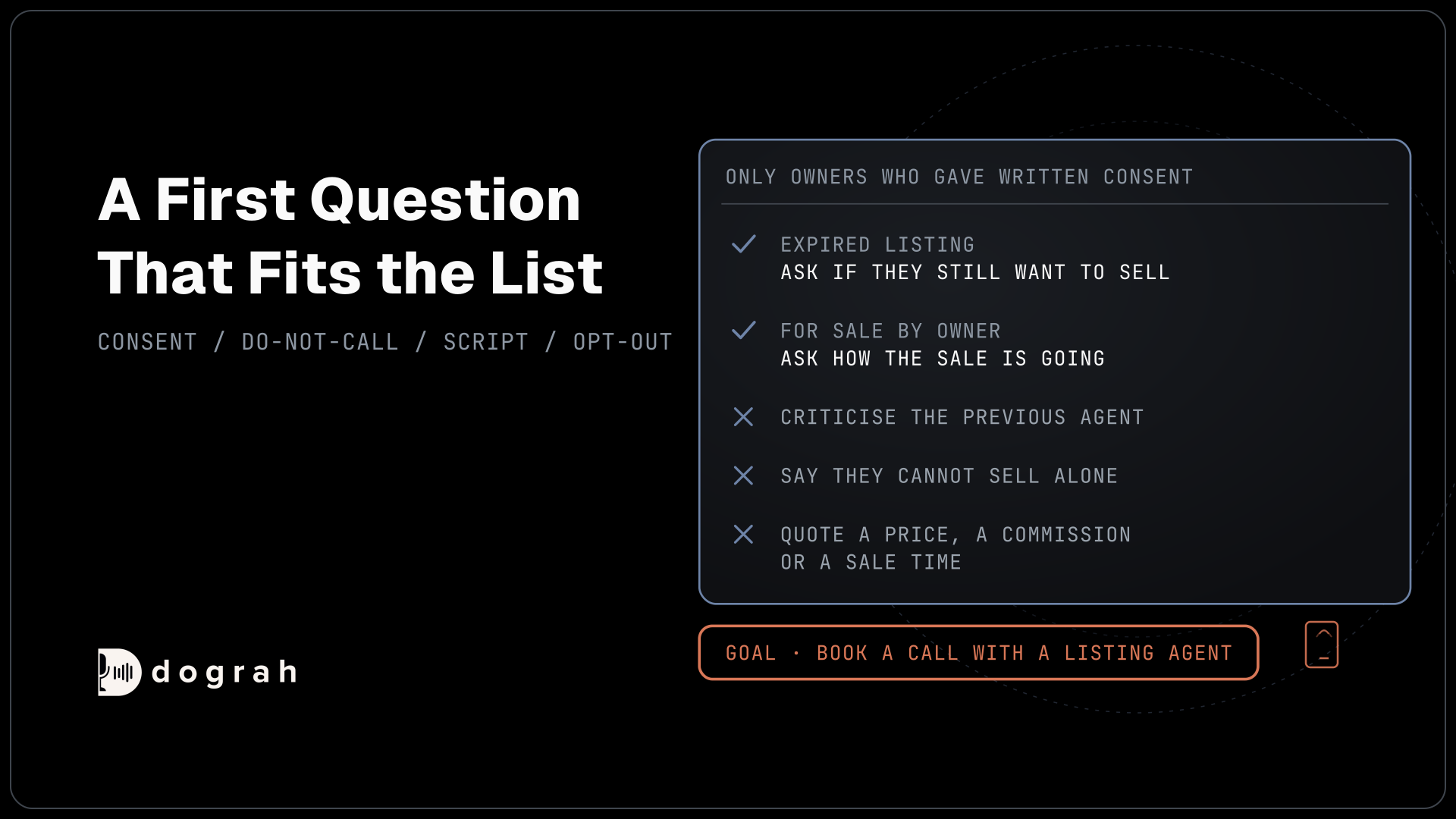
The conversation after the greeting is prompt guidance. The prompt below gives the agent one goal for an expired-listing call and a different first question for a for-sale-by-owner call, using a listing_type value from the list.
Goal: book a 15-minute call with Sam Ortiz, a listing agent at Harbor Realty.
If {{listing_type}} is "expired": ask whether they still want to sell,
and what they think stopped the last listing. Do not criticise the
previous agent.
If {{listing_type}} is "fsbo": ask how the sale is going and whether
they would like a free price check. Never say they cannot sell alone.
Never quote a price, a commission or a sale time.
If they ask to stop, follow the opt-out path at once.
What this does: The agent opens each call with a question that fits the list the number came from, and three lines keep it away from promises your agents should make in person.
The opt-out is fixed too. Draw an edge from the Agent Node to an End Call node with a condition such as "The person asks not to be called again" and a Transition Speech of "Understood, we won't call you again. Goodbye." It plays as typed. For an artificial-voice sales call, the rules also describe an automated opt-out, by voice or key press, offered within two seconds of the identification. Dograh takes the opt-out by voice and ends the call, so ask counsel how your opening and opt-out map onto that rule. Our AI cold call script templates have more opening and objection lines.

Open Source Alternative to Vapi / Retell
Self-hosted voice agent platform — no per-minute fees
dograh-hq/dograh
Star on GitHub
Taking numbers off the next list in Dograh
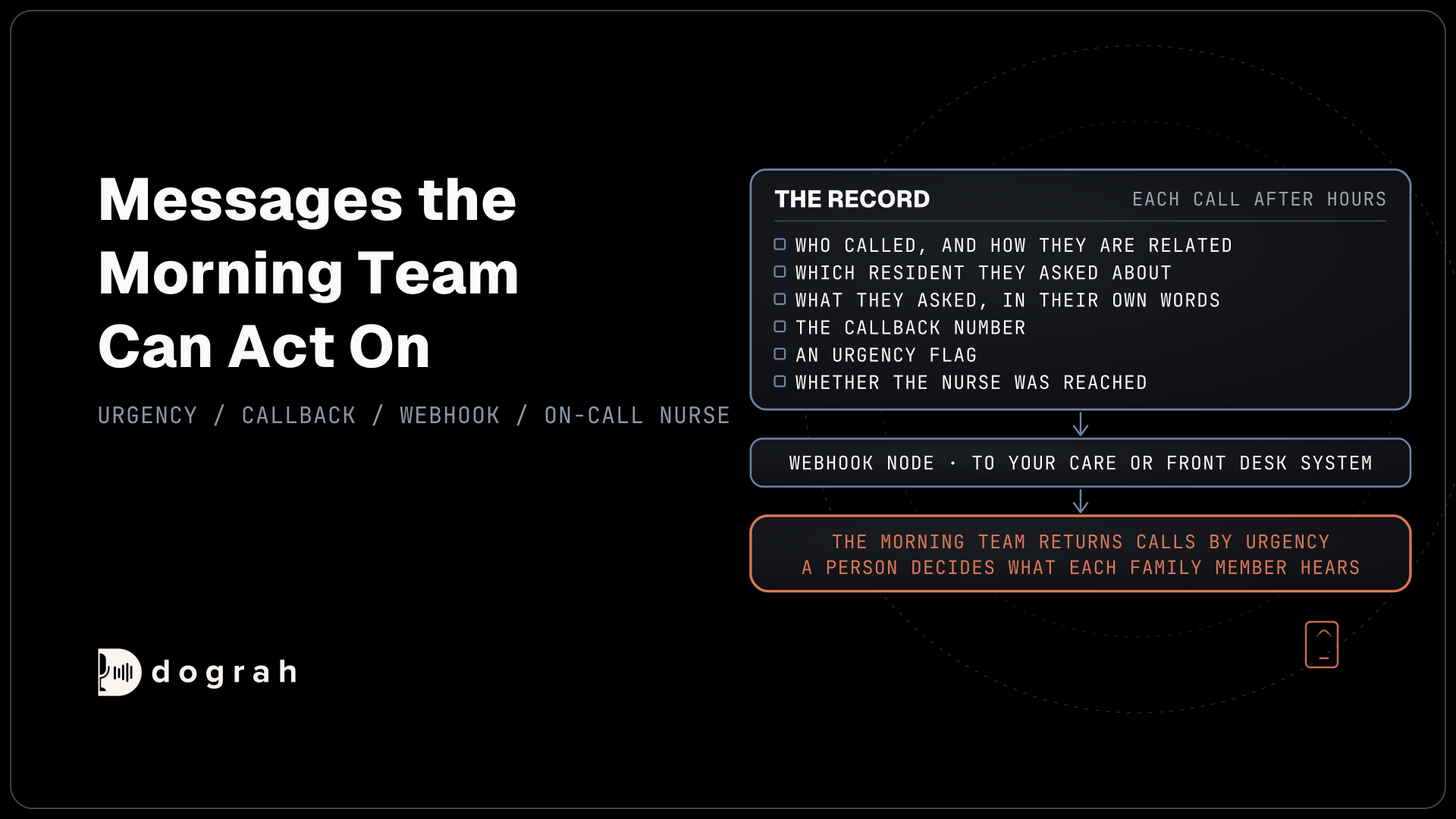
The opt-out only counts once the number leaves every list, so the agent's record has to reach your system. Turn on "Extract call disposition at the end of the call" under Settings, General. It is off by default. Each finished call then gets one call disposition, and do_not_call, "the person explicitly asked not to be contacted again", is in the starter list. Your team takes those numbers off the next list, or a Webhook node sends each outcome to your CRM, as How to Build an AI Cold Calling Agent shows.
Calling hours and retries are campaign settings. A campaign takes your screened CSV, and its Call Schedule runs in one time zone, so split a national list by time zone and keep each window inside the local rules. You set the retries (0 to 10). For Florida numbers, keep retries low enough that no one hears from you more than three times in 24 hours, or set them to zero. Voicemail handling is off by default, and a message the agent leaves is also an artificial-voice message, so it names the business and gives the number too.
Every call keeps its recording and transcript as your record of what each homeowner heard, and a QA node can check a sample for the opt-out offer. Self-hosted, those recordings stay on your brokerage's own servers. Self-hosted Dograh has no per-minute platform fee, but servers, model keys and phone minutes still cost money. Dograh Cloud charges a 1¢-a-minute platform fee.
Start with the leads who signed a consent form, run a handful of calls over a real phone line, and listen for the business name and the opt-out offer on every recording before the first full campaign.
Join the Dograh Community
Dograh is an OSS alternative to Vapi. Join our Slack community for queries, releases, best practices & community interactions.
Glossary
- Prior express written consent
- A signed agreement, on paper or electronic, that allows a business to make sales calls with an artificial voice to a named phone number and says signing is not a condition of buying. An AI voice sales call to a mobile or home line needs it.
- National Do Not Call Registry
- The US list of numbers whose owners do not want sales calls. Sellers screen their lists against it before calling, using registry data no older than 31 days.
- Internal do-not-call list
- A business's own record of people who asked it to stop calling. Requests are honoured within ten business days and kept for five years, whatever list the number later appears on.
- Call disposition
- One outcome code Dograh picks for a finished call from a list you set, such as do_not_call or callback_requested. Extraction is off by default and turned on under Settings, General.