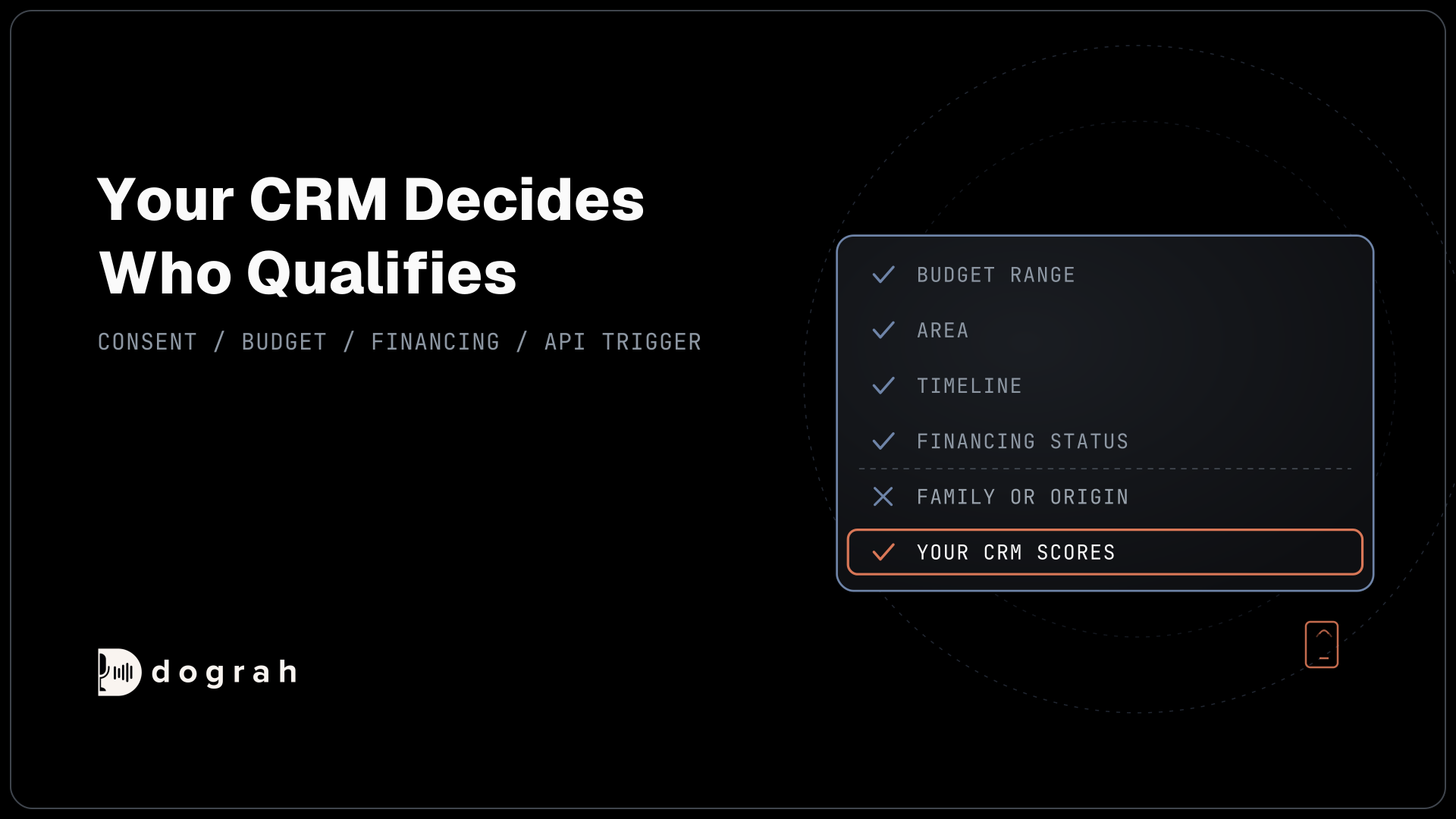

AI voice agents for real estate lead qualification call new web and portal leads, or take an inbound caller after a listing question, and ask every lead the same four questions: budget range, area, timeline and financing status. The agent records each answer as stated, and your CRM does any scoring. Outbound calls need consent first.
Key Takeaways
- Every lead hears the same four questions, and nothing about household or origin.
- The agent records answers as stated; your CRM does all the scoring.
- Check the lead form's consent wording before the API Trigger fires.
This post is part of our guide to AI voice agents for real estate. The guide's section on lead qualification sets the rule this post builds on: the agent records the answers and leaves the scoring to your rules. Here is how that call runs in Dograh, an open-source, self-hostable voice agent platform, from the consent check before the first ring to the record your CRM receives.
Two ways a lead reaches the qualification call
A lead reaches the qualification questions from one of two directions, and the questions are the same at both. The first is inbound. A caller rings about a listing, gets the answer, and is asked whether they have a minute for a few questions. That listing call is covered in AI voice agents for inbound property inquiries.
The second is outbound. A new lead fills in a form on your website or arrives from a property portal, and your customer relationship management (CRM) system starts the call through the API Trigger. The request carries the lead's number and an initial_context with their first name and the listing they asked about. The request itself is shown in API Triggers: Start a Voice Agent Call From Any System.
On both paths, the Greeting Text names the agency. If you want to tell leads they're talking to an automated assistant, or your location requires it by law, write it there too. Asking for the lead by name finds the right person without proving who they are, which is enough here, because the call shares nothing private. The agent names only the listing the lead asked about, since that address is already public.
Check the consent wording before the API Trigger fires
An outbound call to a new lead is the regulated step, so the consent check runs in your CRM before the trigger fires. Inbound callers started the call themselves. This section is general information, not legal advice.
In its February 2024 declaratory ruling, the Federal Communications Commission (FCC) confirmed that the Telephone Consumer Protection Act (TCPA) limits on "artificial or prerecorded voice" calls "encompass current AI technologies that generate human voices". The FCC's rules at 47 CFR 64.1200 define telemarketing as a call made "for the purpose of encouraging the purchase or rental of, or investment in, property, goods, or services". A call that asks a buyer about their budget so an agent can help them buy a home generally fits that definition. Telemarketing with an artificial voice to a mobile number or a home line generally needs "prior express written consent".
That consent has a specific shape. The rule describes a signed written agreement that "clearly authorizes the seller" to make such calls, and that names the phone number they may go to. So the question for each lead is whether their form lets your agency, by name, call that number with an automated voice. A portal lead is only as good as the portal's consent wording. The FCC's stricter one-to-one consent rule never took effect: the Eleventh Circuit vacated it in January 2025, according to a summary by the law firm Reed Smith, so the written-consent definition above is the test.
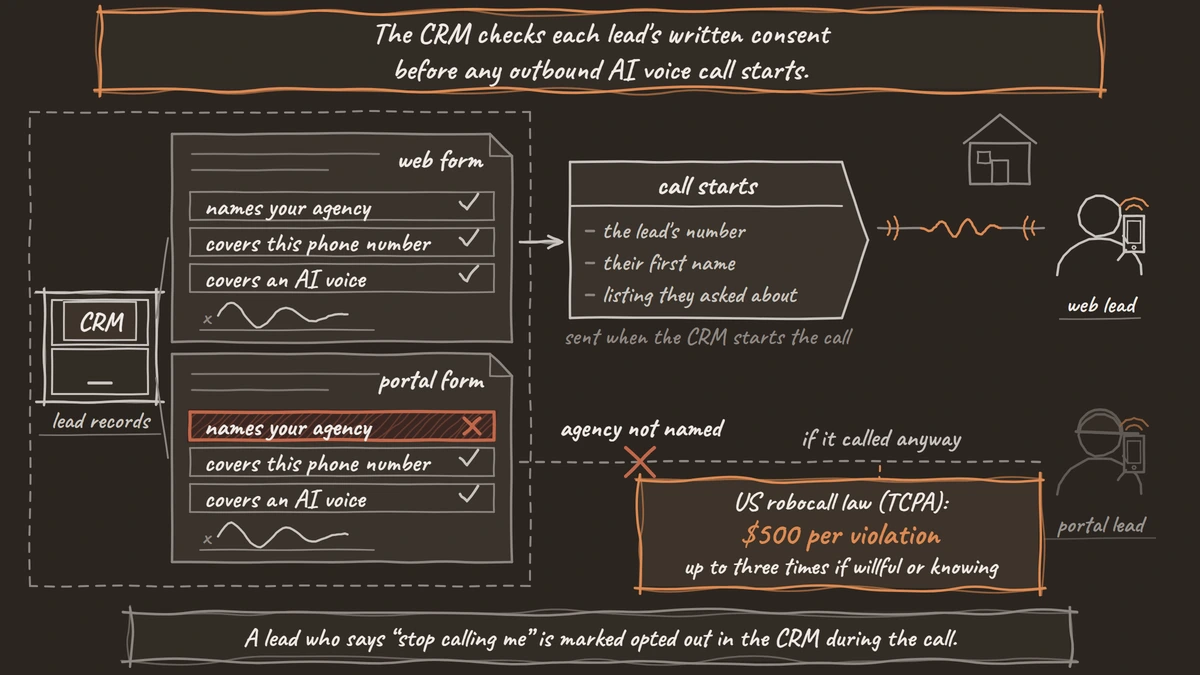
The consent record sits on the lead in your CRM, which sends the trigger only for leads that pass. When a lead says "stop calling me", the agent writes that opt-out to the CRM during the call. Confirm your form wording with counsel before the first call.

Open Source Alternative to Vapi / Retell
Self-hosted voice agent platform — no per-minute fees
dograh-hq/dograh
Star on GitHub
Ask the same questions the same way every time
The script asks every lead the same questions, in the same order and in the same words. Fixed wording helps with fair housing law, and it keeps the answers in your CRM comparable. The agent first asks whether the lead wants to buy or to sell, because a seller goes to an agent. A buyer then hears four questions.
| Field | How the agent asks | What it records |
|---|---|---|
| Budget range | "What price range are you thinking about?" | The range in the caller's own words, or "not sure" |
| Area | "Which areas are you looking in?" | The places the caller names, with nothing added |
| Timeline | "When are you hoping to move?" | The caller's answer, such as "this spring" or "no rush" |
| Financing status | "Are you planning to use a mortgage or pay cash, and do you have a mortgage approval yet?" | Approved, not yet, cash, or not sure |
The financing question offers cash from the start, because many buyers use it. The National Association of Realtors' 2025 Profile of Home Buyers and Sellers, which covers purchases from July 2024 to June 2025, found that 30% of repeat buyers paid all cash, while first-time buyers put down a median of 10%.
The questions also stay away from anything fair housing law protects. Section 3604 of the Fair Housing Act makes it unlawful to make any statement about the sale or rental of a dwelling "that indicates any preference, limitation, or discrimination based on race, color, religion, sex, handicap, familial status, or national origin". A qualification script generally stays clear of that by never asking about any of them, so the agent does not ask how many children will live in the home or where the buyer comes from. If a caller volunteers it, it stays in the transcript and never goes into a qualification field.
The area answer is recorded as the caller states it. The agent never suggests a neighborhood and never describes who lives in one, because that is steering. Many states protect more characteristics than the federal list, so check yours and have fair housing counsel review the script.
Record the answers as stated and let your CRM score them
The agent produces a set of fields, and what they mean is your CRM's decision. Variable extraction pulls each answer out of the conversation as the caller stated it. It is an AI step, so the transcript and the recording remain the exact record.
When the call ends, a webhook node sends the fields to the CRM, using placeholders such as {{gathered_context.budget_range}} in its payload template. A temporary failure, such as a timeout or a 5xx error, is retried automatically, up to 5 attempts spaced from about 30 seconds to 10 minutes apart. Wrong URLs or credentials are not retried. In our experience, the CRM's response is the check that matters: a success response means the record was written, and any failure response means it was not.
Scoring rules belong to the agency and live in the CRM. A rule might flag a lead with an approved mortgage and a move inside three months for a same-day call. The agent never tells a caller they do not qualify, and a lead who answers "not sure" to everything still hears the same offer of a viewing. The same ask-and-record pattern runs in hiring too, as in AI Voice Agents for Delivery Driver Recruitment Screening.
Join the Dograh Community
Dograh is an OSS alternative to Vapi. Join our Slack community for queries, releases, best practices & community interactions.
Hand a ready buyer to a viewing or an agent
Once the answers are recorded, every lead hears the same offer of a next step. A lead who wants to see the home moves to the booking step, covered in AI voice agents for property-visit scheduling.
A lead who wants a person now can be transferred. Transfer Call works on Twilio only and passes no summary by default, so the agent first writes the answers to your CRM through an HTTP API tool. On Twilio you can add a short spoken introduction that both sides hear; it is off by default. If nobody answers within the timeout, 30 seconds by default, the caller stays with the agent, which writes a callback request to the CRM.
Self-hosting Dograh keeps recordings and transcripts on your own servers, and the caller's audio stays inside your infrastructure only when the speech and language models run there too. Self-hosted Dograh has no per-minute platform fee (servers, model keys and phone minutes still cost); Dograh Cloud has a 1¢-a-minute platform fee.
Start with the inbound path, read a week of transcripts, and switch on the outbound trigger only when every lead it would call has a consent record you can produce.
Glossary
- Prior express written consent
- A signed written agreement, defined in 47 CFR 64.1200(f)(9), that clearly authorizes a named seller to make telemarketing calls with an artificial or prerecorded voice to a named phone number. Under the FCC's 2024 ruling, an AI voice counts as an artificial voice.
- API Trigger
- A Dograh endpoint your CRM or website calls to start an outbound call. The request carries the phone number and an initial_context with the details the agent should know before it speaks.
- Variable extraction
- The AI step that pulls answers such as a budget range out of the conversation as the caller stated them. The transcript and recording stay the exact record.
- Steering
- Guiding a buyer toward or away from an area because of a protected characteristic. A qualification agent avoids it by recording area preferences as stated and never suggesting or describing one.