
An after-hours voice agent in assisted living, such as one built on Dograh, tells family callers general community facts like visiting hours and how to reach the nurse, and shares no resident health details. Questions about how a resident is doing go to the on-call nurse by transfer. Every other call becomes a message for the morning team.
Key Takeaways
- The agent shares community facts and never a resident's health or condition.
- The on-call nurse decides what a family member may hear.
- Every call ends as a record the morning team can act on.
A son calling at 11 p.m. about his mother wants a straight answer or a person. Below, we cover what an agent may tell family callers, what it keeps for the nurse, the handoff and the morning record, set up in Dograh, the open-source AI voice agent platform we build.
Who answers the phone at night
At night, the person best placed to answer a family member is usually not in the building. Calls still come in after the front desk closes. A daughter checks in after a confusing phone chat with her father. A son asks about visiting on Sunday. Someone wants to know why this month's invoice changed, and a family touring next week asks about parking.
Most of the overnight staff are aides, and the nurse is often on call from home. In AHCA/NCAL's assisted living facts and figures, drawn from federal labor data, assisted living employed 512,300 people in June 2026. Registered nurses made up 14% of the nursing and social work staff, licensed practical or vocational nurses 18% and aides 68%.
So the overnight phone has two jobs. It has to answer everyone politely, and it has to get the few calls that need clinical judgment to the one person who can give it. A voice agent can do the first job for every call and the second job reliably, as long as it knows where its own answers stop.
What HIPAA lets a family caller hear
Under the Health Insurance Portability and Accountability Act (HIPAA), the decision about what a family member hears rests with a person. First, HIPAA applies to a health care provider only if it sends health information electronically in one of HIPAA's standard transactions, such as billing a health plan, under the definition of a covered entity. Assisted living is licensed by each state, and some communities meet that test while others do not.
For a covered community, the rule on sharing with family members involved in care allows only what is directly relevant to that person's part in the resident's care or payment. It also allows telling them the resident's location, general condition or death. When the resident is present and able to decide, staff share only with the resident's agreement, after giving them a chance to object, or when they can reasonably infer the resident would not object. When the resident is absent or cannot decide, staff use professional judgment about the resident's best interest.
Under the HIPAA rule on stricter state privacy laws, a state law that protects privacy more than HIPAA still applies. Every one of those steps asks a person to weigh the resident, the caller and the moment, so the agent generally should not share any health or condition details at all, even where HIPAA would allow a nurse to. Confirm where your community stands, and what your state adds, with your counsel before the line goes live.
What the agent says, and what it never says
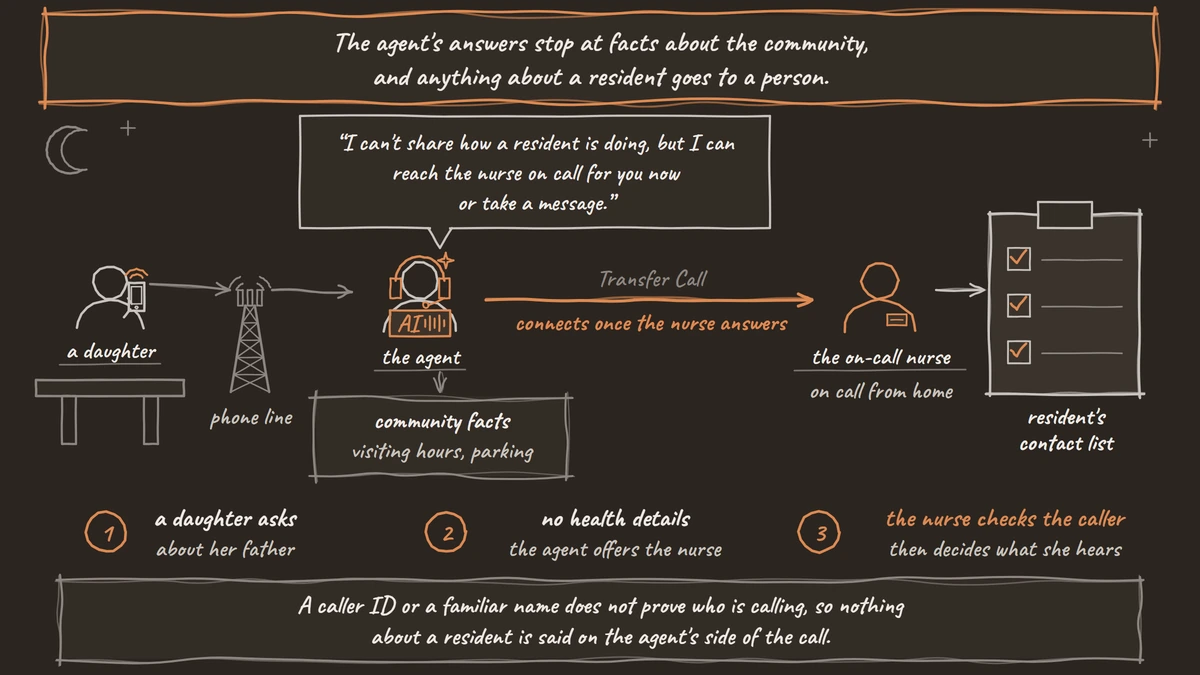
The agent's answers stop at facts about the community, and anything about a resident goes to a person. Start with the Greeting Text on the Start Call node, because it is spoken word for word. Name the community, say this is the after-hours line, and say up front that health information is not shared on this line but the nurse on call can be reached. If you want to tell callers they're speaking with an automated assistant, or your location requires it by law, write it in the Greeting Text along with the community's name.
Allow Greeting Interruption is on by default, so switch it off on the Start Call node. Then a caller who starts talking early still hears the whole notice.
After the greeting, the agent answers what any visitor could read on a sign, such as visiting hours, the front desk's opening time, the address and parking, how to reach the billing office and when the morning team returns calls. It takes questions about a named resident as a message or a transfer and says so plainly, for example, "I can't share how a resident is doing, but I can reach the nurse on call for you now or take a message."
Write the never list into the prompt in plain terms. The agent does not talk about health, medication, falls, incidents or hospital visits, and it does not confirm whether a named person lives in the community or is in the building tonight. A caller ID or a familiar name does not prove who is calling, so nothing about a resident is said on the agent's side of the call.
One line sits above everything. If a caller says someone is in danger where they are, the agent tells them to get to safety and call 911, then stays on the line to take their details.

Open Source Alternative to Vapi / Retell
Self-hosted voice agent platform — no per-minute fees
dograh-hq/dograh
Star on GitHub
When the call goes to the on-call nurse
A caller who is worried about a resident tonight goes to the nurse, not to a message. That includes a family member who says their mother sounded confused on the phone tonight, or a resident calling the line themselves. You write that list in the prompt, and the agent follows it instead of judging how serious the worry is.
The agent first writes the caller's name, the resident's name, the reason and a callback number to the community's system through an HTTP API tool, so the nurse can see the details. Then Transfer Call dials the nurse on Twilio, Telnyx, Plivo, Cloudonix or Asterisk ARI. Dograh calls the nurse first, the caller hears hold music while it rings, and the two are connected only once the nurse answers.
On-call rotas change every week, so hardcoding one number goes stale. A dynamic resolver lets Transfer Call ask the community's own scheduling system for tonight's on-call number at the moment of transfer. The nurse then checks the caller against the resident's contact list before saying anything about the resident, which is the verify step the agent never tries to do itself.
If nobody answers within 30 seconds, the default, the transfer comes back to the agent as failed and the caller stays on the line with it. The agent says the nurse will call back, writes an urgent callback request to the community's system through the same HTTP API tool and can try a backup number the same way. On Twilio, an optional short spoken introduction can play to both people before they are connected, so keep it free of any resident detail you would not want the caller to hear.
Messages the morning team can act on
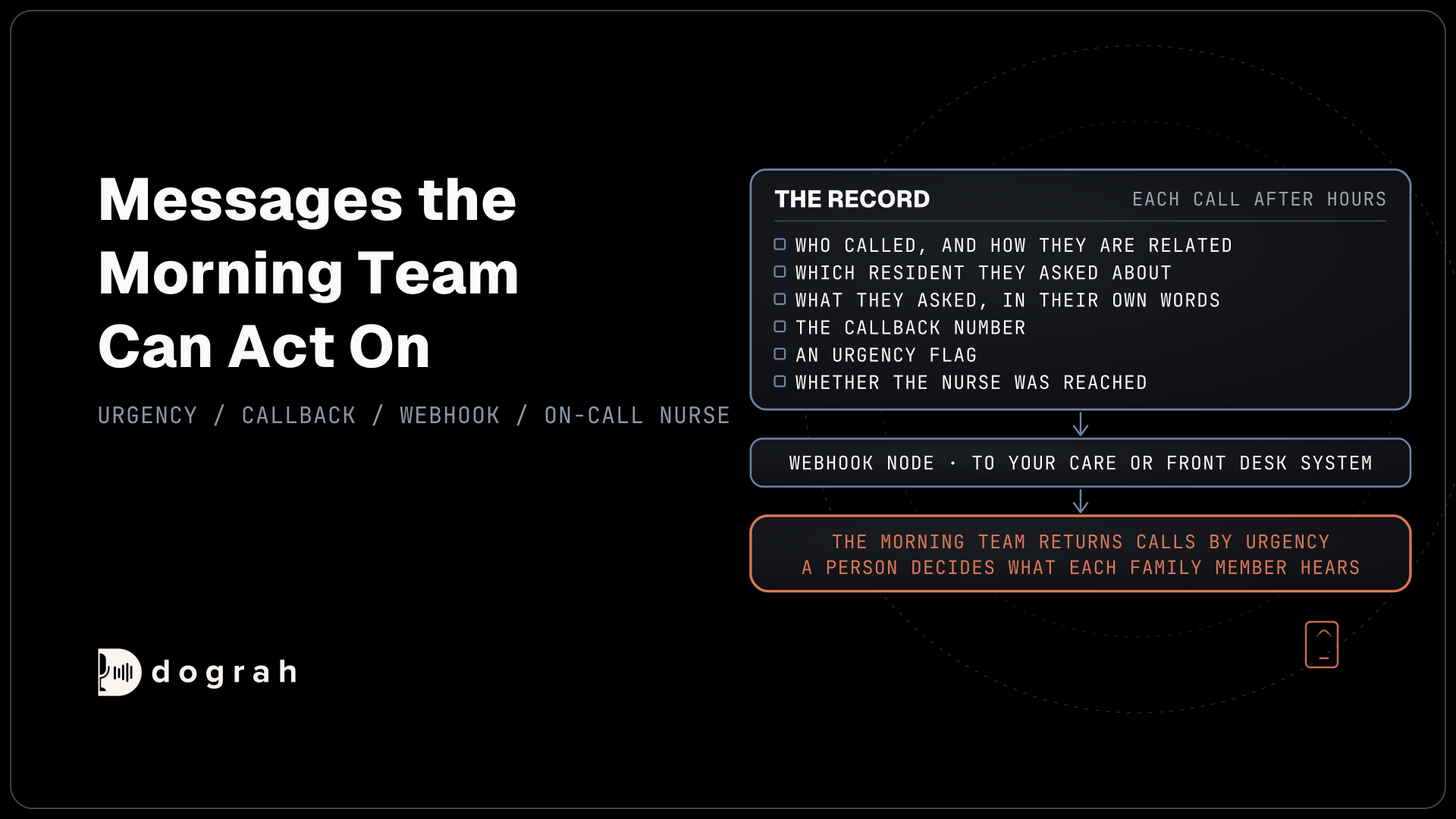
A message is only useful if the morning team can act on it without calling the family back to ask what they meant. Each call should leave a record with who called and how they are related to the resident, which resident they asked about, what they asked in their own words, the callback number, an urgency flag and whether the nurse was reached.
Variable extraction on the agent's node turns the conversation into those fields. It is an AI step, so each field is the agent's record of what the caller said, and the recording and transcript stay the exact version. After the call, a Webhook node sends the fields with the recording and transcript links to your care or front desk system, and it retries temporary failures by itself, up to 5 attempts.
The morning team then returns the calls in order of urgency, with a person deciding what each family member hears. If families should get a confirmation text or email, the community's own messaging system sends it once the record lands. Our post on the AI after-hours answering service covers the rest of the overnight message flow.
Keeping resident calls on your own servers
A family call about a resident carries health worries even when the agent shares nothing back, so where the audio goes matters. You can self-host Dograh on the community's own servers or run it on Dograh Cloud. Full data sovereignty comes only from self-hosting with open-weight speech and language models running on those servers too. Bringing your own keys for a hosted model moves the contract to that provider, not the data, because the audio still reaches it.
Self-hosting also means no business associate agreement (BAA) with Dograh is needed. Model providers may need their own when they handle health information, the phone carrier may need one depending on what it stores (many, such as Twilio, offer one), and a cloud account running your servers needs one too. Our post on what self-hosting changes for HIPAA walks through each layer.
Self-hosted Dograh has no per-minute platform fee, but servers, model keys and phone minutes still cost money. Dograh Cloud charges a 1¢-a-minute platform fee. A pre-recorded clip in a staff member's voice can carry the greeting, with a cloned version of that voice for everything else.
Join the Dograh Community
Dograh is an OSS alternative to Vapi. Join our Slack community for queries, releases, best practices & community interactions.
Test it before the first night
Transfers only run over a real phone call, so test the nurse handoff from a phone, not the browser. Call the line as a son asking about visiting, then as a daughter who will not take no for an answer about her father's medication. Then let the on-call phone ring out once to hear the fallback.
Each call's trace shows the conversation turn by turn, including when the HTTP API tool wrote the record and when Transfer Call ran. Built-in QA can score every call or a sample of them, and its prompt can tag any call where the agent said anything about a resident's health. Our post on AI voice agents for after-hours coverage covers what to do when the on-call phone isn't answered.
Glossary
- Covered entity
- A health plan, a clearinghouse or a health care provider that sends health information electronically in a HIPAA standard transaction. An assisted living community that does not meet that test may still be bound by state privacy law.
- Professional judgment
- The HIPAA standard staff use to decide what a family member hears when the resident is absent or cannot decide. It belongs to a person who knows the resident, which is why the agent hands those questions to the nurse.
- Dynamic resolver
- A Transfer Call setting that asks your own server for the destination at the moment of transfer. One agent can then ring tonight's on-call nurse without anyone editing it each week.
- Greeting Text
- Fixed text on the Start Call node that is spoken word for word when the call connects. The privacy notice belongs here, with greeting interruption switched off so every caller hears all of it.