
Self-hosting makes HIPAA-compliant voice AI simpler by taking the voice platform out of the BAA chain. Call audio, transcripts and extracted data stay in your own database and storage. Hosted models you call by API key, the phone carrier depending on what it stores, and your cloud provider can still need a BAA. The security safeguards stay your job.
Key Takeaways
- Self-hosting removes the voice platform from your list of business associates.
- Hosted models, the carrier and a cloud account can still need BAAs.
- Access controls and audit logs remain your team's job after self-hosting.
Every outside company that holds a patient's call is one more business associate agreement to sign and track. We look at what stays on your servers when you run Dograh yourself, what still leaves through hosted models, and the safeguards that stay with you. It is part of our guide to voice AI in healthcare.
What self-hosting changes for HIPAA
Self-hosting changes how many companies hold your patients' calls. Under the Health Insurance Portability and Accountability Act (HIPAA), any company that creates, receives, keeps or sends protected health information (PHI) for a provider is a business associate, and HIPAA's definition of a business associate extends that to their subcontractors. On a hosted voice platform, the platform is your business associate, and the speech and language vendors it uses are its subcontractors, companies you never sign with directly.
Renting with a BAA is a legitimate route, and HIPAA does not require self-hosting. Vapi's pricing page lists HIPAA as an add-on at $2,000 a month, covered by a BAA. Retell signs a BAA at no extra fee and says it requires its model subprocessors to sign one too. Either way, the platform keeps a copy of every call on its side.
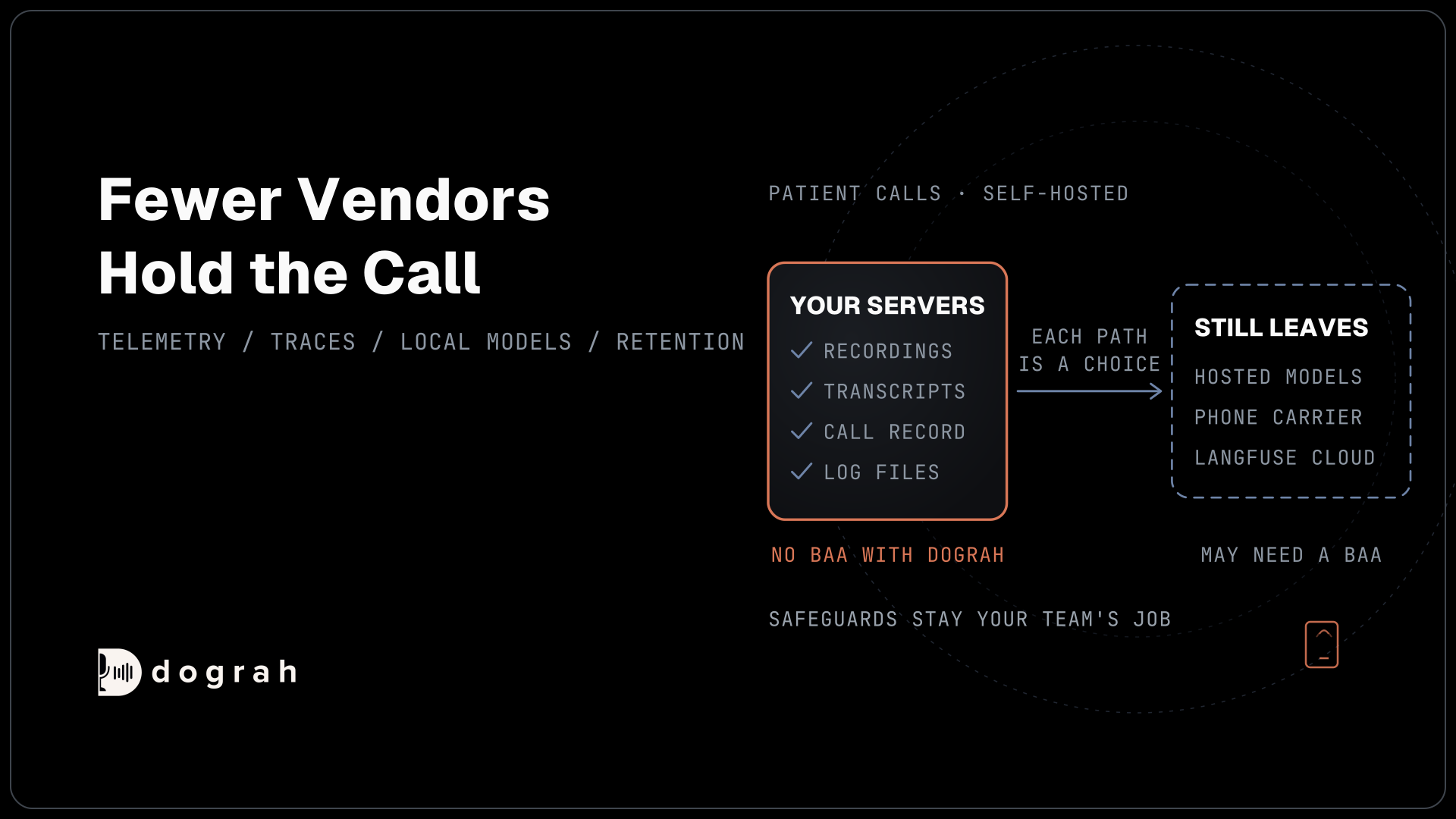
Run Dograh on your own servers instead, and no BAA with Dograh is needed, because the call data never reaches us. That is what self-hosting changes. Fewer vendors hold the call and every stored copy sits in your account, though compliance still takes work on your side. The vendor count matters, because The HIPAA Journal found business associates involved in 43% of the large breaches reported to the Department of Health and Human Services in the first half of 2026.
What stays on your servers
A self-hosted install keeps every stored copy of the call in systems you run. Install it with Docker and the recording is saved as three audio files, for the full call, the caller's side and the agent's side, with a transcript file beside them. They sit in object storage, either the bundled MinIO or your own S3 bucket if you point Dograh at one.
The call record lives in your Postgres database. It holds the pre-call data, the caller's and called numbers, the answers the agent extracted, the call's logs and any QA results. Server log files stay on your machines too, and they can hold call content, since every tool call's inputs are logged at the INFO level Docker sets.
Recordings and transcripts sit in that storage until someone deletes them. Put a retention schedule on your storage, and clear old copies from the database and the object store with your own deletion process. What counts as PHI on a voice agent call shows where each of these copies is kept.

Open Source Alternative to Vapi / Retell
Self-hosted voice agent platform — no per-minute fees
dograh-hq/dograh
Star on GitHub
What still leaves, and who hears it
Some of the call can still leave a self-hosted install, and each path is a choice you make. The biggest is the models. When a hosted provider runs speech-to-text, the language model or the voice, Dograh sends it the data its service needs, which can include audio, transcripts and tool results. Using your own keys (BYOK) puts the provider contract in your name. The audio reaches that provider all the same, so it may need its own BAA.
The phone carrier carries every call. Its BAA need turns on what it stores, and plenty of carriers offer one. Twilio's HIPAA page, for example, says a BAA needs its Security Edition or Enterprise Edition.
Traces are a quieter copy. Dograh sends them only to a Langfuse project you connect, and they hold prompts and replies. Langfuse's HIPAA page says a self-hosted Langfuse needs no BAA with Langfuse, while its cloud signs one on the Pro plan or higher in a dedicated HIPAA region.
Webhooks and HTTP API tools send data only to the endpoints you set, usually your own EHR or scheduling systems. Telemetry is the last path. Out of the box, a self-hosted install reports anonymous usage telemetry. Before the first patient call, set ENABLE_TELEMETRY=false and remove POSTHOG_API_KEY to stop it. Which parts of a voice AI stack need a BAA takes each of these layers in turn.
Local models take vendors off the list
Running the models yourself removes the model vendors entirely. That works because the models sit apart from the platform. Dograh runs the call flow, tools and telephony, and you choose which speech and language models plug in. With open-weight models on your own servers, the patient's audio never reaches a model provider, so no model BAA is needed.
A practical stack is Qwen3.8 27B for language, Parakeet TDT 0.6B v2 for speech-to-text and Magpie TTS for the voice. Parakeet needs roughly 2GB, so it fits beside a 4-bit Qwen3.8 27B on one 24GB card. Magpie ships fixed voices only, so if you need a cloned voice, use Chatterbox. Our guide to running voice AI on local, self-hosted models covers sizing and licences.
What is left is short. The carrier stays, depending on what it stores. If your servers run in a cloud account such as AWS, Google Cloud or Azure, that cloud provider needs a BAA. In your own data centre, it does not.
Join the Dograh Community
Dograh is an OSS alternative to Vapi. Join our Slack community for queries, releases, best practices & community interactions.
What self-hosting does not do
Self-hosting moves the safeguards onto your team, and it does not make a deployment compliant by itself. The Security Rule's technical safeguards apply to every system that holds electronic PHI, so your Postgres database, object storage, log files and trace store each need access controls and audit controls. Your risk analysis has to cover them as well.
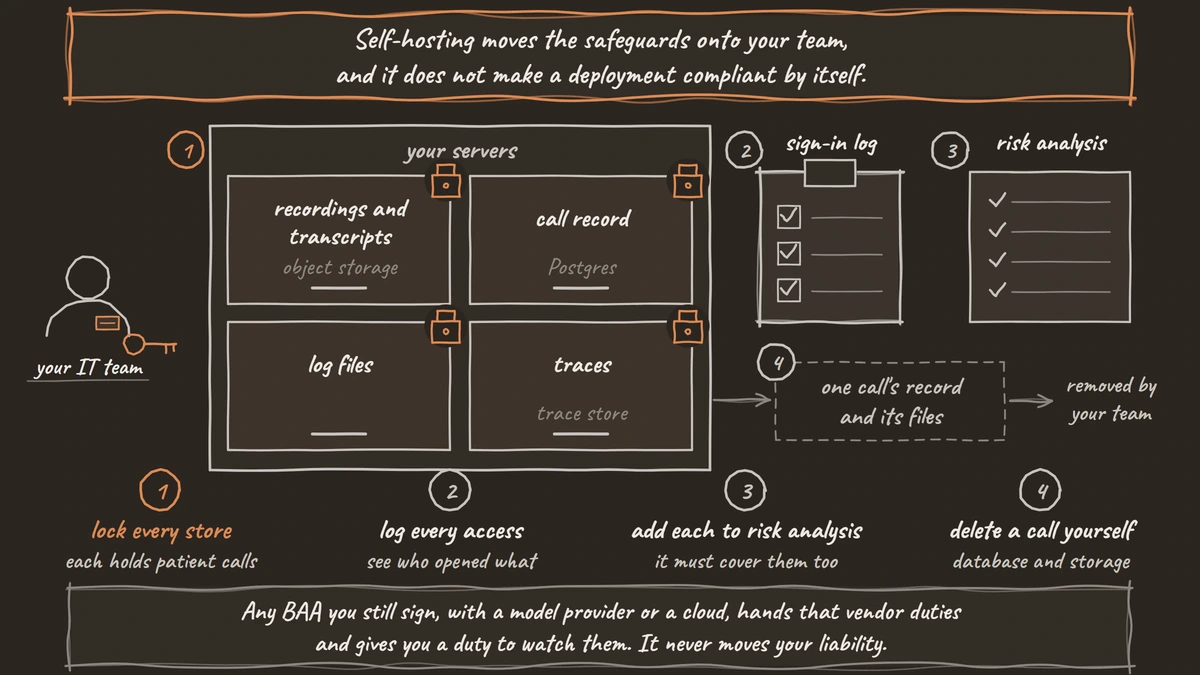
Some controls are yours to build. Recording can be switched off only for the whole server, with ENABLE_CALL_RECORDING_UPLOAD, and transcripts are still saved. Deleting a single call means removing its record and files from your own database and storage.
Any BAA you still sign, with a model provider or a cloud, hands that vendor duties and gives you a duty to watch them. It never moves your liability. Our post on HIPAA-compliant voice AI for hospitals compares the hosted, self-hosted and local-model setups in one table. Treat this as general information, and confirm your own setup with counsel before patient calls go live.
Glossary
- Business associate
- A company that creates, receives, keeps or sends PHI for a healthcare provider. A hosted voice platform is one, and a self-hosted platform on your own servers is not, because it never receives the data.
- Subcontractor (HIPAA)
- A company that handles PHI for a business associate rather than for the provider directly. On a hosted voice platform, its speech and language vendors usually fall here, under contracts you never see.
- Open-weight model
- A model whose weights you can download and run on your own hardware, such as Qwen3.8 27B or Parakeet TDT 0.6B v2. Running one locally keeps patient audio away from any model vendor.
- Technical safeguards
- The Security Rule controls for systems that hold electronic PHI, including access control and audit controls. They apply to your servers whether the voice platform is hosted or self-hosted.