
Conversational AI is software that holds a back-and-forth conversation in everyday language, by text or by voice. A chat assistant and a phone agent can share the same model and instructions. A phone call also brings compressed audio, replies due within about a second, interruptions, no screen to re-read and handing the caller to a person.
Key Takeaways
- Chat and voice agents can share the same model and the same tools.
- On a phone call, the caller expects a reply within about a second.
- Test every voice agent on a real phone line, never only in chat.
A chat assistant that works well can still struggle once it answers the phone. We cover what chat and voice share, then what a call adds, from 8 kHz audio and fast replies to short answers, handover and calling rules, with examples in Dograh. It builds on our guide to voice AI.
What conversational AI means
Conversational AI is any software that talks with people in their own words and keeps track of the conversation as it goes. A support chat on a website is conversational AI. So is a voice agent that answers your phone line and books an appointment.
Most people meet it in text first. In Gartner's 2026 customer survey, half of customers said their interactions are easier when companies use GenAI. The same survey found customers were about three times more likely to use outside tools such as ChatGPT or Gemini than a company's own chatbot in their last service interaction. People already talk to AI. The question for a business is which channel it answers on.
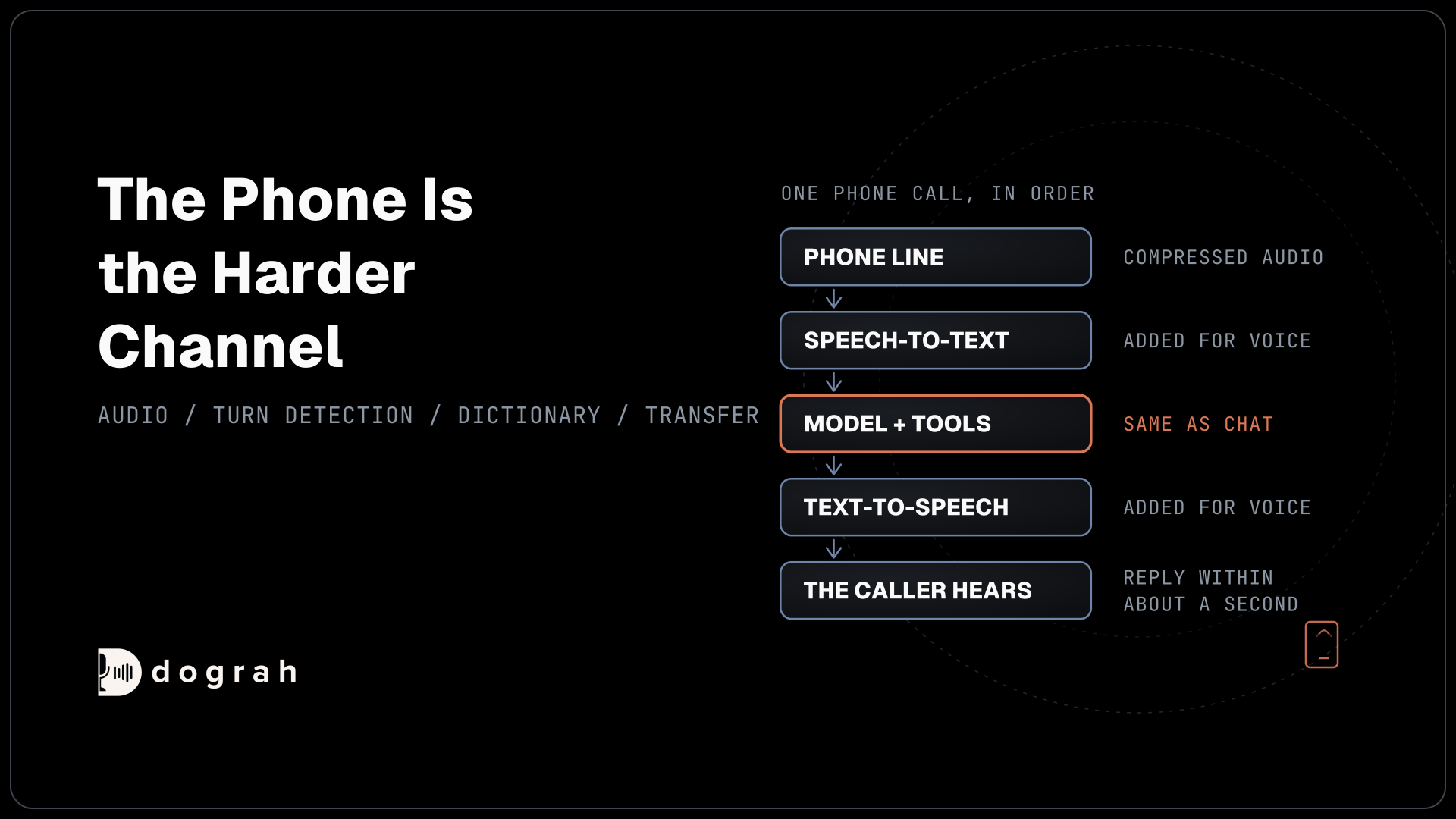
The phone is the harder channel, for reasons that have little to do with the language model. The rest of this post goes through them one at a time.
What chat and voice share
A chat assistant and a voice agent can share the same reasoning. They can run on the same language model with the same instructions, and call the same tools, such as an order lookup or a booking system. If your chat assistant already knows your refund policy, that knowledge carries over.
The difference sits around the model. A voice agent adds speech-to-text in front of it and text-to-speech behind it, and an orchestration layer runs the call. In Dograh, that layer runs the call flow, the tools and the telephony, while the speech and language models are a separate layer you pick for each agent. It runs on your own servers or on Dograh Cloud. Our post on how the voice AI pipeline works follows one sentence through every stage.
Text is still useful while you build. The agent editor's Test Chat tab lets you type to the agent and check its logic. You can send any earlier message again, or change it and continue the chat from there, though tool calls that already reached your systems stay done. Then move to real calls, because nothing below shows up in a chat test.
Phone audio is harder to hear
A chat assistant reads exactly what the person typed. A voice agent has to hear it first, often through a poor line.
A browser demo gets 16 kHz sound, while most phone calls still arrive at 8 kHz. That narrowband audio cuts the high sounds that tell "s" from "f", so names and account numbers get misheard. In WildASR's tests, some speech models barely changed on G.711 phone audio, while Qwen2-Audio's word error rate on English speech rose from 5.8% to 48.3%.
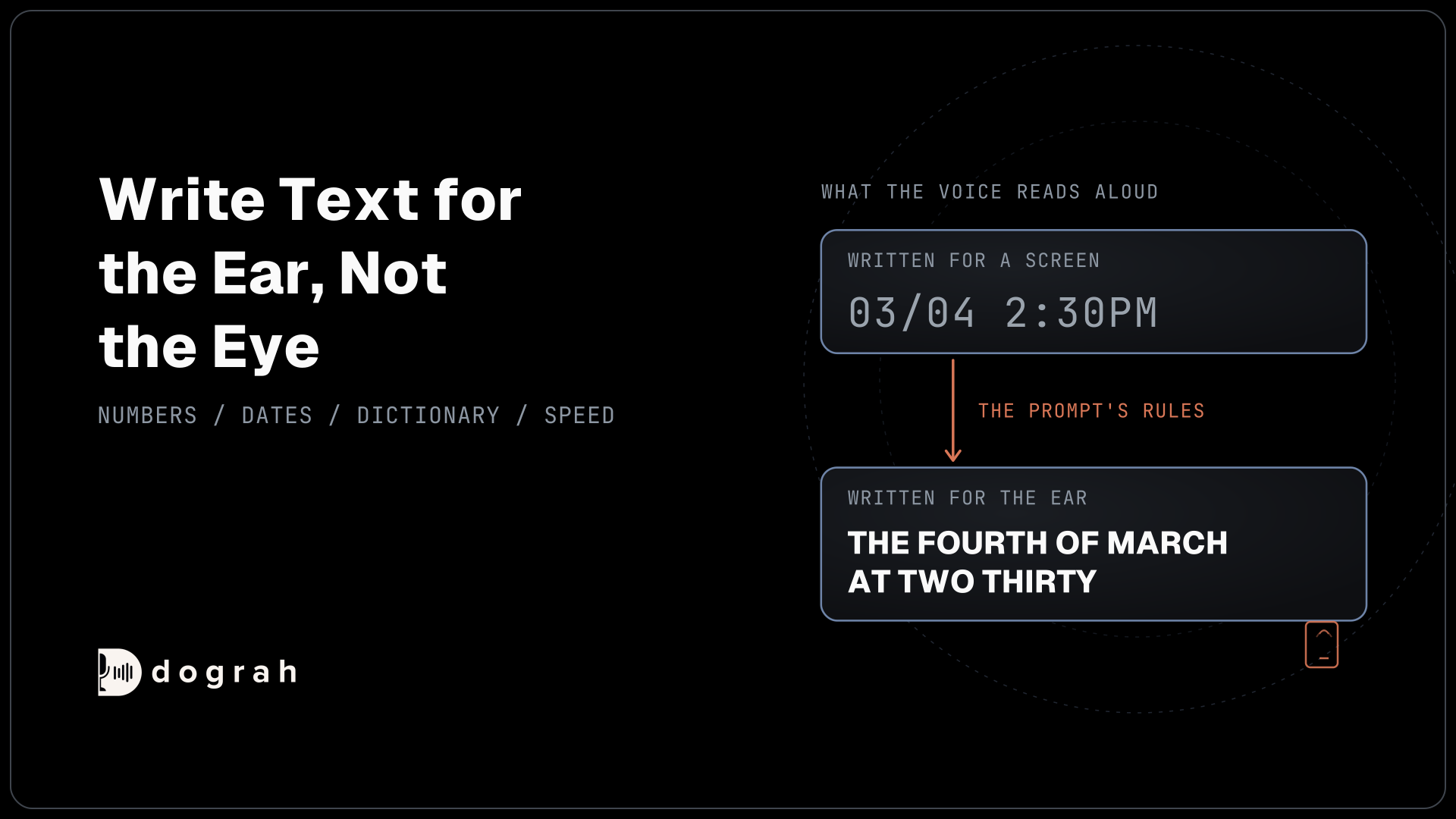
Two habits help. Pick the speech-to-text model by testing it on real phone calls, and add the names and terms your callers say to the agent's Dictionary in Settings. Then have the agent read back anything that matters, such as a date or a spelling, before it acts on it.

Open Source Alternative to Vapi / Retell
Self-hosted voice agent platform — no per-minute fees
dograh-hq/dograh
Star on GitHub
Replies have to come within a second
In chat, a reply that takes three seconds feels fine. On a call, three seconds of silence feels like the line dropped.
In our experience, a voice reply feels natural when the whole round trip stays under about 800 milliseconds, and speech-to-text, more often than the language model, is the slowest stage. Timing is only part of it. The Full-Duplex-Bench study lists pause handling, backchanneling, turn-taking and interruption management as behaviours spoken dialogue needs and text never does.
Each of those has a setting. Under Turn Detection in the agent's Settings, Dograh judges the end of a turn from the transcript by default, or you can switch to the Smart Turn Analyzer, which listens to the audio. Interruption Strategy decides when the caller can cut in: on any detected speech, or only after a minimum number of words, two by default, so a quick "mm-hm" doesn't stop the agent. Our post on barge-in, endpointing and turn-taking covers how to tune them.
No screen, so answers stay short
A chat reader can scroll back. A caller can't, so every answer has to work the first time it is heard.
That changes how you write the prompt. Ask for short sentences and one question at a time. A chat reply that lists five options becomes two options and a question on the phone. Prices and reference numbers get read back slowly and confirmed.
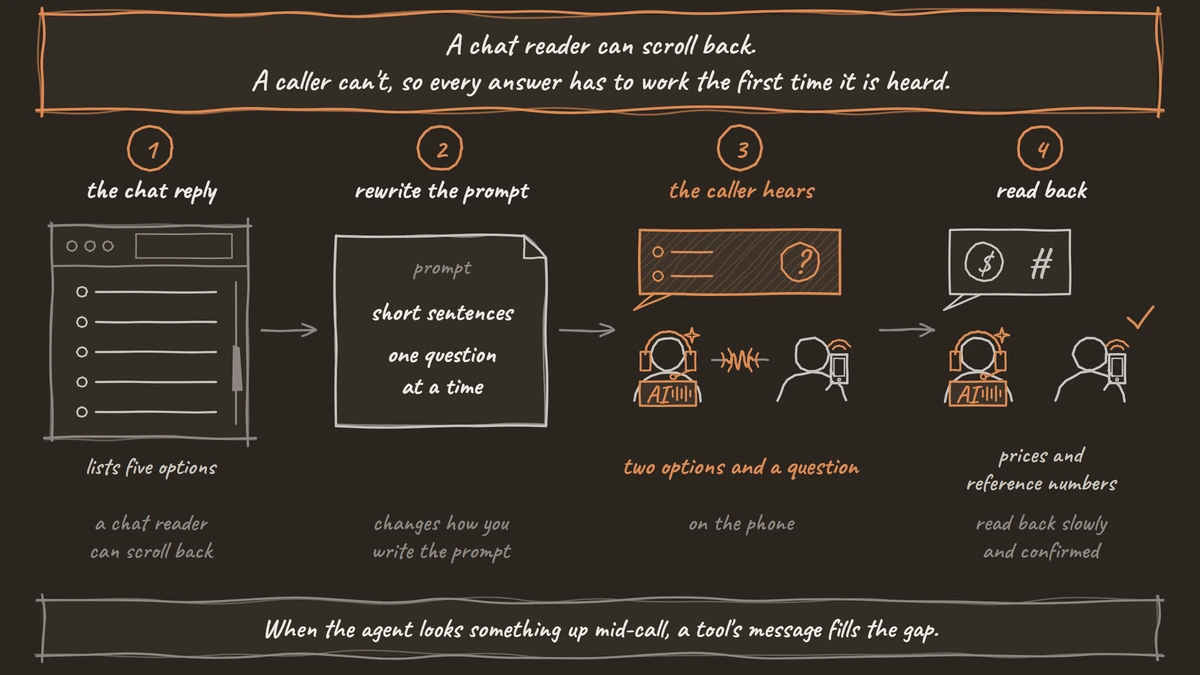
Silence needs managing too. When the agent looks something up mid-call, a tool's message fills the gap: a typed line or recorded clip starts as the tool fires and covers the wait. If the lookup runs long, a second update such as "I'm still checking" can follow. Under Call Management in Settings, Max User Idle Timeout (10 seconds by default) and Max Call Duration (300 seconds, or 5 minutes, by default) decide how long the agent waits on a quiet caller and how long any call can run.
Handover and calling rules
A chat can link to a contact form. A call has to reach a person, live, when the caller needs one.
When a caller asks for a person, Transfer Call moves them across on Twilio, Telnyx, Plivo, Cloudonix or Asterisk ARI. Your team member's line rings first, and the caller is joined only after someone picks up. On Twilio, a short spoken introduction can play to both sides first. No summary travels with the call by default, so have the agent write the caller's details to your system through an HTTP API tool before the transfer.
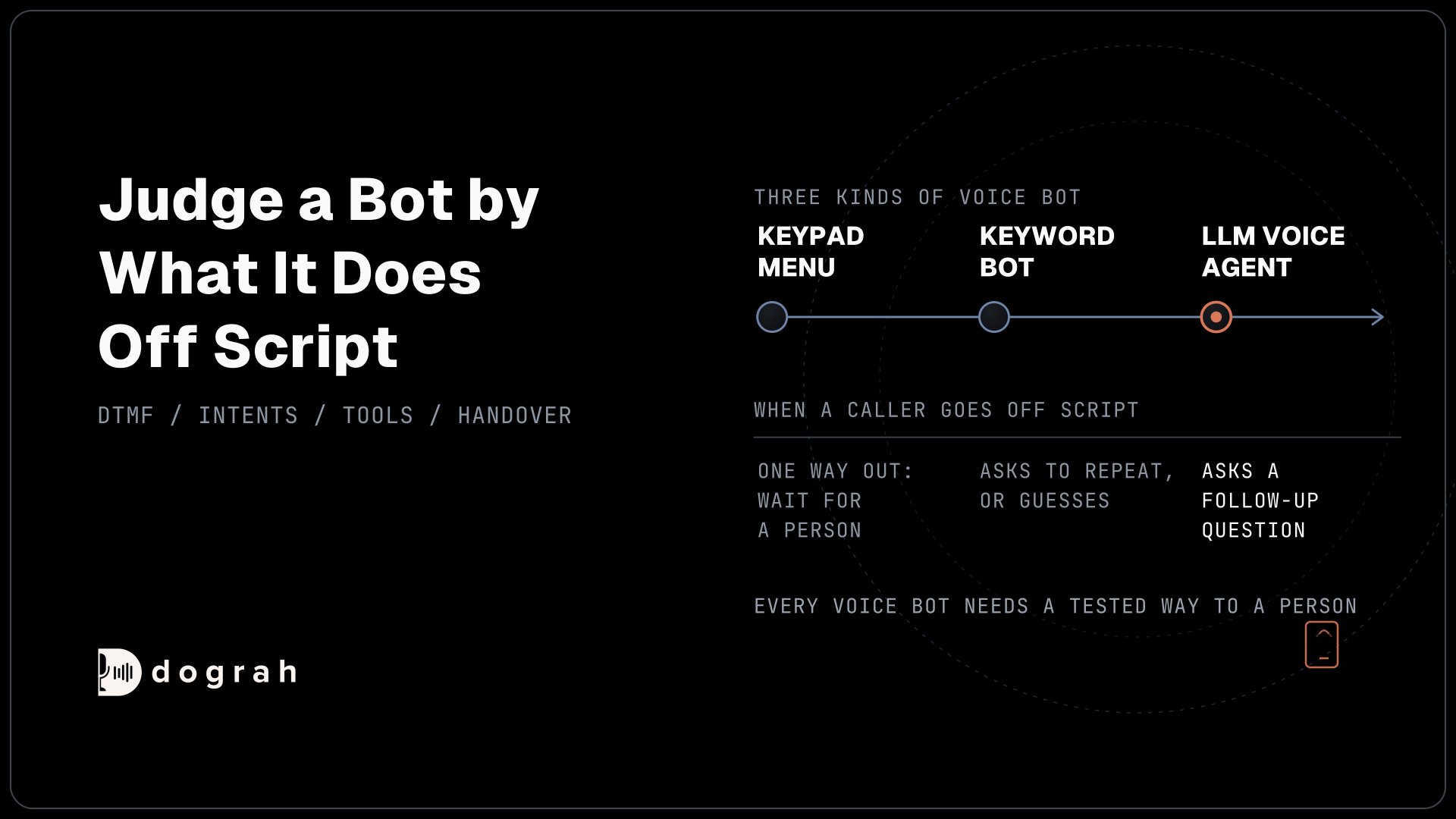
Phone calls also carry rules a chat window doesn't. A voice agent's speech counts as an artificial voice under the Telephone Consumer Protection Act (TCPA), as the FCC's 2024 ruling on AI-generated voices made clear. An outbound service call to a mobile therefore needs prior express consent, and a sales call needs it in writing, while calls the customer places need neither. Have counsel check your outbound setup. Our guide to voice bots covers how phone bots grew from keypad menus to agents like these.
Join the Dograh Community
Dograh is an OSS alternative to Vapi. Join our Slack community for queries, releases, best practices & community interactions.
Glossary
- Turn detection
- How a voice agent decides the caller has finished speaking. Dograh uses the transcript by default, or the Smart Turn Analyzer, which listens to the audio, and chat needs no equivalent.
- Backchannel
- A short sound a listener makes to show they are following, such as mm-hm. A voice agent should not treat it as an interruption, which is why the Minimum words setting exists.
- Narrowband audio
- Phone audio sampled 8,000 times a second. Most phone calls still reach a voice agent this way, so speech models hear less than in a browser test.
- Tool message
- A line or recorded clip a voice agent plays when a mid-call lookup starts, with an optional later update if it runs long. It keeps the caller from sitting in silence.