
A voice bot is software that holds a phone call on its own. Older voice bots follow a keypad menu or listen for set keywords. Modern ones are LLM voice agents that understand free speech, look things up during the call and hand the caller to a person. Judge a voice bot by what it can do on the call.
Key Takeaways
- "Voice bot" covers keypad menus, keyword bots and LLM voice agents alike.
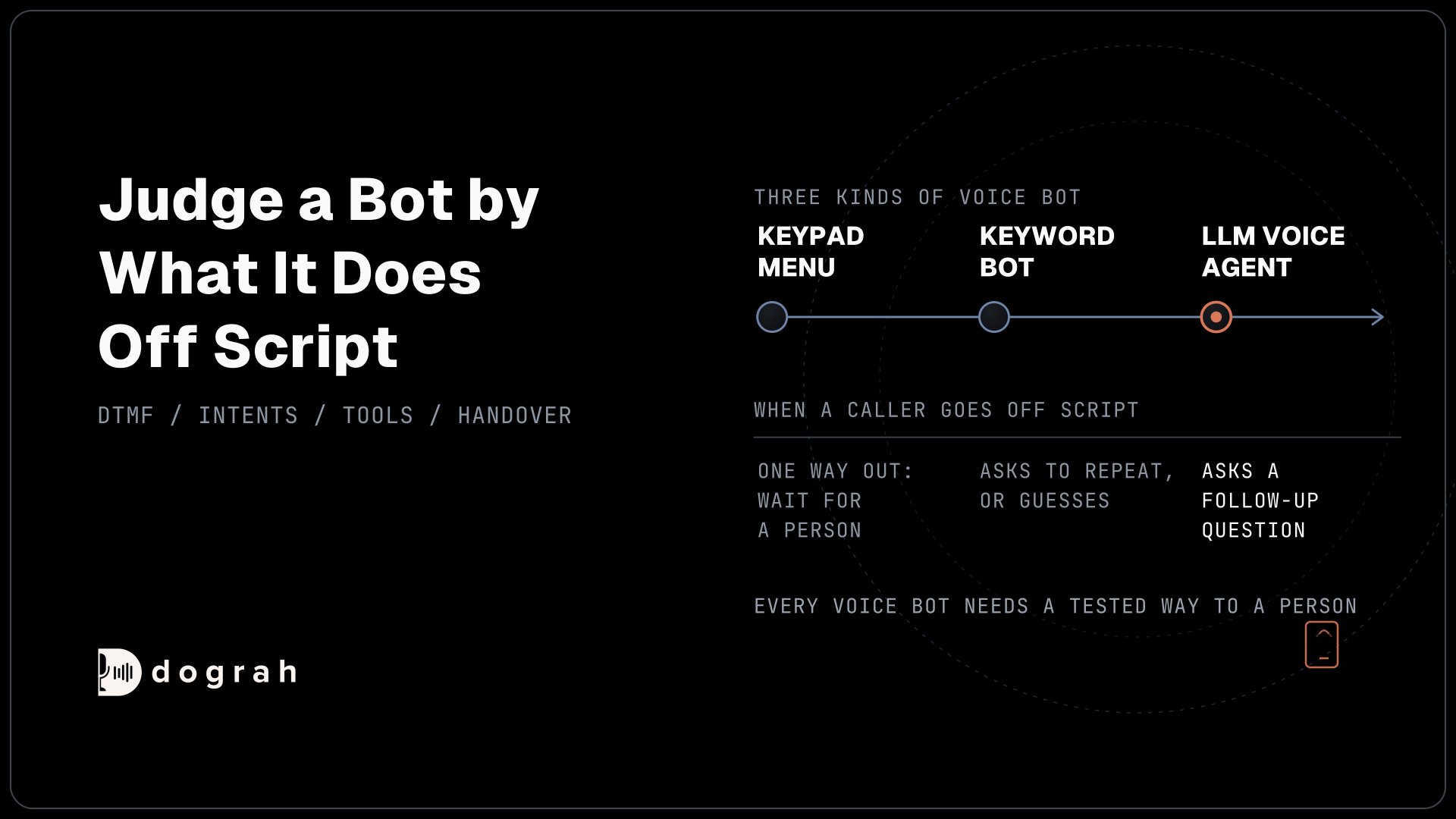
- Judge a bot by what it does when callers go off script.
- Every voice bot needs a clear, tested way to reach a person.
The same label covers a keypad menu and an agent that books appointments on its own. We sort the three kinds, show how a modern one is built in Dograh, where it can answer, where it still goes wrong and how to choose one. It is part of our guide to voice AI.
What a voice bot is
A voice bot is a program that answers or places calls and talks with the person on the line. It can be as simple as a menu that says "press 1 for billing" or as capable as an agent that books an appointment from a calendar during the call.
The names are loose. Vendors say voice bot, voicebot, voice assistant and voice agent, often for the same product. Some use "voice bot" for anything that speaks, and others keep it for the older menu systems and save "voice agent" for software built on a large language model. The label tells you little, so judge the software by what it does when a caller says something the builder didn't plan for.
The category is not going away. In Gartner's August 2026 survey of service leaders, leaders expected GenAI chatbots to become their most valuable channel within two years, followed by live chat and GenAI voicebots.
Three kinds of voice bot
Voice bots have come in three generations, and each one handles an unplanned answer differently.
The first is the keypad menu. It plays a list of options and listens for the tones of the keys you press, called DTMF. Every path is built in advance, so a caller whose problem is not on the menu has one way out: press 0 and wait for a person.
The second listens for words instead of keys. A keyword or intent bot matches what the caller says to a list of intents the builder wrote, such as "check balance" or "change address", each trained on sample phrases. It feels more natural when callers stick to those phrases. When they don't, it asks them to repeat, or guesses an intent and sends them down the wrong path.
The third is the LLM voice agent. It turns the caller's speech into text, lets a language model decide what was meant and what to say, and speaks the reply. It can ask a follow-up question, or look up an order and change it during the same call. It can also be wrong in new ways, which is why the rest of this post spends time on grounding and handover.
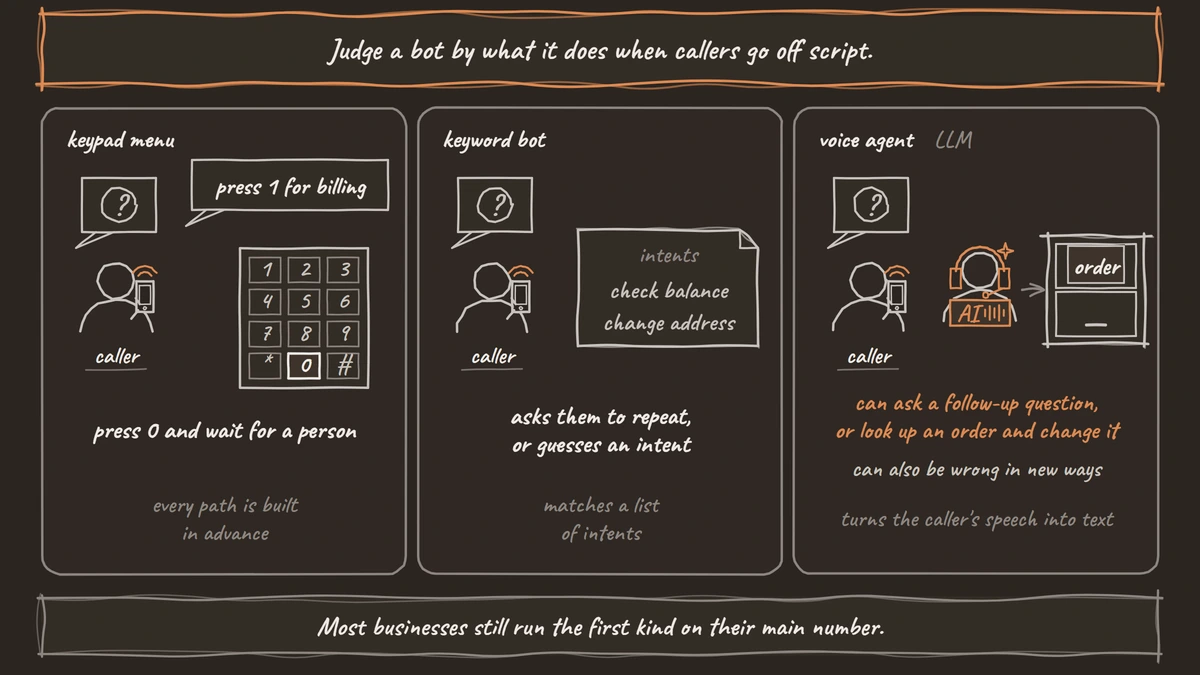
Most businesses still run the first kind on their main number. Our post on AI voice agent vs IVR covers when a keypad menu is still the right tool and how to move off one, one call type at a time.
How a modern voice bot is built
A modern voice bot is two layers: the AI models that hear and speak, and an orchestration layer that runs the call around them.
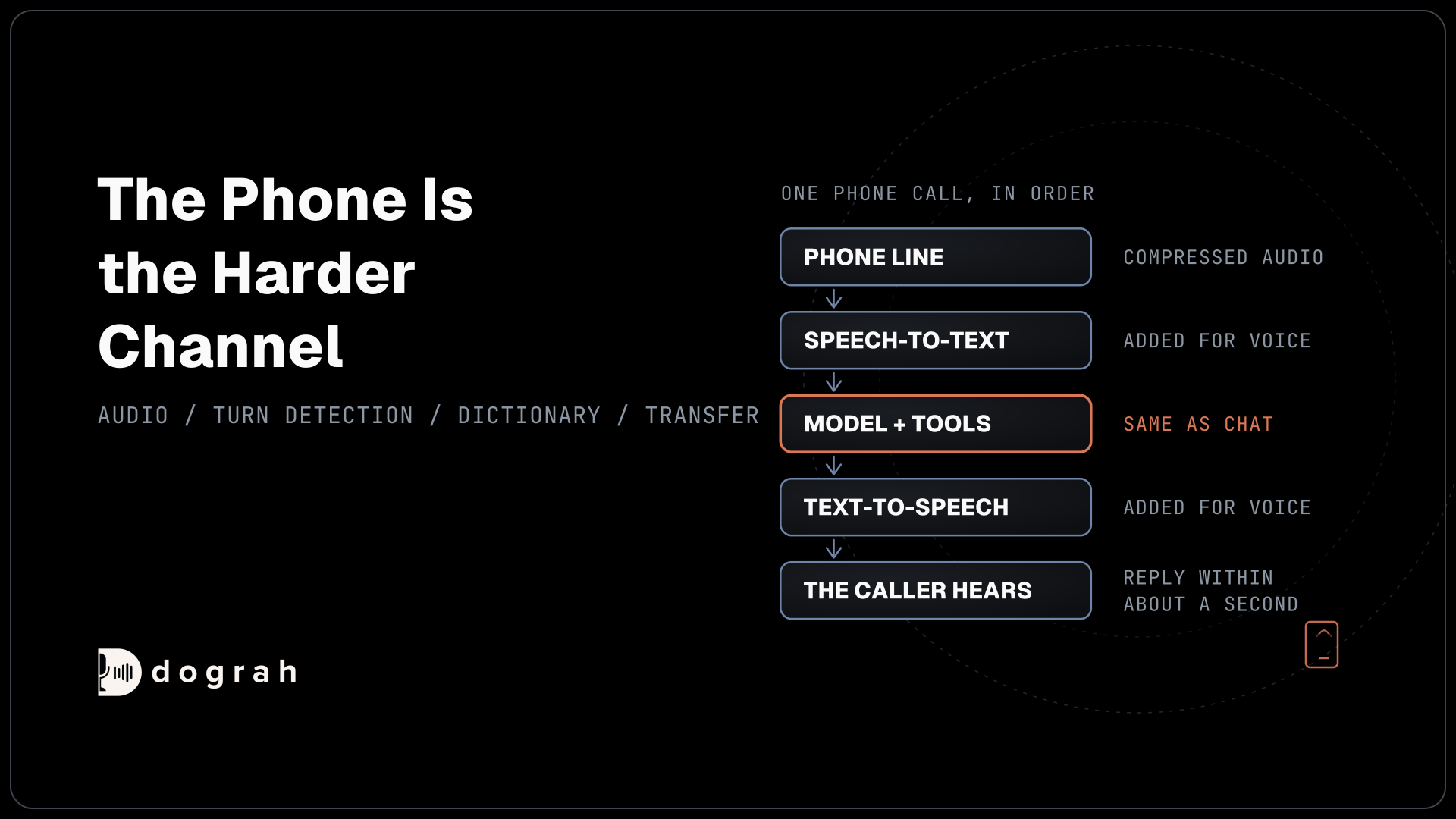
The model layer comes in two shapes. A cascade chains speech-to-text, a language model and text-to-speech. A speech-to-speech model takes audio in and gives audio out in one step. In our view, cascades are stronger at reasoning and tool calls, so they suit complex calls, while speech-to-speech models can stumble on calls with heavy tool use. Our post on cascade vs speech-to-speech compares the two in depth.
Dograh sits in that second layer, running the flow, tools and phone line, while you choose the models that plug into it. Teams run it on their own servers or on Dograh Cloud. It runs speech-to-speech models out of the box, though a few features, such as handing a call to another agent, still need a cascade agent.
You build the call as a workflow of steps on a visual canvas, each with its own instructions. Mid-call lookups go through an HTTP API tool that asks your system for an order or a free slot during the conversation. Policy answers can come from uploaded Knowledge Base files, so the agent answers from your documents instead of from memory.

Open Source Alternative to Vapi / Retell
Self-hosted voice agent platform — no per-minute fees
dograh-hq/dograh
Star on GitHub
Where a voice bot can answer
A voice bot lives wherever a caller can talk to it. The main door is still the phone, for inbound calls to your number and outbound calls from a list.
The second door is your website. The same agent can sit on a page as a voice widget, and it can also run as a text chat there. Our guide to adding a voice widget to your website covers the setup and how to keep it safe.
Dograh can also answer inbound WhatsApp voice calls on a WhatsApp Business number. That covers calls only, with no WhatsApp text messages sent. On every door, callers answer by voice, in their own words.
Where voice bots still go wrong
Most voice bot failures come from a few places, and each one has a fix you can test before launch.
Phone audio is the first. Most calls still reach the bot at 8 kHz, half the 16 kHz a browser demo gets. A bot that understands every word in a demo can mishear names on a real call, so test it on a phone line and add your hard terms to the agent's Dictionary.
Guessing is the second. A language model will answer a question it has no data for unless you stop it. Point the bot at a tool or a file for every fact it gives, and tell it in the prompt to offer a callback when it can't find an answer.
The third is a bot with no way out. In Gartner's 2026 customer survey, 87% of customers said companies using GenAI for service must offer a way to reach a human agent. A bot on Twilio, Telnyx, Plivo, Cloudonix or Asterisk ARI gets that exit through Dograh's Transfer Call tool. The person on the other end is rung first, and the caller joins only once they pick up. On Twilio, both sides can also hear a short spoken introduction before they are joined.
Outbound calls bring rules of their own. The Telephone Consumer Protection Act (TCPA) covers them, and the FCC's 2024 ruling on AI-generated voices counts a bot's AI voice as an artificial voice under it. That means a reminder or other service call to a mobile needs the person's prior express consent, while anything with a sales offer needs prior express written consent. Inbound calls the customer places need neither, and counsel should sign off on your outbound setup.
Join the Dograh Community
Dograh is an OSS alternative to Vapi. Join our Slack community for queries, releases, best practices & community interactions.
Choosing a voice bot for your calls
Pick a voice bot by testing it the way callers will use it. Give it the questions your team actually hears, then go off script on purpose: change your mind halfway, ask two things at once, mumble a name.
Run those tests on a phone line, not only in a browser. Then ask for a person and check that the transfer reaches someone, with the caller's details already written to your system. A bot that passes those tests on a few hundred real calls is ready for more.
If you are weighing a voice bot against a chat assistant, our post on conversational AI on phone calls covers what changes when the conversation moves from a screen to a call.
Glossary
- DTMF
- Dual-tone multi-frequency, the tones a phone sends when you press its keys. Keypad menu bots listen for them, while LLM voice agents let the caller answer by voice.
- Intent matching
- How keyword voice bots decide what a caller wants, by matching their words to a fixed list of intents trained on sample phrases. Callers who phrase things differently get asked to repeat or sent down the wrong path.
- Containment
- The share of calls a voice bot finishes without a person. A high number only means something if callers could reach a person when they needed one.
- Grounding
- Making a voice bot answer from a tool result or a document rather than from the language model's memory. It is the main guard against confident wrong answers on a call.