
Any layer of a voice AI stack that creates, receives, keeps or sends PHI for you generally needs a BAA. That means hosted speech, language and voice models, a hosted voice platform and a cloud account. The phone carrier may need one, depending on what it stores. Self-hosting removes the platform, and local models remove the model vendors.
Key Takeaways
- A voice AI call touches eight layers, and each one needs its own BAA check.
- Fallback models, extra keys and trace stores are vendors too.
- Self-hosting with local models shrinks the list to the carrier and the cloud.
One patient call can pass through several companies, and each may need a business associate agreement. We walk through the layers of a call in Dograh, the carrier question, the vendors that hide in a stack and the choices that shorten the list. It is part of our guide to voice AI in healthcare privacy.
Who counts as a business associate
A company needs a BAA when it creates, receives, keeps or sends protected health information (PHI) on your behalf. The definition of a business associate in the Health Insurance Portability and Accountability Act (HIPAA) also covers a company that transmits data for you and needs routine access to it, and it extends the role to subcontractors, the vendors your vendors use.
The agreement says what the vendor may do with the data and what it must protect, and HIPAA's contract rules list what it has to include. A BAA hands the vendor duties and gives you a duty to watch them. It never moves your liability, so every name on the list is one more company to monitor. Our post on HIPAA-compliant voice AI for pharmacy covers who counts as a business associate on a call in more detail.
The eight layers of a voice AI call
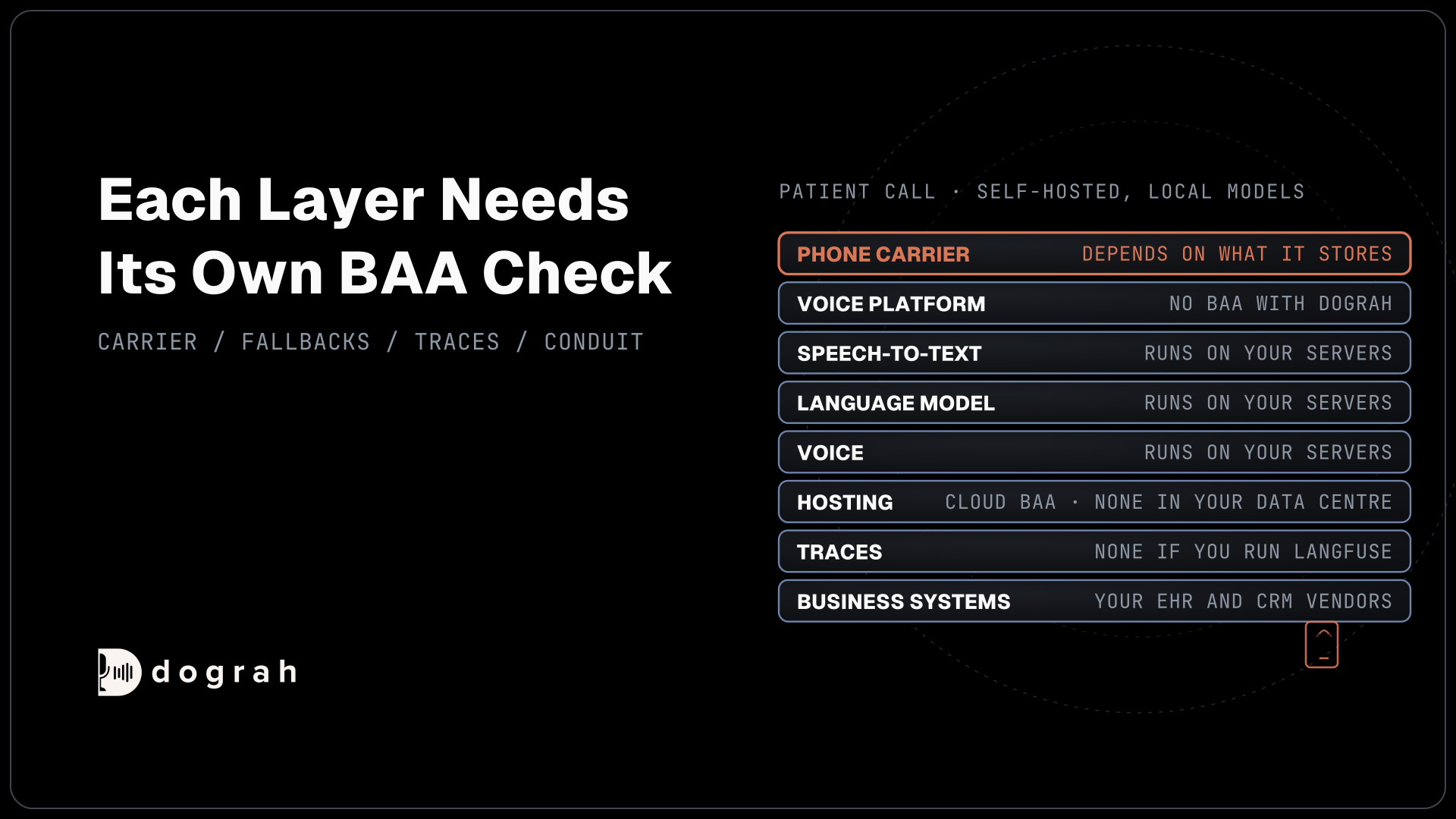
A patient call passes through up to eight layers, and the answer depends on who runs each one. In Dograh's split, the platform runs the call flow, tools and telephony, and the speech and language models are a layer you pick on their own, so each can land in a different column below.
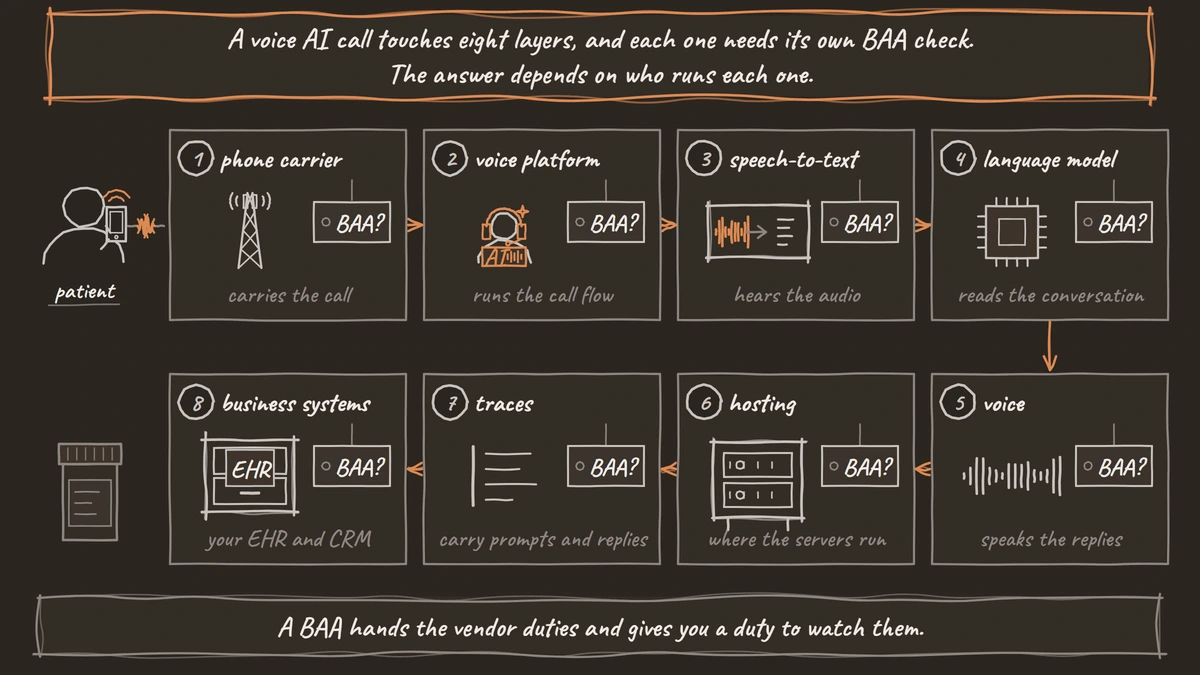
| Layer | Hosted voice platform | Self-hosted Dograh, hosted models | Self-hosted Dograh, local models |
|---|---|---|---|
| Phone carrier | Depends on what it stores | Depends on what it stores | Depends on what it stores |
| Voice platform | BAA with the platform | No BAA with Dograh | No BAA with Dograh |
| Speech-to-text | Platform's subcontractor | BAA with the provider | None, runs on your servers |
| Language model | Platform's subcontractor | BAA with the provider | None, runs on your servers |
| Voice (text-to-speech) | Platform's subcontractor | BAA with the provider | None, runs on your servers |
| Hosting | Platform's cloud | Your cloud provider, or none in your own data centre | Your cloud provider, or none in your own data centre |
| Traces | Platform's tooling | Langfuse Cloud, or none if you run Langfuse | Langfuse Cloud, or none if you run Langfuse |
| Business systems | Your EHR and CRM vendors | Your EHR and CRM vendors | Your EHR and CRM vendors |
The model rows matter most. When a hosted provider runs a model, Dograh sends it the data its service needs, which can include prompts, conversation history, transcripts, audio, tool definitions and results. With your own keys (BYOK), the provider contract, and any BAA in it, sits with you, while the audio still travels to that provider.

Open Source Alternative to Vapi / Retell
Self-hosted voice agent platform — no per-minute fees
dograh-hq/dograh
Star on GitHub
The phone carrier and the conduit question
The carrier is the hardest layer to call, because the answer can go either way. The Department of Health and Human Services (HHS) describes a conduit as a company that only transports PHI and does not access it, except randomly or infrequently, like the postal service or its electronic equivalents, and a conduit is not a business associate, as its business associate FAQ explains.
A modern carrier often does more than carry the call. It may record calls, store voicemail or keep transcripts on its side, and storing PHI goes beyond transport. So whether your carrier needs a BAA comes down to what it stores, and many carriers offer one. Twilio's HIPAA page, for example, says its BAA needs the Security Edition or Enterprise Edition.
In Dograh, recording and transcription run on your side, so check which carrier features you switch on, such as carrier-side recording, before deciding.
Vendors that hide in the stack
Some vendors join the call without appearing on the architecture diagram. Fallbacks are the first. If you set a backup language model, or add several API keys for one provider, every provider and account behind them can receive the call.
The transfer introduction is another. On Twilio, Transfer Call can play a short introduction to both people before connecting them, and your configured voice provider speaks it. That provider hears whatever the introduction says.
Traces carry prompts, replies and tool calls. Dograh sends traces only to a Langfuse project you connect. Langfuse's HIPAA page says a self-hosted Langfuse needs no BAA with Langfuse, while its cloud signs one on the Pro plan or higher in its HIPAA region.
Tools and webhooks send call data to the endpoints you set. Those are usually your own EHR, scheduling or CRM systems, and each vendor behind them is already on your list.
Join the Dograh Community
Dograh is an OSS alternative to Vapi. Join our Slack community for queries, releases, best practices & community interactions.
Shrinking the list
Each design choice can take a layer off the list. Self-host Dograh and no BAA with Dograh is needed, because the call data stays on your servers. Run open-weight models there too, and the speech, language and voice vendors drop out. Host in your own data centre rather than a cloud account, and the hosting BAA goes as well. What remains is the carrier, depending on what it stores. HIPAA-compliant voice AI with self-hosting shows what stays in your storage.
Where you keep a hosted provider, ask which plan and which endpoints its BAA covers, since plans often differ on retention and training. Our post on HIPAA-compliant voice AI for hospitals compares the three setups for a hospital. Treat this as general information, and have counsel review each agreement before patient calls start.
Glossary
- Business associate
- A company that creates, receives, keeps or sends PHI for a healthcare provider, or transmits it with routine access. Each one needs a BAA with the provider.
- Subcontractor (HIPAA)
- A vendor that handles PHI for a business associate. On a hosted voice platform, the speech and language providers it uses usually fall here.
- Conduit
- In HHS's words, a company that only transports PHI and does not access it except randomly or infrequently, like a postal service. A conduit is not a business associate.
- Orchestration layer
- The software that runs the call flow, tools and telephony and passes audio and text between models. Dograh is this layer, and the models are a separate layer you choose.