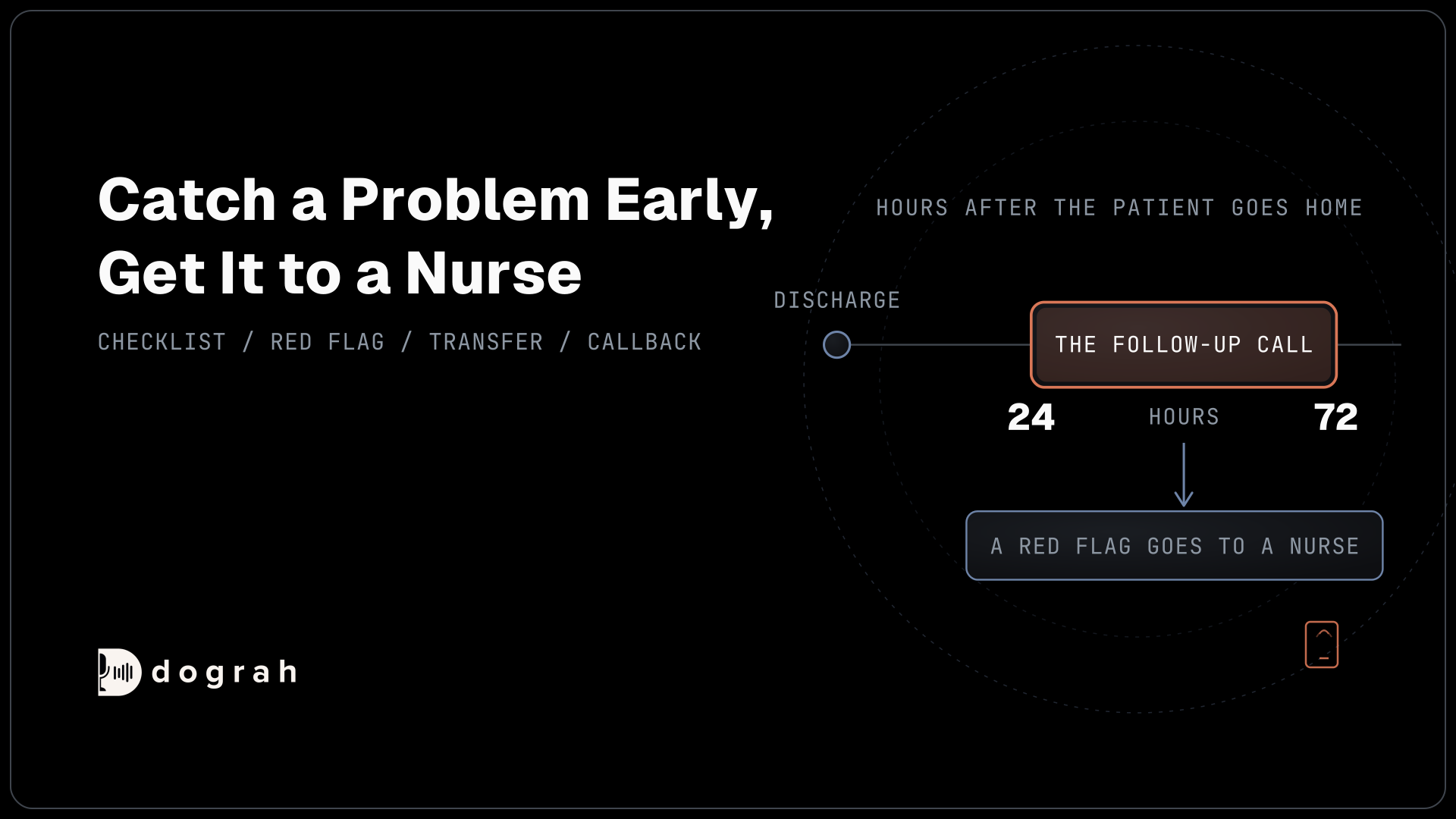

AI voice agents for post-discharge follow-up call patients 24 to 72 hours after they leave hospital. They verify the patient, ask the care team's own symptom checklist, check medications and the follow-up appointment, and send any red-flag answer straight to a nurse, with the details written to your system first. They never give medical advice.
Key Takeaways
- The care team writes the checklist; the agent asks it and records answers.
- Write a red-flag answer to the record, then transfer to a nurse.
- If no nurse answers the transfer, the agent logs a callback request.
This post is part of our guide to AI voice agents for hospitals and health systems. The guide's section on patient calls after a visit places this call 24 to 72 hours after discharge, with red-flag answers going straight to a nurse. This post covers that call in Dograh, an open-source, self-hostable voice agent platform, including what happens when the nurse line does not pick up.
Why hospitals make this call
Patients go home with instructions on new medicines, follow-up visits and warning signs, and the first few days are when those instructions are hardest to follow. When patients end up back in hospital, Medicare can cut the hospital's payments. In Healthcare Dive's report of the latest Centers for Medicare & Medicaid Services (CMS) data, 80% of hospitals, or 2,334 facilities, are having their Medicare payments reduced for fiscal year 2027 under the Hospital Readmissions Reduction Program (HRRP), up from 78% in 2026. Penalties can reach 3% of payments.
A follow-up call is the standard response, and it runs out of nurses quickly. That is why large systems are moving the first call to an agent. Universal Health Services (UHS) launched AI agents for the first post-discharge call at two of its hospitals in 2025. The agent reviews medication instructions, probes for new or worsening symptoms and answers questions, patients can ask for a person, and clinicians can call back afterwards. Patients rated the calls 9 out of 10 on average, by the company's figure.
Be precise about what the call is for. Its job is to catch a problem early and get it to a nurse the same day. Judge it on that, and do not promise a readmission rate it cannot be shown to move.
Greet, verify, then name the stay
A hospital stay is protected health information (PHI), so the agent names nothing until it knows who is on the line. The discharge system starts the call through the API Trigger, or a Campaigns list built from yesterday's discharges. Write the Greeting Text to name the hospital and say the patient is speaking with an automated assistant. Dograh plays exactly what you write; it doesn't add this line on its own. It plays before verification, so it never mentions the stay, the ward or the condition.
The agent then verifies with the date of birth plus one reference, such as the discharge date or the first line of the address. A phone number finds the record; it does not prove who answered. Many of these calls reach a family member or carer. If the patient listed them as a contact, your system can pass that in the call data, and the agent can speak with them. Otherwise it asks for the patient or arranges a better time. Keep the list clean before the call goes out: a patient who has been readmitted, transferred to another facility or has died must drop off the list in your system, not be discovered on the phone.
The agent asks the care team's questions, word for word
The questions come from the care team, never from the model. Each discharge type has its own checklist: a heart failure patient is asked about weight and breathlessness, a surgical patient about the wound and pain. Your system passes the right checklist for this patient when the call is triggered, or the agent fetches it through an HTTP API tool when the call connects.
The agent asks each question and records the answer as the patient stated it, as extracted variables. Extraction is an AI step, so the transcript and the recording remain the exact record the nurse reviews. If the patient is unsure, the agent records "unsure" rather than picking an answer for them, and an unsure answer to a red-flag question is treated as a red flag.
Three questions belong on almost every checklist. Does the patient have their new medications, and are they taking them as the discharge list says? A medication problem is routed, never solved; our post on AI voice agents for medication adherence covers that conversation. Do they know what to watch for, as the care team wrote it? And is the follow-up appointment booked? If it is not, the agent books it through an HTTP API tool against the scheduling system, or routes the patient to the scheduling team.

Open Source Alternative to Vapi / Retell
Self-hosted voice agent platform — no per-minute fees
dograh-hq/dograh
Star on GitHub
Red flags go straight to a nurse
A red-flag answer is any answer the care team marked for escalation, and the checklist defines it, not the agent. When one comes up, the order of steps matters.
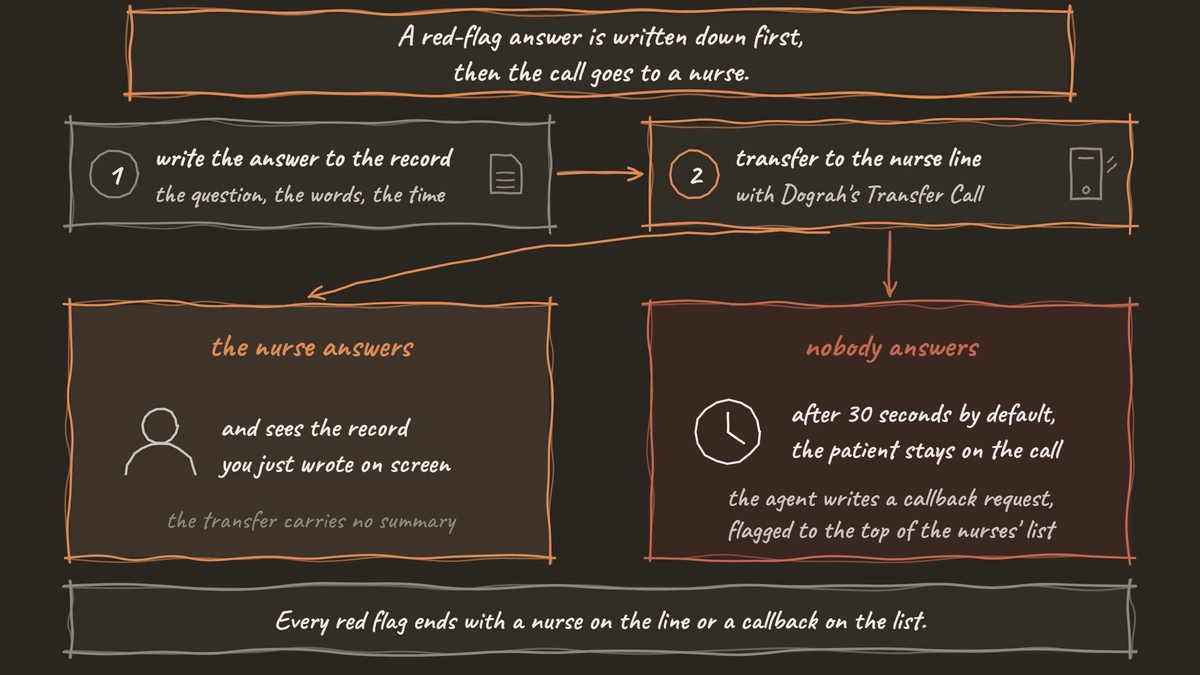
First, the agent writes the answer to the patient's record through an HTTP API tool: which question, what the patient said, and the time. Then it uses Transfer Call to reach the nurse line. Transfer Call works on Twilio only and passes no summary, so the record the agent just wrote is what the nurse sees on screen. On Twilio you can switch on a short spoken introduction, which both people hear.
Then plan for the nurse line not answering. The transfer timeout is 30 seconds by default, settable from 5 to 120. If nobody answers, the agent is told the transfer was not answered, busy or failed, and the patient stays on the call with the agent. Dograh has no built-in callback task, so the prompt covers the next step. The agent tells the patient a nurse will call back, and writes the callback request to your system through an HTTP API tool, flagged as a red flag so it goes to the top of the list.
Emergency wording is different. If the patient describes chest pain or trouble breathing, the emergency pathway plays a fixed instruction to hang up and call 911 before anything else, through Transition Speech or a recorded clip. Choosing that pathway is still the language model reading the pathway's written condition, so keep the phrase list short and explicit, and test it on real calls.
What the agent never says
The agent never gives medical advice, and reassurance counts as advice. "Is this swelling normal?" gets the same answer as "Should I take another tablet?": the agent records the question and sends it to a nurse. It also never says "that sounds fine". A patient who hears that from an automated call may wait a day they should not have waited.
This is where clear wording in the prompt helps most. Write the agent's role in plain sentences: it asks the care team's questions, records the answers and routes anything clinical. Then check that role on real transcripts, because a prompt shapes the words without guaranteeing them.
Join the Dograh Community
Dograh is an OSS alternative to Vapi. Join our Slack community for queries, releases, best practices & community interactions.
Before launch: calling rules, saving answers and a first pilot
Post-discharge follow-up intended to prevent readmission is one of the purposes the FCC's healthcare exemption names for calls to a patient's mobile, with limits on length, frequency and content that the guide's consent section sets out. Opt-out is by voice, and a yes is written to your system at once. A voicemail carries no health details, only a callback number and a toll-free opt-out number, or no message.
After the call, a webhook writes every answer, the escalation status and the recording link to the patient's record. A temporary failure is retried automatically, up to five attempts. Run quality assurance (QA) on a sample of calls, and read every call where a red flag was raised. Measure the program on what it can change: red flags raised, how fast a nurse reached each one, and follow-up appointments booked by the end of the call.
Dograh is the orchestration layer: it runs the call flow, tools and phone line, while the speech and language models are a separate layer you choose. Self-host Dograh and the models, and discharge details and answers stay on your own servers; with hosted models, each provider needs its own business associate agreement (BAA). Self-hosted Dograh has no per-minute platform fee, though servers, model keys and phone minutes still cost money; Dograh Cloud has a 1¢-a-minute platform fee. Start with one discharge type whose checklist the care team has already written down. The call before the stay is covered in AI voice agents for pre-op instructions, and the virtual-visit version of this call in AI voice agents for post-visit follow-up in telehealth.
Glossary
- Hospital Readmissions Reduction Program (HRRP)
- The Medicare program that reduces payments to hospitals with more readmissions than expected for certain conditions. Penalties can reach 3% of payments, and 80% of hospitals face one for fiscal year 2027.
- Red-flag answer
- An answer on the discharge checklist that the care team has marked for immediate escalation, such as a new symptom or a missing medication. The checklist defines it; the agent only recognizes and routes it.
- Transfer timeout
- How long Dograh's Transfer Call waits for the nurse line to answer, 30 seconds by default and settable from 5 to 120. If it runs out, the patient stays with the agent.
- HTTP API tool
- A Dograh tool that lets the agent call your own systems during a call, for example to fetch the discharge checklist, book the follow-up visit or log a callback request when no nurse answers.