
AI voice agents for pre-op instructions call patients before a procedure. They verify the patient, then read the arrival time, fasting rules and what to bring from the hospital's own system, and ask the patient to read the key times back. Any question about the procedure itself goes to a nurse, and the result is written back.
Key Takeaways
- Read the instructions from the hospital's system, never from the model.
- Ask for a read-back of the arrival time and fasting cutoff.
- Every question about the procedure goes to clinical staff.
This post is part of our guide to AI voice agents for hospitals and health systems. The guide's section on patient calls before a visit sets the rule this post builds on: the arrival time, the fasting rules and what to bring come from the hospital's system, and the agent reads them back. Here we build that call in Dograh, an open-source, self-hostable voice agent platform, from the trigger to the write-back.
The instructions come from your system, not the model
A pre-op call is only as safe as the source of its instructions, so the first design decision is where the words come from. The arrival time, the fasting cutoff and the list of things to bring belong to the patient's case in your scheduling or perioperative system. They change by procedure, by surgeon and by patient, and they change over time. A 2025 nurse-led quality improvement project at East Carolina University found that cataract patients who were cancelled had often never heard of a newly introduced fasting rule for people on glucagon-like peptide-1 (GLP-1) medicines. A language model's memory of "standard" fasting rules is exactly the wrong source.
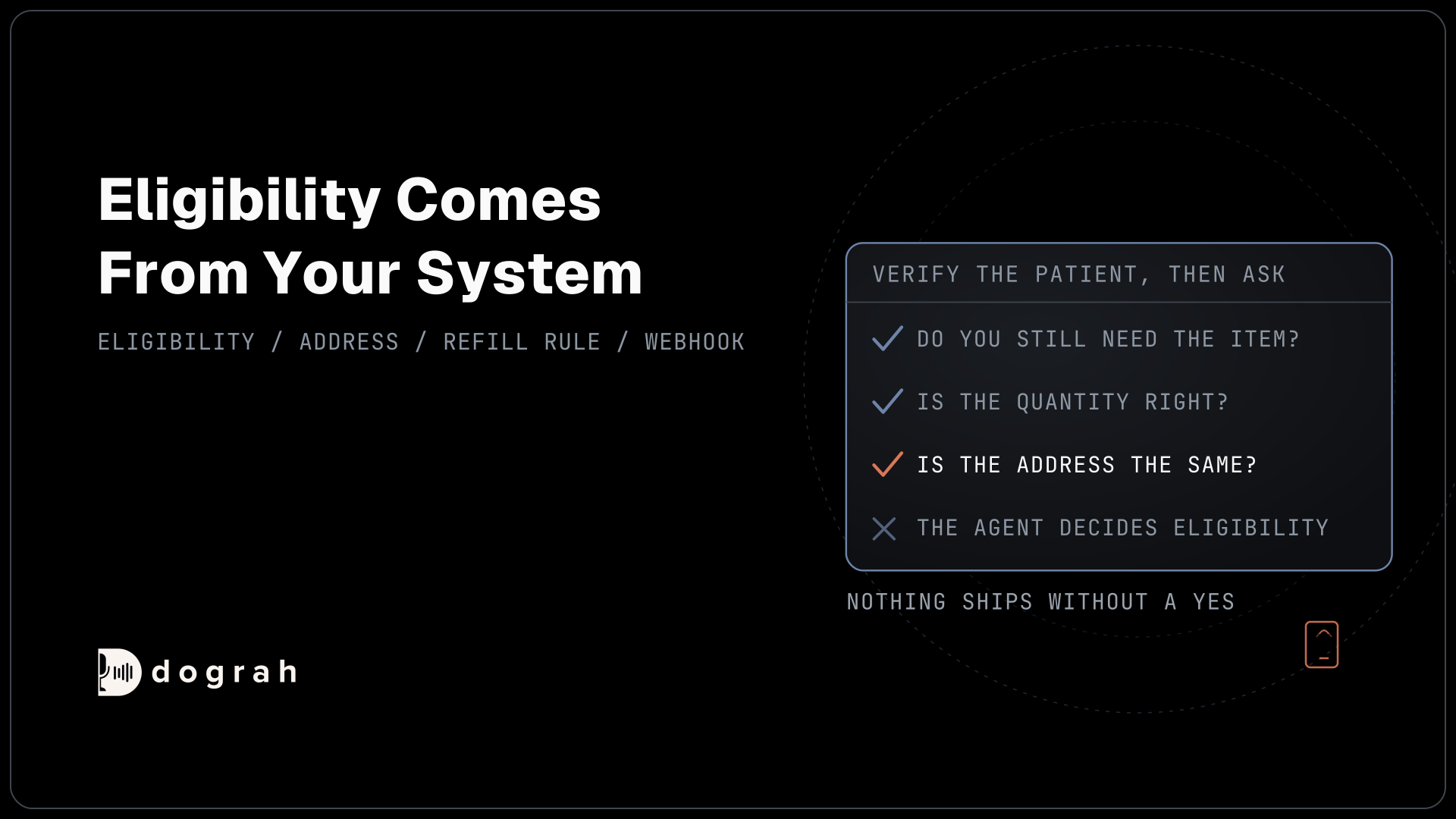
So the hospital's system starts the call through the API Trigger, or a Campaigns list built from tomorrow's schedule, and passes the case reference. When the call connects, Pre-Call Data Fetch, set to Outbound calls only at the bottom of the Start Call node, asks your endpoint for that patient's current instructions. If the endpoint is slow, the agent fetches them with an HTTP API tool instead. Nothing about the procedure is written into the prompt.
The staff time at stake is real. Bausch + Lomb, which is launching a pre-op calling agent for cataract surgery, told Healio that each staff education call takes 30 to 60 minutes, by the company's own estimate.
Greet, verify, then name the procedure
A procedure date is protected health information (PHI), so the agent says nothing about it until it knows who is on the line. Write the Greeting Text to name the hospital, say the patient is speaking with an automated assistant and ask for the patient; Dograh plays exactly what you write. It plays the moment the call connects, before anyone is verified, so it never carries the procedure, the date or a fasting time.
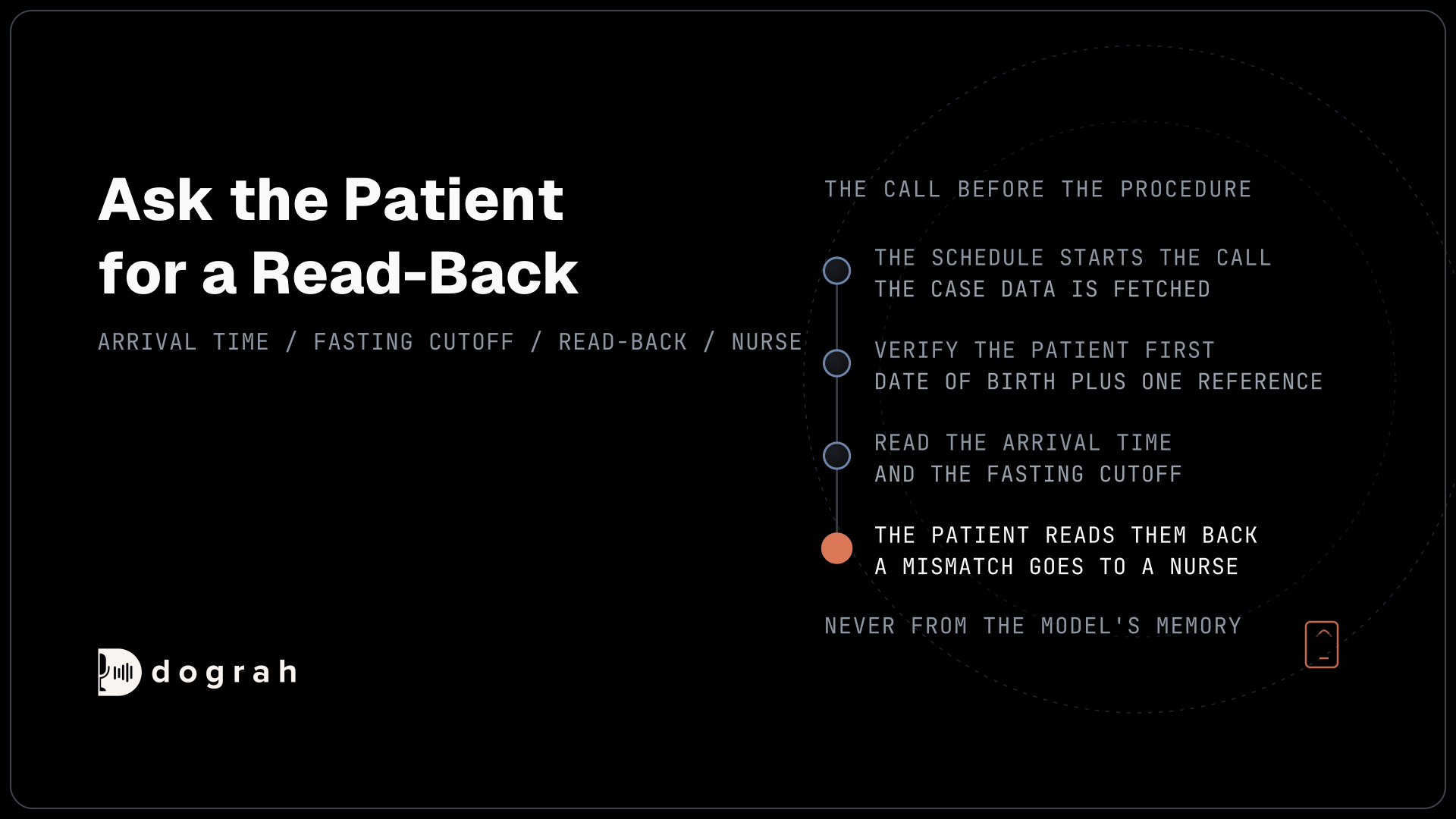
Then the agent verifies with the date of birth plus one reference the patient will know, such as the first line of the address. A phone number finds the record; it does not prove who answered. A spouse or carer may pick up, and if the patient has named them as a contact, your system can say so in the fetched data. Otherwise the agent asks for the patient.
Only after verification does it disclose: the procedure date, the arrival time and the place to report to. If nobody picks up, the agent leaves no instructions on voicemail. It leaves the hospital's callback number and a toll-free opt-out number, or no message at all.

Open Source Alternative to Vapi / Retell
Self-hosted voice agent platform — no per-minute fees
dograh-hq/dograh
Star on GitHub
Read back the arrival time and the fasting cutoff
The agent speaks the per-patient instructions in its own words from your data, and that wording is not guaranteed. In Dograh, exact wording holds only in fixed text: the Greeting Text, a pathway's Transition Speech or a recorded clip. Transition Speech cannot carry per-patient details, and the Greeting Text plays before verification. Inside a node, the model generates the sentence. Our post on Prompt and Flow Design Patterns for Reliable Voice Agents explains why a prompt cannot promise a phrase.
The read-back is the check that makes up for it. After giving the instructions, the agent asks the patient to say back two things: what time they arrive, and when they stop eating and drinking. If either answer does not match the record, the agent repeats that instruction once and asks again. If it still does not match, the call is marked for a nurse. The same applies to anything the patient must bring or arrange, such as a driver home.
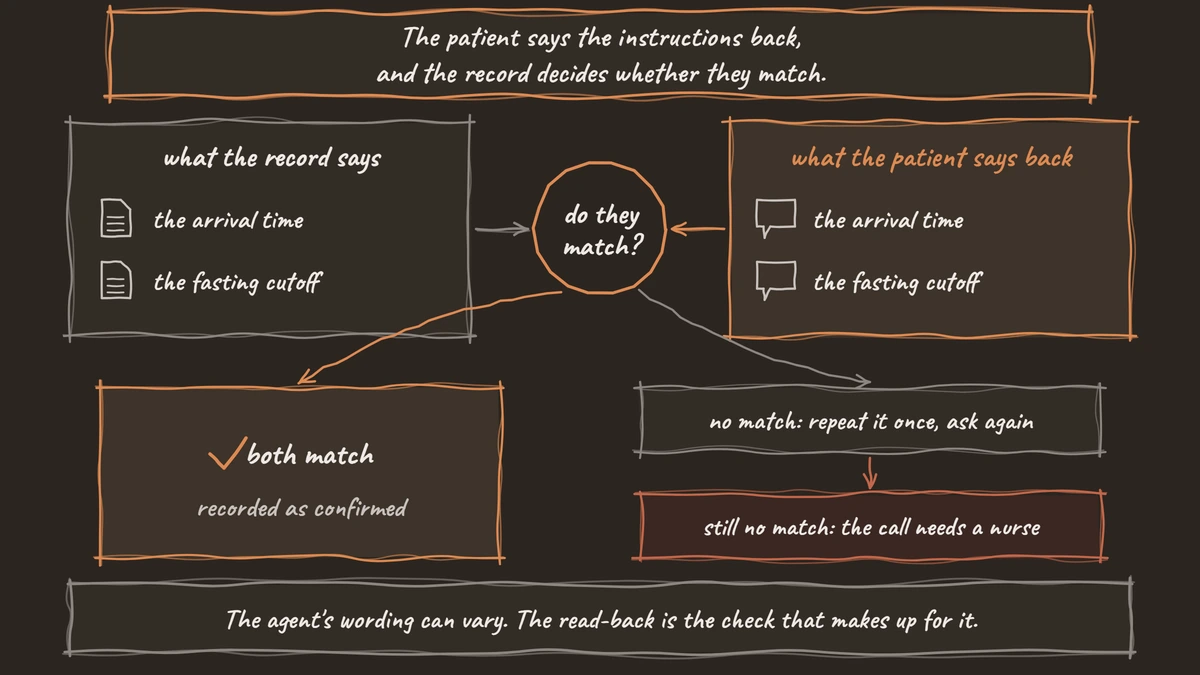
The agent then records one outcome as the patient stated it: confirmed, has questions, or needs a nurse. Extraction is an AI step, so the transcript and the recording remain the exact record a nurse checks.
What the evidence says: most calls still need a nurse
The best evidence on these calls says to design for handoff. A Mount Sinai team published a pilot of an AI pre-procedure calling agent in the European Heart Journal, Digital Health. Between January and April 2025, the agent placed 806 calls to 701 patients before cardiac catheterization, and registered nurses reviewed the calls.
| Outcome of the 806 calls | Share |
|---|---|
| Fully automated, no nurse callback needed | 36.6% |
| Needed a quick, protocol-defined clarifying call | 37.7% |
| Converted to a human call | 12.2% |
| Did not reach the end (7.7% patient-related, 6.0% AI system errors) | 13.6% |
Fewer than four in ten calls needed no nurse at all. That is still most of the routine work taken off the nurses' list, and it is the right expectation to set. Plan staffing for the clarifying calls from day one.
The calls also fix only part of the problem. A two-cycle audit at a UK day surgery unit, presented at the Day Surgery UK conference, added pre-operative confirmation calls among other changes. In its second cycle, July to December 2025, most of the 109 same-day cancellations came from causes no call can prevent, such as acute illness.
Join the Dograh Community
Dograh is an OSS alternative to Vapi. Join our Slack community for queries, releases, best practices & community interactions.
Questions about the procedure go to clinical staff
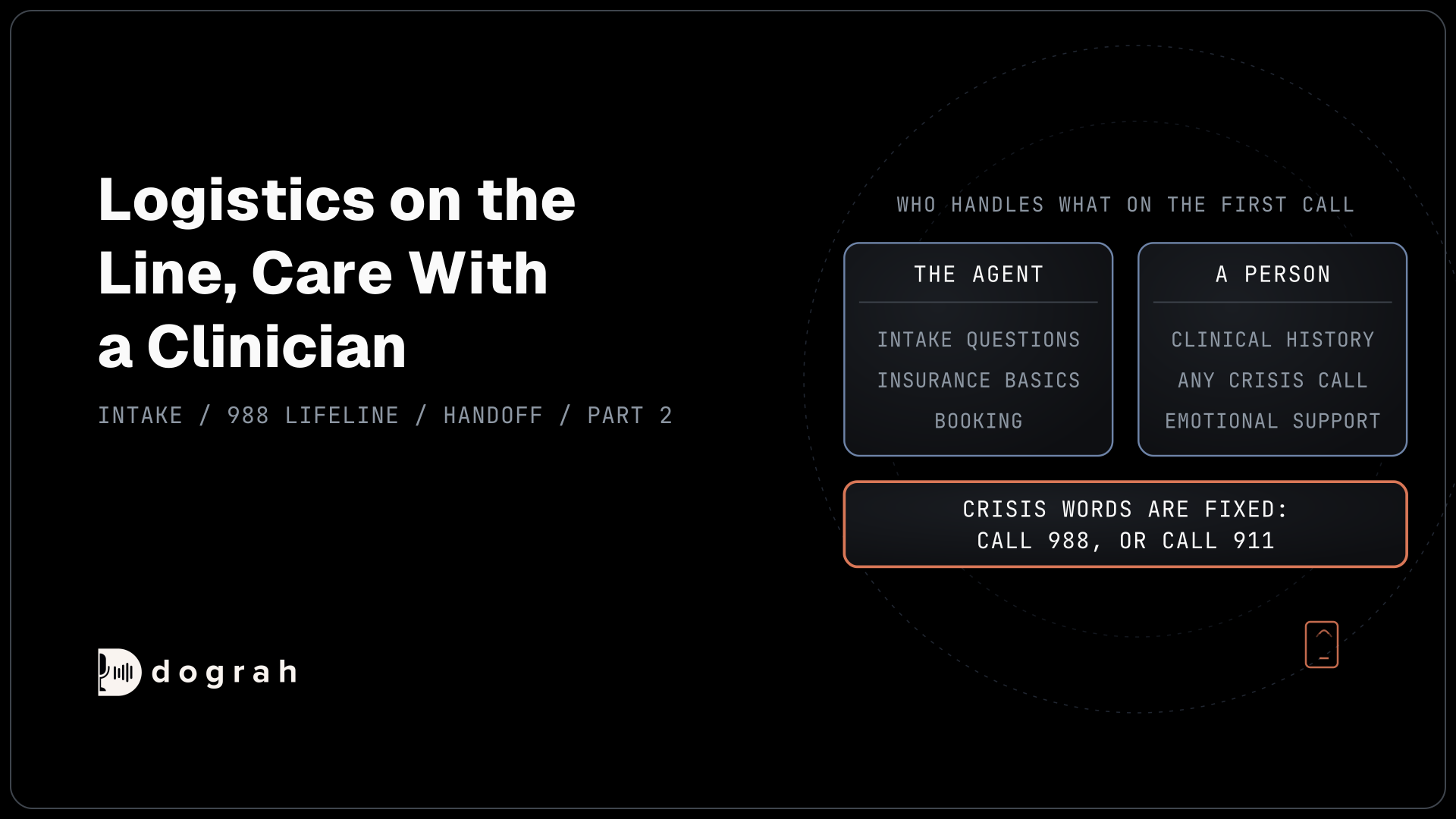
The agent never answers a clinical question. "Should I still take my blood pressure tablet that morning?" sounds simple, and it is a clinical decision. The agent records the question, says a nurse will answer it, and routes the call.
Write the details to your system through an HTTP API tool first, then use Transfer Call to reach the pre-op nurse line. Transfer Call works on Twilio only and passes no summary, so the record on the nurse's screen is what tells them why the patient is calling. The transfer waits 30 seconds by default, settable from 5 to 120. If nobody answers, the patient stays with the agent, which offers a nurse callback and writes the request to your system. There is no built-in callback task, so the prompt covers that step.
If the patient describes something urgent, such as chest pain, the emergency pathway plays a fixed instruction to call 911, through Transition Speech or a recorded clip. The pillar's section on what the agent may say covers how to set that up. Choosing the pathway is still the model reading a written condition, so keep the list of phrases short and test it.
Before launch: calling rules, saving answers and a first pilot
Pre-operative instructions are one of the purposes the FCC's healthcare exemption names for calls to a patient's mobile, with limits on length, frequency and content that the guide's consent section sets out. The opt-out is by voice, and a yes is written to your system at once.
After the call, a webhook writes the outcome, the read-back result and any question to the patient's case. A temporary failure is retried automatically, up to five attempts. Patients marked "has questions" or "needs a nurse" become the nurses' call list for the afternoon. The pattern mirrors reminder calls, covered in Healthcare No-Show Reduction: Why AI Voice Agents Beat Reminders. The call after the procedure is in AI voice agents for post-discharge follow-up.
Run quality assurance (QA) on a sample of calls, and read every call where the read-back failed. Dograh is the orchestration layer: it runs the call flow, tools and phone line, while the speech and language models are a separate layer you choose. Self-host Dograh and the models, and procedure instructions and answers stay on your own servers; with hosted models, each provider needs its own business associate agreement (BAA). Self-hosted Dograh has no per-minute platform fee, though servers, model keys and phone minutes still cost money; Dograh Cloud has a 1¢-a-minute platform fee. Start with one procedure type whose instructions are already structured in your system, and widen only when the clarifying-call rate is one your nurses can absorb.
Glossary
- Read-back
- Asking the patient to repeat the key instructions, here the arrival time and the fasting cutoff, so a mismatch with the record is caught on the call rather than on the day of surgery.
- Pre-Call Data Fetch
- A Dograh setting at the bottom of the Start Call node that asks your endpoint for fresh data when the call connects. Set to Outbound calls only, it loads the patient's current instructions before the agent speaks.
- Clarifying call
- A short follow-up call from a nurse after the automated call, used when the patient had a question or the read-back did not match. In the Mount Sinai pilot, 37.7% of calls needed one.
- Same-day cancellation
- A procedure cancelled on the day it was due, after the theatre slot and staff were already committed. Some causes, like a missed fasting rule, are avoidable; others, like acute illness, are not.