
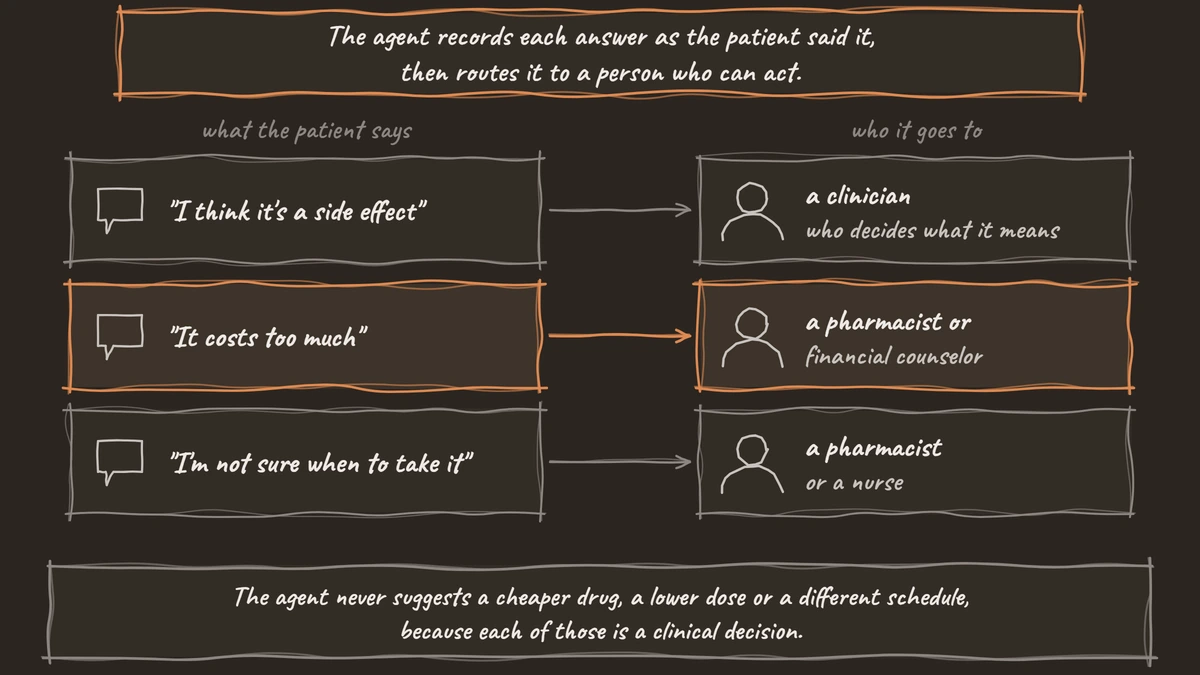
AI voice agents for medication adherence call patients to ask whether they are taking a medication as prescribed, whether they have side effects and what gets in the way. They record the answers as the patient stated them, send side effects to a clinician and cost problems to the right staff, and never advise on dosing.
Key Takeaways
- The call records what the patient says; it does not measure adherence.
- Side effects go to a clinician. The agent never advises on dosing.
- Ask if cost stops the patient taking a medicine, then route it to staff.
This post is part of our guide to AI voice agents for hospitals and health systems. The guide's section on patient calls after a visit sets the scope: ask whether the patient is taking the medication and what gets in the way, record the answers as stated, and never advise on dosing. Here is that call in Dograh, an open-source, self-hostable voice agent platform, from the medication list to the clinician handoff.
What this call is for, and what it is not
An adherence call asks whether the patient is taking the medicine, not whether they collected it. Those are different problems. Refill timing at the pharmacy has its own call, covered in AI Voice Agents for Prescription Refill Reminders in Pharmacy. This call starts once the patient has the medication at home.
Be honest about what the call measures. It records what the patient says. A patient who says "yes, every day" may be right, mistaken or polite, so the call gives you self-reported adherence, not verified adherence. That is still useful. A "sometimes" or a "no" is a lead a clinician would otherwise never hear, and the call can reach every patient on a program, not only those a nurse has time for. Staff who make these calls by hand today keep their time for the patients who answer no.
Verify before naming any medication
A medication name is protected health information (PHI). Many medicines point straight at a condition, so naming one to the wrong person discloses a diagnosis. The agent therefore names nothing until it knows who is on the line.
The care program's system starts the call through the API Trigger or a Campaigns list. Write the Greeting Text to name the provider and say the patient is speaking with an automated assistant; Dograh plays exactly what you write. It plays the moment the call connects, before verification, so it never names a medicine, a condition or a pharmacy. The agent then verifies with the date of birth plus one reference, such as the first line of the address. A phone number finds the record; it does not prove who answered.
Only then does the agent use the medication list. Pre-Call Data Fetch, set to Outbound calls only at the bottom of the Start Call node, can load it into the call's data when the call connects, or an HTTP API tool can fetch it after verification. Either way, the agent speaks none of it before the patient is verified. The names, strengths and schedules come from the record, never from the model. The agent reads each medication's name from the record and asks about it in turn.
Three questions: taking it, side effects, barriers
The call asks three things about each medication, and records each answer as the patient stated it.
First, is the patient taking it as prescribed? The answer is recorded as yes, sometimes or no, in the patient's words. The agent does not quiz the patient on the dose or check it against the label, because a discrepancy found that way needs a clinician to interpret.
Second, has the patient noticed anything they think might be a side effect? The agent records what the patient describes and never judges whether it is one. That decision belongs to the clinician, and the next section covers the handoff.
Third, what gets in the way? Cost, confusion about when to take it, trouble getting to the pharmacy, or worry about the medicine itself. Each answer is an extracted variable. Extraction is an AI step, so the transcript and the recording remain the exact record a clinician checks.
Confusion is routed differently from cost. A patient who is unsure when or how to take a medicine goes to a pharmacist or nurse. Explaining a schedule is clinical advice when the agent does it, even if it reads the schedule from the record.

Open Source Alternative to Vapi / Retell
Self-hosted voice agent platform — no per-minute fees
dograh-hq/dograh
Star on GitHub
Ask whether cost stops the patient taking the medicine
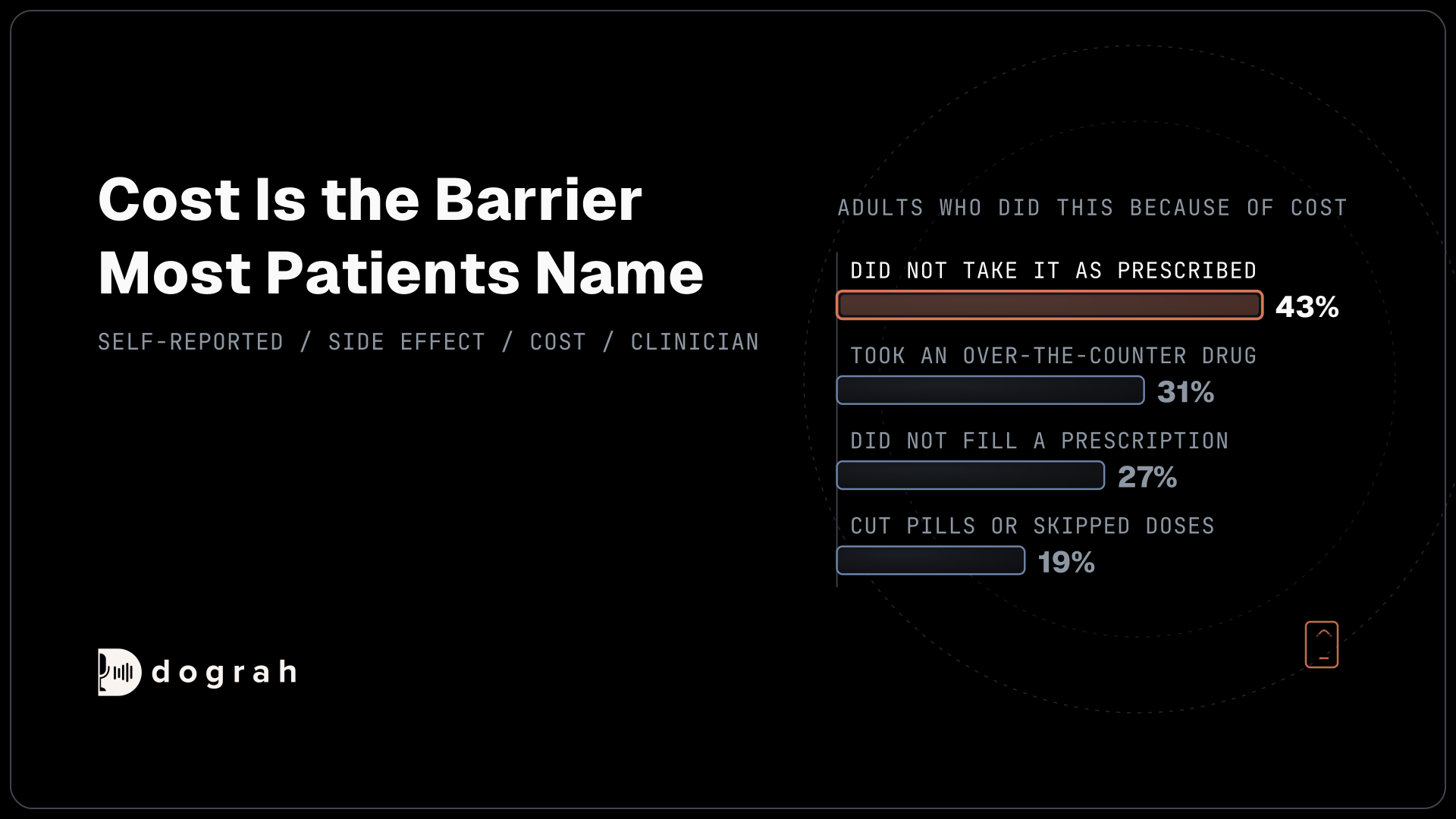
Cost is the barrier most patients will name. Not taking a medicine as prescribed because of its price is called cost-related non-adherence, and the data on it is plain. In the KFF Health Tracking Poll fielded from February 24 to March 2, 2026, 43% of adults said they had not taken a medication as prescribed in the past year because of the cost. 27% had not filled a prescription, 31% took an over-the-counter drug instead and 19% cut pills in half or skipped doses. Among adults with household incomes under $40,000, about half (52%) had done at least one of those three things.
So ask directly whether cost is getting in the way, and route the answer. The agent records that cost is the barrier and passes it to the people who can act: a pharmacist, a financial counselor or the staff who run assistance programs. It never suggests a cheaper drug, a lower dose or a different schedule, because each of those is a clinical decision.
On an outbound call made under the FCC's healthcare exemption, the agent also says nothing about prices, payments or balances. The rule allows no financial content on those calls. Recording "cost is a problem" for a person to follow up is the whole job.
Side effects go to a clinician
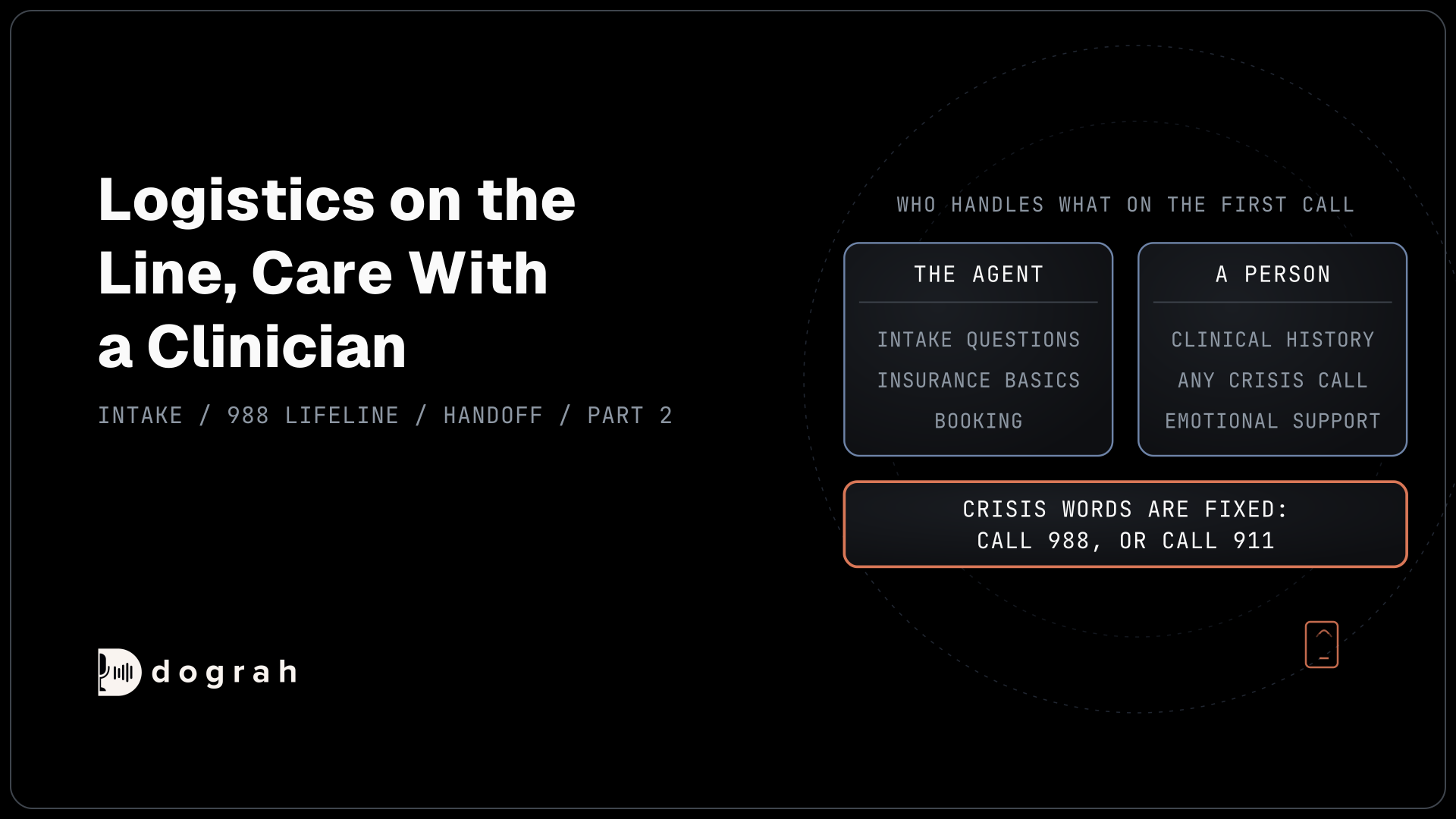
When a patient describes something they think is a side effect, the agent neither reassures nor alarms. It never says "keep taking it" and never says "stop taking it". Both are dosing advice.
Write first, then hand over. The agent writes what the patient said to the record through an HTTP API tool, then uses Transfer Call to reach the clinician line. Transfer Call works on Twilio only and passes no summary, so the record the agent just wrote is what the clinician sees on screen. The transfer waits 30 seconds by default, settable from 5 to 120. If the transfer is not answered, the patient stays with the agent, which says a clinician will call back and writes a callback request to the clinic's system through an HTTP API tool.
If the patient describes something urgent, such as trouble breathing, the emergency pathway plays a fixed instruction to call 911, through Transition Speech or a recorded clip. Choosing that pathway is the language model reading the pathway's written condition, so keep the phrase list short and test it.
Join the Dograh Community
Dograh is an OSS alternative to Vapi. Join our Slack community for queries, releases, best practices & community interactions.
Before launch: who follows up, calling rules and a first program
An agent can find the patients who are struggling. It cannot do the work that helps them. In a PharmExec opinion piece, Michael Oleksiw argues that adherence often breaks on fear and loneliness, and that AI should flag patients at risk while people do the supporting. That is the right split. The agent's job is to reach every patient on the list and route the "sometimes", the "no" and the side effect to a person the same day.
Whether an outbound adherence call fits the FCC's healthcare exemption depends on its purpose, so check it against the rule's list of purposes, quoted in full in the guide's consent section, and confirm with counsel. Opt-out is by voice. A webhook writes the answers to the record after the call, and a temporary failure is retried automatically, up to five attempts. Patients who prefer Spanish can take the same call in Spanish, covered in Spanish AI voice agents for healthcare.
Run quality assurance (QA) on a sample of calls, and read every call where a side effect was reported. Dograh is the orchestration layer: it runs the call flow, tools and phone line, while the speech and language models are a separate layer you choose. Self-host Dograh and the models, and medication names and answers stay on your own servers; with hosted models, each provider needs its own business associate agreement (BAA). Self-hosted Dograh has no per-minute platform fee, though servers, model keys and phone minutes still cost money; Dograh Cloud has a 1¢-a-minute platform fee. Start with one chronic-care program whose medication list is already structured, and the medication questions in AI voice agents for post-discharge follow-up can reuse the same flow.
Glossary
- Self-reported adherence
- Whether a patient says they take a medication as prescribed. It is what an adherence call can record, and it can differ from what the patient actually does, so treat it as a lead for a clinician.
- Cost-related non-adherence
- Not taking a medication as prescribed because of what it costs, by skipping doses, splitting pills, delaying a fill or substituting another drug. 43% of US adults reported it in a 2026 KFF poll.
- Clinician line
- The phone line the agent's Transfer Call reaches when a patient reports a possible side effect. The agent writes the details to the record first, because the transfer passes no summary.
- Medication list
- The medications, strengths and schedules in the patient's record, fetched after verification. The agent reads names from it and never adds, changes or explains a medication.