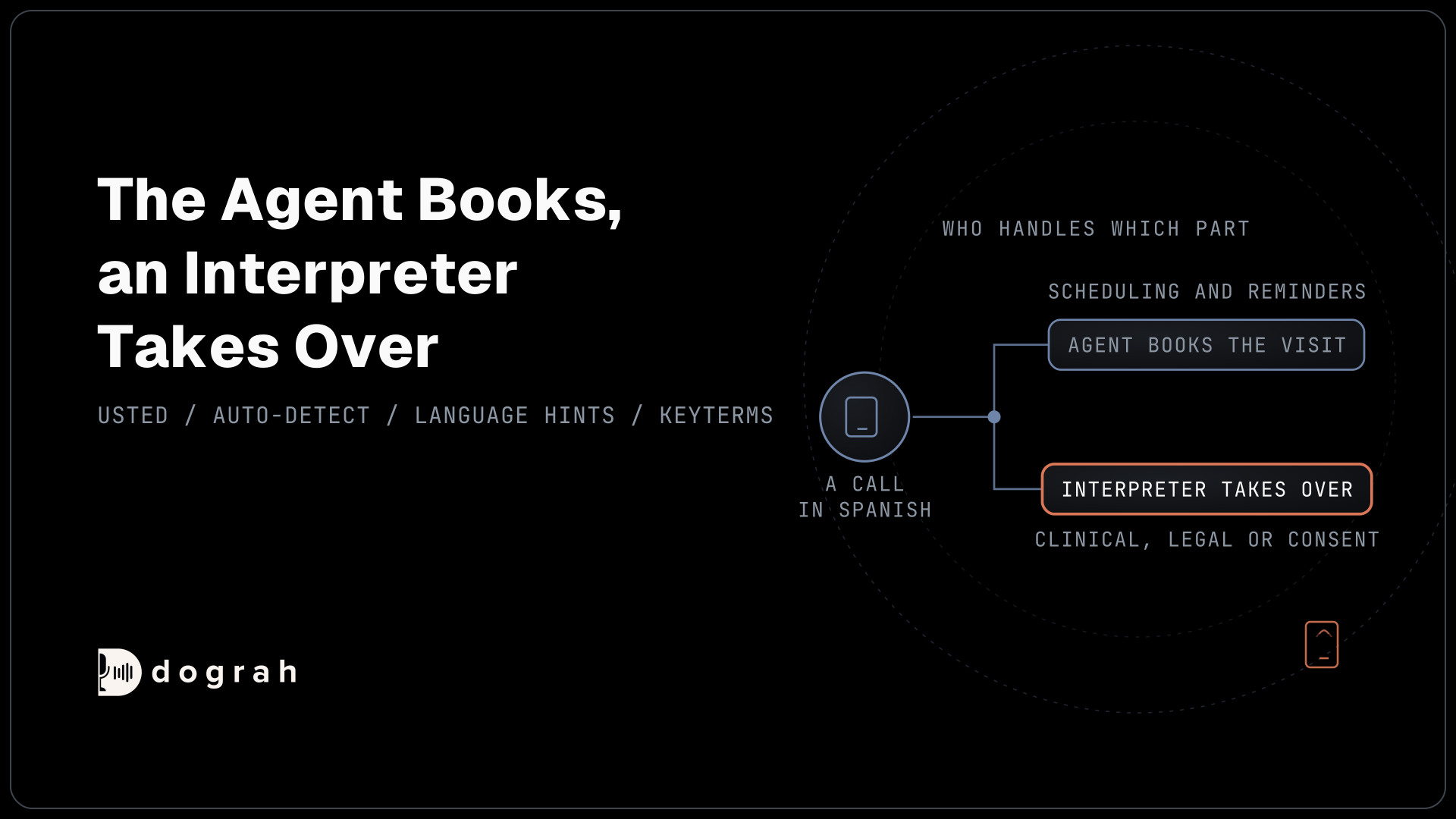

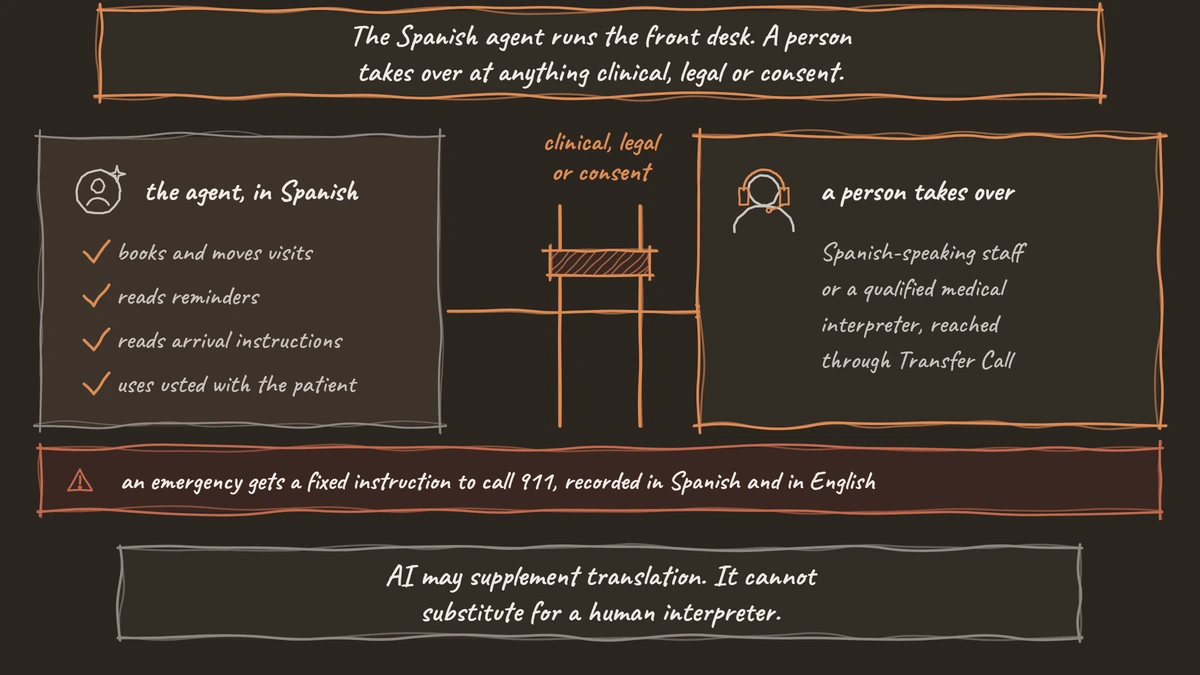
Spanish AI voice agents for healthcare handle scheduling, reminders and routine follow-ups in Spanish for US patients, and follow a patient who switches between Spanish and English on the same call. They stay on administrative calls. Clinical, legal and consent conversations go to Spanish-speaking staff or a qualified human interpreter.
Key Takeaways
- Keep the agent on administrative calls. Clinical questions need a qualified interpreter.
- Multilingual auto-detect with Spanish and English hints follows a mid-call switch.
- QA summaries come out in English by default, so plan your review.
This post is part of our guide to AI voice agents for hospitals and health systems. The guide's last section covers language: the same patient calls in Spanish, with switching between Spanish and English on one call. This post is the language-access layer for those calls, written for US providers using Dograh, an open-source, self-hostable voice agent platform, and it is not a translation of the English posts.
Why practices need a Spanish phone line
Spanish-speaking patients are a large share of many US practices' callers, and an English-only phone line fails them before the first question. The Census Bureau's 2024 American Community Survey language table counts about 45 million people who speak Spanish at home, and about 18 million of them speak English less than very well. Those figures were measured in 2024.
Pew Research Center puts the US Hispanic population at 70.1 million as of July 2025. Hispanic origin is not the same as speaking Spanish, so use Pew's number to size the community and the Census figure to size the caller list. The 18 million who speak English less than very well are the patients for whom a Spanish line changes whether the call works at all.
The calls themselves are the ones the rest of this guide describes: booking, reminders for visits already booked, as in Healthcare No-Show Reduction: Why AI Voice Agents Beat Reminders, and routine follow-ups. What changes in Spanish is the verification script and the line the agent must not cross.
The agent's job ends where an interpreter's begins
A Spanish voice agent is a front-desk tool, and federal guidance treats it that way. The California Health Care Foundation's March 2026 report on AI and language access sums up federal guidance in one line: the Department of Health and Human Services (HHS) "has clarified that AI may supplement translation workflows and cannot substitute for a human interpreter in clinical, legal, or consent-related contexts", while leaving flexibility for administrative uses. The same report found that pilots showed gains "when AI tools are paired with structured human oversight".
The federal language-access rule under Section 1557 of the Affordable Care Act sets the floor. 45 CFR 92.201(a) says a covered entity "must take reasonable steps to provide meaningful access to each individual with limited English proficiency". A voice agent that books a visit in Spanish helps with that. It does not replace the interpreter you still need for the visit itself.
So the agent's scope is narrow by design. It books and moves visits, and it reads reminders and arrival instructions from your system. When the patient asks anything clinical or reaches a consent form or a billing dispute, the agent hands the call to Spanish-speaking staff or a qualified medical interpreter through Transfer Call on Twilio. An emergency gets a fixed instruction to call 911, recorded in Spanish and in English, played once the emergency pathway is chosen. Outbound reminder calls in Spanish meet the same Federal Communications Commission (FCC) healthcare exemption as English ones, and the guide's consent section sets out its limits.
Verification and wording in Spanish
The call still runs greet, verify, disclose, and the verify step needs its own Spanish script. The greeting names the practice and says, in Spanish, that the patient is speaking with an automated assistant. Address the patient as usted. Then confirm the date of birth plus one more detail, such as the appointment date, before the agent names any visit or medication.
Dates and names are where Spanish verification breaks. Spanish speakers say the day before the month, so the agent reads a date back in full words, "quince de marzo", rather than as digits that could mean two different days. Many patients carry two surnames, and your record may hold one or both, so the prompt tells the agent to accept either before it fails the check. Add provider names and common medication names to Dograh's keyterms, its custom dictionary, so speech-to-text hears them as words it knows.
Instructions need the same care. If your system stores arrival or preparation instructions only in English, the agent would be translating them live, and the language-access rule is wary of exactly that. Under 45 CFR 92.201(c)(3), when machine translation is used for text that is critical to a patient's access or where accuracy is essential, "the translation must be reviewed by a qualified human translator". Generally, the safer design is to store Spanish versions a translator has checked and have the agent read those.

Open Source Alternative to Vapi / Retell
Self-hosted voice agent platform — no per-minute fees
dograh-hq/dograh
Star on GitHub
Following a patient who switches language
Bilingual patients switch mid-sentence, and the agent has to follow without restarting the call. In Dograh, set speech-to-text to Multilingual (Auto-detect) and tick English and Spanish under Language hints. Spanish also works on Dograh's speech-to-speech option (Gemini Live), and Dograh supports 70+ languages. Text Transition Speech doesn't play on speech-to-speech models, so use a recorded clip for fixed wording there. The hints bias recognition towards both languages. They do not guarantee it, so a patient who answers in Portuguese is still a case to plan for.
The prompt tells the agent to answer in the language the patient is using, and the voice has to speak both, since the default voice is English-only. When the agent is unsure which language it heard, it asks a short question offering both, switches only when the patient confirms, and otherwise transfers to a Spanish-speaking person. If no one is free, it collects only what it needs and writes a callback request in the patient's language to your system.
Speech models verified for Spanish
Name a speech provider for a Spanish line only after reading its own language page. Deepgram's Nova-3 lists Spanish as es and es-419 and offers a multilingual mode that includes Spanish, and Google's speech-to-text lists es-US among its telephony languages. For open-weight speech-to-text on your own servers, Whisper and NVIDIA's Parakeet TDT 0.6B v3 both cover Spanish. ElevenLabs and Cartesia list Spanish voices, and Chatterbox Multilingual and Kokoro are open options with Spanish voices.
None of these providers claims medical vocabulary accuracy in Spanish, so do not assume it. The full list, with what each model can and cannot do, is in Spanish AI Voice Agents for Logistics and Delivery: What Changes in Spanish.
Join the Dograh Community
Dograh is an OSS alternative to Vapi. Join our Slack community for queries, releases, best practices & community interactions.
Test and review with Spanish-speaking staff
The only honest test is a phone call with Spanish speakers reading real details. Most phone calls reach the agent as 8 kHz audio, while a browser test runs at 16 kHz, so test from a mobile. Ask staff from different regions to say a date of birth and a medication name, and check the extracted values against the recording.
Review needs a plan too. Dograh's quality assurance (QA) node scores each step of a sample of calls, and its summaries come out in English by default. A Spanish-speaking reviewer should still read the Spanish transcripts of flagged calls, because an English summary can smooth over a misheard name.
The data question is the same as in English. Self-hosting Dograh puts recordings and transcripts on your own servers, and running the speech models there too, as in Running Voice AI on Local, Self-Hosted Models, keeps the audio in-house. Self-hosting also means no business associate agreement (BAA) with Dograh is needed. Model providers used by API key still need their own BAA unless the models also run on your servers, and the phone carrier may need one, depending on what it stores. Self-hosted Dograh has no per-minute platform fee, though servers, model keys and phone minutes still cost money, and Dograh Cloud has a 1¢-a-minute platform fee. Start with the booking calls described in AI voice agents for patient appointment scheduling, in Spanish, before any follow-up call.
Glossary
- Limited English proficiency
- The federal term for people who do not speak English as their primary language and have a limited ability to read, write, speak or understand it. Section 1557's language-access rule protects them.
- Qualified interpreter
- A person who has shown they can interpret accurately and impartially in a medical setting. AI may support administrative calls but is not a substitute in clinical, legal or consent conversations.
- Language hints
- Dograh's transcriber setting that biases multilingual auto-detect towards the languages you tick, such as English and Spanish. It narrows the guess; it does not exclude other languages.
- Keyterms
- Dograh's custom dictionary of words the speech-to-text should listen for, such as provider and medication names.