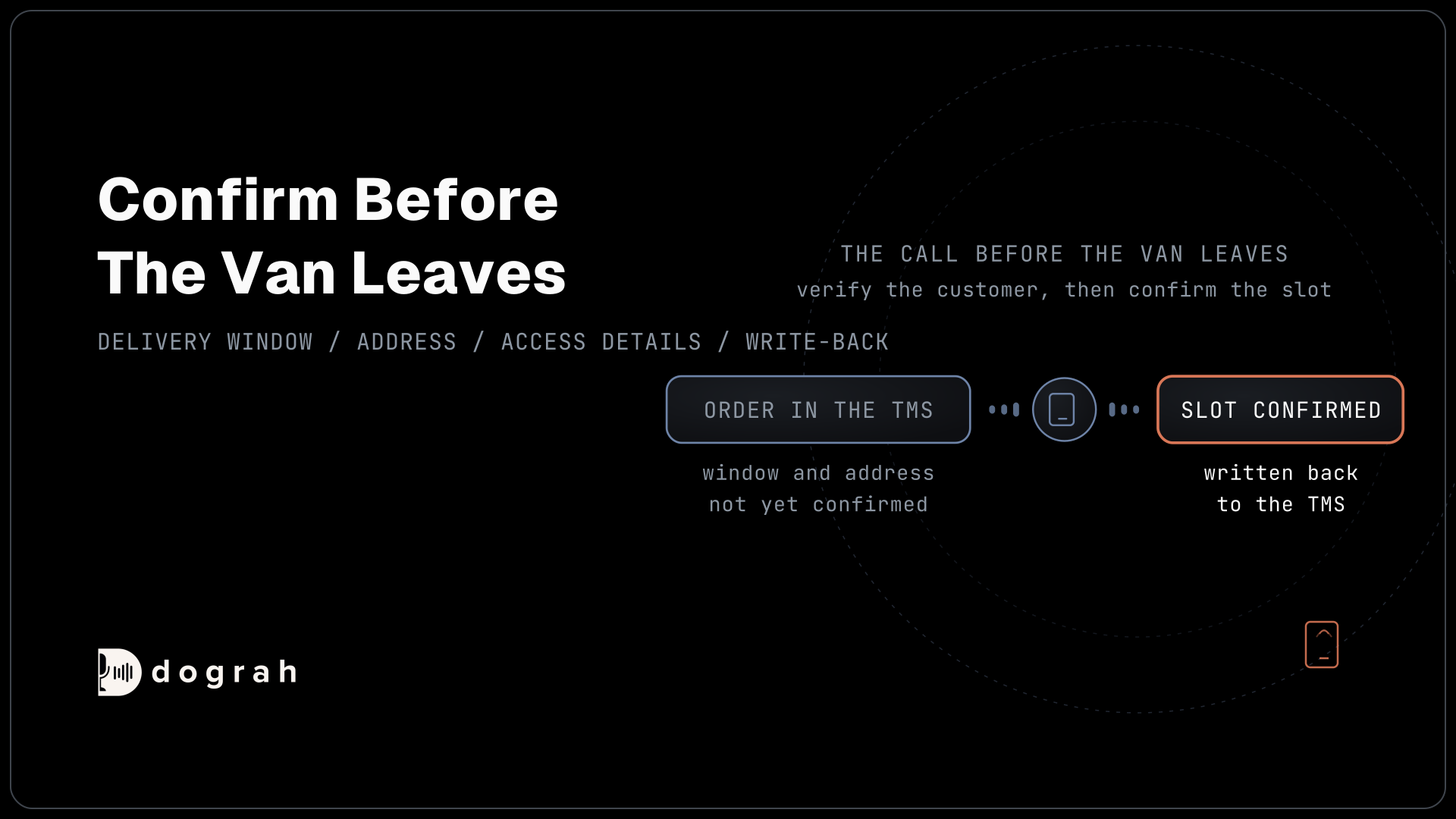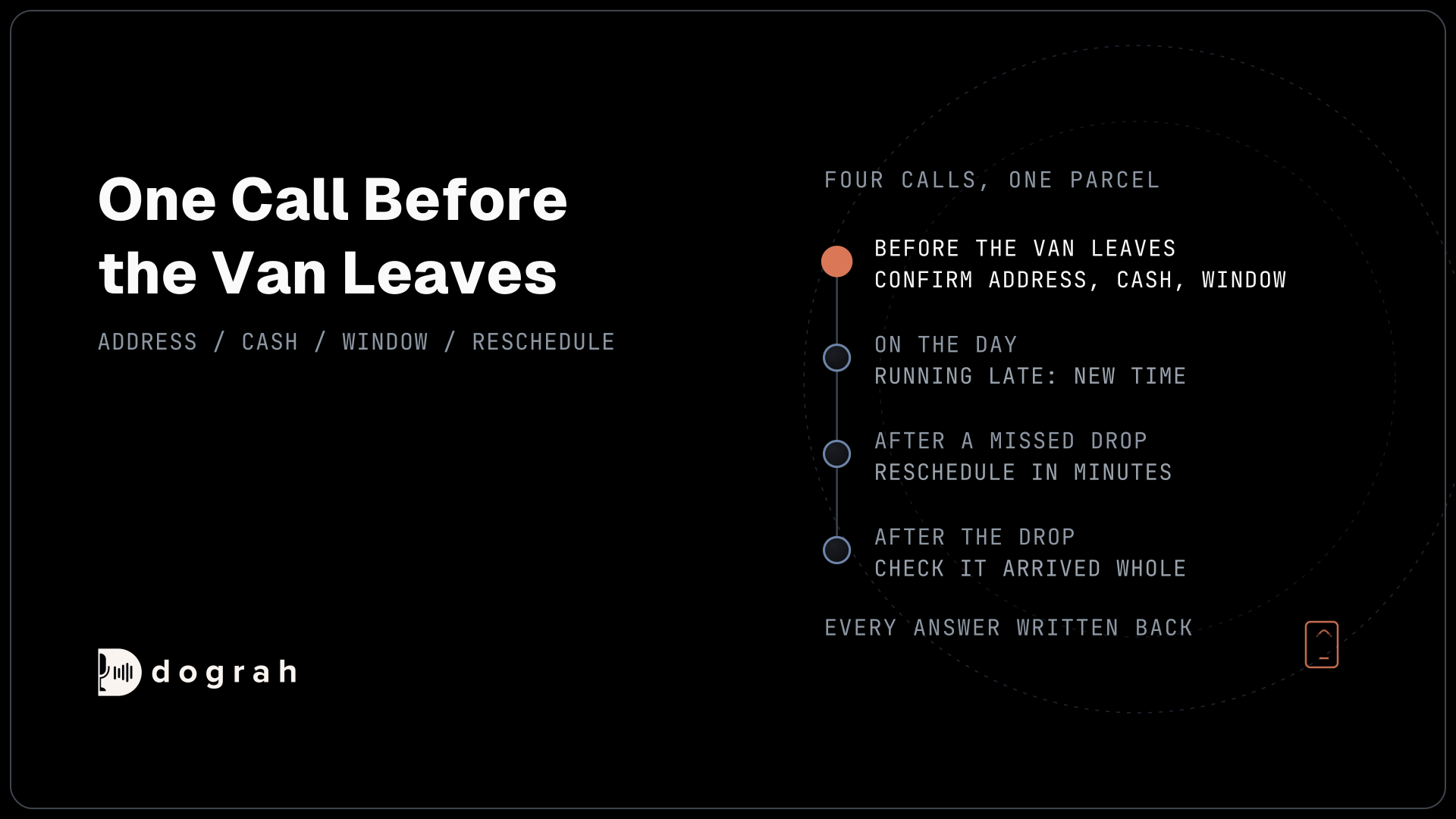

A Spanish AI voice agent for logistics and delivery handles order status, delay alerts and rescheduling in Spanish, verifies the caller in Spanish before it shares any detail, and follows a caller who switches to English when speech-to-text runs in multilingual auto-detect with Spanish and English hints. It uses only speech models whose Spanish support is verified.
Key Takeaways
- Verification wording, numbers and addresses change first. The call flow does not.
- Auto-detect with Spanish and English hints follows a switch, but hints only bias.
- Pick a Spanish voice and a Spanish-verified speech model, or the first address fails.
This post is part of our guide to AI voice agents for logistics and delivery. The guide's closing section covers language: the same calls with different verification wording, numbers and addresses, mid-call switching through multilingual auto-detect, and only verified Spanish speech models named. This post is that section in full, not a translation of the English clusters. In Dograh, an open-source, self-hostable voice agent platform, most of what changes is a transcriber setting and a voice choice.
Who is on the other end of the line
A delivery line that only speaks English fails a large share of its callers before the first question. The Census Bureau's 2024 American Community Survey language table counts about 45 million people in the United States who speak Spanish at home, and about 18 million of them speak English less than very well. For those 18 million, an English-only agent cannot verify identity reliably, cannot be sure the new delivery window was understood, and cannot tell a complaint from a question.
The Spanish-speaking parcel market is large in its own right. AMVO's Estudio de Venta Online 2026 puts Mexican retail e-commerce at 941 billion pesos in 2025, up 19.2%, with 77.2 million digital buyers. Asked what annoys them most about delivery, 45% of its online panel said an incomplete order, 38% a damaged one and 33% a missed delivery time. In Spain, the regulator CNMC reports that e-commerce turnover passed 114.8 billion euros in 2025, up 20.6% on the year before.
The calls themselves are the ones the rest of this guide describes. An agente de voz IA logística answers order status in logistics, places delivery delay and exception alerts and runs the reschedule from AI Voice Agent for Failed Delivery Rescheduling: The 2-Hour Rule. What changes is below.
Verification wording changes before anything else
The call still runs greet, verify, disclose, and the verify step is where Spanish needs its own script rather than a translation. Address the caller as usted until they switch to tú themselves. Confirm identity with something the caller knows, such as a date of birth or the last digits of the order number or the phone number on the account, before the agent names an address, a parcel or a delivery window. A phone number finds the record. It does not prove who is calling.
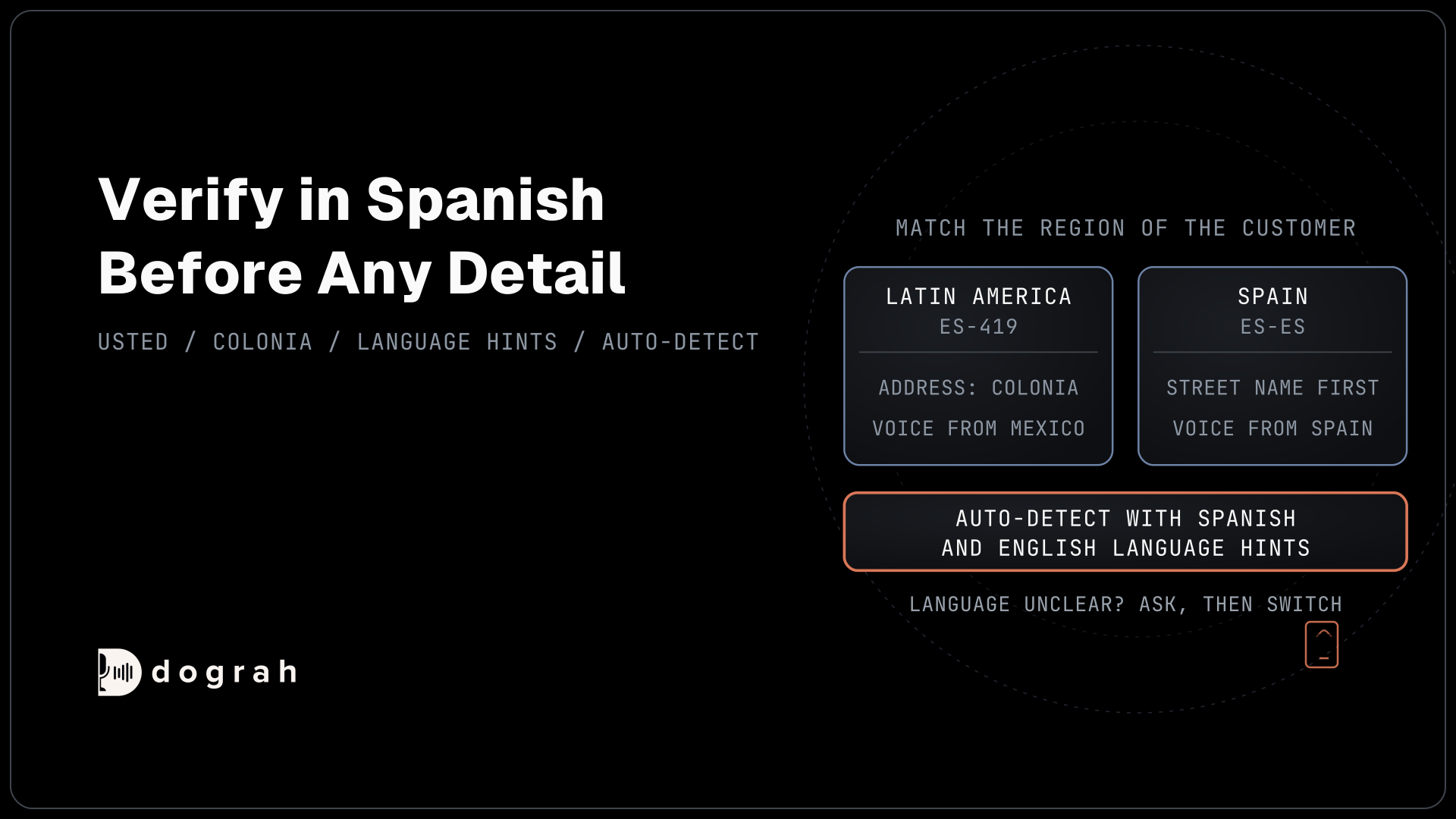
Numbers and addresses are where Spanish calls break, so the script controls how they are spoken. Spanish speakers give long numbers in pairs, so the agent reads a tracking number back in pairs too and asks "correcto?" after each group. A Mexican address has a colonia and a codigo postal that an English-trained agent will mangle, and a Spanish address puts the street type first. Put street names, colonias, depot names and carrier names in the agent's dictionary so the speech-to-text hears them as the words they are. One more constraint shapes everything: most phone calls reach the agent as 8 kHz audio, which makes recognition harder than the 16 kHz browser demo, so every read-back earns its place.
For outbound calls, the customer's consent is captured at order or sign-up in whatever language the order was placed, and the post on US consent rules for delivery calls covers the US side.

Open Source Alternative to Vapi / Retell
Self-hosted voice agent platform — no per-minute fees
dograh-hq/dograh
Star on GitHub
Following a caller who switches language mid-call
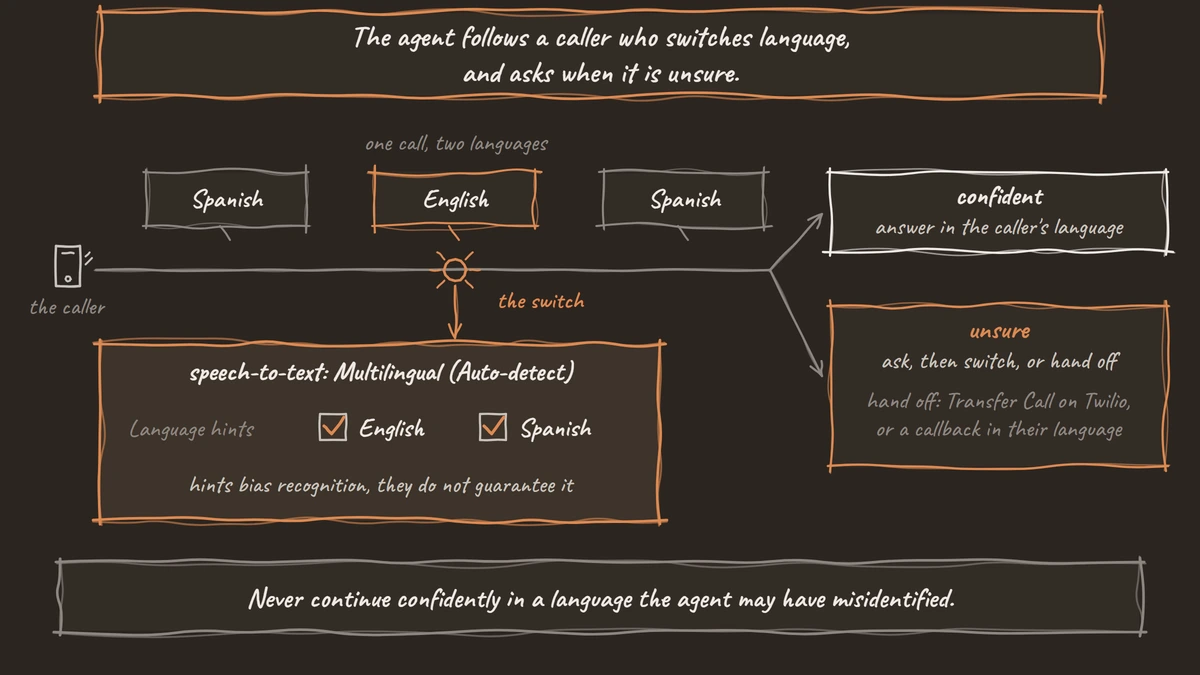
Callers switch languages without warning, and the agent has to follow without resetting the call. In Dograh, this is a transcriber setting. Set speech-to-text to Multilingual (Auto-detect) and tick English and Spanish under Language hints, in Dograh mode or with Deepgram's Flux multilingual model. The hints bias recognition towards both languages; they do not guarantee that a third language is excluded, so a caller who answers in Portuguese is still a case the flow has to handle.
Hearing the switch is half the job. The prompt tells the agent to answer in the language the caller is using, and the voice has to be able to speak both, since the default voice is English-only. Pick a voice from a provider whose Spanish you have verified, and listen to its English too.
Then apply the rule this hub set for every multilingual agent: never continue confidently in a language the agent may have misidentified. When the transcription confidence is low or a key detail cannot be confirmed, the agent asks a short clarifying question that offers the two likely languages, switches only when the caller confirms, and otherwise hands the call to a Spanish-speaking person. Transfer Call does that on Twilio. Where no live transfer is available, the agent collects the minimum it needs and arranges a callback in the caller's language.
Which speech models actually speak Spanish
Dograh is the orchestration layer: it runs the call flow, the dictionary, the tools and the telephony, and the speech and language models are a separate layer you choose. Every model named below had its own Spanish language page read before it went into this post, which is the only way a provider earns a place in a Spanish call.
For hosted speech-to-text, Deepgram lists Spanish as es and es-419 and offers a multilingual mode built for code-switching between languages in one conversation, which is the clearest fit for a bilingual line. Google's speech-to-text lists es-ES, es-US and es-MX across its telephony models. OpenAI's transcription models accept Spanish as a language code. AssemblyAI lists Spanish for pre-recorded audio, with its streaming support for Spanish not confirmed, so it is not the choice for a live call yet.
For open-weight speech-to-text that runs on your own servers, Whisper covers Spanish under an MIT licence. NVIDIA's Parakeet TDT 0.6B v3 covers 25 European languages including Spanish and detects the language of the audio on its own, under a CC-BY-4.0 licence that requires attribution. Mistral's Voxtral Mini 3B covers Spanish under Apache-2.0 and also predicts the source language itself.
For text-to-speech, ElevenLabs lists Spanish for Spain and Mexico. Cartesia's Sonic lists Spanish. Chatterbox Multilingual is open source under MIT, lists Spanish with Latin American and Spain variants, and can clone a voice, which matters if you want the pre-recorded clip and the fallback voice to match. Kokoro has Spanish voices and no cloning. NVIDIA's Magpie TTS renders Spanish text, and it does so through five English speaker voices under NVIDIA's own open model licence, so it is an open-weight model and not an open-source one, and its Spanish will sound like an English speaker reading Spanish. Choose a Latin American or Spain voice to match where your customers live, and never let a demo in one accent stand in for the other.
Join the Dograh Community
Dograh is an OSS alternative to Vapi. Join our Slack community for queries, releases, best practices & community interactions.
Test with Spanish speakers over a real phone call
Structured data is where a Spanish logistics call fails, and the only honest test is a phone call with Spanish speakers reading real addresses. Freight Technologies, which runs Spanish voice agents for its Mexican freight customers, reports a 69% exact match against human-verified answers when its agents extracted plate numbers, driver names and tractor IDs in simulated tests. The company's own figure, from its own lab, and still a useful warning: the plate and the name are the hard part, and the chat is the easy part.
So the test plan is specific. Call the agent from a mobile, not the browser, because the phone path changes the audio. Have speakers from Mexico and from Spain read a colonia, a codigo postal, a tracking number and a surname with a double letter, and check the extracted variables against what they said. Fix the misses in the dictionary and the read-back script, then run the ten calls again. After launch, Dograh's QA scores each step of the agent, so a Spanish-speaking reviewer can see which step misheard the address without listening to every call.
Keep the call data where the customer is
A Spanish delivery call carries a name, an address and a voice, and the customer may be in Mexico, Spain or Texas. Self-hosted Dograh runs in the region you choose, with no per-minute platform fee (servers and any paid model keys still cost money), or on Dograh Cloud at 1 cent a minute. When the speech and language models are open-weight models you run yourself, the audio and the transcripts never leave your infrastructure. With hosted model keys the contract moves and the audio still reaches the provider. The post on on-prem voice AI for logistics sets out when the extra servers are worth it.
Start with ten test calls in Spanish, read the extracted addresses against the transcript, and only then switch the number over. The agent that passes that test will handle the English callers too.
Glossary
- code-switching
- A caller moving between Spanish and English inside one conversation, sometimes inside one sentence. The transcriber has to follow without resetting.
- Language hints
- Dograh's transcriber setting that biases multilingual auto-detect towards the languages you tick. It narrows the guess; it does not exclude other languages.
- open-weight model
- A speech or language model whose weights you can download and run on your own servers. Its licence may still not be open source, as with Magpie TTS.
- es-419
- The language code for Latin American Spanish, as distinct from es-ES for Spain. Providers that list both let you match the customer's region.