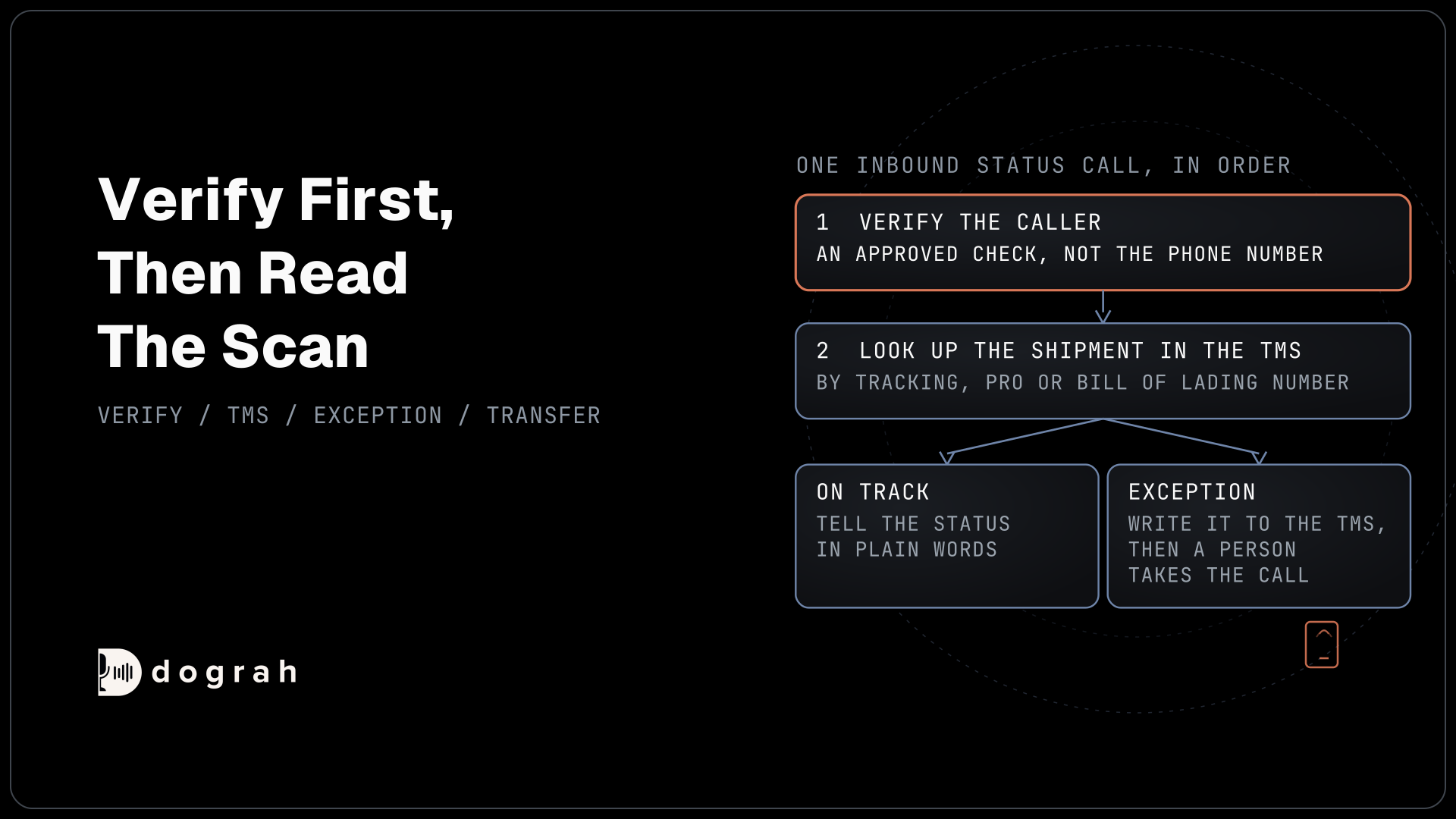

AI voice agents for order status in logistics answer where-is-my-shipment calls on a carrier, 3PL or broker line. The agent verifies the caller, reads the shipment from the TMS or visibility platform through an HTTP API tool, tells them the last scan and the next milestone, and hands exceptions to a person with the lookup already written to the TMS.
Key Takeaways
- A tracking number finds the shipment. It does not prove who is calling.
- Most status calls are about on-time freight the agent can close alone.
- Exceptions go to a person after the lookup is written to the TMS.
This post is part of our guide to AI voice agents for logistics and delivery. In its section on customer calls during the delivery, the guide describes this inbound line as the call where the agent verifies first, reads tracking data from the TMS and sends exceptions to a person. Here is how that line works when three different people can call about the same shipment. In Dograh, an open-source, self-hostable voice agent platform, the line is one flow: verify the caller, look up the shipment live, and write the lookup to the TMS before any hand-off.
Three callers, one shipment
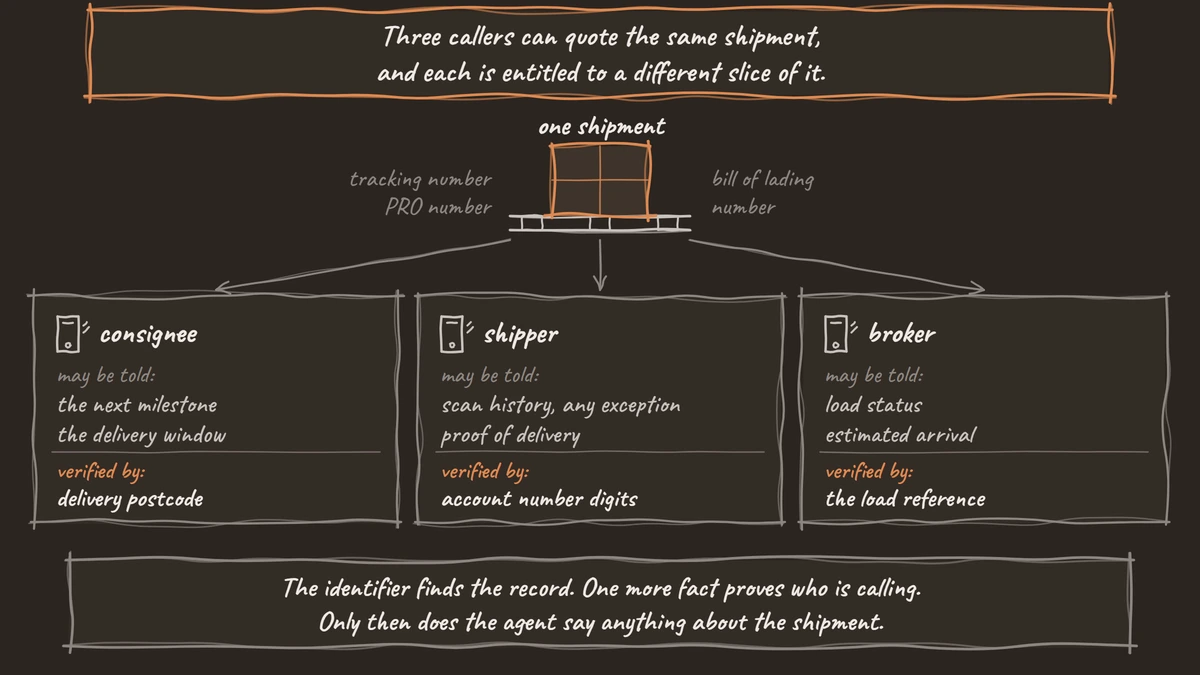
The logistics status line is harder than a shop's order line because the caller is not always the customer. A consignee wants to know when the pallet arrives. The shipper who paid for the move wants scans, exceptions and proof of delivery. A broker wants load status for a customer of their own. All three can quote the same shipment, and each is entitled to a different slice of it.
They also quote different identifiers. A parcel has a tracking number. A less-than-truckload (LTL) shipment has a PRO number, the carrier's own reference. A freight move has a bill of lading (BOL) number. The agent has to recognise all three, find the record in the transportation management system (TMS) or the visibility platform, and then decide what this caller may hear.
If your callers are a shop's customers asking about a shop order, the design is simpler and our post on AI Voice Agents for Order Status and Updates in E-commerce covers it. This post is for the carrier, the third-party logistics (3PL) provider and the broker.
Why the phone still rings
The phone rings because the data the caller wants is often not where they can see it. In Adelante SCM's 2025 survey of freight forwarders, 67% of the shippers asked named real-time shipment tracking as the forwarder capability they value most. On the forwarder side of the same study, only 23% of the 65 forwarders surveyed had digitised more than 75% of their business processes. The caller wants a live answer, and most of the companies they call are still partly on spreadsheets.
Damage makes it worse. Tive's State of Visibility 2025 release reports that 60% of businesses learn about shipment damage only after delivery, or never. When the consignee calls about a crushed pallet, the carrier often hears about it for the first time on that call.
None of this means every status question should be a call. A shipped, out-for-delivery or delivered milestone needs no decision from anyone, and it belongs on SMS or WhatsApp, sent by your own system rather than by a call. The voice agent is for the caller who still phones, which in freight is most of the shippers and brokers, and for the shipment with a problem.

Open Source Alternative to Vapi / Retell
Self-hosted voice agent platform — no per-minute fees
dograh-hq/dograh
Star on GitHub
Verify before you disclose
A status line that reads a shipment to whoever quotes the number is a data leak with a friendly voice. The tracking, PRO or BOL number finds the record. It does not prove the caller is the consignee, the shipper or the broker on that record.
So the flow runs greet, verify, disclose. The greeting names your company and says this is an automated assistant. The verification asks for the identifier, finds the record, and then asks for one more fact the right caller knows: the delivery postcode for a consignee, the last digits of the account number for a shipper, the load reference for a broker. Only then does the agent say anything about the shipment.
What it says depends on who passed. A consignee hears the next milestone and the delivery window. A shipper hears the scan history, any exception and whether proof of delivery exists. A broker hears load status and the estimated arrival. A caller who fails the second check hears that the agent cannot share shipment details on this call and is offered a transfer. The agent never fills the gap with a guess about who is on the line.
Reading live tracking during the call
Dograh reads the shipment while the caller is on the line rather than from a copy loaded earlier. The agent's HTTP API tool calls your TMS or visibility platform with the identifier, and the response comes back into the conversation as the last scan, its time, the current location and the next milestone. The pattern is the same one we use in our post on webhook-driven voice agents.
A lookup against a third-party API can take a second or two. Tool Messages cover that gap: a start line such as "Let me check that shipment for you" and, if the lookup runs long, a short update. The caller hears a person-shaped pause, never dead air.
Stale data is the other half of honesty. If the last scan is nine hours old, the agent says so: "The last scan was at 2 a.m. at the Memphis hub, and the next scheduled milestone is arrival at the delivery terminal this evening." Have your tracking API return scan times in local time with the timezone, such as "2 a.m. Central". The agent reads the time as your system sends it. It never invents a location between scans. Tive's finding that damage surfaces late is a reminder that the record can be incomplete, and the agent's job is to read it faithfully and never improve on it.
Most calls end there, because most shipments are on time. ShipMatrix measured December 2025 on-time delivery at 94.1% for USPS, 95.3% for FedEx Express and 97.2% for UPS. Its method excludes delays caused by weather and by shippers or consignees, so the customer-felt rate is lower. Even so, the agent can close the large majority of calls alone, and the people on your team get the shipments that are actually late.
The data layer to feed this agent already exists at scale. project44 reports that its models surfaced delivery issues an average of 35 to 56 hours before carriers reported them during the 2025 peak, in a company post from January 2026. C.H. Robinson reports over 3 million shipping tasks performed by its generative AI agents, in a release from April 2025. Both are the companies' own figures. The inbound status call is the leg of that lifecycle most operators still answer by hand.
Join the Dograh Community
Dograh is an OSS alternative to Vapi. Join our Slack community for queries, releases, best practices & community interactions.
Exceptions go to a person, with the lookup already written
Held at customs, misrouted, damaged, refused at the dock: these calls need a person, and the person should not start from zero. Before the transfer, the agent writes what it has to the TMS or the customer relationship management (CRM) system through an HTTP API tool: who called, which identifier, what the lookup returned and what the caller asked. The person sees it on screen as the call arrives. Transfer Call then connects the caller. It works on Twilio only, and an optional spoken introduction can summarise the call for both sides.
At 2 a.m. the person may not exist. Our post on AI voice agents for after-hours logistics support covers the overnight version of this line, where urgent exceptions become a ticket for the morning team.
Sometimes the right outcome is a callback once the terminal has an answer. A callback is an outbound call with an AI voice, and it generally needs consent captured when the shipment was booked or the account was opened. Our post on US consent rules for logistics and delivery calls sets out the rules.
What to measure, and where the data lives
Four numbers tell you whether the line is working. The share of calls the agent closed alone. The share transferred, and for which exception types. How often the agent had to read a stale scan rather than a fresh one, which points at your visibility data rather than the voice agent. And repeat callers on the same shipment within a day, which means the first answer was not good enough.
Where the recordings and transcripts live is a decision you make once. A status line hears consignee addresses, account numbers and the details of damaged freight all day. Self-hosted Dograh with self-hosted open-weight speech and language models keeps that audio on your own servers. With hosted models, the audio reaches the model provider. The TMS stays the system of record either way.
If your status line today is a keypad menu that reads one tracking status and hangs up, our comparison of AI Voice Agent vs IVR: From Keypad Menus to Open Conversation explains what changes. Start with the consignee calls, where verification is simplest, then open the line to shippers and brokers once the TMS lookups are clean.
Glossary
- PRO number
- The carrier's progressive rotating number that identifies a less-than-truckload shipment on the carrier's own system; the identifier most LTL callers quote.
- Bill of lading
- The contract and receipt between shipper and carrier that identifies a freight shipment; callers quote its number to find a load.
- Tool Messages
- The short lines a Dograh HTTP API tool plays when it starts and while it runs, so a lookup never leaves silence on the line.
- Visibility platform
- The system that combines carrier scans and telematics into one shipment status, which the agent reads instead of each carrier's site.