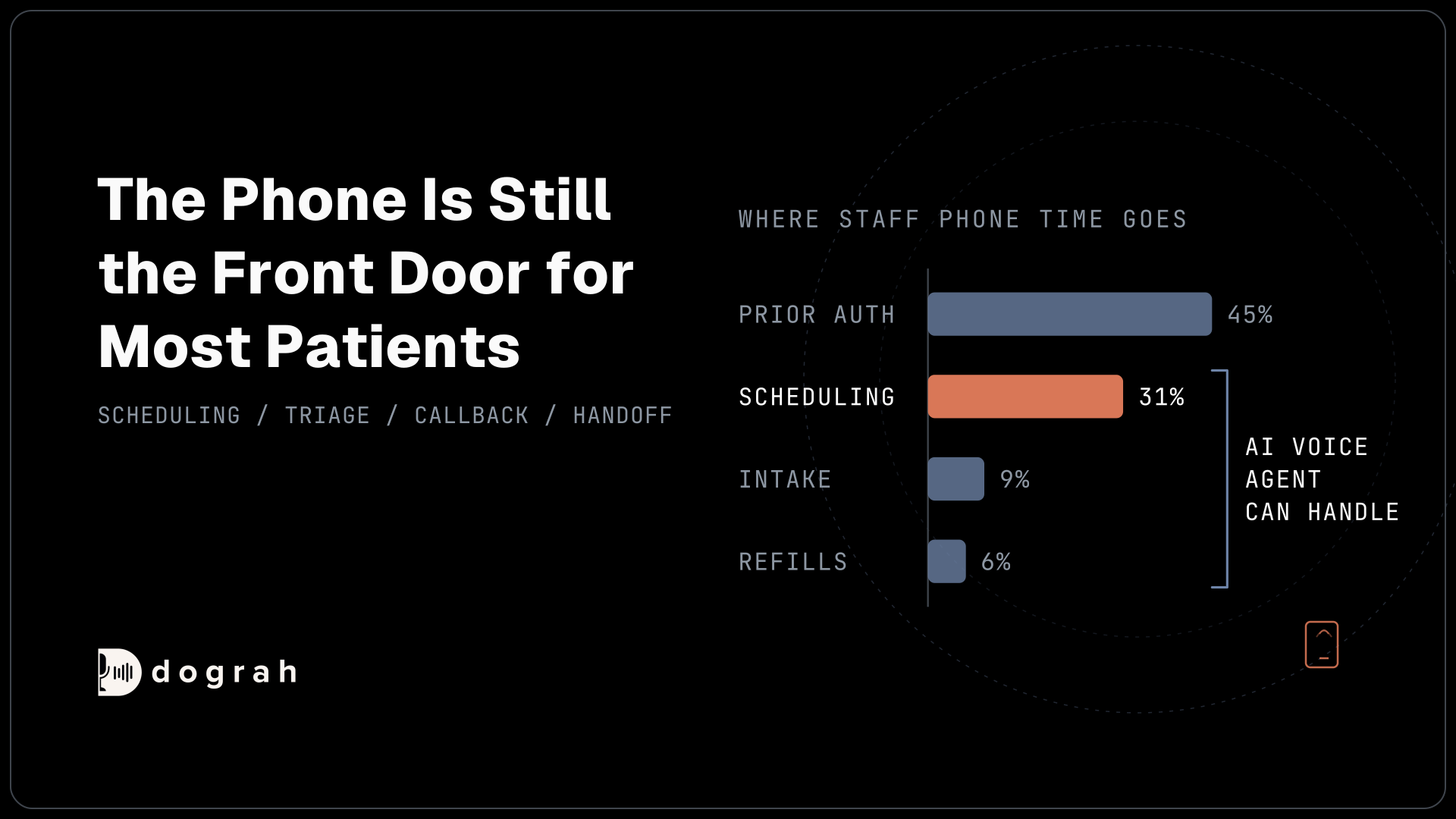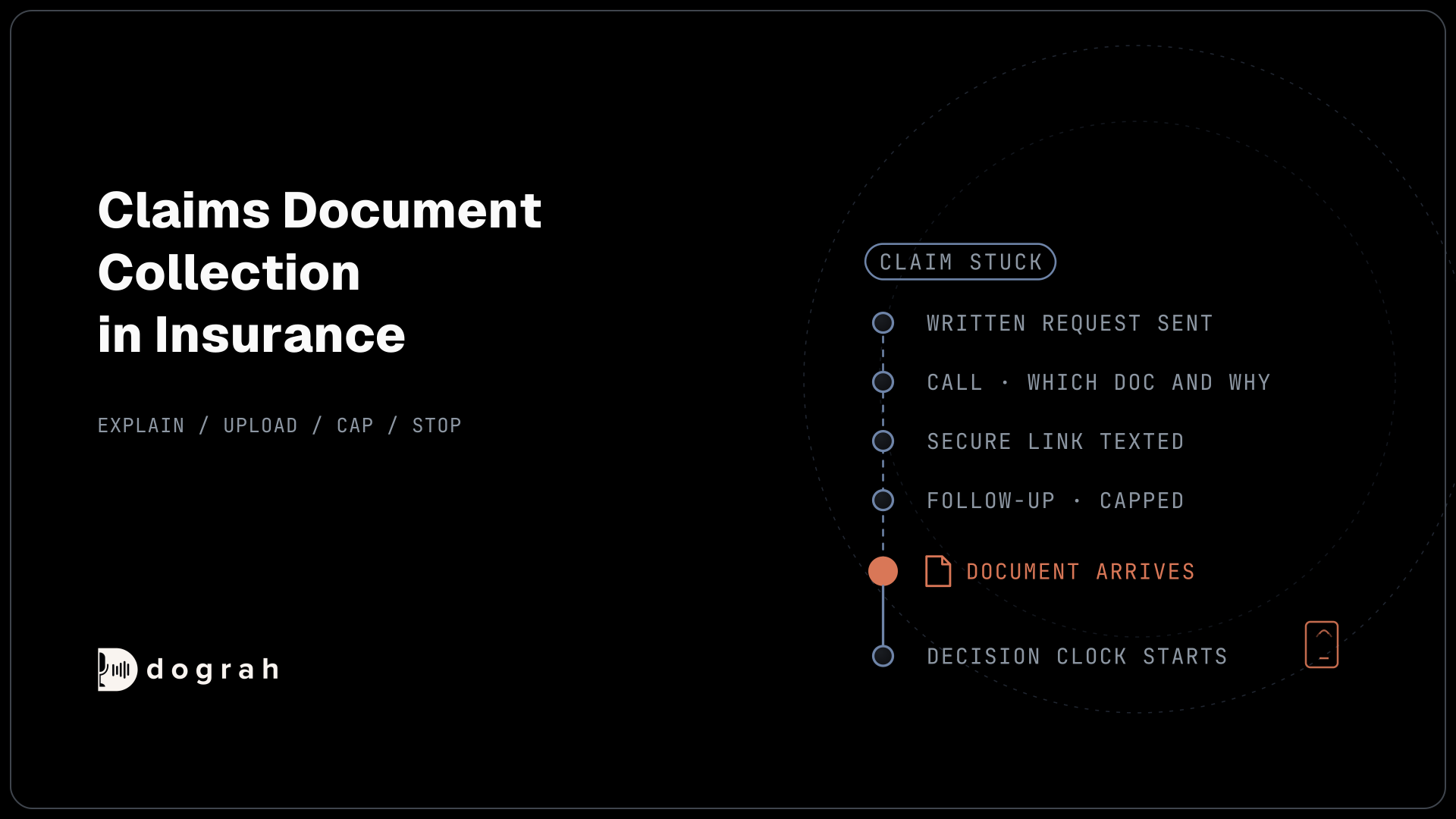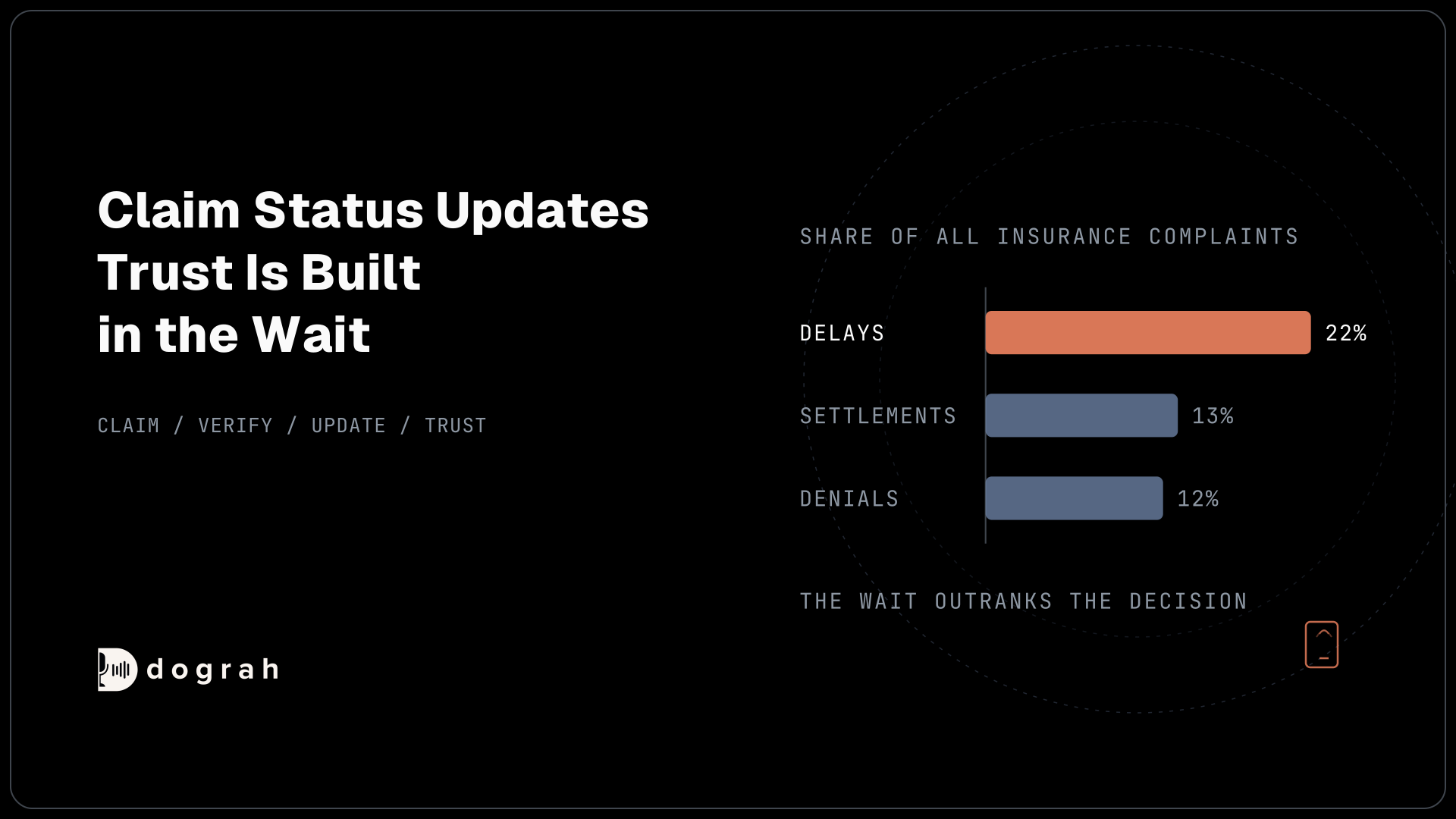

An AI voice agent for e-commerce order status handles two kinds of calls. It answers customers who call to ask where their order is, with their order already pulled up from their phone number. It also calls customers when a delivery will miss its promised date. Routine updates, such as shipped or delivered, are better sent as texts.
Key Takeaways
- With 74% of shoppers hit by a late delivery, delay calls need automating.
- Send routine updates as texts; use the voice agent when a delivery slips.
- The agent finds the caller's order by phone number before it says hello.
Tracking pages and shipping emails have not stopped customers from calling to ask where their order is. We build Dograh, an open-source voice agent platform, and this post covers both sides of that call, the customer calling in and the store calling out.
Late deliveries are common, and customers want to hear first
Most online shoppers now expect a delivery to go wrong at some point, and they want the store to say so before they ask.
In Narvar's survey of 3,461 US shoppers in August 2025, 74% had a late delivery in the past year and 86% ran into at least one delivery problem. When something does go wrong, 46% want the retailer to acknowledge it and 45% want real-time updates, before they have to ask.
Even a good year for carriers leaves a lot of late parcels, so delay calls come in volume. In December 2025, the busiest month, ShipMatrix figures reported by FreightWaves show USPS delivered 94.1% of parcels on time, FedEx Express 95.3% and UPS 97.2%. Across about 2.3 billion peak-season parcels, even the best of those rates leaves millions arriving late. Those figures also leave out delays caused by weather or wrong addresses, so customers see more late parcels than the rates suggest.
A late parcel also costs repeat business. In the same Narvar survey, 60% of shoppers aged 18 to 29 said they would not buy again from a retailer after a late delivery.
The promised date is what sets that expectation. Narvar found 73% of shoppers say an estimated delivery date influences whether they buy at all. Once a store has shown a date at checkout, missing it without a word is the failure customers remember.
Texts for milestones, calls when plans change
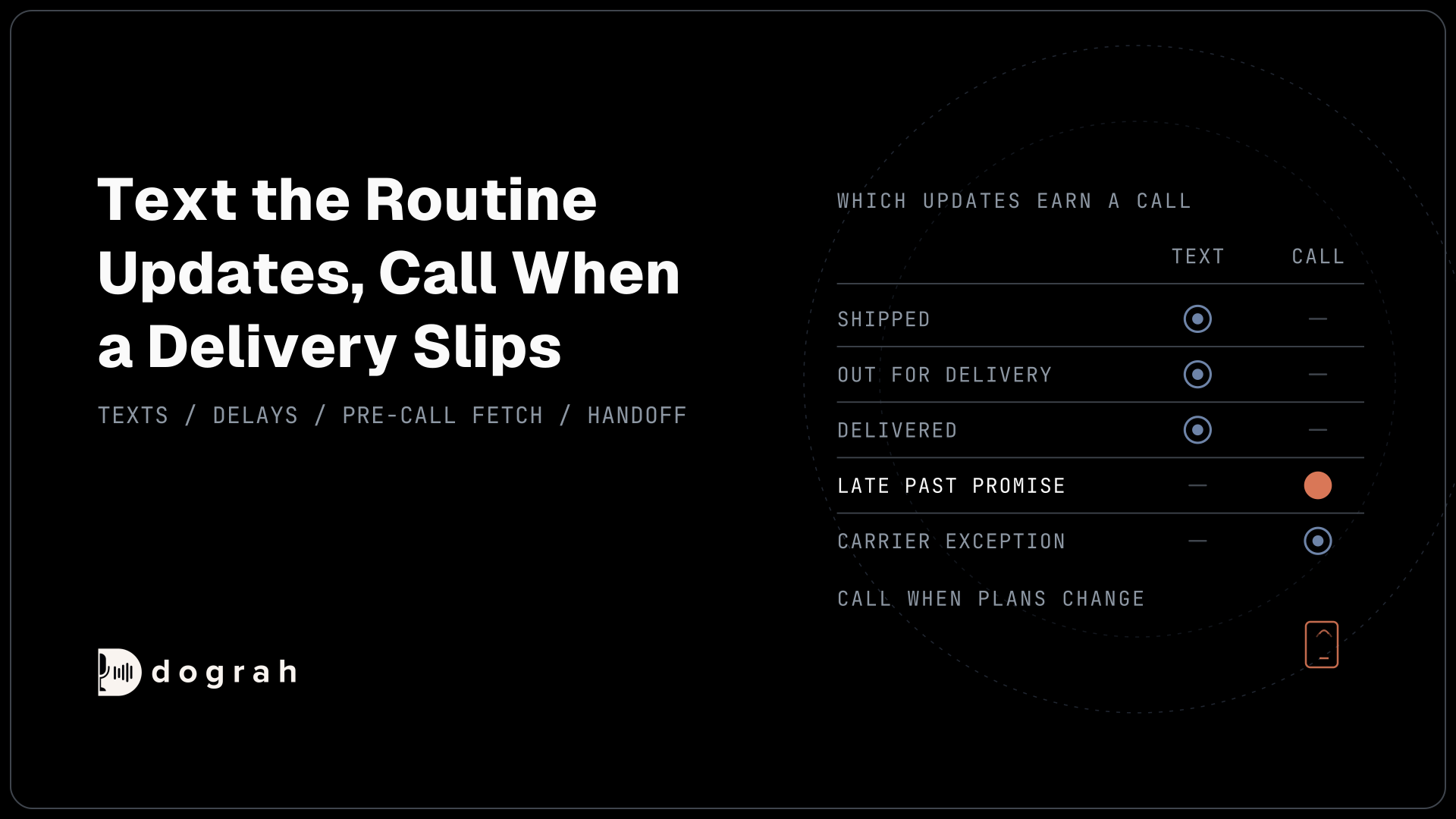
Most order updates belong in a text, and a call is worth making only when the news changes what the customer planned.
The case for texting is strong. In EZ Texting's January 2026 survey of 959 US consumers, 56% preferred text for delivery confirmations, and Narvar found nearly half of shoppers prefer SMS, push or WhatsApp for urgent updates. So the routine milestones, from shipped through delivered, should go out as texts from the notification tools your store already uses, and the voice agent does not need to be involved. Dograh handles the calls. During a call, it can trigger a text through a tool call to your SMS or WhatsApp integration, for example to send a tracking link.
A call earns its place when a text would leave the customer with a decision to make. That covers an order sliding past its promised date and a carrier exception such as a damaged parcel or a customs hold. In both cases the customer may want to wait or may want to cancel, and that is easier to settle in a conversation.
Tie the trigger to the promised date. A parcel that is a few hours behind but still inside its delivery window needs nothing. A parcel whose new estimate lands after the date the customer was shown is worth a call. We would also call sooner for customers who paid for faster shipping, because they paid for the date itself.
Phone is also still close to text for people who contact a business themselves. In the same EZ Texting survey, 46% preferred text and 43% preferred phone. That 43% is who the inbound agent is for.
The inbound call starts with the order on screen
A "where is my order" caller should not have to read out an order number, because the agent can find the order from the number they are calling from.
Dograh's pre-call fetch runs before the agent speaks. It looks the caller's phone number up in your order system and loads their open orders into the call. By the time the agent says hello, it knows what the customer bought and when it should arrive.
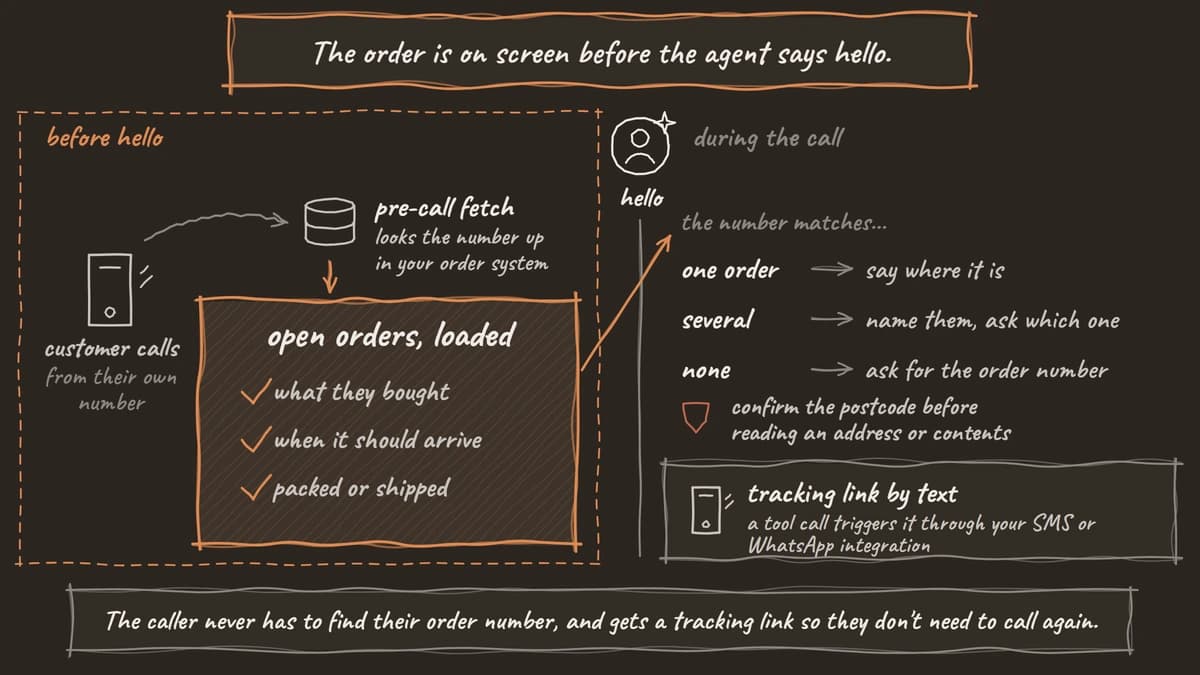
Pre-call fetch loads the caller's open orders before the agent says hello, so nobody reads out an order number, and a tool call triggers the tracking link through your SMS or WhatsApp integration.
If the number matches several open orders, the agent names them briefly and asks which one the caller means. If it matches none, the agent asks for the order number instead.
Some orders have not left the warehouse yet, so the carrier has nothing to report. The agent should read the fulfilment status from your order system in that case and say plainly that the order is still being packed, along with the date it is expected to ship. A vague "it's being processed" is exactly the kind of answer that makes customers call back.
Be careful with what the agent reads out before it knows who is on the line. A shared family phone or a reassigned number can reach the wrong person. Confirm something simple, such as the postcode, before reading back an address or order contents. We made the same point about claim status calls, where the stakes are higher.
Once the caller has the answer, a tool call can trigger a text with the tracking link through your SMS or WhatsApp integration, so they have something to check later without calling again.

Open Source Alternative to Vapi / Retell
Self-hosted voice agent platform — no per-minute fees
dograh-hq/dograh
Star on GitHub
What the agent says when an order is running late
A delay call should open with who is calling and what changed, then give the new date and the customer's options.
Start with the store's name. An unexpected call about a parcel sounds like a delivery scam until the customer knows who it is from, and the first seconds decide whether they stay on the line. We wrote about those first 15 seconds separately.
Then say what changed and give the new estimated delivery date from the carrier data. Narvar's respondents asked for acknowledgement and a clear explanation in equal numbers, 46% each. One short, specific sentence covers both, such as "Your order is held at the carrier's depot and should now arrive on Thursday."
Call early, while the customer can still do something about the delay. The moment the carrier's new estimate falls after the date you promised, make the call, within your normal calling hours. Don't wait until the day the parcel was due. If nobody answers, leave a short voicemail with the new date and trigger a text with the same news through your SMS or WhatsApp integration. One missed delay call does not need a chase.
Keep the options to what your policy allows. Some stores let the customer cancel or switch to store credit, and the agent can handle that through a tool call. Anything outside the script, such as a refund dispute, goes to a person. Outbound AI calls also carry consent rules, so check yours with counsel before switching delay calls on.
Keep status calls apart from redelivery
Order status and failed delivery look alike, but they are different calls with different triggers.
A status call is triggered by the order's timeline, such as a delay or an exception, and its job is to keep the customer informed. A failed-delivery call is triggered by a missed drop, and its job is to book a new slot fast. We covered that one in our post on failed delivery rescheduling.
Keeping them as separate flows in the workflow builder keeps each script short. It also lets you measure each one on its own terms. Judge status calls by how many "where is my order" contacts they prevent, and redelivery calls by how many parcels arrive at the second attempt.
Join the Dograh Community
Dograh is an OSS alternative to Vapi. Join our Slack community for queries, releases, best practices & community interactions.
Where hosted voice platforms fall short on order calls
Order calls are high volume and carry customer data, which makes per-minute pricing and the data path the two questions to ask.
Most closed platforms charge a platform fee of around 5 to 7 cents a minute, with model usage billed on top. Delay calls come in bursts during peak season, when volumes are highest. We broke down where per-minute voice costs go in a separate post.
Every order call also carries personal data, from the delivery address to what the customer bought. On a hosted platform, that passes through the vendor's infrastructure on each call. Dograh is open source under the BSD-2 license and can run on your own servers. You can use Dograh's own models or bring keys for any provider, and for full data sovereignty, run open-weight models on your own hardware.
The build uses standard Dograh pieces. Pre-call fetch loads the caller's orders. A webhook from your order system starts a delay call when a carrier event arrives. Tool calls trigger texts through your SMS or WhatsApp integration and write the outcome back to the order. Call transfer hands the customer to a person, and automatic quality checks flag calls that went off script.
That handoff matters more than it looks. When a caller asks for a person, the staff member should see the order the agent already found and what the customer was told, so nobody starts again from an order number.
Start with the inbound side. Turn on pre-call fetch for your support number and measure how many "where is my order" calls the agent resolves. Then add delay calls for orders that slip past their promised date, and leave the routine milestones to texts.
Customers will keep asking where their order is. The stores that answer quickly, and call before the customer has to ask, are the ones they keep buying from.
Glossary
- Pre-call fetch
- A lookup that runs before the agent speaks, pulling live data such as the caller's open orders from your systems into the call.
- Estimated delivery date (EDD)
- The date a retailer tells the customer to expect a parcel. Narvar found 73% of shoppers say it affects whether they buy.
- Carrier exception
- A carrier status meaning a parcel has left its normal path, for example a damaged label or a customs hold.
- WISMO
- Short for where is my order, the name support teams use for order status contacts.