
AI voice agents for home health visit coordination confirm visit windows with patients and family members, call when a clinician is running late and handle reschedules. The agency's scheduling system starts each call through the API Trigger, the agent reads live slots during the call, and the outcome is written back. Anything clinical goes to the agency's clinical line.
Key Takeaways
- The scheduling system starts each call through the API Trigger.
- Read live slots during the call; write the outcome back after it.
- Visit assignment, capacity and clinical questions stay with the agency's people.
This post is part of our guide to AI voice agents for hospitals and health systems. The guide sorts calls by care setting, and in home health most calls are about visit windows, because the clinician travels to the patient. This post covers those calls in Dograh, an open-source, self-hostable voice agent platform, from the trigger in the scheduling system to the outcome written back.
The schedule owns the visit
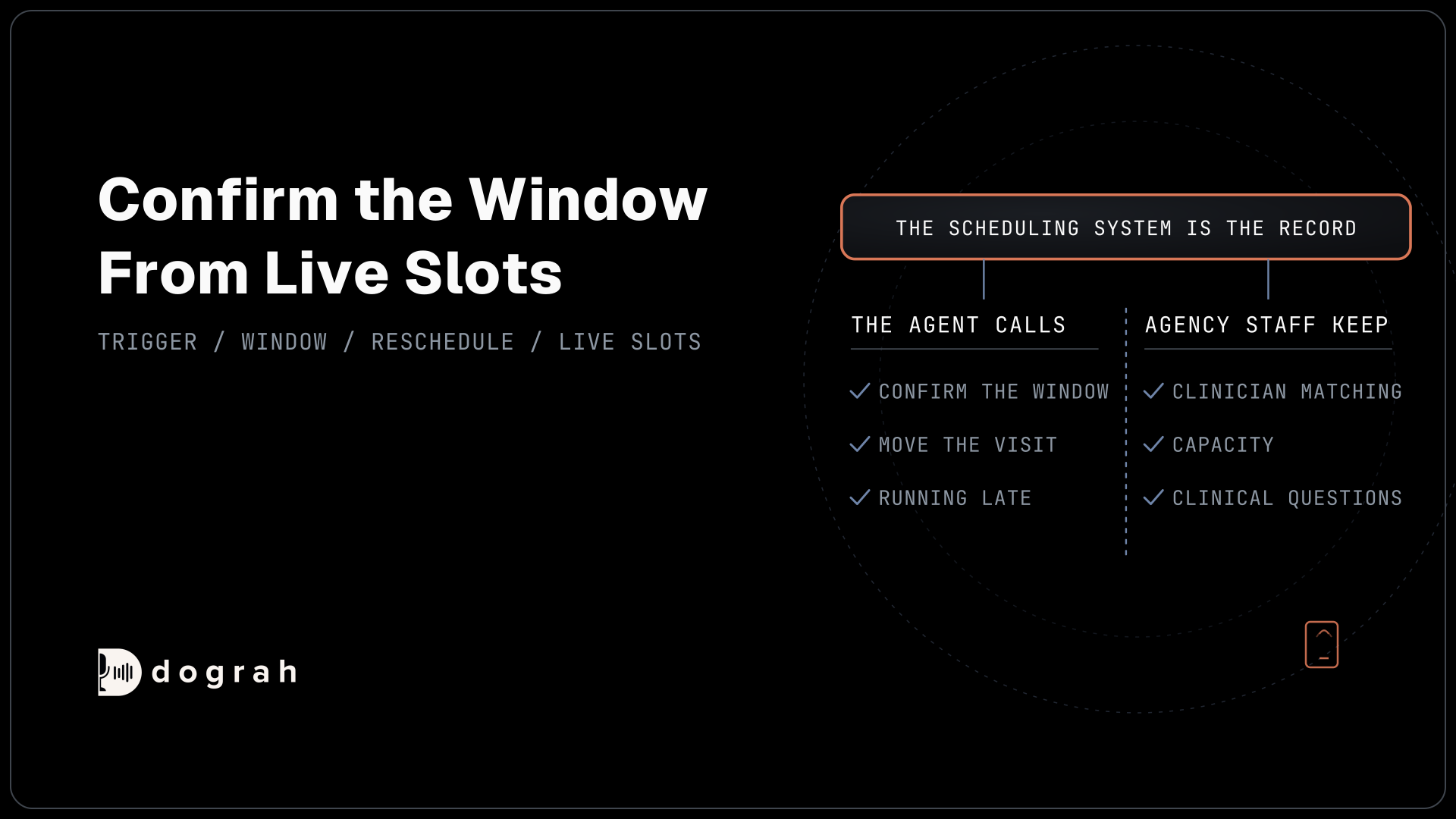
Every home health call in this post starts and ends in one place: the agency's scheduling system, which is the system of record for every visit. It knows which clinician is visiting whom, in which window, and which slots are still open. The agent reads from it and writes to it. It never keeps its own copy of the schedule, and it never decides who visits.
That matters because home care runs on people who are out of the office. The schedulers and clinicians who could answer the phone are on the road during the hours patients and families call. Every confirmation call a scheduler makes by hand is time taken from the work only a scheduler can do: matching clinicians to patients, filling gaps, handling the hard cases.
Money is tight too. For calendar year 2026, the Centers for Medicare and Medicaid Services (CMS) finalized an aggregate 1.3% decrease in Medicare payments to home health agencies, about $220 million. Scheduler hours are part of the cost agencies are trying to protect.
So the agent takes the repetitive calls: confirming tomorrow's window, moving a visit the patient cannot make, telling a family the nurse is running late. Visit assignment, clinician matching and any promise of capacity stay with people.
The scheduling system starts the call
The agent never decides to call anyone. The scheduling system does, through Dograh's API Trigger. Each trigger sends the patient's phone number and the visit details, such as the window, the discipline and a visit reference, and they become the call's context. The production URL runs only the published version of the agent, so a draft change never reaches a patient by accident.
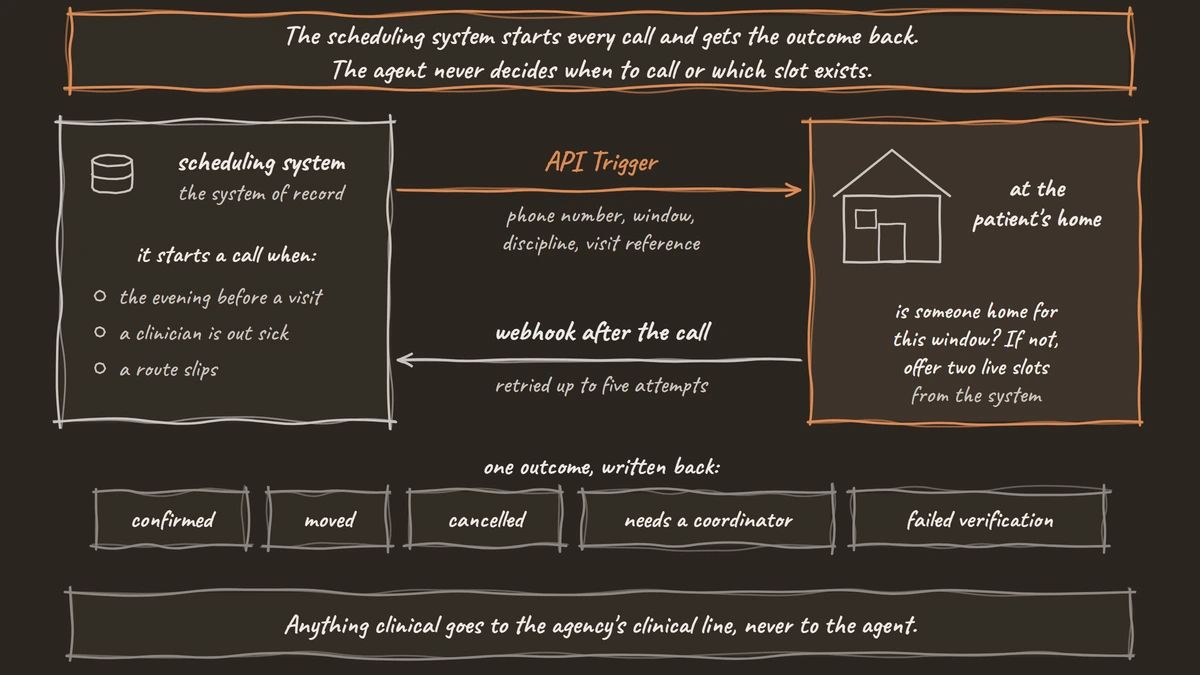
Three events usually start a call: the evening before a visit, to confirm the window; a cancellation or a clinician's sick day, to move the visit; and a route that slips, for the running-late call. Our tutorial on API triggers shows the request.
These are outbound calls to patients' phones, so consent rules apply. The Federal Communications Commission (FCC) healthcare exemption at 47 CFR 64.1200(a)(9)(iv) lists home healthcare instructions and appointment confirmations among its purposes, generally with limits such as one call a day, three a week and no financial content. Dograh's Campaigns cannot cap calls per patient, so the scheduling system must hold to that limit. The pillar's consent section covers the details. Opt-out is by voice: the agent asks whether the patient wants to stop these calls and writes a yes back at once.

Open Source Alternative to Vapi / Retell
Self-hosted voice agent platform — no per-minute fees
dograh-hq/dograh
Star on GitHub
Verify the patient or an authorized family member
The person who answers is often not the patient. A spouse, an adult child or a paid caregiver may pick up, and some of them are allowed to hear about the visit while others are not.
So the call runs greet, verify, disclose. Write the Greeting Text to name the agency and say the patient is speaking with an automated assistant; Dograh plays exactly what you write. It plays before verification, so it never names the patient, the clinician or the type of visit. Then the agent asks for the patient's date of birth plus one reference, such as the street name or the visit reference. A family member can continue only if the agency's record lists them as someone the patient has authorized, and the agent checks that list, read from the scheduling system, before saying anything about the visit.
A phone number finds the record. It does not prove who is holding the phone. If verification fails, the agent says the agency will call back and writes that outcome to the system.
Voicemail follows the same rule. A message names the agency and a number to call back, and nothing about the visit. If the call falls under the healthcare exemption, any voicemail also includes a toll-free opt-out number.
Confirm the window or move it from live slots
A confirmation call has one job: get a clear yes, or find out the window does not work. The agent reads back the visit window from the call's context and asks whether someone will be home. A yes is the most common answer, and the agent ends the call there.
If the window does not work, the agent reads live slots through an HTTP API tool, filtered to the right discipline and area, and offers two. The patient picks one, the agent books it through the same tool and reads the new window back. It offers only slots the scheduling system returned, so it never promises a clinician or a time the agency does not have. If nothing fits, the agent records the patient's preferred days and marks the visit for a coordinator.
The agent also records anything that changes how the clinician gets in, such as a new gate code, a dog in the yard or a different entrance, exactly as the patient states it. Extraction is an AI step, so the transcript stays the exact record. For booking patterns in a clinic setting, see AI voice agents for patient appointment scheduling.
Join the Dograh Community
Dograh is an OSS alternative to Vapi. Join our Slack community for queries, releases, best practices & community interactions.
The running-late call
A clinician's day slips: a long first visit, traffic, a patient who needed more time. The running-late call tells the next patient before the window passes, so nobody waits at home without news.
The scheduling system watches the route and triggers the call when the clinician's estimate moves past the booked window. It sends the new estimated window, and the agent reads only that. It never guesses an arrival time of its own. After verification, the agent gives the new window and asks one question: keep the later window, or move the visit to another day? A move goes through the same live-slot read and booking as a reschedule. If the patient needs to talk to someone, for example because they have their own appointment to get to, the agent marks the visit for a coordinator.
Write it back and route anything clinical
Every call ends with one outcome in the scheduling system: confirmed, moved, cancelled, needs a coordinator or failed verification. A webhook sends it after the call, with any access notes. A temporary failure such as a timeout or a server error is retried automatically, up to five attempts. Our post on webhook-driven voice agents covers the payload. Run quality assurance (QA) on a sample of calls, and read every call that ended with a coordinator flag: those are the cases the agent could not settle, and they show where the prompt or the slot rules need work.
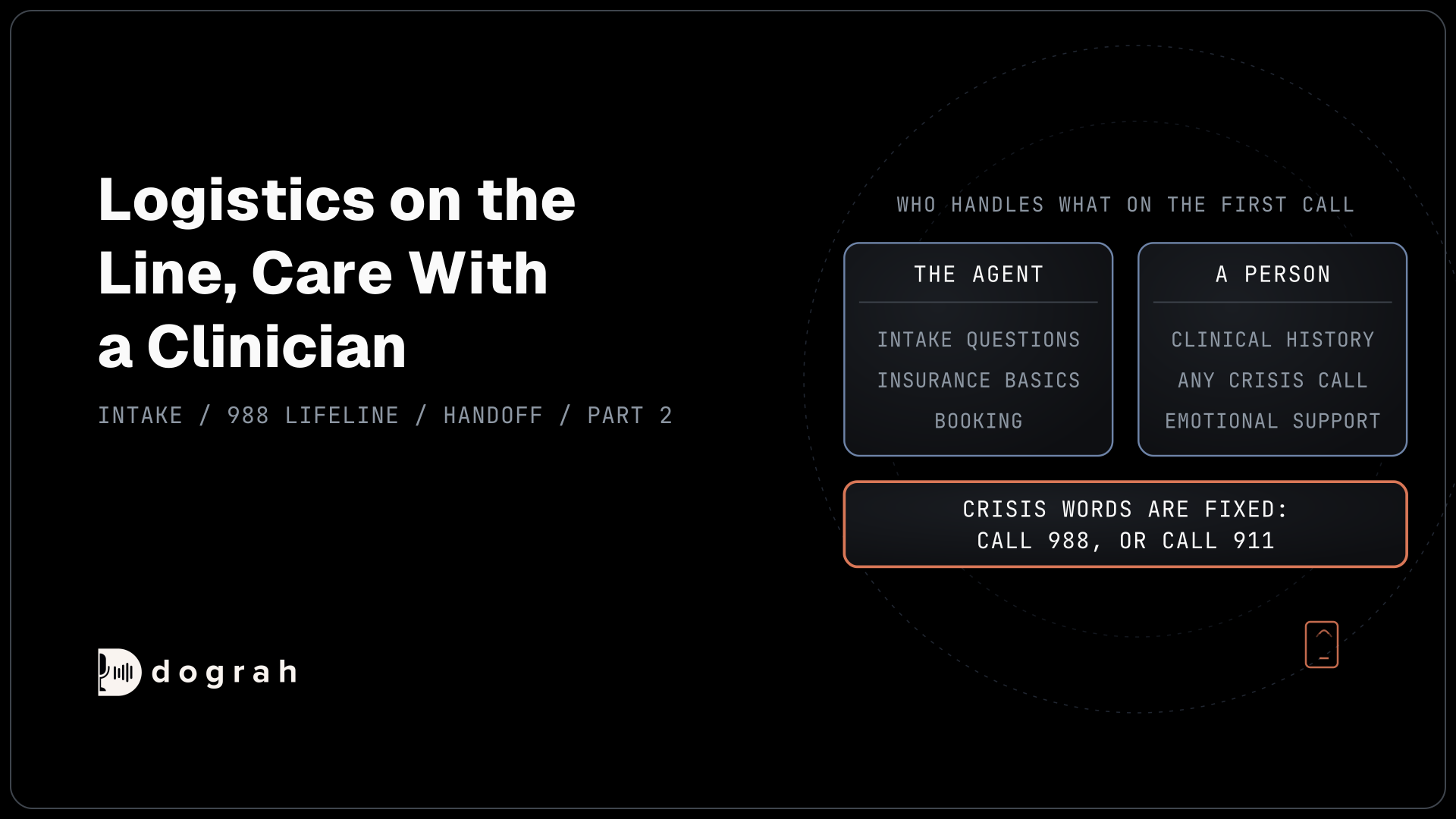
Home health patients often mention how they feel. The agent does not interpret it. Any symptom, medication question or worry goes to the agency's clinical line. Dograh's Transfer Call works on Twilio only and passes no summary, so the agent first writes the reason to the system. If nobody answers within the timeout, 30 seconds by default, the agent writes a callback request through an HTTP API tool. An emergency gets one fixed instruction to call 911, played as Transition Speech or a recorded clip. Many home health episodes start after a hospital stay, which our post on post-discharge follow-up covers.
Self-hosting Dograh keeps recordings on the agency's servers. Self-hosted Dograh has no per-minute platform fee, though servers, model keys and phone minutes still cost money. Dograh Cloud has a 1¢-a-minute platform fee. Our page on self-hosted voice AI for home health agencies shows the setup.
Glossary
- Visit window
- The time range in which a home health clinician is booked to arrive at the patient's home. The agent confirms it, offers a new one from live slots, or reads out a later estimate, and never sets one itself.
- API Trigger
- Dograh's endpoint that lets another system start a call. Here the agency's scheduling system sends the patient's number and the visit details, and the production URL runs only the published agent.
- System of record
- The one system whose copy of a fact wins when two disagree. For visit coordination it is the agency's scheduling system, which the agent reads during the call and writes to afterwards.
- Running-late call
- An outbound call the scheduling system starts when a clinician's estimated arrival moves past the booked window, so the patient hears the new window and can keep it or move the visit.