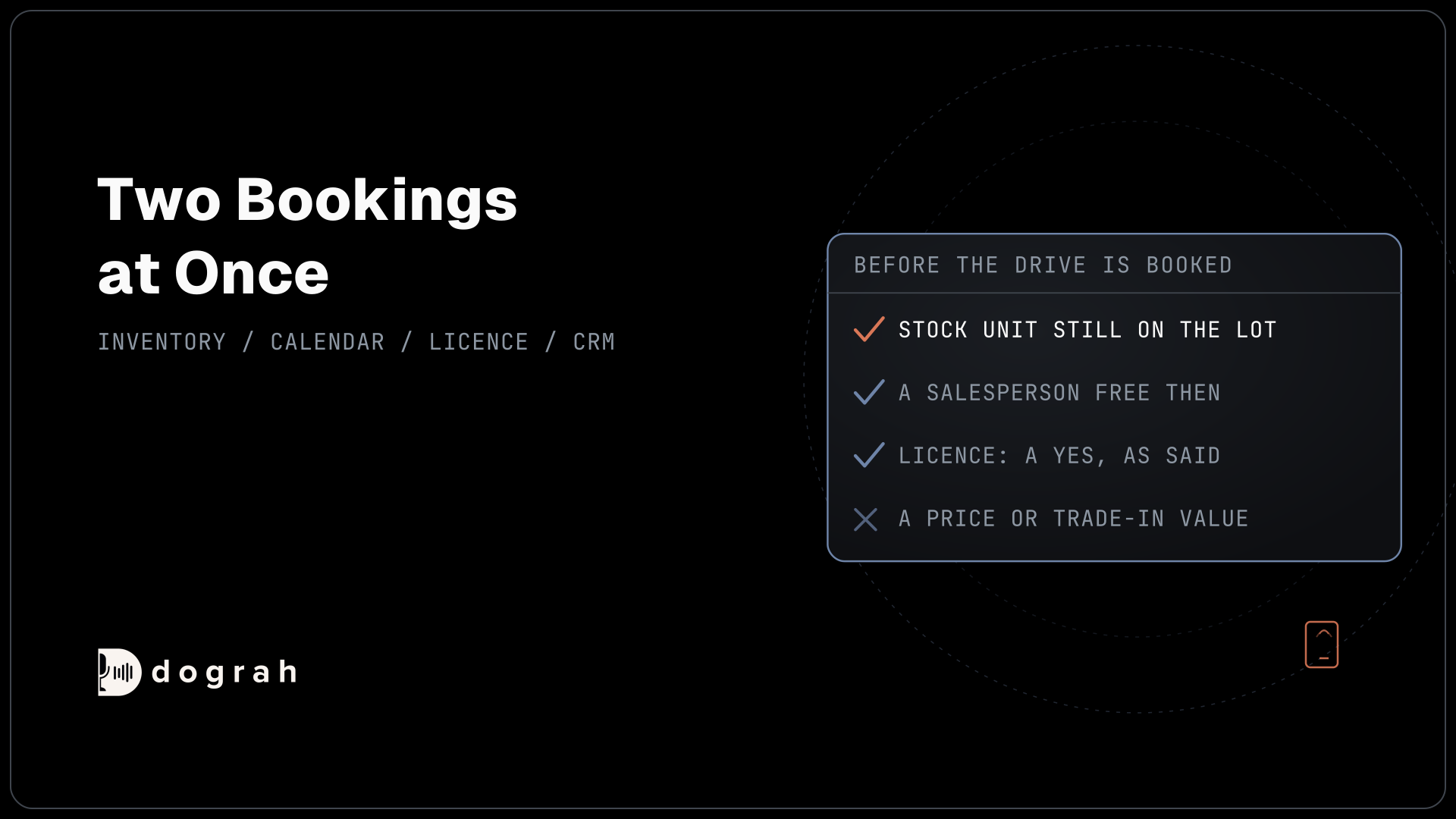

AI voice agents for test-drive scheduling book a specific stock unit with a free salesperson, reading live inventory and the sales calendar during the call. They record the vehicle of interest and the caller's confirmation that the driver holds a valid licence. Price, trade-in and finance questions go to sales staff.
Key Takeaways
- Book the stock unit and the salesperson, both read live during the call.
- Record that the driver has a licence. Never take the number by voice.
- Price, trade-in and finance questions always go to a salesperson.
This post is part of our guide to AI voice agents for automotive and dealerships. The guide's section on test drives and the sales floor sets the rule that every question about money goes to a salesperson. This post covers the test-drive call itself, inbound and outbound, as Dograh, an open-source, self-hostable voice agent platform, runs it against the dealer's own inventory and sales calendar.
Why a test drive is two bookings at once
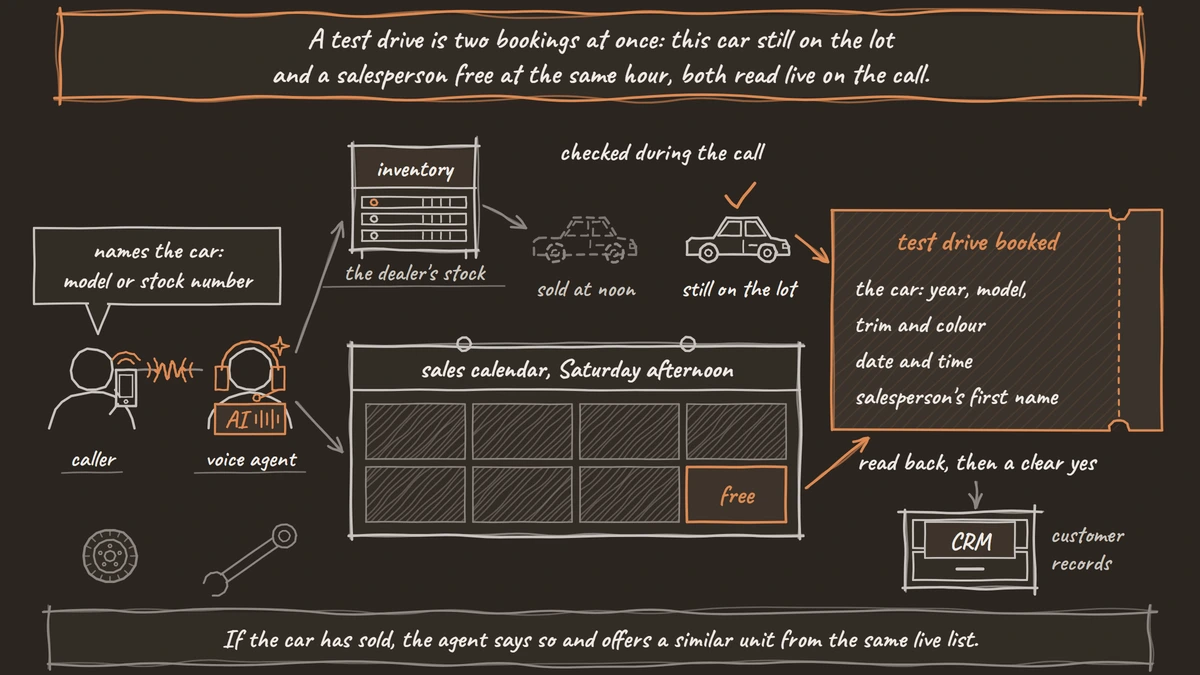
A test drive needs a particular car on the lot and a salesperson free at the same hour, so the agent books against two live sources. A time slot on its own is only half a booking.
Buyers already rate the process highly, and the phone booking should keep it that way. In Cox Automotive's 2025 Car Buyer Journey study, which surveyed 2,300 recent buyers in fall 2025, 76% of new-vehicle buyers were highly satisfied with the buying process, a record for the study, and 81% were highly satisfied with the dealership experience. Booking the wrong car puts both numbers at risk.
Inventory moves through the day. A unit can sell at noon or go out on another drive. So the agent asks about the specific stock number at the moment of the call, never from a list loaded in the morning. The sales calendar is read the same way, so the agent knows who is actually on the floor on Saturday afternoon.
The mechanics of reading open slots and writing one back are the same as for a service visit, and AI Voice Agents for Service Appointment Booking in Automotive covers them. What changes here is the stock check, and who takes over when the talk turns to money.
The inbound call, from first question to booked drive
The inbound call starts with the car the caller saw and ends with a read-back of the booking. The Greeting Text names the dealership. If you want to tell callers they're speaking with an automated assistant, or your location requires it by law, write that there too. It plays the moment the call connects, so it names no car and no customer.
A new caller asking about a listing has no record to protect yet, so the agent can talk about the car straight away. The caller names it by model or by the stock number on the listing. During the call, one HTTP API tool asks the inventory system whether that unit is still available, and a second reads the sales calendar for open times. The agent offers two times, then reads back the year, model, trim and colour with the date, time and salesperson's first name. Only after a clear yes does it write the appointment to your customer relationship management (CRM) system.
If the car has sold, the agent says so and offers a similar unit from the same live list.
An existing booking belongs to someone, so it is protected. A phone number finds the booking, but it does not prove who is calling. Before the agent names the car or the time, it asks for the postcode on file, or for an owner calling about their own car, the last four characters of the vehicle identification number (VIN). Then it can move or cancel the drive.
Booking requests can be retried when a network call fails, so the CRM needs a way to spot a repeat. How to Build a Voice Agent for Automotive Dealerships shows how each request carries the call's ID so the second copy is ignored.

Open Source Alternative to Vapi / Retell
Self-hosted voice agent platform — no per-minute fees
dograh-hq/dograh
Star on GitHub
The licence question: record a yes, never the number
The agent asks whether the person driving holds a valid licence and will bring it, and records the answer as the caller stated it. That is the whole licence step on the phone.
It never asks for the licence number. Staff check the physical card at the showroom before anyone gets the keys. A number read out on the call would also land in the recording and the transcript, and Dograh has no retention setting, so your own policy decides how long those are kept. The simplest policy is to never collect the number.
The agent also records who will drive, since the caller may be booking for a partner. It never decides whether someone may drive. Age limits and insurance rules are questions for your staff. If the caller says the driver has no licence yet, the agent records that and flags the booking for the salesperson.
Price, trade-in and finance go to a salesperson
The agent never quotes a price, a monthly payment, a trade-in value or a finance rate. Each of those depends on the buyer's credit and on a car nobody has inspected yet, and a figure spoken by the agent becomes the figure the customer remembers.
When the caller asks, the agent offers a salesperson. Transfer Call puts the caller through to the sales desk. It works on Twilio only and passes no summary, so the agent first writes the caller's question and the booked car to your CRM through an HTTP API tool. The salesperson sees it on screen as the call arrives. If nobody answers within 30 seconds, the default timeout, the caller stays with the agent, which writes a callback request the same way.
Interest in a new car also starts in the service lane. In Cox Automotive's 2025 Service Industry Study, 33% of owners said they were highly interested in getting a trade-in value during a service visit, while only 14% had been given one. When a service caller raises it, the agent can book a test drive or a valuation appointment with sales. The value itself comes from a person who has seen the car.
Join the Dograh Community
Dograh is an OSS alternative to Vapi. Join our Slack community for queries, releases, best practices & community interactions.
Calling internet leads back: consent first
Calling back a web lead to book a test drive is a sales call, and with an AI voice it needs written consent before the first dial. This section is general information, not legal advice.
The Telephone Consumer Protection Act (TCPA) rule at 47 CFR 64.1200(a)(2) covers any call "that includes or introduces an advertisement or constitutes telemarketing" made with an artificial or prerecorded voice to a mobile number, and it allows such a call only with "the prior express written consent of the called party". The Federal Communications Commission (FCC) treats an AI-generated voice as an artificial voice. Inviting someone to drive a car you want to sell them is generally telemarketing.
The rule's definition asks for a signed written agreement, which can be an electronic signature, that clearly authorizes such calls to that number and is not a condition of buying. So a lead form generally needs that wording, and a record of the agreement, before an AI follow-up call is made. Keep the consent record with the lead in your CRM and put only those leads on the calling list. Campaigns retry a busy or unanswered line up to the limit you set, with no cap per person, so your list also decides how often someone is called.
Once consent is in place, The First 15 Seconds Decide Everything in AI Outbound Calls covers how the opening should sound. Confirm your consent wording with counsel before the first campaign.
What the salesperson gets after the call
The call is finished when the sales team has everything it needs without listening to the recording. A webhook node sends the outcome to your CRM after the call: the car and its stock number, the booked time and salesperson, the licence answer, any money questions in the caller's own words and, for outbound calls, the consent record the call relied on. Links to the transcript and recording go with it. A temporary failure such as a timeout is retried automatically, up to 5 attempts.
A test-drive call carries a name, a phone number and sometimes a finance question. Self-hosting Dograh puts the call platform and its recordings on your own servers, and the audio stays in-house only when the speech and language models run there too. Self-hosted Dograh has no per-minute platform fee, though servers, model keys and phone minutes still cost money. Dograh Cloud has a 1¢-a-minute platform fee.
Start with the inbound line, where the customer calls you and consent is not in question. Add outbound lead follow-up once your consent records are checked.
Glossary
- Stock number
- The dealership's own ID for one specific vehicle in inventory. The agent checks it at the moment of the call, so a car that sold this morning is never booked for a drive.
- HTTP API tool
- A Dograh tool that calls your own system during the conversation, such as the inventory system or the sales calendar, and gives the reply to the agent. It is how the agent reads live stock and writes the booking.
- Transfer Call
- The Dograh tool that hands the call to a person, here the sales desk. It works on Twilio only and passes no summary, so the agent writes the details to your CRM first.
- Prior express written consent
- The signed agreement the TCPA rule at 47 CFR 64.1200(a)(2) requires before a telemarketing call is made with an artificial voice. An AI follow-up call inviting a lead to test-drive a car generally needs it.